
Welcome to Art Expeditions where with Travel the World through ART
I’m excited to announce that we’ll be starting a weekly feature called – Renaissance Wednesdays.
Every Wednesday we’ll learn more about Renaissance art history (with a bit of travel included)
Exploring the Renaissance:
The Renaissance is classified as an era of economic, social, scientific and artistic rebirth following the Middle Ages. It included a surge of interest in Classical scholorship and values. Rediscovering the principles of classical art and architecture opened up society to new ideas.
The Renaissance is an historical period loosely dating from the 14th to late 16th-centuries. From an art perspective, it began in Italy and expanded across Europe (in different stages and varying styles). Florence, Italy is considered to be ‘the birthplace of the Renaissance,’ as it was a leader in commerce, art, humanities, science and architecture. Donatello, Brunelleschi, Masaccio, Botticelli, Leonardo da Vinci and Michelangelo are just a few of Florence’s ‘Who’s Who of Renaissance Art’
The Middle Ages was a fruitful period of art (shocking to most), but the focus was not on realism as much as practical art. Many of the icons from the Middle Ages are gorgeous, but lack the depth and perspective that we are now accustomed to in art.
The Middle Ages in truth gets a bad rap for being ‘dark,’ but in truth The Middle Ages was just as impactful on architecture as The Renaissance – with Gothic and Romanesque styles emerging – I mention this because while The Renaissance is a rebirth of sorts – you should not dismiss The Middle Ages as ‘bad’ and Renaissance as ‘good’ – they were simply different.
- Without innovations in The Middle Ages, The Renaissance would have never happened…History is divided into periods/epochs but it is a continuum too. Think about your own life and the shifts and changes – history builts on the past and moves forward through the present.
Why: The Renaissance is important? After The plague ravaged Europe (The Black Death killed up to one half the population of Europe)the economic system began to shift.
- There were not enough workers (many had died), so the feudal system began to die out; workers who were still available were in high demand – this created a more diverse class system
- After the heartache of The Plague (which continued to affect Europe for several centuries), life was seen through the lens of judgement and penance, but also the ideal that God created man in HIS image to be Good. The Renaissance began a renewed humanist movement, where humanity was worth exploring and celebrating as a Glory to God and for the sake of humanity itself.
- The Renaissance ushered in a renewed interest in Classical scholarship (which had begun with Aquinas and others in The Middle Ages) and exploring Greek and Roman art and architecture
- The Renaissance witnessed the discovery and exploration of new continents, and the Copernican system took overr the Ptolemaic system of astronomy
- Innovations in paper making, printing, the mariner’s compass and gunpowder chanced the world forever!
A SHIFT in Perspective:
For the first time in the history art became to shift from focusing directly on a primary color and the landscapes and images were flat.
Up to The Renaissance there was not a systemic way to create depth in painting (at least not that we have a record of). Even the best art from the Greco-Roman to Medieval area lacked a fully realism or depth that we now take for granted in painting.
It took an architect from Florence with an artistic and mathematical brain to devise a way to create depth in painting – translating math into art.
His name…Filippo Brunelleschi…
Brunelleschi helped discover a now common artistic method called Linear Perspective.
- Linear Perspective – when lines converge into one of more distant vanishing points (think of the train tracks getting smaller in the distance and then vanishing – while we know they keep going at the same size our human perspective sees them vanishing) – the ability to translate what we see in real life perspective onto canvas came by exploring a method of creating illusion of infinite space through math.
- Brunelleshci may not have invenent perspective, but he was the first to document it. The Greeks and Romans attemped this by using angular lines to convey space in their art and even early Renaissance artists like Giotto and Duccio used similar devices…but it was Brunelleschi who fully matured linear perspective.
- In 1415, Brunelleschi made the first known drawing that used the mathematical system of linear perspective to create the illusion of a building receding towards the horizon line.
- He made the most radical breakthrough by devising an easy to apply system of creating a vanishing point on a horizon line and drawing diagonal lines towards it.
- Fun fact: Renaissance polymath, Leon Battista Alberti recorded Brunelleschi’s incredible discovery in his treatise ‘Della Pictura (On Painting)’ in 1435. This was indeed a monumental shift in artistic style and perception of space in art.
Brunelleschi’s work influenced his friend and contemporary, Mascaccio – who was the first painter in the Renaissance to incorporate linear perspective into his art. He first did this with his fresco, The Holy Trinity in Santa Maria Novella in Florence. Click here to learn more on the Santa Maria Novella website.

Getting to know Brunelleschi:
Born in Florence, Italy in 1377, Brunellschi’s family included his father, Brunellesco di Lippo – a notary and civil servant, and his mother Guiliana Spini. He also had two brothers. He came from a well-off family and the palace of the Spini still exists across from the church of the Trinita in Florence.
Filippo originally set to follow in his father’s footsteps, but being artistically inclined he began an apprenticeship at age fifteen to the Arte della Seta (woold merchant’s guild) , which was the most prestigious guild in the city. From there he became a master goldsmith and sculptor working with cast bronze.
The Competition for The Florence Baptistry Doors:
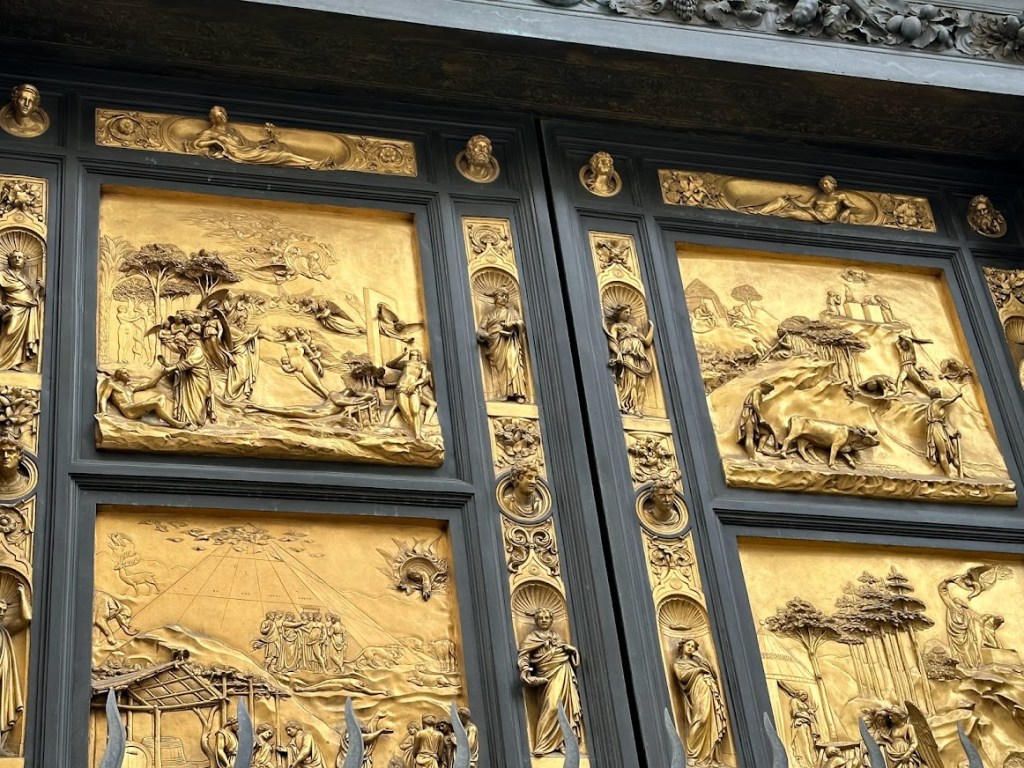
One of the most important early events in The Renaissance was a competition in 1400 to create new sculpted and gilded bronze doors for the Florence Baptistry. In 1401 a competion was held for the design, which drew seven competiotrs, including Brunelleschi and his future rival, the sculptor Lorenzo Ghiberti.
- In the competition, each sculptor was required ot produce a single bronze panel depecting the Sacrifice of Issac within a four-leaf frame.
- The design had to harmonize with the style of the existing doors, made in 1330 by Andrea Pisano.
- The head of the jury was Gionovanni di Bicci de’Medici…(The name Medici sound familar – they were the ruling class of the city and owned a banking empire…we’ll be discussing them a lot on Art Expeditions)
- The jury publically praised the work of Ghiberti’s panel before they saw Brunelleschi’s. After seeing both the jury was at a standstill…both entries were magnificent…they asked if the two would collaborate on the project….
- Brunelleschi was not one to colloborate on this sort of project and refused the commission.
- Both he and Ghiberti were extremely talented and there was respect among them, Brunelleschi did not like working with Ghiberti and also sidelined collaboration with him on his future commission for The Florence Cathedral (Duomo)
Brunelleschi decided to abandon sculpture and focus on architecture…where once again his innovations in design reawakened classical inspiration.
He studied ancient Roman architecture like Rome’s Pantheon to figure out how to make a massive domed ceiling for Florence’s new Duomo (Cathedral).

You would assume that it would be easy to simply copy the Roman blueprints for The Pantheon, but unfortunately after The Fall of Rome in 476 and subsequent centuries of transition that knowledge was lost. It need to be ‘rebirthed’ – Brunelleschi figured out how to create a large domed church that is still one of the largest in the world.
We’ll dive deeper into The Duomo in future blogs/videos…but in the meantime read more about it here.
He also designed several other important buildings including:
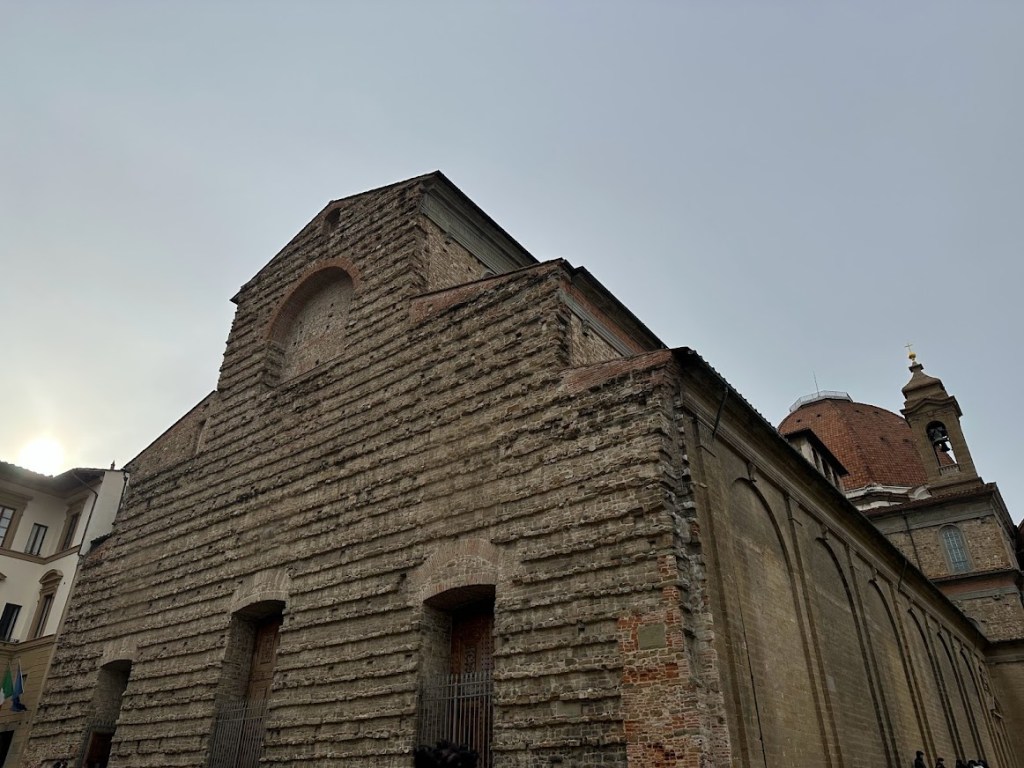
- The Basilica of San Lorenzo (Home church of The Medici Family)
- The Pazzi Chapel – where the Pazzi Scandal occurred (more to come in future posts)
- The Foundling Hospital – this was one of the first hospitals where mothers could ‘drop off’ their babies safely and secretly if they could not provide for them. The architectural style of this hospital is heavily copied even today.
Getting to know Masacchio
We’ll be doing a deeper dive into Mascchio in our upcoming Renaissance Explorers Series but here is a quick introduction to this AMAZING and revolutionary Renaissance Man
- Born in the province of Arezzo, Tuscany near Florence, like Brunelleschi, Masacchio’s father was a notary. His mother was the daughter of an innkeeper.
- His father died when he was only five and that same year a brother was born, Giovanni who also became a painter
- Masacchio died very young – at only twenty-six and yet his influence on the history of art was groundbreaking. When Masacchio died, Brunelleschi said ‘we have suffered a great loss.’
- Masacchio is considered to have started the Early Italian Renaissance and is the first painter to incorporate linear perspective into his artwork. He embraced chiaroscuro for greater realism
- You can see much of his work in Florence including at ‘The Uffizi Gallery,’ Brancacci Chapel and The Church of Santa Maria Novella
Don’t forget to check back for:
#medievalmondays
#renaissancewednesdays
#impressionismfridays
Plus lots of other great articles and video lessons!
I hope you enjoyed this expedition…Don’t forget to subscribe for future posts and like us on Facebook
If you like Travel – check out our Partner Page – American Nomad
 Art Expeditions
[…] week we learned about two ‘founders of The Renaissance’ – Brunelleschi and Massacio. They were the first to use linear perspective, which helped to make artwork more […]
LikeLike
[…] Brunelleschi invent linear perspective and was the first to rediscover how to build a large domed structure since The Roman times…learn more here […]
LikeLike
[…] Giotto and Duccio border the edge of The Medieval World and Renaissance. In my opinion both should be categorized as Early Renaissance because they had an anticipation of perspective in painting before it was firmly established by Brunelleshi and Masachio (you can read more about Masachio here). […]
LikeLike