Thanks for stopping by Art Expeditions – where the Travel the World through ART!
Every Friday we’ll be delving into Impressionism – a movement of color and perspective that transformed the art world.
When we think about Impressionism we often associate it first with Monet, who indeed was one of the founder’s of the movement. Today, however, I wanted to start with the origins of Impressionism and give a basic timeline of it’s movement from Europe to a worldwide art style.
As a painter myself (in the dark shadows of the masters for sure) – I derive so much inspiration from the vivid colors and use of unbridled realism in Impressionist painting. I say unbridled realism, because while Impressionism may seem unrealistic compared to a perfect portrait or exacting landscape – Impressionism provides a deep realism in the way it captures light as though we see it and draws the emotion of the scene on the canvas where we can imagine ourselves as part of the space.
It may not be ‘fully realistic’ but realism also speaks to truth and The Impressionists invented a way to reveal the truth even if the lines weren’t exactly perfect…not so dissimilar from a new perspective that Masacchio and Brunelleschi created in The Renaissance…Both, in different ways working to bring out truth and invite us into a conversation with the painting.
Precursors of Impressionism
The years leading up to Impressionism were preceded by several important styles of art that built the foundation shift towards Impressionism.
- Neoclassicism
- Romanticism
- Realism
Are three of the important movements in the years moving towards Impressionism.
In Art History we often group periods and styles together, but I also challenge you to look at art as a continuum because many of The Impressionists were influenced by masters of The Renaissance, Baroque to the Neoclassical and Realism styles.
Many of the Impressionists did not set out to become Impressionists, but this grew out of their indivial growth as artists and a coming together though various new thought in art and moving away from the set in stone paths established by the art world at that time.
Some say Impressionism was a rejection of the past, but many artists like Morisot, Monet, Degas were all influenced by those who came before. They just established a different path and were not afraid to break with the establishment.
when we look at the movement towards Impressionism I like to look at several import figures from the generation before – each leaving their distince mark on inspiring the movement.

- John Constable – (1776-1837, British) – one of England’s greatest landscape painters, Constable had the innate ability to capture the pastoral landscapes of England with realism and a dash of romantic air. Standing in front of one of his paintings you feel as though you are transported to a scene from a British novel like Thomas Hardy’s Far from the Madding Crowd or a British mystery in a cozy town.
- His sweeping landscapes and use of the ground-breaking ‘plein-air’ painting inspired The Impressionists.
Let’s pause for a moment:
You’ve probably heard ‘plein-air’ thrown about, or if you are an artist perhaps you enjoy plein-air painting
Plein air means to ‘paint out of doors’ in French and became a popular method used by Impressionists. In the past this wasn’t feasible because paint had to be mixed in the studio, but all that changed with companies like Windsor and Newton and Sennelier manufacturing paint tubes. These were first invented in the US by John C. Rand
Learn more about history of paint tubes here.
- Jean-Baptiste Corot – (1796-1875, French) One of my favorite artists, Corot is known for his glorious landscapes with depths of color. They were visually pleasing and well-balanced yet informal in character. He occasionally added mythical creatures to the landscape (popular at the time), which appealed to the Salon (establishment in Paris to show artwork). Corot also adopted plein-air painting
- Corot mentored a young (nineteen-year old) Berthe Morisot. He was so impressed with her paintings that he invited Morisot (main female Impressionist) to work with him in his studio in the village of Ville-d’Avray (12 miles from Paris)
- The Barbizon School:
- In the 1840s a group of urban artists abandoned city life and retreated to the country and the forest of Fontainebleau. They settled in the village of Barbizon. Inspired by Constable and 17th-century Dutch landscape artists, like Jacob van Ruisdael, they worked to create truthful images of the forest without being constricted to the set artistic styles by the strict Paris salon. They were also know as Le Grand Refuse…
- As we mentioned earlier, the refusal wasn’t so much of the art of the past as the ridiculous standards the Paris Salon and art establishment demanded in order to be considered for public shows, which led to commissions. It became a clique and this movement was a refusal of strict rules that blocked artistic expression
- Theodore Rousseau (French) was one of the artists who at Fontainebleau. He became a popular and distinguished art later in life and today is featured in museums like The National Gallery in London
- As we mentioned earlier, the refusal wasn’t so much of the art of the past as the ridiculous standards the Paris Salon and art establishment demanded in order to be considered for public shows, which led to commissions. It became a clique and this movement was a refusal of strict rules that blocked artistic expression
- In the 1840s a group of urban artists abandoned city life and retreated to the country and the forest of Fontainebleau. They settled in the village of Barbizon. Inspired by Constable and 17th-century Dutch landscape artists, like Jacob van Ruisdael, they worked to create truthful images of the forest without being constricted to the set artistic styles by the strict Paris salon. They were also know as Le Grand Refuse…
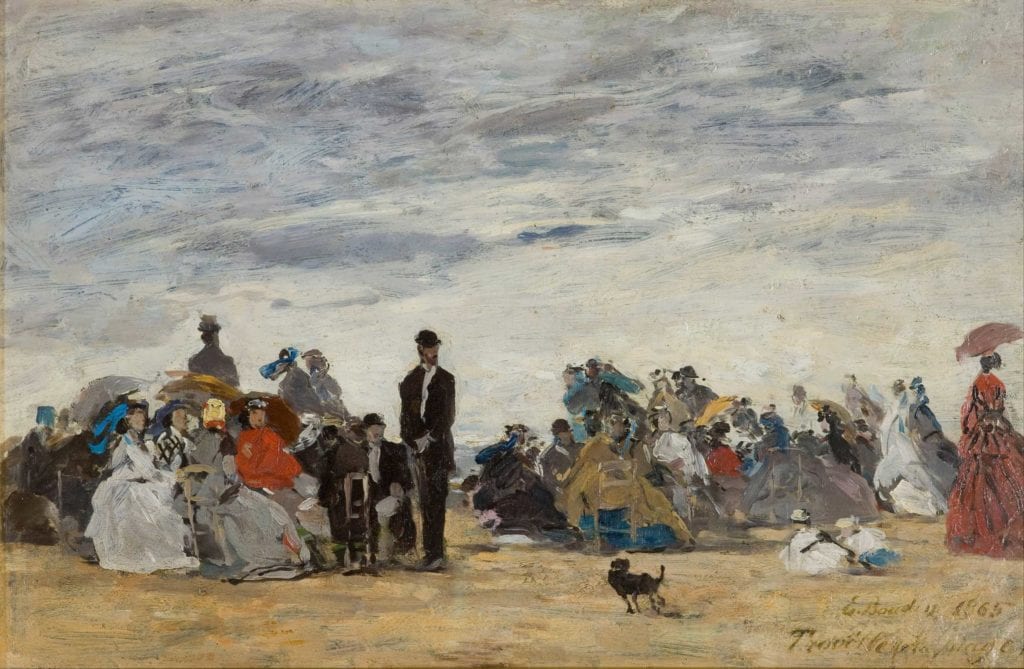
- Eugene Boudin: In the past I used to associate Boudin with The Impressionism movement because he is tied to Monet and often presented in museums like The National Gallery (DC) alongside of The Impressionists, but in truth he was just outside of the movement. And yet, what an influence he had on Monet.
- Monet was born in Normandy and was continually drawn back to the coast – creating some of his most iconic paintings in the region. In 1858, when Monet was only eighteen he met Boudin (34 at the time). Boudin encouraged young Monet to go to the sea and paint in plein air. Monet said later in life: “If I have become a painter, it is entirely due to Eugène Boudin.”
Gustave Courbet: A tour de four in French painting and strong influence on Monet, Courbet also refused to go along with The Salon and paved his own path. He painted a series of (at the time controversial) nudes, but is also known for his stormy landscapes and dark rich colors.
These are just a few of the ‘precursors’ of Impressionism and we’ll be focusing on all of them in future lectures/posts.
Manet – A Father of Impressionism:
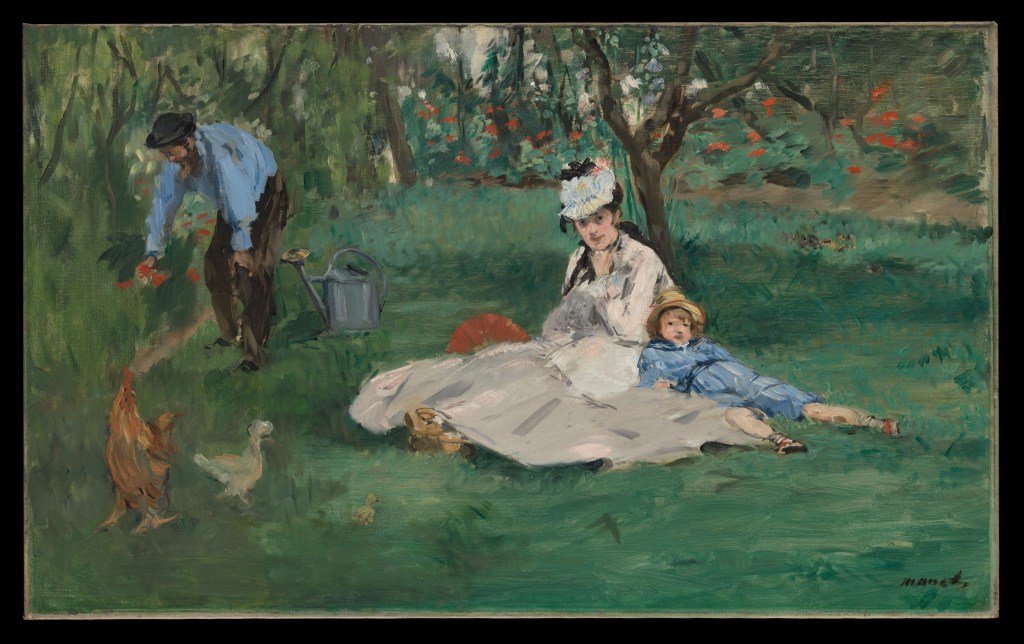
Edouard Manet is generally considered ‘A Father of Impressionism’ because he directed bridged the gap from Realism to the Impressionist movement. He was friends with Morisot, who introduced him to Claude Monet and the other Impressionists. The header image is Monet’s family painted by Manet.
When observing Manet’s style it often resembles Impressionism with broad brushstrokes and the emotional charge of the subject. However, Manet himself never considered himself an Impressionist…I see Manet as a bridge – both a Realist, Impressionist and something in between. No doubt he is one of the most capable and diverse French painters of the period.
Getting to know Manet:
Born in 1832 in Paris to a upper class family, Manet rejected his father’s desire for him to join the navy and moved towards a career in painting instead.
Manet drew his inspiration from a number of artistic styles and in many ways doesn’t fit the exact mold of any movement. He was strongly influened by Renaissance artists like Titian, who he emulated in modern re-workings of their paintings. See Olympia.
From 1853-56, Manet toured Italy, German and the Netherlands were he was introduced and became influenced by the work of Frans Hals (Netherlandish) and Spanish painters Goya and Velasquez.
When he opened his studio, Manet was influenced by the paintings of Courbet but eventually created his own unique Manet style.
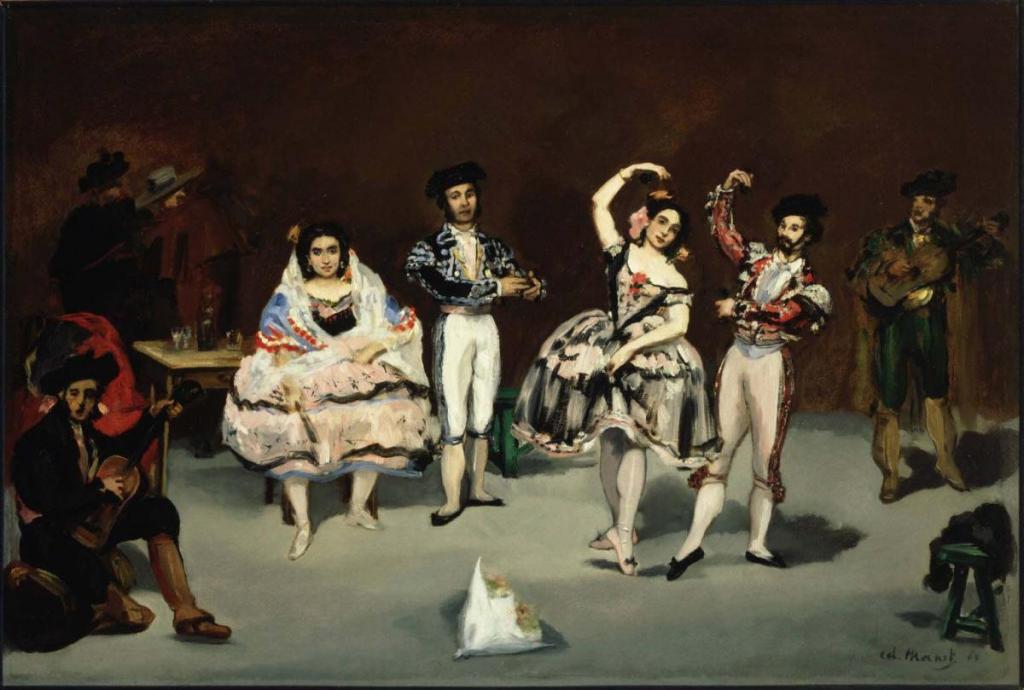
Edouard wanted to be accepted by the Salon and was surprised not only by his rejection but the contovery of his work like Luncheon on the Grass and Olympia. Both took cues from famous Renaissance works but were put in a modern setting, which many found crude and offensive. Manet was finally accepted into the Salon in 1861.
Morisot and Manet developed a friendship. He asked to paint her portrait and she introduced him to Monet and others. In many ways it was Morisot who founded Impressionism by building a bridge from Corot to Manet to Monet.
Manet’s radical painting style and modern subject matter – painting realistic scenes certainly moved Degas and others. Manet found photography fascinating and used it as a way to drive creativity into painting. The French photographer Nadar and Manet were friends. If photography was showing real to life contemporary scenes, then Manet could use his ‘impressions’ to paint the way he saw Paris and beyond.
In addition to painting, Manet liked print making and worked to revive its popularity
He was admired by the author Emile Zola even when the establishment rejected his work.
The Dawn of Impressionism
Why Manet may be ‘A Father of Impressionism,’ Berthe Morisot is certainly the founding member. She helped start this movement and became one of the best painters in French history. We’ll be featuring her a lot on Art Expeditions.
Another important artist in the founding of Impressionism was Camille Pissarro, who was born in St. Thomas (then the Dutch West Indies) and later moved to France. His work tells the story of the common man and the age of industrialism against the pastoral landscape.
- Pissarro was the oldest of the Impressionist painters; Art historian John Rewald called him the “dean of the Impressionist painters,” because “by virtue of his wisdom and his balanced, kind and warmhearted personality.”
- Paul Cezanne (founder of modern art) said “he was a father for me. A man to consult and a little like the good Lord”
- Renoir referred to his work as revolutionary.
- Pissarro is the only artist to have show his work at all eight Paris Impressionist exhibitions from 1874 to 1886.
What’s in a name?
While it is easy to see why ‘Impressionism’ is the word for works by Monet and others with thick brushstrokes that are an impression of the scene…the name actually started off derogatory and wasn’t created by The Impressionists, although they eventually adopted it.
During what would become the first “Exhibition of the Impressionists” in Paris, 1874, Monet showed the now famous ‘Impression, Sunrise.’ The painting depicts the port of Le Havre in Monet’s hometown. It shows the ‘impression’ of how you see the world at sunrise when it is hazy. Monet states:
“They asked me for a title for the catalogue, it couldn’t really be taken for a view of Le Havre, and I said: ‘Put Impression.'”
- Fun fact: The Barbizon School also used the world ‘Impressionism’ to describe a few of their works, but the school did not see that term as a movement or style. It made sense that Monet would use the word as it had a common usage
One of the critics at the show made fun of the painting and its name: Louis Leroy, a report for Le Charivari, is often quoted in his review of Monet’s work. His article “The Impressionist Exhibition” is written as a dialogue from the imaginary perspective of an old-fashioned painter who is shocked by the work before him.
“‘Ah! This is it, this is it!: he cried in front of n. 98. ‘This one is Papa Vincent’s favorite! What is this a painting of? Look in the catalogue.’ ‘Impression, Sunrise.’ ‘Impression– I knew it. I was just saying to myself, if I’m impressed, there must be an impression in there… And what freedom, what ease in the brushwork! Wallpaper in its embryonic state is more finished than this seascape!”
Ironically this review is often attributed with launching Impressionism as a movement.

I hope this background helped put Impressionism in perspective.
In coming ‘Impressionism Friday’ posts we’ll dig into the other titans of the movement:
- Brazille
- Degas
- Sisley
- Renoir
- Monet
- Morisot
- and so many more!
I look forward to sharing this journey with you.
Don’t forget to subscribe to the blog
You can also find us on facebook
If you are looking for a good read I recommend: Impressionism by Ralph Skea on Amazon
 Art Expeditions