
Welcome to Art Expeditions – Where we Travel the WORLD through Art…
Every Monday we explore the artistic history and heritage from The Medieval Period, also know as The Middle Ages or Dark Ages.
This period is loosely categorized as the years following the fall of the Western Roman Empire (in Rome) after attacks from the Goths and other Barbarians (non-Romans).
The aftermath of the Fall of Rome sent a shockwave through Europe and beyond. The Romans had a system of government that was ordered and engineering infrastructure supplying food and water; not to mention the social connection through Rome. All roads really did lead to Rome and peace and security of the Western Empire was essential to stability throughout Europe, Northern Africa and The Middle East.
With the invasion of the Goths many Roman records and knowledge was physically lost. Documents for instance on how The Parthenon was built. This led to a loss of acquired knowledge in Europe, not because of lack of intelligence, but like any major world trauma – things get lost. People had to create new communities and form new governments.
I want to start by challenging you to put aside all your assumptions about what ‘Medieval’ means.
The period is unfortunately be poorly stereotyped for being backwards, dark, primitive and generally hopeless.
The term ‘The Dark Ages’ only adds to this misconception. While we often champion ‘The Renaissance’ for being a rebirth of civilization, as we spoke about in our Renaissance Wednesday post…The Renaissance revitalized and energized creativity in a new way…some even rejected the ‘last generations’ (sound familar in your own life), but they would hardly classify the period as ‘backwards.’
In fact some of the greatest scholars in history date from what we dub ‘The Dark Ages’ and they strongly influenced Masters of the Renaissance and beyond…
It is also important to keep in mind that the Eastern Roman Empire – Byzantium continued to shine and grow until it’s demise in the 1400s. We’ll study this in our series about Venetian Art and the Influence of Constantinople(now Istanbul)
A few examples of ‘Who’s Who in Medieval Times’
- St. Benedict of Nursia – a monk who was the Father of Monastacism
- St. Gregory the Great (Pope Gregory I) – reformed the church and helped fund and support charitable organizations
- Emperor Justinian I who commissioned Hagia Sophia to be built in Constantinople
- Charlemagne – leader of Europe and first Holy Roman Emperor
- St. Thomas Aquinas
- Maimonides (Jewish philosopher)
- Hildegard of Bingen
- Peter Abelard and Heloise – academics and star-crossed lovers
- Chretien de Troyes-French poet of Grail legends
- St. Francis of Assisi
- St. Joan of Arc
- William the Conquror
- Dante…
- The list goes on and on
The art of the Medieval ages was focused primarily on religion because most could not read and religious art in churches instructed people in the faith and taught moral lessons. They did not use perspective but in spite of many of the Medieval icons appearing ‘flat’ the beauty is still magnificent and moving.
The innovations in archicture soared to new heights with Romanesque and Gothic styles…churches like Notre Dame and Westminter Abbey were built during this time.
One of the most popular art forms from The Middle Ages is Illuminated Manuscripts. These are gorgeous and intricately detailed illustrated Bibles and other documents. You can learn more about the history of Illuminated Manuscripts here.
On our first Medieval Expedition I thought we’d head over to Dublin Ireland and Trinity College to learn about the most magnificent illuminated manuscript – The Book of Kells.
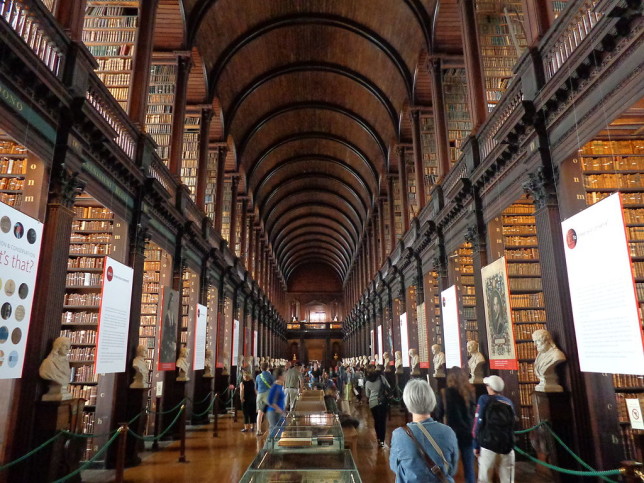
Housed in Trinity College Library in Dublin, The Book of Kells is a glorious Illuminated Manuscript that dates back to circa 800 A.D. It is an Illuminated Manuscript of four gospels.
Highly detailed with intricate designs of the Hiberno-Saxon style, the manuscript is considered to be a masterpiece of the insular style of art.
Illuminated Manuscripts could take years to complete as they were all hand drawn and handwritten. Learn more about how Illuminated Manuscripts were made here.
What does that mean:
- Hiberno-Saxon style is a blend of Irish-Celtic and Anglo-Saxon traditions from 7th-century. The Irish-Celtic has curvilinear style and Anglo-Saxon is defined by zoomorphic interlacing and vivid colors
- curvilinear: The style is characterized by a curving line used to form abstract patterns, such as spirals, circles, swirls, and S-shapes, as well as to define human facial features. The straight line and the right angle are practically nonexistent in both the abstract and the anthropomorphic types of ornamentation.
- zoomorphic – depicts animals…this style was used by other cultures as well including Romans…
- Insular style: With the arrival of Christianity, Celtic art was influenced by Mediterranean and Germanic traditions through Irish contact with the Anglo-Saxons, resulting in the Insular style. Insular art is often characterized by detailed geometric designs, interlace, and stylized animal decorations in illuminated manuscripts. Reference.
Why it’s important?
The Book of Kells is a treasure in art and history…it is considered one of the most important artifacts in the world and one of the best surviving illuinated manuscripts.
- During the Middle Ages, Viking Raids attacked monasteries and villages in England, Wales, Scotland and Ireland…unfortunately the Vikings destroyed many other manuscripts and other artifacts in these raids. Ironically though some Vikings eventually gave up pillaging and settled permanently in the area and also in Normandy – where William the Conqueror was from. You can learn more about British History in the Medieval Ages here.
The history behind the manuscript:
The origin of The Book of Kells is a bit of a mystery. It was made in circa 800 AD either by Scottish or Irish monks. It was at a monastery at Kells in Ireland for perpetual memory, but there is some debate as to whether it was made there or at another location. One theory is that it was made in Iona, Scotland but then moved to Kells for protection during The Viking raids. Either way the artistry and devotion in making this manuscript is amazing.
As we mentioned earlier, the book includes the Four Gospels…It includes the complete Gospels of Matthew, Mark and Luke but only part of John survives.
There is debate as to whether those pages were lost or stolen, or perhaps simply never finished.
What is truly remarkable is that the manuscript is painstakingly indexed and contains cross references to ensure ease of use
Today the Book of Kells is 13 inches wide and 10 inches high. It has 340 folios made of calfskin and vellum. It was trimmed back by book binders in the 19th-century. 30 folios of text and illustrations are believed to have been lost at one point in the book’s history.
The original book was covered in precious jewels and gold, but unfortunately that was stolen from the cover in a 1007 CE/AD in a robbery. This left significant damage to the cover.
The Book of Kells was made by three different individuals. It is known for its intricate illuminations in the shades of blue, white, red, pink, green and yellow.
The most prominently featured color was blue (symbolically a color of royality and The Virgin Mary because blue and purple were expense colors to make). The color blue is found on nearly every decorative page.
- For many years it was believed that the blue came from Lapis Lazuli, which was often the case in blue dye. Lapis was a very expensive mineral from Afghanistan so receiving it was very costly. Hence the reason it was a symbol of royalty and The Blessed Virgin Mother as a ‘royal’ mother of Jesus Christ (God)
- However, researchers have now found that the blue in the manuscripts is less exotic. The Conservation team at Trinity College found out that the book’s blues are are made from woad.
- Woad is a flowering plant used throughout Europe and Asia to produce pigments and dyes. It was first used (recorded use) by The Egyptians nearly 2500 years ago.
- Woad is a darker shade than lapis lazuli, which aligns with the rich deep hues in The Book of Kells
From Kells in County Meath Ireland to Trinity College in Dublin?
- In 1641 the Monastery of Kells was sadly destroyed. With Oliver Cromwell invading Ireland in 1649 it was decided to move the Book of Kells to Dublin. It was permanently moved to Trinity College for safekeeping in 1661 and remains there today.
- Trinity College’s Library looks like a scene from an Indiana Jones movie and contains over 200,000 books
- 500,000 visitors come to see The Book of Kells every year
- For conservation efforts, only a few pages are ever on display at one time.
Interested in learning more about The Book of Kells – you can see the digitized manuscript online at Trinity College’s website.
Thanks for joining us today for Medieval Monday…
Don’t forget to subsribe for the latest posts.
Also follow on facebook
 Art Expeditions