
Welcome to another edition of Renaissance Wednesday where we explore the artists and history of the Renaissance.
Last week we learned about two ‘founders of The Renaissance’ – Brunelleschi and Massacio. They were the first to use linear perspective, which helped to make artwork more realistic.
Today I want to introduce you to another ‘founder of The Renaissance’ – Giotto di Bondone.
The image above is from my local art museum The North Carolina Museum of Art and is Giotto’s Peruzzi Altarpiece
- altarpiece is an artwork such as a painting, sculpture or relief representing a religious subject made for placing at the back of or behind the altar of a Christian Church
Giotto was born in a farmhouse in Tuscany, just outside of Florence in 1266. He died in 1337 in Florence.
Some art historians do not place Giotto in The Renaissance, given he was squarely on the edge of The Early Italian Renaissance and last of The Middle Ages.
I personally move Giotto and a similar artist of the time Duccio into The Early Renaissance because they were so ahead of their time and truly captured the realism and depth of action in their scenes.
Giotto has been called a ‘founder of modern painting’ and was the preeminent artist of his time. Dante, a contemporary and possible friend of Giotto (there are debates if they simply met or were friends) said of Giotto – “In painting Cimabue thought he held/the field, and now it’s Giotto they acclaim-/the former only keeps a shadowed fame” reference
What sets Giotto apart from the Byzantine and Medieval influences of his era was his ability to create natural movement and vivid emotions in his painting…while he did not use linear perspective, he created a dimensionality that is in line with later works in The Renaissance.
Today we’re are going to highlight a few of Giotto’s masterpieces including his unparalled Arena (Scrovegni) Chapel in Padua. (Learn more on my sister site, American Nomad where we toured the Chapel recently)
Giotto was an in demand painter in his day and traveled extensively for commissions throughout Italy. He worked heavily in Florence (Tuscany) and Padua (near Venice) as well as Rome. His travels and talents as an artist led to friendships with Boccacio (author of The Decameron)
His first major commission was for a shrine for St. Francis of Assisi in Assisi (Umbria district), where he did a series of frescoes on the Life of St. Francis. This Basilica is where St. Francis is buried. Unfortunately the Basilica was heavily damaged in 1997 by an earthquake, but by God’s grace the Giotto frescoes were only mildly damaged.
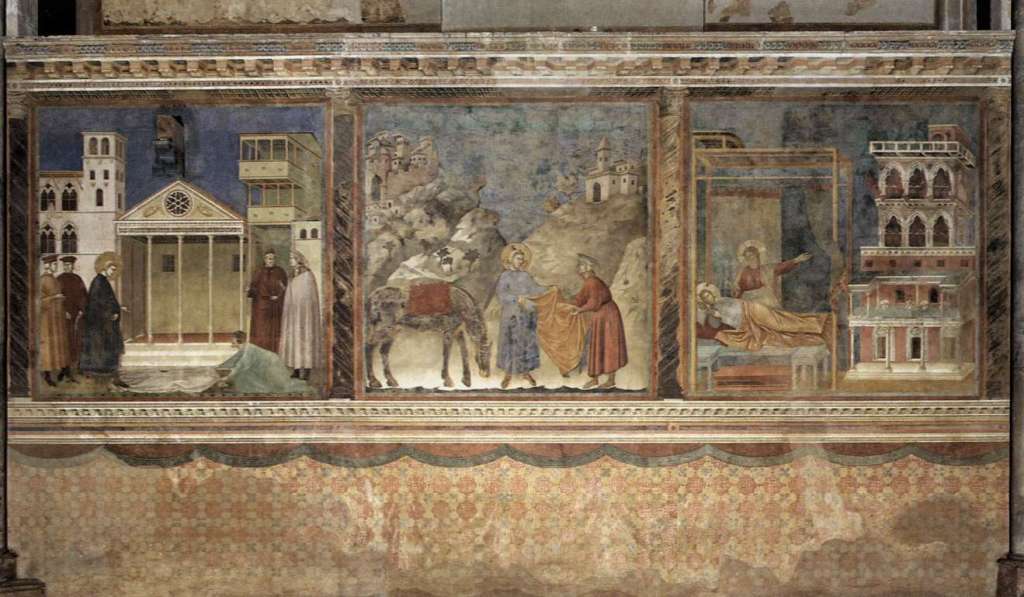
Giotto arrived in Padua (145 miles approximately from Giotto’s base in Florence) in 1303 for what would become is masterpiece The Arena (Scrovegni Chapel).
The Scrovegni (similar to The Medici in Florence) were a powerful and wealthy family in Padua. Unfortunately they made their wealth from banking and lending and charging interest, which biblically is technically a sin per the Catholic Church at the time.
Like, The Medici (also bankers), The Scrovegni were deeply religious and wanted to make sure they got to heaven. God’s grace is bigger than that I believe, but as a sign of devotion they built this chapel to honor Jesus and the Virgin Mary.
The Scrovegni Chapel is known to many art historians as The Arena Chapel because it was built on the site of an ancient Roman arena and the name as stuck. (check out my article about the chapel here)
The Arena Chapel is all that remains of what used to also be the Scrovegni Palace. It was nearly destroyed in World War II – but thankfully it remains in its glory.
Art historian Professor William Kloss mentions in his ‘Italian Renaissance Series’ that “The Scrovegni Chapel is one of the supreme achievements in Western European Art.”
The chapel is fairly plan on the outside, but as you enter into the church you’ll be awed by wall to ceiling frescoes
- 38 frescoes cover the walls telling narrative scenes of the life of The Blessed Virgin Mary and Christ’s life, death and resurrection
- It also includes a huge last judgment on the entrance wall.
As you enter the chapel you’ll first be greeted by The Last Judgment…this is actually a common theme in Medieval and Renaissance churches. It reminds you of how fleeting life is and the eternity of God and is meant to move you to reconcilation and hope of eternal life. You see this when you arrive and when you leave…while it can seem a bit heavy it is meant as both a warning and a grace.
- The frescoes are done in three tiers and movements
But before we continue…What exactly is a fresco?
- Fresco means ‘fresh’ in Italian. It was the principal method of decorating walls in the Renaissance. Fresco is water based and painted on a plaster wall. Most frescoes were painted on wet plaster as the water based colors infused into the plaster creating a truly permanent painting technique.
- Some works were painted dry fresco (the plaster was already dry), but these would chip are more likely to fade.
- Because the plaster had to be wet you had to paint fairly concisely and quickly. Most painters would focus on a face or a portion of the landscape in one day – called a giornata (or day’s work). You can usually trace the time it took based on how the plaster was painted.
- Giotto started the painting in 1303 and many believe he finished it within two years, by the time the church was consecrated in 1305. However he may have worked on it until 1310.
- The tiers:
- The Top Tier (right south wall) tells the story of Mary’s parents and then moves into the life of Mary
- Many of the stories here are apocryphal – based on traditions in the church or legend, but still holy and beautiful
- The Middle Tier shows the Nativity of Jesus through his ministry
- The Bottom Tier is The Last supper to Crucifixion
- The Last Judgment Entrance Wall
- The Top Tier (right south wall) tells the story of Mary’s parents and then moves into the life of Mary
In each of the scenes you see a movement of dimension – characters faces filled with excitement, terror, awe…Giotto incorporates natural landscape into the scenery to make you feel as though you are right there.
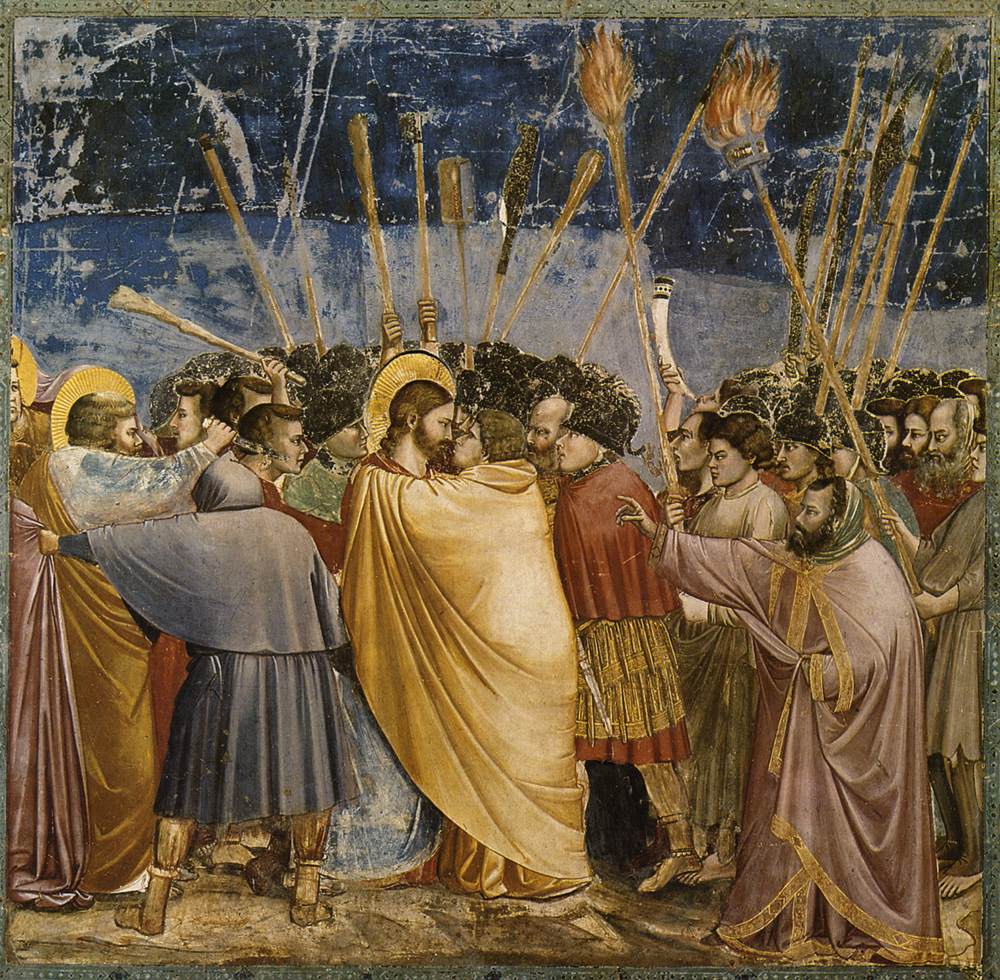
The scene of Judas betrayal is haunting. Judas leaning in to kiss Jesus’s cheek while he has betrayed him. Look at all the different facial expressions and the way he creates depth (even without linear perspective)
Interested in visiting the Scrovegni Chapel click here.
We could spend days in The Arena/Scrovegni Chapel, but alas we must continue to Florence.
I was blessed to visit the Uffizi in January, which home to several important works by Giotto.
- Giotto lived most of his life (and died) in Florence where he was an in demand artist.
- He married his wife, Citua, in 1290 and they had eight children, including a son who also became a painter
- In addition to being an artists, Giotto was an architecture and designed Florence’s Campanile (Bell Tower) – known as Giotto’s tower.
- When I was in Florence they joked that they were better than Pisa because their Tower was straight (Pisa’s is Leaning) – city rivalry is strong in Italy.
- You can learn about the campanile here.

The Uffizi has several pieces by Giotto, but my favorite is The Ognissanti Madonna. This large altarpiece was painted circa 1310 for the Florentine church of Ognissanti. It was a revolutionary painting a direct doorway to works by Massacio and others.
Both the Madonna and the Child appear to be inserted into a realistic and well defined space, whereas Medieval icons can feel like the subject is not grounded in a real life scene (floating in space). The folds of the garments outline the volume of the bodies and the figures are in conversation with you – the viewer.

Giotto died in Florence and his last work was the Podesta Chapel. He continues to be considered one of the most important artists of all time.
If you are interested in learning more about Giotto I hope launch a class on his work in late April/early May.
Don’t forget to subscribe to the blog and follow us Facebook
 Art Expeditions