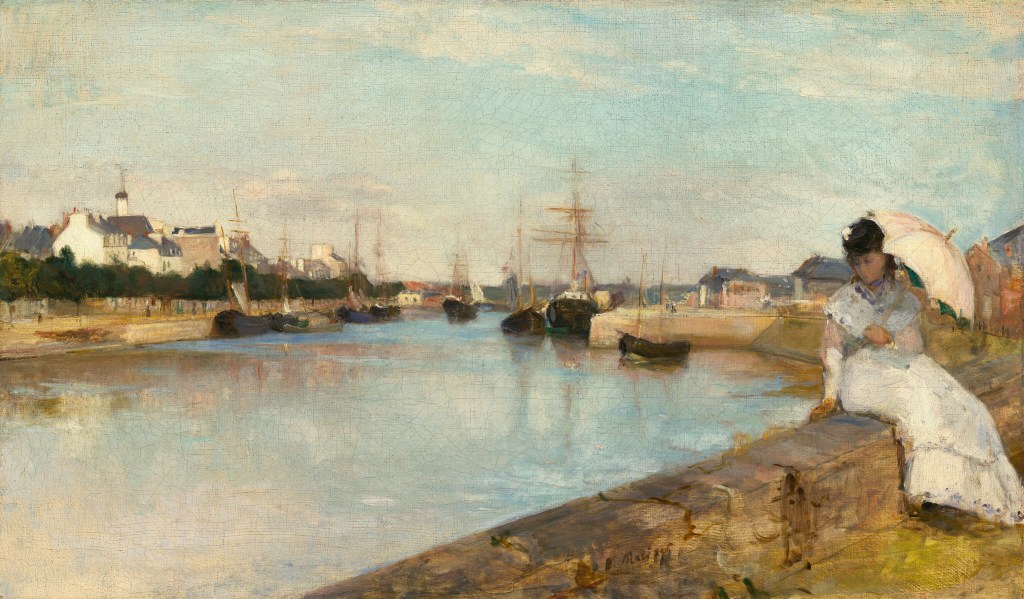
Welcome to this week’s edition of Impressionism Friday, where we explore the history and beauty of Impressionism.
Last week we learned about the Dawn of Impressionism and how this extraordinary movement came to be influenced by artists like Corot and Manet.
Today we’re going to learn about one of the founders of The Impressionist Movement – Berthe Morisot.
This extremely talented and diverse painter’s ability to see the natural landscape and depict real-life social scenes in a vivid way powered Impressionism. It was Berthe Morisot who introduced her friend and ‘Father of Impressionism’ to Claude Monet and others.
Morisot studied with pre-Impressionism influencer Jean-Baptise-Camille Corot, as a teenager. Corot’s pastoral landscapes and use of early plein air (painting outside) no doubt struck an early fire of the Impressionist spirit in Morisot.
Early Life:
Born Berthe Marie Pauline Morisot on January 14th 1841 to a upper-middle class family in Bourges, Cher, France. Her father, Edmé, served as the senior administrator of the department of Cher. The family moved to Paris in 1852, when Morisot was a child.
It is interesting to note that Berthe’s mother, Marie-Joséphine-Cornélie Thomas, was the great-niece of Jean-Honoré Fragonard, one of the most prolific Rococo painters of the ancien régime.
Berthe had two older sisters, Yves (1838-1893) and Edma (1939-1921) and a younger brother, Tiburce (1848). All the Morisot children were artistically talented. Berthe often painted her sisters including portraits like
While they no doubt had the artistic gene from their mother’s side of the family, The Morisot girls were first introduced to art during private lessons by Geoffroy-Alphonse Chocarne and Joseph Guichard. They initially started classes to make a drawing for their father’s birthday gift.
Guichard saw their gift and introduced them to the Louvre Gallery where they learned art by copying paintings.
- Fun fact – did you know many masters learned by becoming official copyists at The Louvre. By copying master works you learn style and proper form and develop into a better artist. As an artist myself, I often ‘copy’ or ‘trace’ a work to develp the perspective so I can translate it into my own work. Learn more here.
Unfortunately at the time, it was hard for girls to get a formal arts education outside of tutoring and copying. Berthe Morisot however was a force and quick to learn from teachers like Chocarne, Guichard and Corot.
Edma and Berthe worked closely together as art students until 1869 when Edma married naval officer, Adolphe Pontillon. Edma moved to Cherbourg and had less time to paint.
Letters between the sisters demonstrate their closeness and Berthe’s regret of their distance and Edma’s withdrawal from painting.
Edma was extremely supportive of Berthe’s focus on art as a career. Edma wrote: “…I am often with you in thought, dear Berthe. I’m in your studio and I like to slip away, if only for a quarter of an hour, to breathe that atmosphere that we shared for many years…”.
Her sister Yves married Theodore Gobillard, a tax inspector, in 1866 and was painted by Edgar Degas as Mrs Theodore Gobillard. The painting is in The Met in NYC.
Art Career
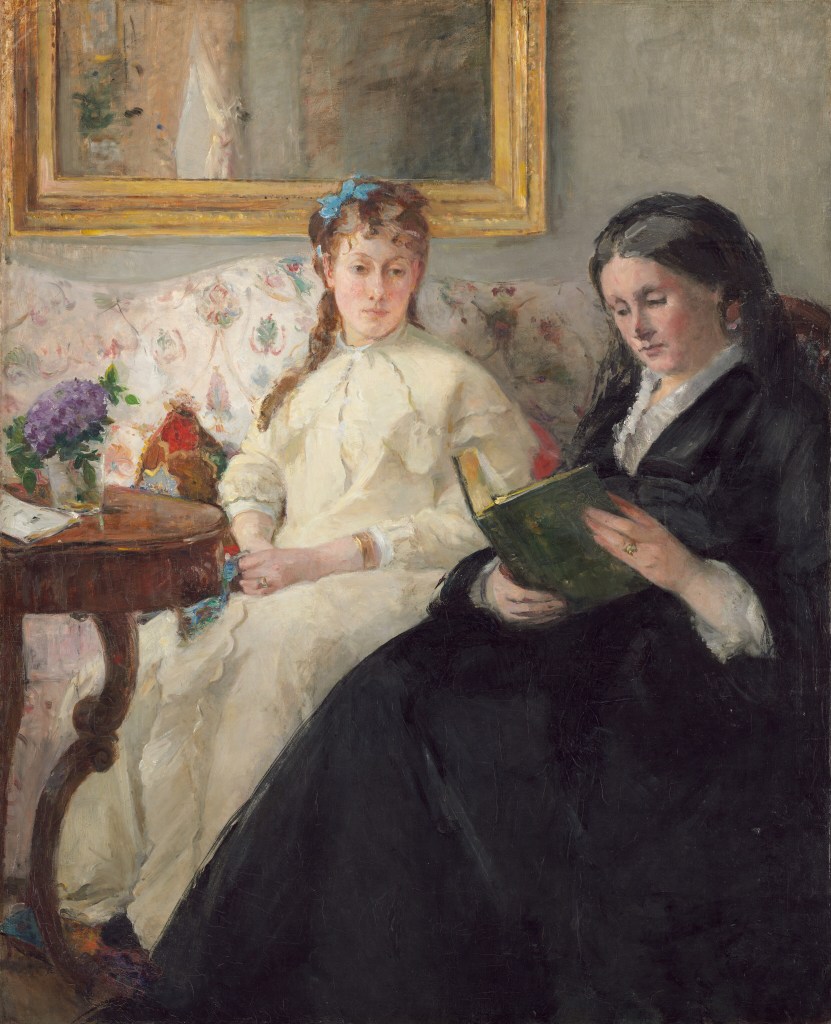
As a copyist at the Louvre, Morisot became friends with other artists like Manet and Monet. It was as a copyist she first met her teacher, Corot. She also began to study with Achille Oudinot, of the Barbizon School (artists who ‘returned to nature,’ and embraced early plein air).
Morisot’s friendship with Edouard Manet was fruitful for both of them. Manet used Morisot as a model many times. It was through Morisot that Manet began to connect with Monet and other Impressionists and no doubt influenced their work. Though Manet did not consider himself an Impressionist, his broad brushstrokes and real-life scenes of Paris are categorized as Impressionism by many today. Manet is considered ‘A Father of Impressionism.’
Edouard Manet introduced Berthe to his brother Eugene Manet. Eugene and Berthe fell in love and ended up getting married. They had one daughter in 1878.

Morisot found success with the Salon de Paris and was first accepted with two landscape paintings in 1864 at age twenty-three. She continued to show regularly in the Salon to favorable reviews. In 1874 she decided to show her work in what would become the first Impressionist exhibition. She featured in all but one of the eight Impressionist Exhibitions from 1874-1886, missing the exhibition in 1878 because her daughter was born.
She was the only women to showcase in the exhibitions and is one of only two prominent female Impressionists, the other is American-born Mary Cassatt, who worked in partnership with Edgar Degas (we’ll cover her in a future post).
Morisot died fairly young in 1895 after contracting pneumonia from her daughter (her daughter survived). Yet her memory lives on as a force of art in Impressionism and beyond.
Morisot’s work can be found at major art museums around the world including D.C.’s National Gallery, which has a large and diverse collection of Morisot.

Want to learn more about Morisot? I recommend these books
Berthe Morisot – Woman Impressionist (great artwork and information about her life)
Thanks for reading and don’t forget to subscribe for updates
 Art Expeditions