
Today on Medieval Monday we’re going on a journey to the ancient Roman and Byzantine Capital of Ravenna in Italy.
Ravenna and the surrounding are are UNESCO World Heritage Sites for their historical and cultural significance in Byzantine Early Christian Art.
Often when we think of The Middle Ages we imagine stained-glass windows or Gothic structures, but architecture and art in The Middle Ages varied depending on region and government influence. In the East and Northern Italy – Byzantine Art and Culture reigned. In Ravenna to Venice they eventually created their own unique Byzantine-Northern Italian Style (Venetian Style in Venice)
Before we get started on our art expedition, I want to prime us for the adventure with a quick history lesson.
We’ll reference the terms ‘Byzantine’ and ‘Byzantium’ a lot on Art Expeditions and the upcoming Masters of Venice Course, but what does it actually mean?
Byzantine: of or relating to the Byzantine Empire and/or the Eastern Orthodox Church.
What was The Byzantine Empire…
- In 313 Roman Emperor Constantine issued The Edict of Milan, which made Christianity legal in The Roman Empire
- Constantine realized that in order for The Empire to maintain power and flourish it needed to be divided between Eastern and Western Capitals that would then be linked to the central government.
- In 330 AD Constatine established Constantinople (now Istanbul) in modern day Turkey to serve as the Eastern Capital of the Roman Empire
- In 476 Barbarian (non-Roman) – Germanic Tribes and The Huns began to wreck havoc on Northern Italy leading to the Fall of Rome
- We have all heard about ‘The Fall of Rome’ and in truth it was a devastating event for western Europe, but it is also important to note that The Roman Empire didn’t fully collapse until 1453…because The Eastern Roman Empire known as Byzantium continued to be a super power and world influencer until it was conquered by The Ottomans in 1453. With the Fall of the Western Roman Empire in 476 AD, The Eastern Roman Empire remained and Byzantium was an important player in the social, cultural, political and trade networks of The Middle Ages.
Art in Byzantium:
- One of the most popular styles of art in The Middle Ages is Byzantine Art, which is defined by it’s rich symbolism, recurring religious themes, golden imagery and intricate mosaics.
- It is also known for the iconography. These icons represent Jesus Christ or another holy figure in a traditional style, usually on wood, that are venerated and used to aid in the devotion. You can meditate on the mysteries of the Gospel or Christ by ‘venerating’ – praying with an icon. It was not an idol, but more of a visual tool to connect faithful with story of their faith.

- Byzantine art is a combination of Eastern and Classical Western Art (inspired by classical art of Greece and Rome) as well as art of the Near East
- In antiquity, most mosaics adorned floors and were usually made of colored stones and could withstand people walking on them, but in Byzantium they put mosaics on the walls and could therefore use fragile materials like Mother of Pearl, gold and Silver Leaf and glasses of different colors
- Small glass cubes or tesserae were placed at angles to catch and reflect the light creating a sparkling otherworldly atmosphere.
- One of the best preserved collections of Byzantine art outside of Istanbul (Constantinople) is in the area around Ravenna in Northern Italy.
- Ravenna includes 8 UNESCO World Heritage Sites including the Basilica of San Vitale
- Byzantine Art influenced many artistic styles in The Middle Ages moving into present day Russia and Ukraine and as far north and Norway. This is because Byzantium had a huge trading empire and brought their culture with them. Outposts and Trading Partners with Byzantium married their unique art styles with those of the Byzantine culture, and took the Byzantine style as their own.
- The art of Byzantium has at times been criticized for being repetitive, but this was the point. With many unable to read and so many different cultures coming together under Byzantium, it was important to have a seamless and unified way to communicate through art. This was essential in spreading The Gospel message to the Empire as the stories needed to be easy to recognize in church mosaics and icons based on imagery and iconography. The symbolism of the works became the depth and uniqueness of the art
- What it lacked in originality these works made up in splendor with gold, ivory and precious stones used in icons and mosaics. The idea was to elevate you to a mystical plane with God.
- The Church and State were both glorified in the Mosaics to show a unified front and Emperors like Justinian are seen in mosaics in Ravenna showing his power, but also submission to Christ. This motif was copied in Venice as the Doge would be represented kneeling before The Lion of St Mark…
- Purpose was to glorify the Christian religion and express its mystery – spiritual symbolism things on earth to stand for order in heaven
- Did not seek to express a realistic or physical perfection but to evoke the spirit of holy figures – capture the spirit of Bible
- Cross
Symbolism in Byzantine Art:
- Christ is represented as Pantocrator – Ruler or King of the Universe, giving a blessing to all – this theme was heavily used in Byzantium including Constantinople (Istanbul)’s Hagia Sophia, Ravenna and St. Mark’s in Venice
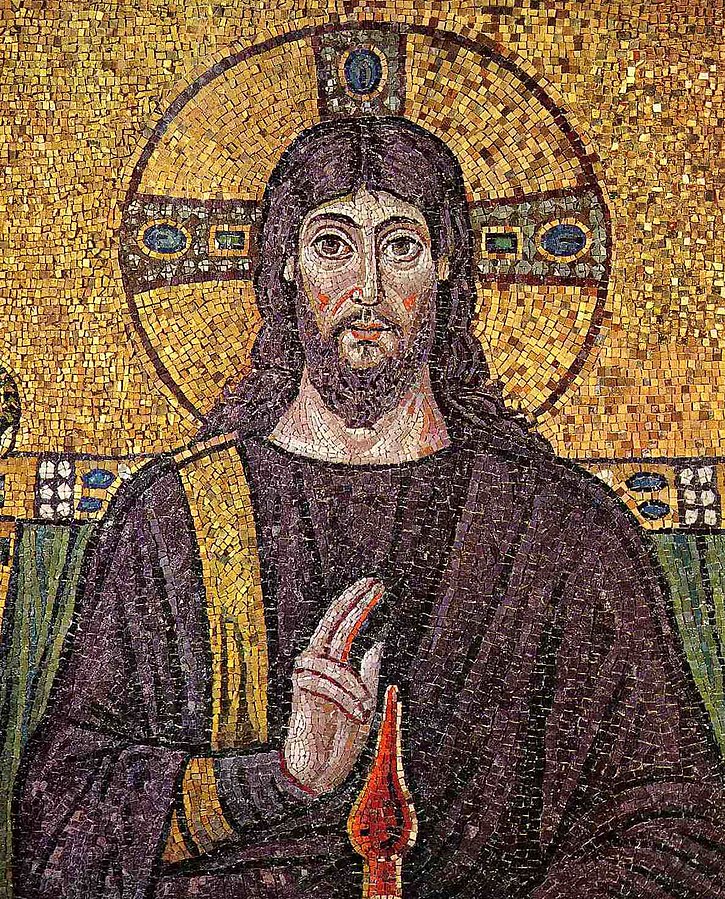
- You will often see zoomorphic themese where animal imagery symbolizes characters or saints based on their moniker.
- St. Mark was known as ‘The Lion’ and is represented as a Winged Lion; this reference comes from Hebrew Scriptures (Old Testament) Book of Ezekiel ( 1: 1-2) and The New Testament Book of Revelation (4:6-8)
- St. John is symbolized as a Rising Eagle
- St. Luke is symbolized as a Winged Ox
- St. Matthew – a Man in Heaven
- for more info about this symbolism click here
- Saints are represented by standard representations to make them clearly recognizable. For instance St. Peter holds Keys from words “on this rock I will build my church…and give you the keys to heaven” (Spoken by Jesus in Matthew 16:18-19
- Blessed Mother Mary is often seen wearing blue – a symbol of royalty and red for the struggles of Christ’s passion
- Gold represented the divine light and glory of God
- Emblems of wheat represent the bread of the sacrament in The Last Supper and The Eucharist.
- Learn more about symbolism here.
While Byzantine Mosaics and Religious Iconography flourished through much of Byzantium two periods of Iconoclasm destroyed some older mosaics and iconography. Fortunately the area of Ravenna was spared as it had mostly fallen out of Byzantine control by that time. Learn more about Iconoclasm here. Also additional Christian iconography was destroyed or lost after The Fall of Constantinople.
The jewel of Byzantium in Constantinople was Hagia Sophia, which can still be toured in Istanbul today.
Visiting Ravenna
Today we are going to visit the area of Ravenna and Classe in Northern Italy. Ravenna is located 89 miles (roughly 2 hour travel time) from Venice. Ravenna is the best place in Italy to see Byzantine Art and learn about the history of Rome to Byzantium.
A little Ravenna History:
The area has been settled since the 7th century-5th-century BCE (oldest evidence is 5th-century but it is believed that the Etruscans lived in the area as far back as the 7th-century); it was settled by The Etruscans and Umbri peoples before Rome took over in the 3rd-century BCE.
Ravenna, like Venice was built in a marshly lagoon, which made it easy to defend given its waterways and territorial position.
After the separation of East and West in The Roman Empire, Rome became increasingly less important except in matters of Church and some trade. With the Barbarian invasions it seemed practical to move the capital of the Western Empire to Ravenna in 408 AD. It also helped that it is connected to The Adriatic by The Candiano Canal
Unfortunately this did little to protect The West as the Barbarians bypassed Ravenna and simply sacked Rome in 476 and eventually Ravenna soon followed.
- Ravenna became the capital of the Ostrogothic Kingdom from 476 AD to 540 AD, when it was taken over again by Byzantium
- Emperor Justinian was determined to cement Byzantine authority into Ravenna, making it the capital (Exarchate) of Italy (or area of Italy).
- It was during this time that Justinian ordered the building of many churches in Ravenna that can still be seen today and are among the oldest in Italy
- Ravenna remained under Byzantine rule until the Lombards invaded and killed the Byzanatine Exarchate of Ravenna in 751. The city then moved between the territory of Venice and the Papal States and Austrian Empire until the unification of Italy in the 1800s.
Why is Ravenna important:
- It did not face the iconoclasm of other Byzantine cities and many of the churches remain perfectly in tact as archaelogical and art time machines
- It captures the story of Roman rule to the Middle Ages and how art and progress didn’t turn dark, but pivoted and the shifts led to the eventual formation modern Western and Eastern Europe
Byzantine Art in Ravenna:
Ravenna includes Eight UNESCO World Heritage Sites on the historic tour including:
- The Mausoleum of Galla Placidia
- The Neonian Baptistery
- The Basilica of Sant’Apollinare Nuovo
- The Arian Baptistery (Constructed in the Ostrogothic period as they were sect of Christianity known as Arianism, which eventually died out and was labeled heretical by the main church)
- The Archiepiscopal Chapel
- The Mausoleum of Theodoric
- The Church of San Vitale
- The Basilica of Sant’Apollinare in Classe
- Each of these were constructed in the 5th and 6th centuries. They show great artistic skill, including a wonderful blend of Graeco-Roman tradition, Christian iconography and oriental and Western styles.
Today we’re going to focus on The Church of San Vitale – one of the oldest and most beautiful churches in Italy and Byzantium
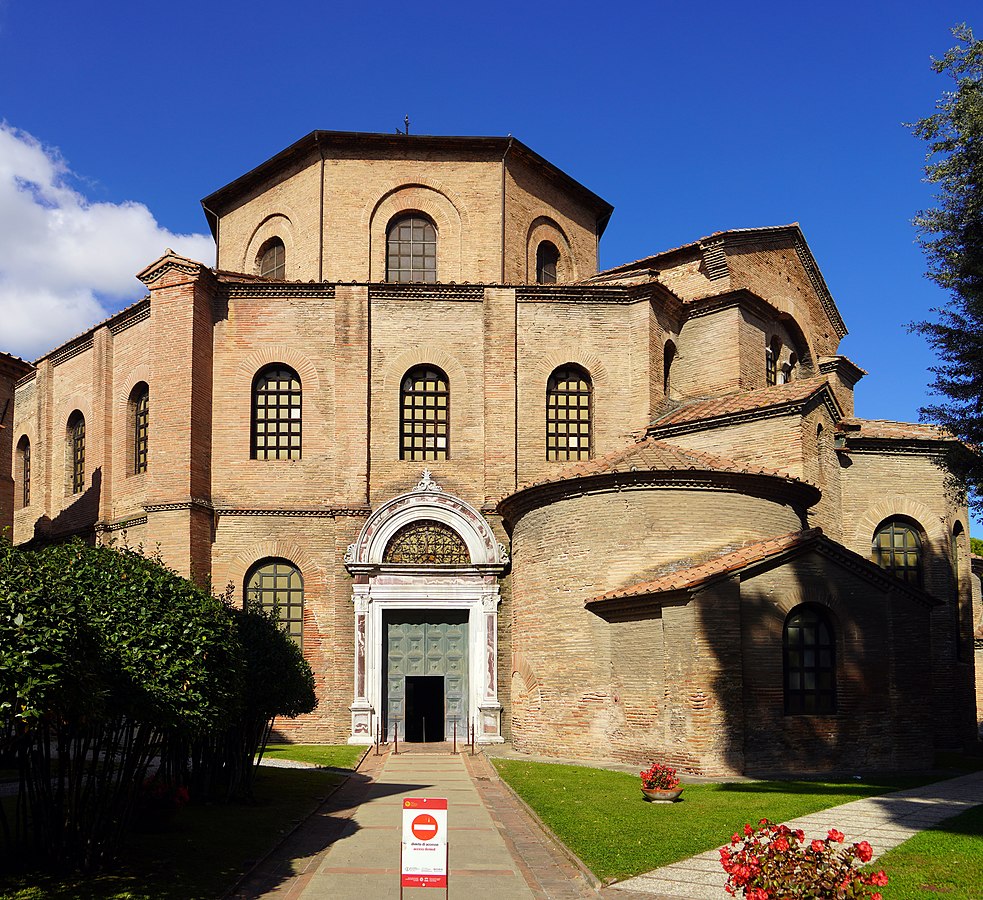
These beautiful church is a marvel – nearly 1500 years old!
The initial construction of the church started by The Ostrogoths but was finished and refined by order of Emperor Justinian of The Byzantine Empire.
- The funding for the church was partially sponsored by local banker and architect Julius Argentarius who also sponsored the Basilica of Sant’Apollinare in Classe. His donor portrait is said to be among the courtiers of Emperor Justinian who is featured heavily in the church.
- The style is a mix of Roman and Byzantine styles
- Dome of the church and doorways with stepped towers are traditional Roman Classical Style
- While the polygonal apse, capitals, narrow bricks and early example of flying buttresses are typical of Byzantine architecture
- The church is known for it’s masterful Byzantine mosaics – the largest and best-preserved Byzantine created mosaics outside of Istanbul
- One of the only major churches in the West from the period of Emperor Justinian I to survive virtually intact
- The mosaics tell the stories of New and Old Testaments as well as incorporate elaborate mosaics of Justinian I and his wife Empress Theodora.
- Emperor Justinian and Empress Theodora ruled hand in hand and she was a powerful Empress who focused strongly on religious and social programs. You can learn more about them here. Theodora is honored as a Saint and her shrine is the Church of the Apostles in Istanbul. She was one of the first women to advocate for women’s rights (given the era this was a big deal)
- The church is named after Saint Vitalis who is said to have died near the church site.

While in the area…I also recommend visiting the equally impressive Basilica di Sant’Apollinare Nuovo in Classe, which provides a dazzling display of mosaics and Byzantine iconography.
For great insight about the sites in Ravenna check out their official tourism site here.
We’ll learn more about The Byzantine influence in Italy in the Masters of Venice Course, which will be offered in The Patreon Group (Join for Great Art Videos and Additional Resources.
Don’t forget to subscribe for blog updates and more ART…
Follow on Facebook
Prefer video – check out my mini YouTube lesson
 Art Expeditions