
Today on Impressionism Friday we’re going to learn about one of the founders of Impressionism, the versatile artist Camille Pissarro.
Pissarro was the only Impressionist painter to be featured at all 8 of the Impressionist Exhibitions that took place in Paris from 1874-1886.
Camille Pissarro was born on July 10th, 1830 in St. Thomas, which at the time was the Danish West Indies. He was the third son of a Jewish merchant of French and originally Portuguese descent.
His family owned a shop on Charlotte Amalie in St. Thomas, where Camille lived until he was twelve years old. The family sent him to school in Passy, near Paris, where he began to show an early talent for drawing. Camille learned by visiting the collections of the Louvre.
At seventeen when he returned to St. Thomas, his father anticipated him to become next in line at the family business, but Camille’s heart was set on painting and sketching the St. Thomas harbor.
After meeting the visiting Danish painter Fritz Melbye in 1852 he sailed to Venezuela with the older artist to sketch the streets of Caracas.
Pissarro said he “abandoned all I had and bolted to Caracas to get clear of the bondage of bourgeois life.”
When he returned home to St. Thomas in 1854, his parents realized that no amount of argument when change their son’s desire to be a painter and they supported his decision to leave in 1855 to move to Paris to pursue his dream.
It is interesting to me that while Pissarro is a of French background gained recognition in France his is also a painter of the Caribbean, which no doubt influenced his use of color and style in addition to his French-Portuguese roots.
In fact his early works are painted scenes of the West Indies from memory, as he found mentorship with Melbye’s brother Anton. When Pissarro first showed his works at the Paris Salon of 1859 he styled himself ‘A student of A. Melbye); a title he continued to use until 1866.
One of his biggest influences was that of Camille Corot (a predecessor to Impressionism), who taught Pissarro and urged him to paint from nature.
Pissarro’s early natural paintings are of a path or river receding and have a blonde and green tone, which differed from Corot’s silvery tone.
Pissarro continued to work on his craft and figuring out how to tackle and experiment with different styles, although his signature ‘Impressionism’ no doubt is highly recognizable with is broad and quick brushstrokes mixed with small and delicate work to create serene and thought provoking stories in paint.
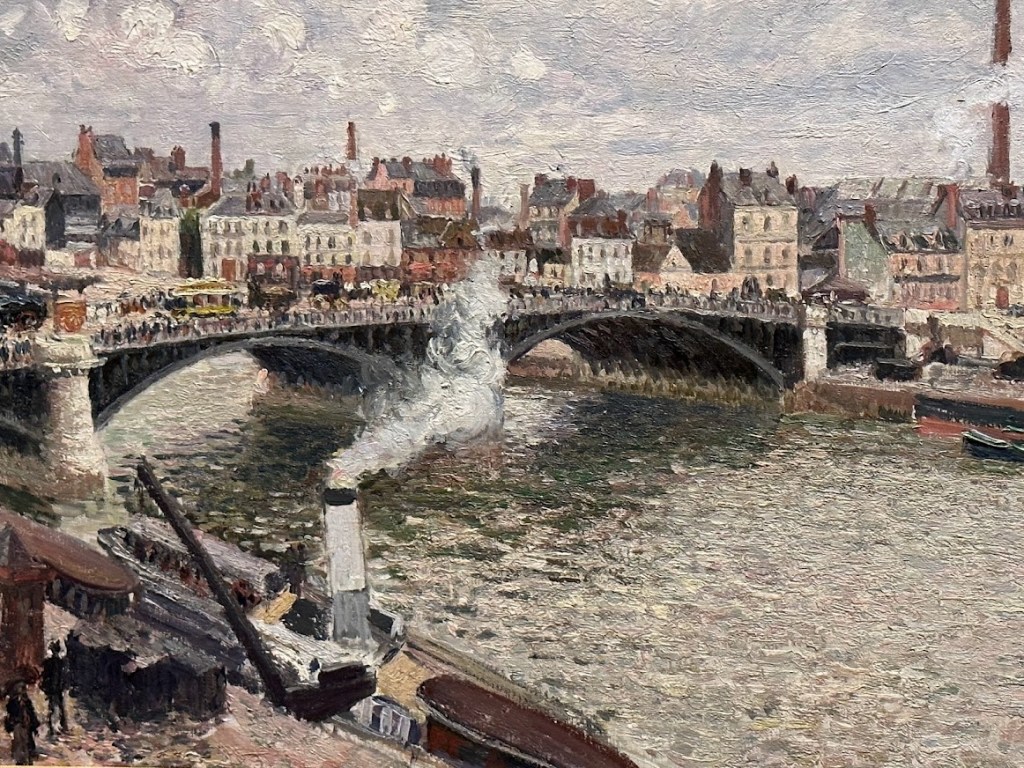
Common themes were paintings of pastoral life and farmers, but also the emerging industrialization of France. No one could capture the steam of a railroad coming into the countryside quite like Pissarro.
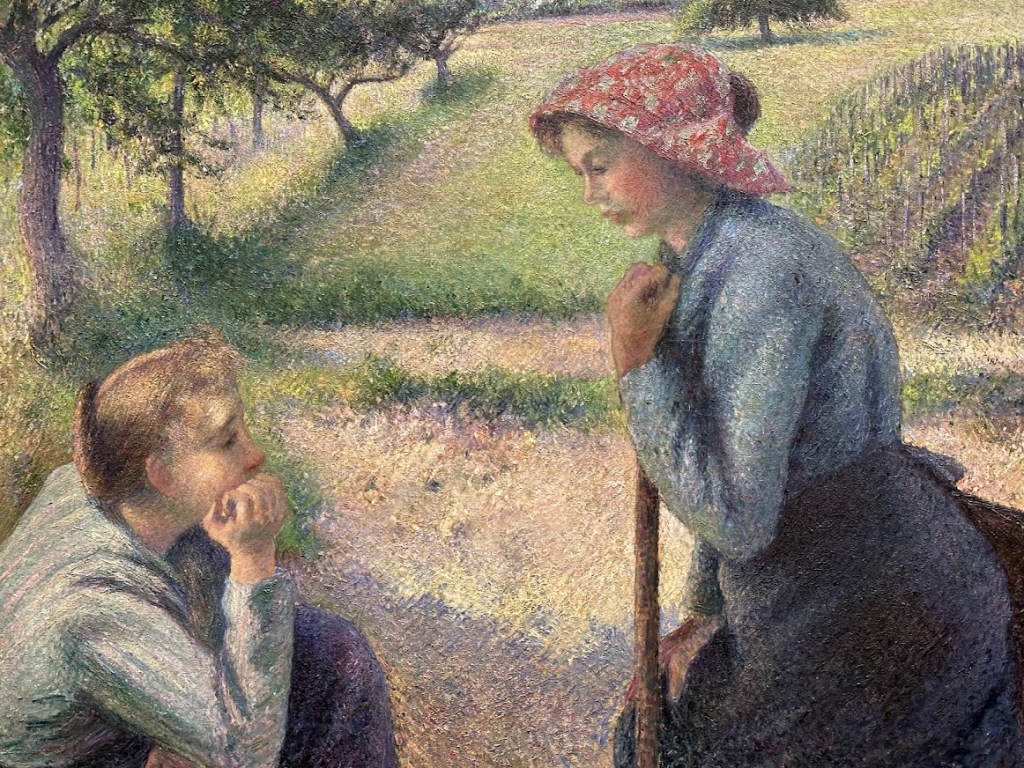
He was a friend of Seurat and for a period adopted his pointillism, while still mainting his own unique Pissarro style stamp. I can see the influence of Pointilism meets Impressionism in this painting at The Met in NYC (Two Peasant Girls)
A key theme in Pissarro is the battle between industrialization and agrarian life. Pissarro wanted preserve the values of agrarian society that were threatened by rapid industrialization. The Two Peasant Girls (1892) appeared in a major exhibition of his work organized by his art dealer Joseph Durand-Ruel. While most of the paintings sold, Pissarro loved this one and kept it as a gift for his wife.
Pissarro was also adept at still life…

Over his career he mentored other artists and was known for his affable personality and good heart.
He mentored post-Impressionism artists like Paul Cezanne and Paul Gauguin who called him “Father Pissarro.”
I’m blessed that my local museum, The North Carolina Museum of Art has a gorgeous Pissarro, which I make a point to view every chance I get

Pissarro fell in love and was happily married to Julie Vellay, a vineyard grower’s daughter. They had seven children…six of which became painters including: Lucien, Georges Henri Manzana Pissarro, Felix, Ludovic-Rodo, Jeanne Bonin-Pissarro and Paul-Emile.
He died in 1903, yet his legacy remains.
Don’t forget to subscribe for more Art Blogs!
Follow on Facebook here.
 Art Expeditions