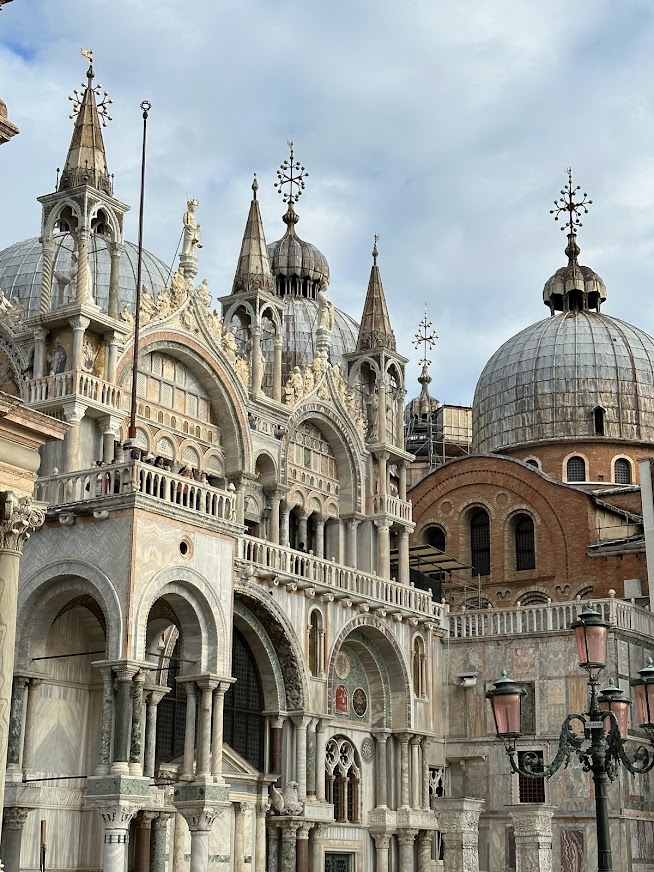
Welcome to our first Art Expeditions Virtual Course – The Masters of Venice.
Over the next two months we’ll be exploring the majesty, wonder and history of Venetian art from early Byzantine influences to the Venice of Canaletto and others.
This FREE course will be a mix of blog posts accessible here and YouTube videos.
Subscribe to Art Expeditions for course updates
You can also bookmark The Masters of Venice main portal to get updated resources and videos.
This is a self-paced course and meant to provide an engaging overview of Venice’s history and art. It is meant to be FUN and stress free.
I’m available for questions or feedback via email
If you would like to support Art Expeditions consider joining us on Patreon.
Get your art passports and get ready for our Venetian Adventures
We’re kicking off our Venetian Art Expedition with an early History of Venice.
You can access our first lecture on The Art Expeditions YouTube page (or embedded below)
Laying the foundation…Venice’s Early History:
Venice was born as a town of refugees seeking peace from The Barbarian Invasions at the end of The Western Roman Empire.
In the 5th century AD, increasing attacks from Germanic tribes and The Huns of the East threatened and weakened the stability of Rome and the Western Empire.
We learned in our recent Medieval Monday post during a visit to Venice’s neighbor to the south, Ravenna…that the increase in the Barbarian attacks led Roman government to move its capital from Rome in the West to Ravenna.
Ravenna like Venice is also off the Adriatic (Mediterranean Sea off Eastern Italy) and is a bog that demands innovative building techniques to make the land habitable.
Ravenna was chosen because, it had passage to the coast via a canal, which make it easy to reach the Eastern Roman Empire (Constantinople), but also because it’s location on the water was easier to defend.
Unfortunately Ravenna’s ‘secure location’ didn’t stop The Western Roman Empire falling in 476 AD, when barbarians moved into the city of Rome, cut the aquaducts and raided the city. Ravenna also fell and was taken over by The Ostrogoths.
- Key history: When we think of the Fall of Rome, we assume because The City of Rome fell that The Roman Empire was dead – it was not. In fact The Eastern Roman Empire continued as Byzantium until 1453, when Constantinople fell to the Turks.
- The Fall of Rome refers to the Western Empire (City of Rome and much of present day Italy).
- Byzantium continued to evolve in the Middle Ages as a thriving empire with the legacy of Rome and the riches of its Eastern influence
- Venice’s location on the Adriatic kept it close with Byzantium and the Eastern Empire for many years and helped influence the city’s art and culture.
I start with this backstory because it is important to understand the uniqueness of Venice.
Venice is a fairly young city in the sense it was not founded until the collapse of Western Rome and it started off as a hiding colony from invaders. Eventually it rose to have arguably the greatest trading empire in Europe and one of the richest artistic histories throughout the world.
The Early Years: 421-697 AD
Legend has it that Venice was founded on The Feast of the Annunciation – March, 25th, 421 AD at noon.
- Fun fact: In many Italian city-states The Feast of the Annunciation marked the start of the new year, because Mary said yes to becoming the Mother of Christ and thus the chance for human redemption and union with God began. The Annunication is one of the most painted themes in art history
Early residents settled near the present day Rialto Bridge and eked out a living by fishing. They used their engineering ingenuity to put thousands of stakes into the marshly islands of The Venice Lagoon and then put wooden planks and boards to build the foundation to build the city on.
- Venice is a city with over 100 mini islands and sandbars that are now connected by hundreds of bridges and canals. The Grand Canal is the deepest canal and man thoroughfare through Venice. It snakes like an S through the islands.
- Venice ironically is shaped like a fish
Venice began to grow quickly after 476 AD and the 6th century.
Without fresh water, Venetians began to collect rainwater in wells. Venetians are masters of figuring things out because they lived on the edge with a determination of survival.
By 540, The Ostrogoths were kicked out of Ravenna and The Veneto Region (Area around Venice) for good when Byzanatine Emperor Justinian I and Belsarius retook Ravenna and the area near Venice back and rededicated it to The Byzantine (Roman) Empire.
Ravenna because the capital city of this region and important political and religious hub in region.
Venice became part of Byzantium in 565 AD and remained under Constantinople (Byzantine Capital) until around 697 when a series of revolts and incursions from The Lombards allowed Venice to declare it’s independence.
The Most Serene Republic Begins – 697 AD
With Venetian independence secured it was decided to create an elaborate Republican system of elected officials to govern and secure freedom and stability in Venice. This constitutional monarchy of sorts was helmed by The Doge, who was elected for life to oversee the government and had little power.
The first historical Doge was Paolo Lucio Anafesto. Learn more about The Doge and their role here.
Eventually The Doge and the elected officials would live and rule from The Ducal Palace, which we’ll tour in a later lesson. If you are interested to learn more about The Ducal Palace in the meantime, check out an article I wrote for our sister site American Nomad.
Over the next 1100 years, until Napoleon invaded in 1797 – The Doges ruled over what was known as The Most Serene Republic. It gets this moniker because the city was highly esteemed for its stable government, selfless leaders and free citizens.
The Early Churches and Foundation of Art in Venice:
Before glorious St. Mark’s Basilica was born, Venice built San Giacomo di Rialto, which was later rebuilt in the 11th-century but remains one (if not the oldest) church in town
Santi Apostoli’s foundations date to the 7th century with changes throughout the years. Today this church includes works by Renaissance Masters like Veronese and Santi.
We’ll be exploring many of the magnificent churches in Venice and their art throughout this course…
The most famous church and one of the most stunning and hynoptic churches in all of Christendom is St. Mark’s Basilica, located on St. Mark’s Square.
Consecrated in 1094 as a Byzantine Romanesque five domed cathedral, The Basilica of St. Mark is so unique and breathtaking in its design words fail to describe its full mysteries and wonders (but we’ll try)
St. Mark’s is unique in that it has a strong Byzantine style and connection that was meant to rival Hagia Sophia and the great churches of Constantinople.
The design is based off of the now destroyed Church of the Apostles in Constantinople, but St. Mark’s is its own unique creation.
Whereas many other Medieval Churches in Italy and the Northern European countries focused on soaring stained glass windows flooded with light, the interior of St. Mark’s is almost completely covered in gold and silver leaf mosaics.
It is dark and yet full of light as the fire of candles cause the glitter of glass and gold in the thousands of mosaic tiles to shimmer.
Stepping into St. Mark’s you feel as though the gates of heaven have opened…the verse that comes to mind is “darkness is not dark to you O Lord”
The floors are perfectly geometric shapes that are designed to reveal God’s perfect geometry in the universe and his creation.
Statues and chapels are found in every crevice speaking stories from The Gospels.
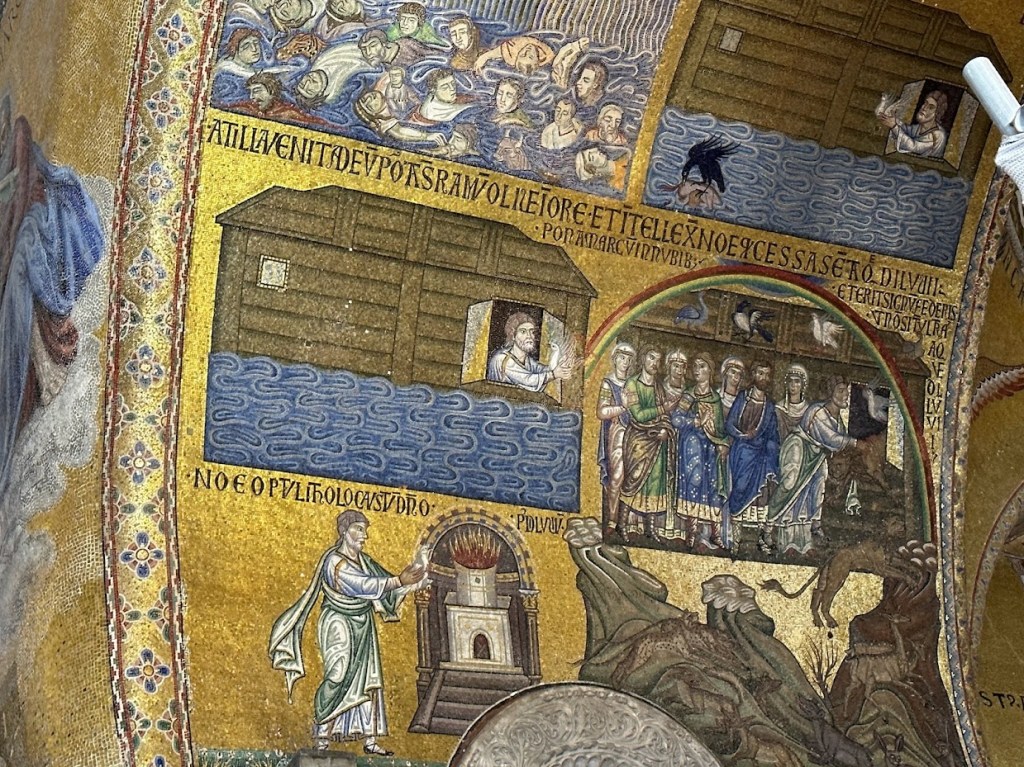
When you first enter St. Mark’s Basilica – you will see mosaics telling Old Testament stories like The Flood…some of the oldest mosaics in St. Mark’s are just inside the church.
The Stealing of a Saint
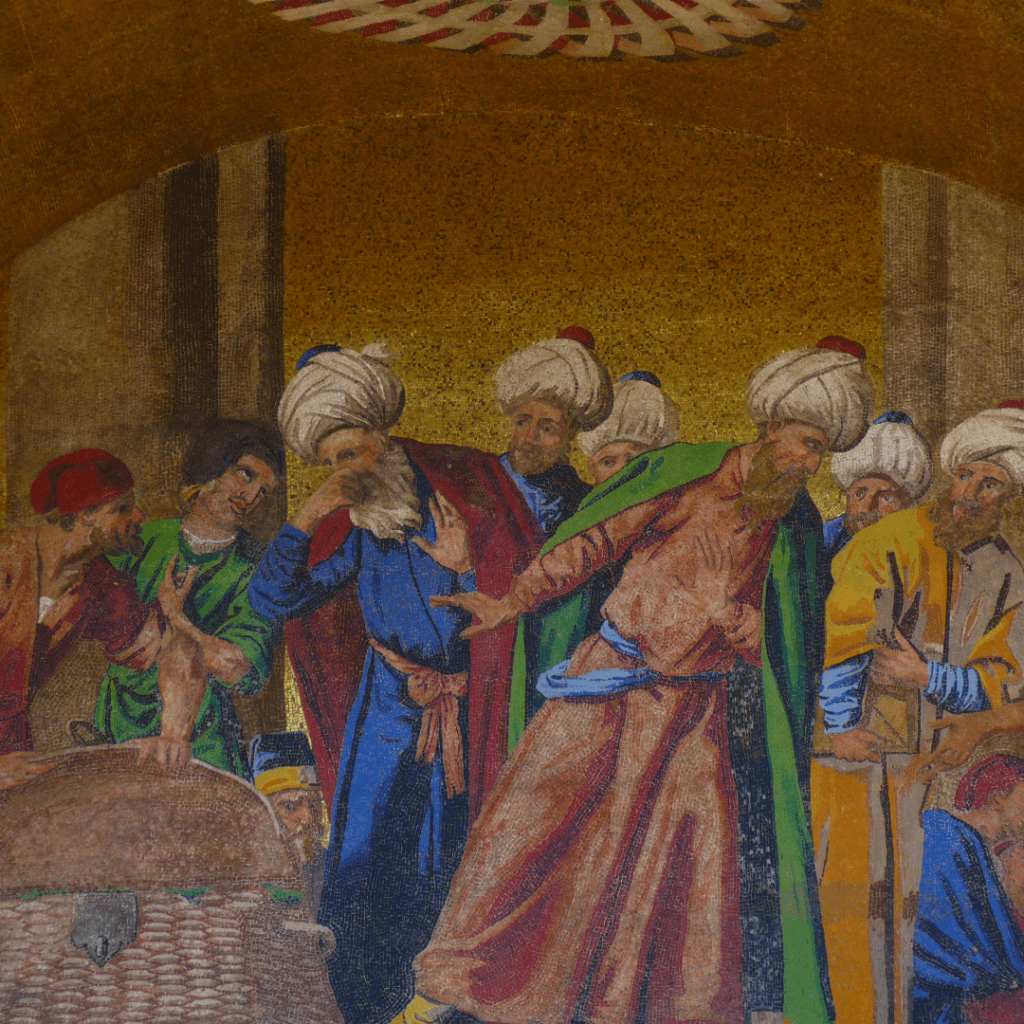
In one of the most unusual stories in all of Christendom, St. Mark came to Venice and the Basilica after being stolen from Islamic Alexandria in Egypt in 828 AD.
There was a legend that St. Mark during his ministry was in a terrible storm and had to seek refuge in what is now Venice. It was believed that Mark would eventually be buried in Venice.
The Venetians decided to build a Basilica in honor of St. Mark and bury him there. The issue? He was martyred in Alexandria (Egypt) and buried there.
That didn’t stop Venice.
In 828 it was decided to send a group of Venetians to ‘Rescuse’ (Steal) St. Mark’s Body from Alexandria. Their motives were pure in the sense they felt that The Muslim occupied Alexandria didn’t care about a Christian martyr and St. Mark deserved to be buried in Venice in a beautiful church.
In order to smuggle him out, The Venetians put Mark’s body in a vat of pork and snuck past the Muslim guards. Muslims do not eat pork and it is unlawful to do so – and so history goes…St. Mark eventually came to bodily rest in Venice
You can still visit his tomb in the basilica today and it is a major pilgrimage site.
- pilgrimmage site: a spot that has holy or cultural significance. In the Christian faith, many travel to holy sites where martyrs and/or saints are buried to pay homage and ask for them to pray for them. In Anglo-Catholic traditions asking the Saints to ‘pray for you’ means simply asking them to pray on your behalf to God who is the only one in charge. This is why so many European cities wanted to have a saint’s relics in their city and church.
This stealing/rescue of St. Mark’s body is told in splendid detail in mosaics in St. Marks (see below)
The symbol of Saint Mark is a Winged Lion.
Why a lion? Each of the Gospel writers is identified with a symbolic image. This comes from Prophet Ezekiel (1:1-21) and Revelation (4:4-6)
Mark is a Winged Lion
John is a Rising Eagle
Luke is a Winged Ox
Matthew is a Divine Man
You’ll see the symbol of St. Mark everywhere in Venice – it also is used as a symbol of the state.
- Fun fact: The Doges are meant to be humble servants of The Republic – you often see them kneeling before The Lion of St. Mark (aka – God and servant of God and people)

The Artistry of St. Mark’s
Venice, more than any other city in Italy as well as Northern Europe (including France) was as influenced by Byzantine art.
Venice as an extension of Byzantium. Even after declaring their independence they continued to trade extensively with Constantinople and the East.
It is also interesting to note that given Venice’s wet climate (it is in the middle of a lagoon) – that mosaics were often preferred because they glass in the mosaics was not as threatened by potential water damage like tempera.
St. Mark’s brough in skilled Byzantine glassworkers to create what is over 1.5 football fields worth of mosaic tiles.
Mosaic tiles are known as tesserae.
- Tesserae: a small block of stone, tile, glass, or other material used in the construction of a mosaic.
Venice perhaps by its Byzantine glass mosaic traditions became the leading Glass Makers in the world for many years – a tradition that remains to this day.
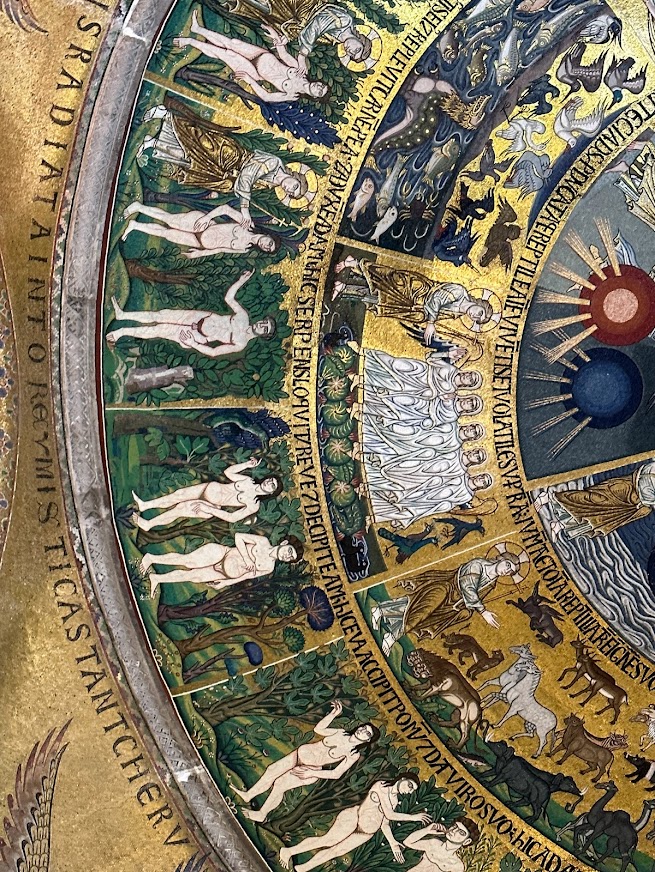
Byzantine Art has been dubbed by some as repetitive, especially after The Renaissance, but stepping into St. Mark’s you’ll find The Medieval style of Byzantine mosaics is anything but boring. It may not be as realistic as a photograph, but the images are filled with spectacular storytelling and you can easily read the scenes based on thematic symbols and visual storytelling.
On the panel above (my photo from January 2023) you see the story of creation to the fall of man through the Ark. Look at the animals and the dynamicism of the color and expression.
Byzantine Art was often meant to appear as a copy – because the church and state wanted to ensure that those who could not read or spoke different dialects in the Empire would be able to always recognize the message and stories from The Old Testament to The Gospels.
Renaissance Art has deep sacred symbolism too, but its also highly realistic.
The point of Byzantine art isn’t realism – it is storytelling and spiritual meditation. That is why even to this day may faithful Christians venerate (pray to God while pondering the icon’s story) with icons of saints and The Virgin Mary. Icons help call to mind the Biblical Story and lessons of God’s redemption in that story. Once you recognize that you’ll have a deeper appreciate of the art even if you are not of the Christian faith.
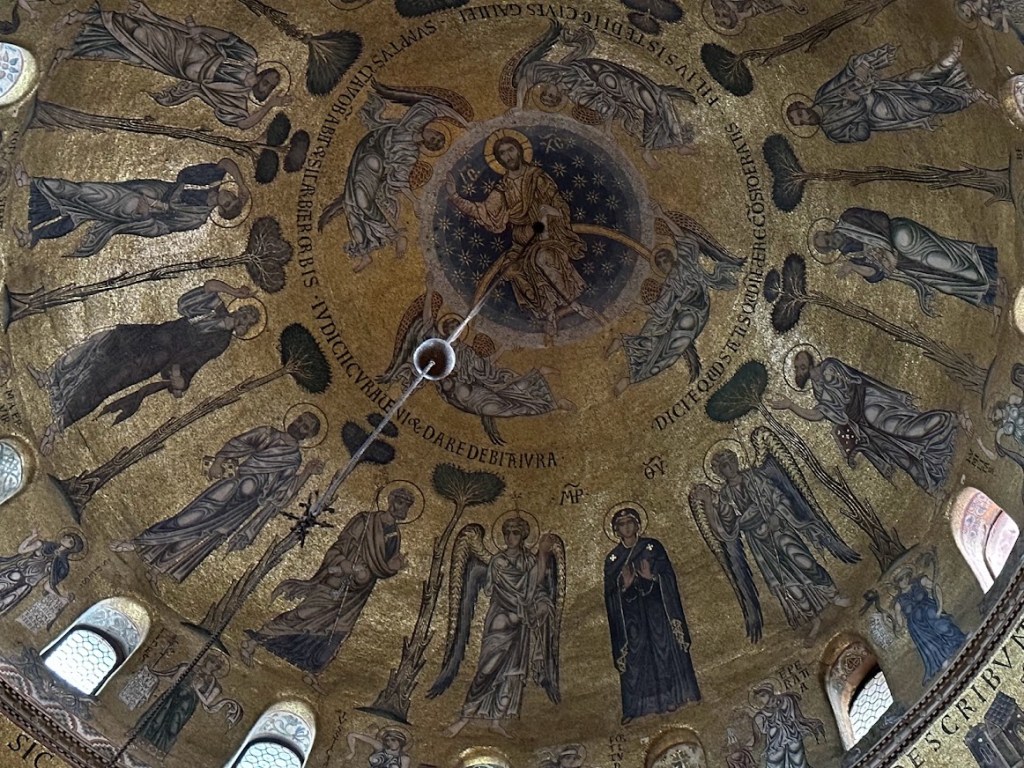
- One common theme you see, especially in Byzantine art is Christ Pantocrator – a seated crowned Christ giving his blessing it shows that he is the King of the Universe

Stolen from Constantinople
It is important to note that many of the treasures of St. Mark’s including the Our Lady of Nicopeia (Our Lady of Victory)icon and Palla d’Oro were stolen loot from Constantinople.
Venice and Constantinople had a love-hate relationship. Venice was strongly tied to the city of Constantinople and loyal trading partners until 1182 when the Emperor of Constantinople and Byzantium decided to target Venetians (called Latins) living in the city. Many Venetians lived and worked abroad in Constantinople for trade. The leader, Komenos, of Byzantium wrongly accused Venice of attacking part of Byzantium.
Many of the Venetians in Constantinople were killed or harmed.
While the successor to Constantinople sought to create a peace and work with Venice to make amends, this anger and need for revenge led to one of the most horrendous incidents in The Middle Ages – The Sack of Constantinople.
You can read the entire history here.
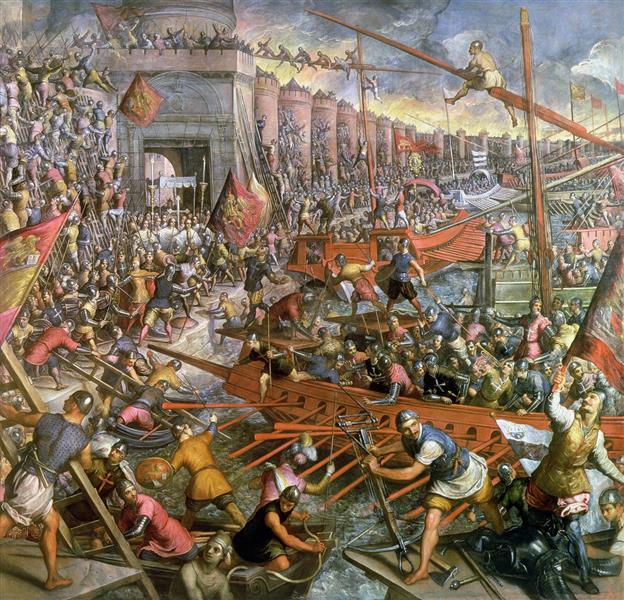
Essentially Venice joined the The Fourth Crusade in 1204 AD to free Jerusalem from Muslim occupation, it instead turned to Constantinople and sacked the city – taking jewels, religious icons and also destroying much of the infrastructure.
Constantinople never fully recovered from The Sack…it eventually fell to invading Muslim-Ottoman Turks in 1453.
Venice does not try to hide from this truth – and in all honestly this atrocious theft probably protected the art from later incursions Constantinople faced, but alas it is a sad and cautionary tale and reminder to both guard your hearts, but forgive your enemies.
The grand prize of this sack were the four horses of Constantinople, which were ancient Roman horses from the Hippodrome. You can read more about them here.
When planning your visit to Venice, I recommend you book your tickets for St. Mark’s ahead of time to avoid the line. I enjoyed a tour with a local guide and he provided a deep history about the church and mosaics.
I highly recommend taking a tour of The Treasury and Saint Mark’s Museum in addition to the main Basilica.
The Treasury contains priceless artifacts as well as reliquaries and holy items for the faithful to venerate.
The Chapel of St. Isidore – an early Christian saint who is buried in St. Mark’s is gorgeous
You can also view the amazing works by Venetian Renaissance sculptor and architect Jacopo Sansovino (we’ll talk about him in a future Masters of Venice)
You can see the original Horses of St. Mark (stolen from Constantinople) here as well.
To book your tour I recommend the official St. Mark’s website. I also like Viator for finding local tour guides.
Photos from my trip to St. Mark’s
Look at this gorgeous mosaic of the flood and the dove returning to the ark to tell Noah the floodwaters had receded. And the rainbow below showing God’s promise to never cover the earth in floodwaters again.


Next time, we’ll fast forward to the late Middle Ages and advent of the early Renaissance as we learn about master painters
Vivarini and Alemagna…
What to learn more about St. Mark’s?
I recommend these resources:
- Overview of St. Mark’s Basilica
- Wondrium.com’s Guide to Essential Italy (episode about St. Mark’s)
 Art Expeditions