
Last time on The Masters of Venice, we learned about the early history of Venice from it’s foundations as a city of refugees to the building of magnificent St. Mark’s Basilica.
- Recap:
- Venice was founded in 421 after the Fall of the Western Roman Empire. It was part of Byzantium (East Empire) fro 565 AD to 697 AD when Venice declared its independence.
- It began a system of elected government led by Doges, who served the people and Republic of Venice. The Republic of Venice lasted until 1797 when Napoleon took over by conquest.
- The early art of Venice was strongly tied to Byzanatium and the masterful mosaics and religious icons.
- They stole/rescued the body of Gospel writer St. Mark from Muslim occupied Alexandria Egypt in 828. (Mark was martyred there).
- The saint’s church, The Basilica of St. Mark’s – a Byzantine Romanesque church modeled after Hagia Sophia and The Church of the Apostles in Constantinople was consecrated in 1094 AD.
- We’ll continue to revisit St. Mark’s throughout the series as embellishments and additions were made for centuries. It is also such an artistic marvel you need to take in its mystic grandeur in small meaningful doses.
- 1204 – The Sack of Constantinople by Venice was a controversial act in The Fourth Crusade, which brought much of the treasures of Constantinople like the Hippodrome Horses and Our Lady of Nicopeia back to Venice and St. Mark’s Basilica.
- Venice became a maritime trading power and crossroads of information and connection from East to West
As you can see Venice’s history is anything but boring – it reads like a scene from a Netflix drama or HBO’s Game of Thrones.
Today we’re fast forwarding from the mid-Medieval period of 1204 AD to the 15th-century in Venice (circa 1430-40)…While The Renaissance had begun to bloom in Florence, at this time, Venice had not flowered into its own Renaissance quite yet. It was approaching it’s Early Renaissance movement – or The Late Gothic Period in Venice. This important period laid the groundwork for Venice to inherit the legacy of The Renaissance in the late 1400s-1500s.
Thinking about the Transition from Medieval to Renaissance:
It is important to realize that while we often group ‘The Renaissance’ into one central movement, The Renaissance was really many movements that were tied to interconnected movements and all rooted in the concept of humanism.
For example, the birth of The Renaissance in Florence eventually found its way to other parts of Italy, including Venice and beyond to Northern Europe. And from there the new ideas and concepts continued to spread back and forth in a period of a great exchange of ideas.
- Example: oil paint was introduced into Italy by way of Venice (and Naples) from Flemish territories, but linear perspective had reached Northern Europe through the exchange of ideas via Florence. This created a unique environment of innovation that had not been seen in this way since the Fall of Rome.
During the period of the late 1300s-mid 1400s, after Black Death had terrorized Europe there was a shift and a hope out of the darkness that humanity at its core had a goodness and unique ability to create amazing things because we are made in the image of God. While this might not sound revolutionary, you have to put into perspective that while The Middle Ages were a time of great learning, architectural and engineering feats…the instability after The Fall of Rome led to a different focus on art and society.
In Medieval Mondays we dive into The Middle Ages and the wonders of this era, because too often The Middle Ages is deemed ‘backwards’ and The Renaissance ‘progressive,’ which is too simple a viewpoint. The priorities and the way art was interpreted was different, but both provide a value and the art of The Renaissance was no doubt inspired not just as a refusal of the past, but a desire of a different perspective into the future.
The Renaissance is a rebirth in the sense that for the first time since the Roman Empire (Western Roman Empire pre 476 AD) was there this feeling of destiny to discover and design and grow towards perfection in humanity. The Renaissance went backwards in time to ‘rediscover’ works by early philosophers (pre-Christian) and artistic styles (Roman statues) to create a new foundation and appreciate of antiquity. This admiration of neoplatonic ideas was seen not antagonist to Christianity but rather, these were forebearers of truth – while pagan, they had truths about humanity and science that were relevant and could be appreciated.
- Interesting enough, this rebirth of Classicism actually has its roots in the Middle Ages with theologians and philosophers like Thomas Aquinas and others who sought to find value in Greco-Roman pre-Christian philosophers.
We’ll focus on this more in upcoming posts. If you are interested in the history side of the The Renaissance I highly recommend a book by Professor Ken Bartlett.
It is important to not simply see the end of The Middle Ages and beginning of The Renaissance artistic movements happen on a specific date. It often can fluctuate not only by region but the artist. Some artists could be grouped with their Renaissance peers (like Florentine Giotto, who worked in Padua near Venice) long before ‘The Renaissance,’ given their use of humanism and shift in style.
Today we’re going to focus on several important late Gothic-early Renaissance Venetian artists:Paolo Veneziano, The Vivarini Family and Giovanni d’Alemagna
Paolo Veneziano:
This 14th-century painter was active around 1333 to 1358 and is considered the “founder of the Venetian School”of painting.
He was the most important Venetian painter of the 14th century and his work led to the development of the elaborately framed Venetian style polyptych (composite altarpiece).
- polyptych:a painting, typically an altarpiece, consisting of more than three leaves or panels joined by hinges or folds.
He is the earliest Venetian painter known by name, mostly because he signed his works. While his style is still Byzantine it began to shift into the Gothic style, which was developing just north of The Alps (The Dolomites are the Alpine Mountain Range in Italy)
Veneziano became the official painter of The Venetian Republic and was the official painter of Andrea Dandolo (54th Doge).
He was heavily influenced by The Byzantine style as well as time he spent in Rimini where he saw other contemporary non-Byzantine styles of painting from the time.
He and his sons, Marco, Luca and Giovanni were involved with metalwork and enamel on St. Mark’s Pala d’Oro, but unfortunately most of their scenes was lost over time. Learn more here.
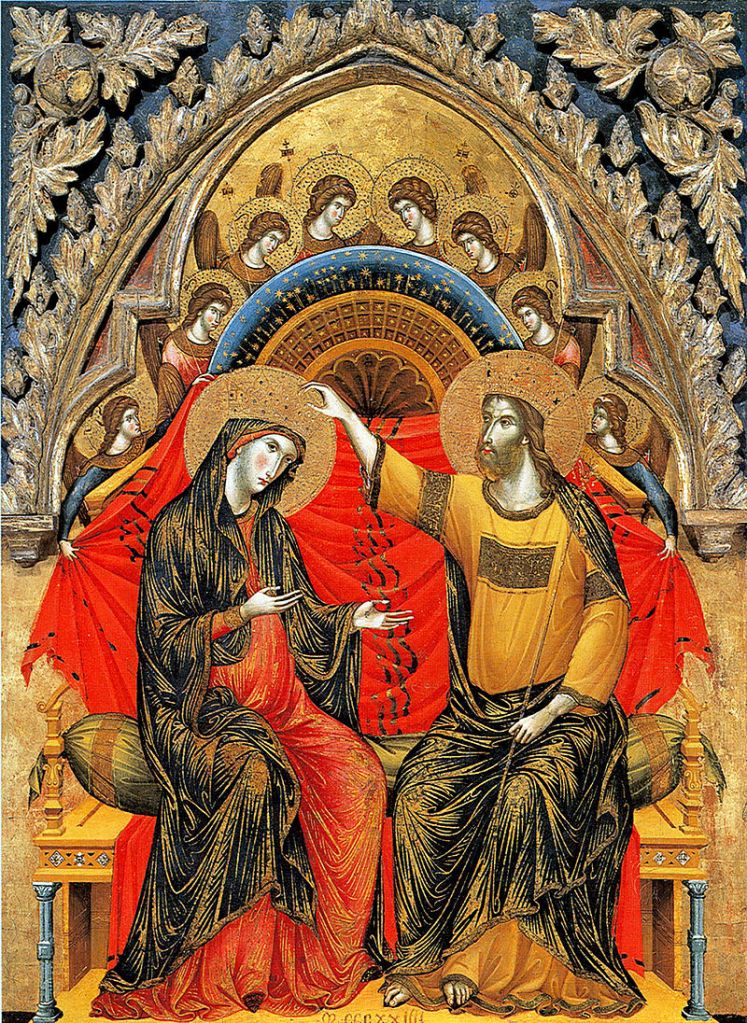
http://www.aiwaz.net/uploads/gallery/coronation-of-the-virgin-4620.jpg – credit National Gallery
The Vivarini Family of Murano:
The Vivarini Family are a late-Gothic-to-early Renaissance family of painters from the Venetian island of Murano.
- You may recognize Murano as the capital of Venetian Glass-Making…In the 1200s, all glass blowing was moved to Murano for safety concerns given the smelting furnaces 1000+ degree temperatures.
This family of painters emerged in the 1400s, becoming some of the most important artists in Venice.
- Antonio Vivarini (Antonio of Murano) came from the school of Andrea da Murano, who also worked with Antonio’s artist brother Bartolomeo. Antonio was influenced by renowned Italian painter Gentile da Fabriano, who painted in Venice from 1405-1420, before working in Florence and Rome. Fabriano is one of the most important painters of the late Medieval to early Renaissance.
Here is a picture of Fabriano’s work on display in The Florence Uffizi…in the image below you see a multitude of people, animals and vibrant emotions and perspectives. This is not a flat or stiff painting, but you are carried away with the scene. When I saw this painting at The Uffizi I was most struck by the cows who are in awe of the Baby Jesus – it is easy to see how Fabriano’s time in Venice influenced many artists in the city.

- Antonio Vivarini often collaborated with his brother in law, Giovanni Alemagna – who was of German descent.
This is a wonderful collaboration by Antonio Vivarini and his brother in-law Giovanni Alemagna of St. Francis and St. Mark at London’s Naitonal Gallery.
Key concepts:
- Sacra Conversazione (Sacred Conversation): Comes from the Italian meaning holy conversation. The idea of painting a scene with multiple saints from different periods of time who enter into scenes together where they converse with each other and use. It is a spiritual reminder that we are all part of the body of Christ as a church. This also was a tool to invite you into the mysteries of the divine story – and God’s grace and the saints ability to persevere over doubt and temptation. You’ll see this them over and over again in religious art.
- It is oftern applied to an altarpiece in which attendant saints are grouped in a unified space around the Virgin and Child.
- Scuola: School in Italian, but in Venice and other city-states this usually was a fraternal organization…Many of the scuolas were tied to a specific industry or interest; they usually worked on social projects like helping the poor – in Venice the scuolas were one of the biggest benefactors of art

Bartolomeo
- Bartolomeo was Antonio’s brother and was equally talented. He learned oil painting from Antonello da Messina, who was originally from Messina and Naples. Antonello also influenced and worked with The Bellini Family (the topic of our next class)
- In 1473, Bartolomeo is said to have produced the first oil painting done in Venice for the church of San Giovanni e Paolo. The large altarpiece in nine divisions represents St. Augustine and other saints. You can still visit this beautiful church in Venice today.
- Fun fact: The Church of San Giovanni e Paolo is named for Saints John and Paul – but not the Biblical Gospel Writer and Evangelist…instead these were obscure martyrs from persecutions in Rome.
- Much of Barolomeo’s work can be seen at The National Gallery in London
- Vivarino means ‘goldfinch’ in Italian and while this is an important symbol in Christian art (rebirth, passion) – it is sometimes included in Bartolomeo’s paintings as a signature of his family name.
Bartolomeo has two works featured at The Frari Church in Venice (also home to works by Sansovino and Titian!) You can learn more about the church here.
Notice the Sacred Conversation taking place here… Mary is fully focused on Jesus – which was to remind the viewer to look to Christ as did Mary, whereas you have St. Paul with his sword on the right panel in deep conversation.

Alvise Vivarini
Alvise Vivarini was born c. 1446 and was the son of Antonio. (He was also known as Luigi) His best executed work was for the Scuola di San Girolamo in Venice, representing the saint caressing his lion. He has other works in Treviso and Milan. The painter Marco Basaiti was one of his pupils.
In Alvise’s work at The Frari Church in Venice, you will be astounded by his detail in the Sacred Conversation in ‘St. Ambrose and other Saints.’
In religious art, saints are often identified by unique repetitive symbols. For instance in this painting you see the arrows protruding from St. Sebastian (a Roman martyr who survived flaming arrows before his eventul martyrdom).

Next time we’ll learn about The Bellini Family and their influence on the transition to The Venetian Renaissance
Don’t forget to subscribe below to stay in the loop about The Masters of Venice
The Masters of Venice and Art Expeditions is curated by Art Expert and Virtual Art Guide, Adele Lassiter.
 Art Expeditions

[…] Masters of Venice: Early Years – Veneziano to Vivarini Family and Alegmagna — Art Expeditions […]
LikeLike
[…] of The Venetian School, Veneziano as well as early Renaissance (late Gothic) Venetian painters The Vivarini Family and Alemagna. Click here for the last […]
LikeLike