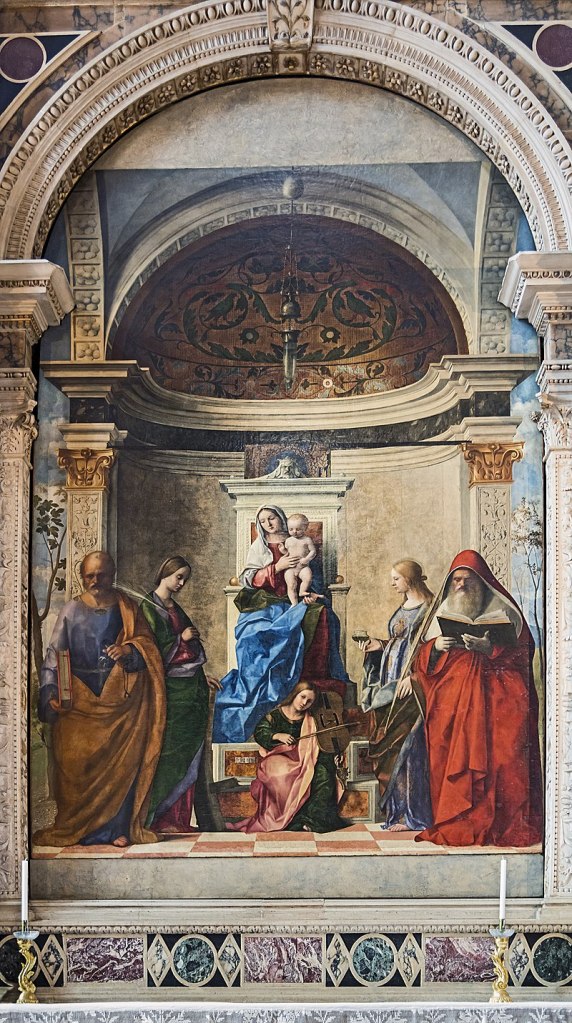
A recurring theme in throughout Renaissance Art is a concept known as the Sacra Conversazione, Italian for Sacred Conversation. It’s roots can be traced to The Middle Ages, but the concept of genre painting around ‘Sacred Conversations,’ became highly sought after during The Renaissance.
Much of Medieval and Renaissance Art was focused on religious storytelling. This was due to:
- The church was the leading patron of the arts as it invested in altarpieces, church sculpture and devotional art to adorn churches
- The state also invested in religious themed art, often to invoke the graces of God and humble the state (in theory) before God.
- Most Europeans were faithful and private donors/patrons of the arts, would commission paintings, altarpieces, triptychs, icons, etc…for personal devotion or their own private chapel.
Religious art is about TRUTH, but the definition of Truth in religious art goes beyond realistic interpretation of time.
For example: At the crucifixion, St. John and the Blessed Mother Mary were there, but in The Sacra Conversione or religious art, you might at St. Francis and St. Catherine of Siena because while they were not physically at The Crucifixion, spiritually they are venerating Christ’s sacrifice and drawing us into the scene.
Much of The Bible (Hebrew Scriptures and New Testament) is about spiritual truths and inviting the reader into the scene to meditate and ponder their role in relationship to God. This can be frustrating for those who want to portray art from a purely literal interpretation or criticize because the TRUTH the painting represents is supernatural in style.
Art challenges us to think beyond what is directly in front of us and look at TRUTH from multiple perspectives and being drawn into a conversation with the art.
This art is meant to incite the faithful to meditate on the mysteries of God and be in a ‘conversation’ with multiple saints throughout history. Because in the Mass it is believed that all of the Saints of Heaven and faithful on earth are united in the Eucharist.
Common themes of the Sacra Conversazione:
- The Virgin Mary is usually at the center of the painting holding The Christ Child
- The Blessed Mother typically is adorned in blue (royal color) and red (symbol of her sorrows and Christ’s Sacrifice).
- Mary may be in ‘conversation’ with the saints – engaging them as she speaks to The Christ Child or she and the saints may be together, and yet separate – in deep thought and prayer.
- In the Sacra Conversazione the audience understood the language of the paintings. Once you learn the language of the Sacra Conversazione you will begin to develop a deeper appreciation for the art because it is not just about what you see, but also the deep symbolism and call to spiritual action and medition the paintings provide.
- Examples:
- The saints each have recognizable and repeating attributes that clue you into the ‘conversation’ depicted.
- St. Peter is always seen with keys (a set of keys) because Christ gives Peter the keys to ‘the kingdom’ in Matthew 16:14-19.
- St. Paul is seen with a sword
- St. Catherine of Alexandria – a Wheel because she was tortured and martyred with a wheel
- St. Sebastian is covered in arrows because he endured flaming arrows before his martyrdom
- St. Jerome usually has a long beard and carries a book because he was very learned and was the first to translate the Bible into Latin
- Often you’ll see the donors (patrons who funded the painting) included in the scene as pious and humbly praying with the saints and Mary to Christ.
- This is unique because it not only brings together the heavenly saints, but also invites everdya citizens to be in the crowd with the saints – this is not just a party for the perfect – but an invitation for sinners and saints alike to reflect on God and the mysteries of his creation.
Many of the artists during this time were acutely aware of theology and symbolism. Artist’s like Giovanni Bellini (painting at top of post) were not just fantastic painters in the Renaissance focus of linear perspective and a new realism in structure – but also masters of storytelling and bringing both the real and mystical together in painting.
Though the theme of Sacra Conversazione is constantly recycled it is hard to tire of it, because each painter offers a different and unique perspective to their work. They might focus on a different saint, or aspect of that saint’s life and suffering.
Bellini, who was known for his Madonnas, painted the subject many times, but each painting is fresh because it is like a photograph that captures a different angle of the story and timeline – each work engaging us in new ways.
As a person of faith, I enjoy contemplating with the paintings. How would I handle the trials of losing my child (Mary); How often I can be like Peter – faithful and resolute, yet insecure and scared.
For faithful and non faithful alike, these paintings draw you into contemplation and conversation with the scene.
The paintings are like novels, each color and detail a chapter telling a story and inviting us to become part of that conversation.
If you are interesting in learning more about The Sacred Conversation, I recommend
The Secret Language of the Renaissance – you can purchase it from the National Gallery of Art (DC) here or from your local bookseller.
It gives you a detailed window into the symbols of Renaissance art.
I have learned a lot about recognizing symbolism from curiosity. If I go to a museum and see that the painting has St. Sebastian with arrows, I do a search on the saint. I know have begun to recognize St. Sebastian and other saints in paintings immediately because I understand the ‘artistic language.’
Our featured painting:
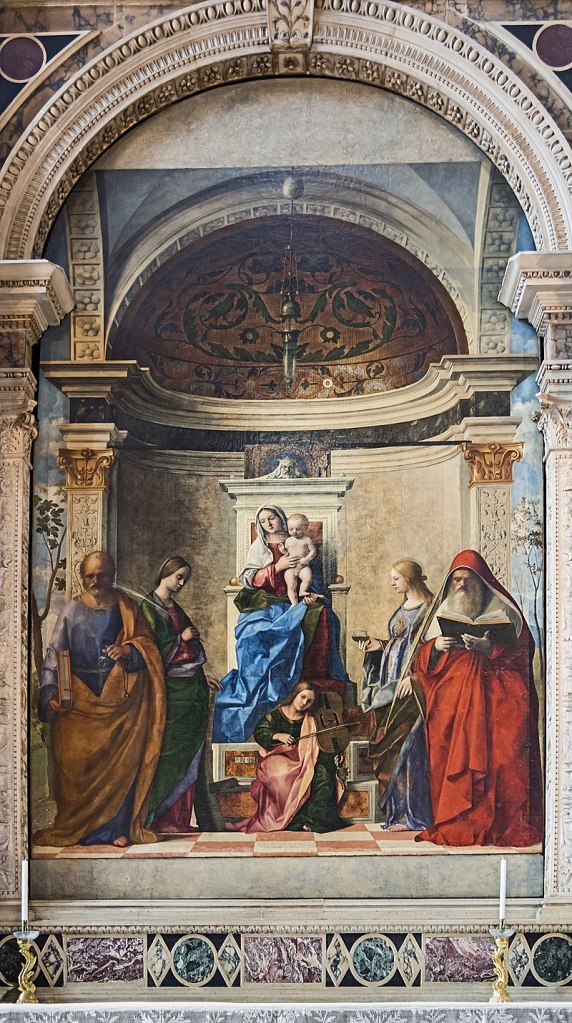
The Sacra Conversazione by Giovanni Bellini
We’ll be learning about Giovanni Bellini and his artistic family in the Masters of Venice Course (click here to take the course for FREE)
He was a Venetian painter who was known for his masterful and insightful paintings of religious art – including his Madonnas and Sacra Conversazione. Each Madonna and Child or Sacred Conversation piece is uniquely and sometimes wildly different. It is interesting how artists across time periods, often paint the same topics or landscapes over and over again – but each time with a unique vantage point (think about Monet in Impressionism).
Repetition is not always boring, because in life each scene has so many different depths it is fun to see how each painter recounts the same story. The foundation and spiritual (or emotional truth) is the same even if the subject is portrayed in different ways.
Themes of Bellini’s Sacra Conversazione:
This is located in the Church of San Zaccaria in Venice. St. Zachariah (St. John the Baptist’s father) is actually buried in this old Venetian Church.
- In this work by Bellini all of the individuals are aware of one another, even though they span from across different eras of Christendom.
- The viewer feels as though they are part of the painting and scene, with Bellini carefully creating the perspective and details to draw us into the ‘conversation’
- This painting is part of the altarpiece where the Eucharist is consecrated. A moment in Anglo-Catholic traditions where the Eucharist become the body and blood of Christ. At this moment all of heaven opens up for ‘communion’ with The Holy Trinity. This therefore isn’t just symbolically depicting saints from different times in a painting for the sake of it, but actually reminding the faithful that in the Mass, all of heaven and earth are united via the communion table.
- No matter your faith, seeing how art reflects this spiritual story is remarkable and to me only adds more depth to the beauty and nature of Bellini’s work.
Can you figure out which saints are which?
On the left we have St. Peter who is identified by his ‘keys’
Saint Catherine of Alexandria – a popular Renaissance Saint who lived in early Christendom is identified by her wheel (tool of her martyrdom)
Mary is the Queen of Heaven and holds Christ.
Mary is often shown with long fingers able to intercede on our behalf as she did at The Wedding of Cana.
On the far right is Jerome – his thick beard and book reveal his identity. Jerome is often seen with a lion – based on the story he tamed a lion who became a companion to the saint (this is not depicted here)
In between Mary and St. Jerome you’ll find St. Lucy. She is often identifed with a crystal (glass) or her eyes on a plate because it is said her eyes were removed by her persecutors because of her Christian faith. St. Lucy is the patron saint of the blind (and salespeople)
- You’ll also notice in this image how Bellini brings heaven down to earth by having this glorious throne surrounded by a doorway/windows to earthly attributes like trees. Another symbolism of heaven and earth uniting in the Eucharist and our invitation to join in this Sacred Conversation.
We’ll continue to explore this artistic theme on Art Expeditions, but before we sign off today, here are a few of favorite Sacra Conversacione scenes.

It the above image, you see how this Venetian artist brings the local Alpine countryside from the nearby mainland into his scene as Mary crowns one of the saints and St. Peter is scene with his keys.
I love how engaged with the audience Mary is in this scene. She is not afraid to speak with those around her and shws a warm personality.


Another example of Giovanni Bellini – knowledge how different this Sacred Conversation is from the altarpiece. You can discover this painting in Venice’s Accademia Galleria.

Don’t forget to SUBSCRIBE for more ART and Travel
Adele is an art history buff who has traveled to countless museums and enjoys sharing her passion for travel, history and art with others. In addition to runninng Art Expeditions and sister blog American Nomad, she is an artist and author (Solitude Lake – Adele Darcy pen name).
 Art Expeditions
[…] especially for his many Madonna’s and altarpieces. We learned a bit about Giovanni in the feature lesson – Sacra Conversazione, and how artists like Bellini used a scene of multiple saints […]
LikeLike
[…] is a more traditional painting by Giorgione, invoking The Sacra Conversazione (click here to learn more), with the Madonna enthroned with baby Jesus and surrounded by […]
LikeLike