Today on Renaissance Wednesday we’re going to learn about one of the most important sculptors of The Renaissance – Donatello.
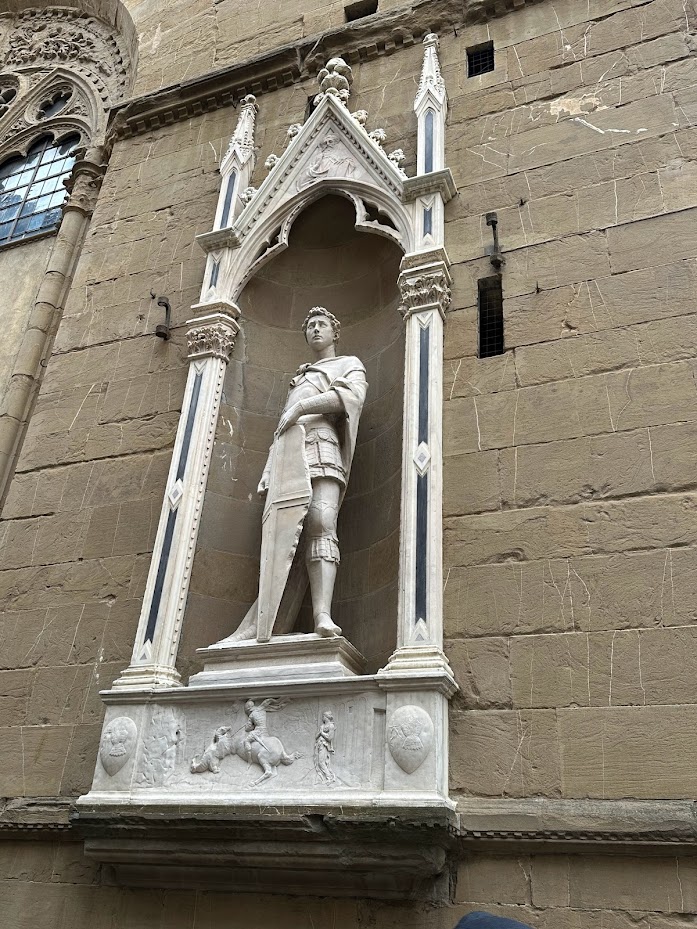
I was blessed to see several works by Donatello during my visit to Florence, including his famed St. George, which is housed in the Orsanmichele Church Museum.
If you are a fan of Teenage Mutant Ninja Turtles – no doubt you’re family with the name Donatello (each of the turtles was named after a Renaissance artist), but who was Donatello in real life and why was he important?
Born in the city of Florence in 1386, he studied in the House of Martelli family and trained in a goldsmith’s workshop before working in Ghiberti’s study (our last Renaissance Wednesday introduction).
Ghiberti asked Donatello to assist him with the statues of the prophets on the north Baptistery Doors.
Donatello developed a friendship with the older Brunelleschi (inventor of linear perspective and architect behind the Florence Duomo).
Brunelleschi invited Donatello to go to Rome in 1403 where they specifically studied architectural ruins to learn and improve their craft. This return to Classical study and learning from the past no doubt influenced Donatello in his work and movement as a key player in The Renaissance movement.
One of his major commissions was working on the colossal seated figure of St. John the Evangelist, which ws once in the Cathedral in Florence until 1588. It is now visible in the Opera dell Duomo Museum near the Florence Duomo.
Donatello collaborated with architect Michelozzo on the funerary monument of the Antipope John XXIII, which is in the Florence Baptistery. (To learn more about the ‘antipopes’ click here)
Donatello’s detailed and masterful style that melded classical inspiration with a natural realism made him a high in demand sculptor throughout his life.
He was commissioned to create works outside of Florence including:
- Pisa: marble relief for funerary monument of Cardinal Brancacci at church of Sant’Angelo a Nilo in Naples (1427)
- Siena: He executed a relief of The Feast of Herod and the statues of Faith and Hope for the Baptistery of San Giovanni in Sienna.
- The Feast of Herod is mostly stiacciato – a very low bas relief, with foreground figures done in bas-relief. It is one of the first examples of one-point perspective in sculpture. Read more here.

- During the period 1425-30, he worked on his masterpiece the Pazzi Madonna – a rectangular marble bas-relief – also in stiacciato. It is now in the Bode Museum in Berlin.
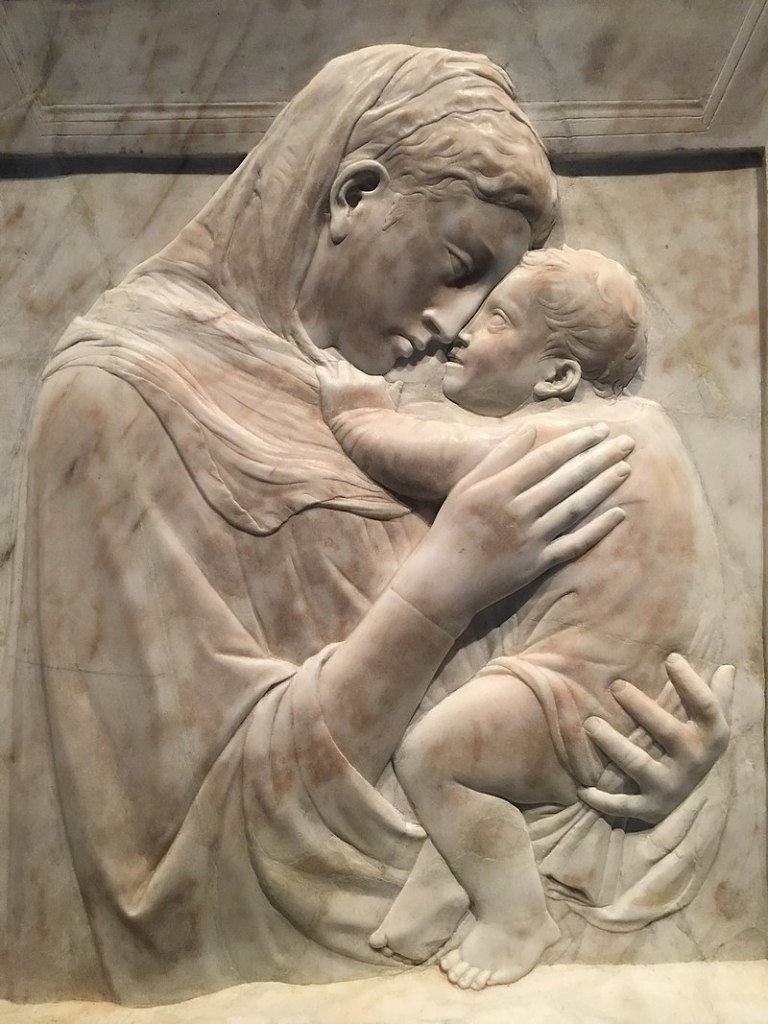
Stiacciato: Stiacciato relief is an extremely subtle type of flat, low relief carving that is especially associated with the 15th-century sculptors Donatello and Desiderio da Settignano. The design is partly drawn with finely engraved chisel lines and partly carved in relief.
In addition to his own works, Donatello was entrusted to restore antique sculptures that were collected by The Medici Family.
The David:
Donatello is best known for his work on David, which was commissioned by Cosimo de’Medici (il Vecchio) around 1434.
Preceding Michelangelo’s David, Donatello’s Bronze David is the first known free-standing nude statue produced since antiquity.
This David has a playful and youthful look and in an unusual choice by Donatello, the nude is wearing a hat and boots. This speaks to me as David’s innocence by God’s grace as the anointed one. He may be ‘naked’ but he is armed and prepared for battle – not by armor but perhaps the boots and hat -which could symbolize ‘helmet of salvation.’ This is speculation, but that is what great art does – it invites you into a conversation and to ponder the art.
The Donatello David is in the amazing Bargello Museum in Florence.

Later in his life, Donatello was in Padua where he designed several altarpieces for the Basilica of St. Anthony

Donatello died in 1466 and is buried in San Lorenzo Church in Florence, which was the main church of The Medici Family.
Thanks for joining us on this Art Expedition.
Don’t forgot to subscribe for updates. You can also follow Art Expeditions on Facebook.
 Art Expeditions