
Today on The Masters of Venice we are going to meet one of the most important artists to come out of The Venetian Renaissance – Giorgione.
Born circa 1473 in the Castelfranco region of Veneto, roughly forty miles from Venice, Giorgione emerged as an innovator of style and depth within his lifetime. Sadly, this ‘Master of Venice,’ only lived until he was thirty-six when he died from an outbreak of plague and yet his artwork continues to impact us today.
Contemporary art historian, Baldassare Castiglione, wrote in his 1516 “Book of the Courtier” that:
“(Giorgione was) one of the greatest artists of his age, along with Leonardo da Vinci, Mantegna, Raphael and Michelangelo.”
In 1548, Venetian theorist Paolo Pino called Giorgione “the painter of poetic brevity, as the inventor of new Venetian mode of creation.”
Artist and the first Art Historian of The Renaissance, Vasari said: “the artist ho introduced the style of The High Renaissance to Venice.”
It is evident that Giorgione was beloved and admired as an artist in his lifetime and beyond, but what made his work so revolutionary and unique?
- He was one of the first Venetian artists to paint pastoral and mythological scenes. His art was intended to a sort of visual poetry – that fused intellectual meaning as well as lyricism in paint. His work spanned from religious themes to work that was mean to simply refresh and delight the viewers senses.
- Trained by The Bellini brothers, who began to delve into pastoral scenes and backdrop as a character in the painting, Giorgione built upon this foundation and perfected it. According to Washington’s National Gallery: “For Giorgione, more than any artist before him, the landscape became an end itself. It was no longer a mere backdrop to the action of the figures but an equal actor in creating his poesia (poetry.”
- Giorgione is one of the first ‘mood painters.’ He was able to cultivate use of light and dark shadowing that is blended in a way similar to Leonardo Da Vinci’s sfumato technique. In fact, Giorgione met Leonardo when we came to Venice
- Giorgione was one of the first artists to work directly on the canvas or medium without detailed preparatory drawings. His colleague and successor in vision, Titian, continued this ‘al primera’ – right on the canvas technique.
- Interestingly enough you can see how he painted over and redesigned the painting in progress – something the new medium of oils at the time allowed. This could not be done in fresco
- As an artist myself, I also paint al primera and have often found myself repainting or tweaking because the idea is you can fix or repaint as you go. The viewer usually cannot tell, but radiographs and x-rays reveal the changes which is interesting to understand the process of artists like Giorgione.
- Canvas over wood panel- Giorgione favored canvas over wood panel, a marked shift at the time, although today canvas is the primary choice when paintinng.
- The woven canavas enouraged a looser pattern of brushwork and made it easier to create detailed, yet nuance scenes.
Quick Biography:
Little is known about the details of Giorgione’s life outside of his work on art projects.
Born in the mainland town of Castelfranco in The Veneto region in 1473 (mainland area around Venice), Giorgione moved to Venice where whe studied and worked in the The Bellini Studio and learned much from Giovanni Bellini.
Bellini’s influence in style, landscape and pastoral mood are clearly seen in Giorgione’s style. Giorgione took the lessons from Bellini and further moved them to the next generation of painting technique.
He was also influenced by Antonello da Messina (who helped introduce oil paint to Venice)
In addition to his work as an artist, he loved music and was a musician.
- Fun fact: Venice was the first city to open a public opera house and the amazing Baroque musician, Vivaldi was from Venice (he composed The Four Seasons)
In Bellini’s studio he met and began to work with the artist Titian, who became a close friend. Titian finished several of Giorgione’s works when he died and they no doubt collaborated as friends and colleagues. There is some debate as to which paintings Giorgione was majority painter on or Titian (depending on date of the painting).
Giorgione died at age 36 when an outbreak of The Plague killed him suddenly.
Titian took up his remaining commissions and paid tribute to Giorgione in several of his own works.
Art of Giorgione
Only six paintings remain that are firmly attributed to Giorgione alone, but around fifty that he worked on or was the sole painter on. We’ll go through a few of his important works here:

This captivating painting is unique for The Italian Renaissance, which sought to unite beauty and realism. Why many Florentine painters would take subjects like ‘the old woman’ and somehow keep an edge of glamor with the realism, Venetian artists like Giorgione were less concerned with this.
Venetian artists were influed by Northern European painters who focused on perspective and depth, but were less concerned with the perfection of ‘beauty’ in the subject.
Giorgione’s old woman speaks to us with a voice of fortitude that she is not ashamed of her old age, but let it be a warning to ‘number your days.’ It is an allegory of old age and the passing of time as death will greet everyone eventually. The sheet she carries contains words that appear to said (in Latin) – ‘with time.’
The woman is old, but Giorgione takes care to make her humanity shine through. You can see the veil of her youth behind the aged face and that though she has carried burdens, she also has a confidence and understanding of her fate. If anything she is simply providing wisdom – life is short and you will get older.
- It has been speculated that Giorgione was influenced by Albrecht Durer’s 1507 Avarice which was produced with the German master artist visited Venice.
- Some suggest that this painting was seen by Michelangelo during his trip to Venice and it may have influenced his interpretation of his Sistine Chapel ceiling.
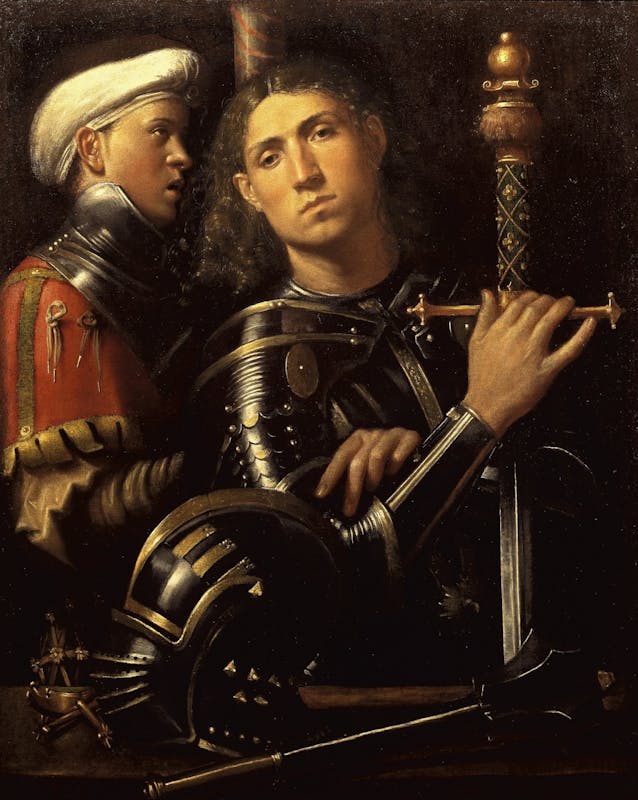
This armored figure is quintessential Giorgione as he creates what I call a softer realism in the face. This looks like a person we could have a conversation with and yet it doesn’t have at that stark realism you see in other contemporary paintings. This work is at The Uffizi in Florence. Learn more here
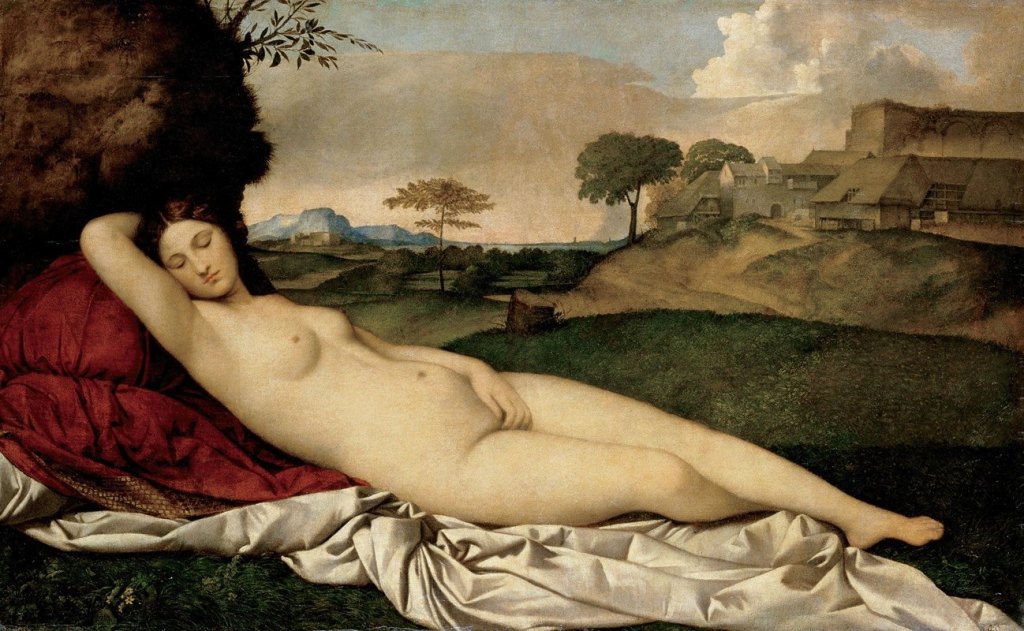
This mythological painting moved past with works by Florentine masters like Botticelli (Venus) to create an entirely new brand of mythological interpretation. This painting included Titian’s own sleeping Venus and eventually Manet’s Olympia.
Looking at this work, the nudity i snot mean to incite alarm, but is soft in reflecting the beauty of the human form. The landscape is just as much of a character in this scene as is Venus herself.
- This is the first reclining nude in Western painting
- It established the mythological pastoral, a standard of art for years to come.
- Titian may have helped finish the details on this painting after Giorgione’s death.
- The Painting is in The Dresden Museum
- There has been much scholarly debate about the symbolism of this painting and it’s meaning.
- One interpretation is that the ‘sleeping Venus’ has succumbed to sleep because she is dreaming about a past – something was loss in the reality of the world around her and she sleeps to remember or symbolize a longing to return to what was lost.
- What do you think?

This remarkable painting, housed in Venice’s Accademia, is an allegory without a clear meaning. To me I see nature and life vying for our attention. Humanity in the painting is at the forefront and yet the true star is the landscape. According to a lecture by art historian William Kloss on Wondrium, this may be the first time that lightning was painting in a natural landscape.
I see the gentleman in the left hand corner as confident in his station and ready to take on the world, and yet the lightning would indicate that nature is far more powerful than the human will to simply master nature.
The woman is perhaps showing virtue of motherhood and service, but this has been debated.
The man and the woman do not interact and it has been theorized that are oblivious to one another.
You have to search out certain details in this painting – a tiny stork way in the distance on the top of building in the back near the lightning can be seen if you squint. Storks in The Renaissance often symbolized a mother’s love for their child.
Lord Byron said this was his favorite painting (he spent time in Venice in his controversial exile from England) because the viewer could make up their own tale.

The Madonna and Child Between St. Francis and St. Nicasius is more commonly referred to The Castelfranco Madonna. Located in Giorgione’s hometown of Castelfranco, the altarpiece was created around 1504 and is in its original setting (a side-chapel in the Cathedral of Castelfranco)
This is a more traditional painting by Giorgione, invoking The Sacra Conversazione (click here to learn more), with the Madonna enthroned with baby Jesus and surrounded by saints.
St. Nicasius was a Sicilian who was martyred by the Sacracens and a popular Italian saint at the time. Learn more here.
What is unique and quickly mesmerizes the viewer is how high the throne of The Virgin Mary is compared to the saints below. She is clearly looking down on them in love and as a friend and mother, and yet it reminds the viewer of the uniqueness of The Blessed Mother above the other saints, given her call to be The Mother of God.
Giorgione is clearly versed in his theology and builds on the tradition of having a ‘conversation’ between saints and The Blessed Mother in heaven as a reminder that we have heavenly help before God to intercede for us. The religious art of the time was meant to stir the viewer to deepen their ‘conversation’ aka prayer with God and understanding the mysteries of the faith.
Giorgione’s death sent shock waves in Venice and his paintings became hot ticket’s in the city.
In our next post we’ll discuss the Legacy of Giorgione as his death passed the torch and enflame the destiny of one of the greatest painters in history – Titian.
Don’t forget to subscribe for blog updates.
We are also on facebook
Art Expeditions is the passion project of Art History lover, Adele Lassiter. If you want to support our mission in art history education consider supporting our Patreon page.
 Art Expeditions