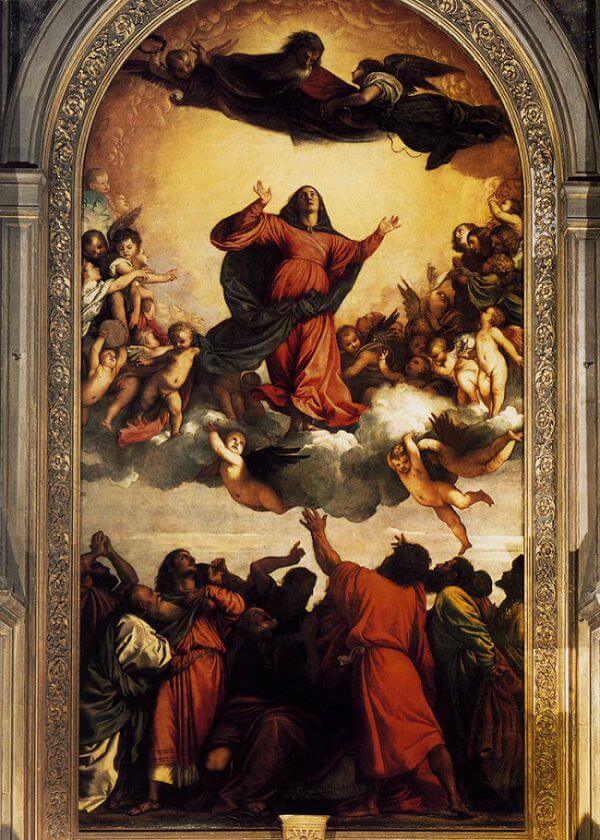
Today on The Masters of Venice, I’m excited to feature one of my favorite painters – a master of color, light and storytelling – Titian.
The art theorist Giovanni Lomazzo declared him “the sun amidst small stars non only among the Italians but all the p
Born circa 1488 in the small village of Pieve di Cadore, eighty miles north of Venice near the Italian border with the Austrian Alps, Titian showed an early talent for art. His father, Gregorio and mother, Lucia arranged for Titian (aged nine) and his brother Francesco to move in with their uncle in Venice, where Titian could apprentice with master of mosaics, Sebastiano Zuccato.
Titian then began to study in the Bellini Family studio, and was taught by Giovanni Bellini who heavily influenced the young Titian. In our feature on The Bellini Family we learned that Gentile and Giovanni Bellini were among the first Venetian painters to use oil paints and paint pastoral scenes, as well as mythological and religious themes.
Titian also studied and worked with another Bellini protege, Giorgione and they developed a High Renaissance style as they worked in tandem of a fresco cycle on the exterior of the Fondaco dei Tedeschi (Warehouse of the German merchants). These frescoes unfortunately disappeared in the Venetian humidity and dampness of the city. (Venetians often preferred mosaics to fresco because of the destruction of fresco by Venice’s water and humidity). A few pieces of this collaboration can be seen in the Ca D’Oro Museum in Venice today.
With Giorgione’s tragic death from the plague at thirty-three years old, Titian inherited Giorgione’s incomplete commissions including Giorgione’s famed ‘Sleeping Venus.’
Early in his career, Titian emulated Giorgione so well there is often debate about which artist originated the work and if Titian assisted Giorgione on popular pieces like The Adoration of the Shepherds (National Gallery DC)
Titian, however quickly came into his own to become an international art superstar and the most important Venetian painter of the 16th-century.
Titian was adept at painting numerous themes from pastoral landscapes and allegories to mythological sequences, religious art and portraits.
He is one of the finest portraitists of the High Renaissance, and was sought after as a portraitist by nobles from across the Italian city-states and Holy Roman Empire.
Titian, like Bellini and Giorgione before him painted works with mythological subjects for domestic settings. These mythological paintings often referred to a poem or classical allegory and were usually commissions by wealthy patrons or state governments.
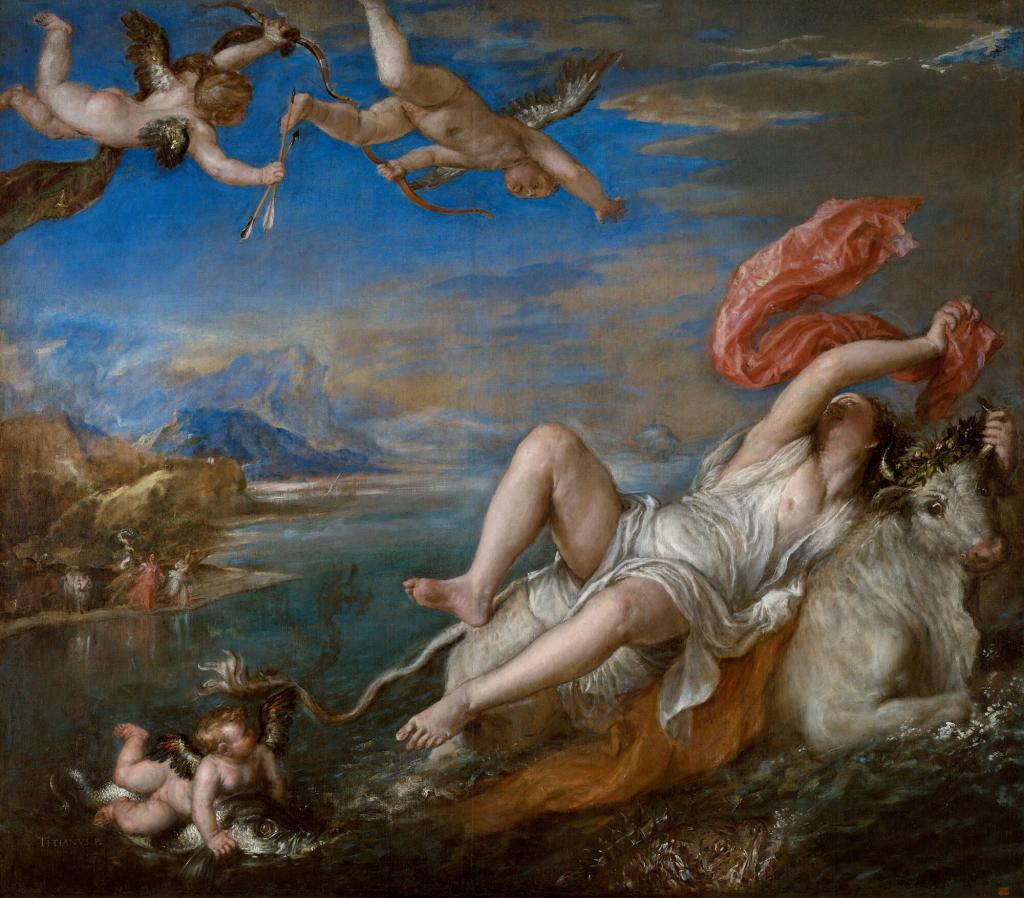
Titian called mythological subjects poesie – likening them to visual poetry. Many of his poesies were inspired by popular poets of the day. One of his most famous poesies is The Rape of Europa, which was a legend of Ancient Rome that is often repeated in sculpture and painting. (In myth rape usually means abduction – i.e. the rape of the Sabine women, who were abducted…not great, but helps understand context in Renaissance works) Titian was one of the first to capture the theme of The Rape of Europa it in The Renaissance.
One of Titian’s most important mythological sequences is a commission for Duke Alfonso d’Este of Ferrara in 1518. Duke Alfonso was from the area of Ferrara (an independent city-state) southwest of Venice in Northern Italy.
- Fun fact – Alfonso married the infamous Lucrezia Borgia
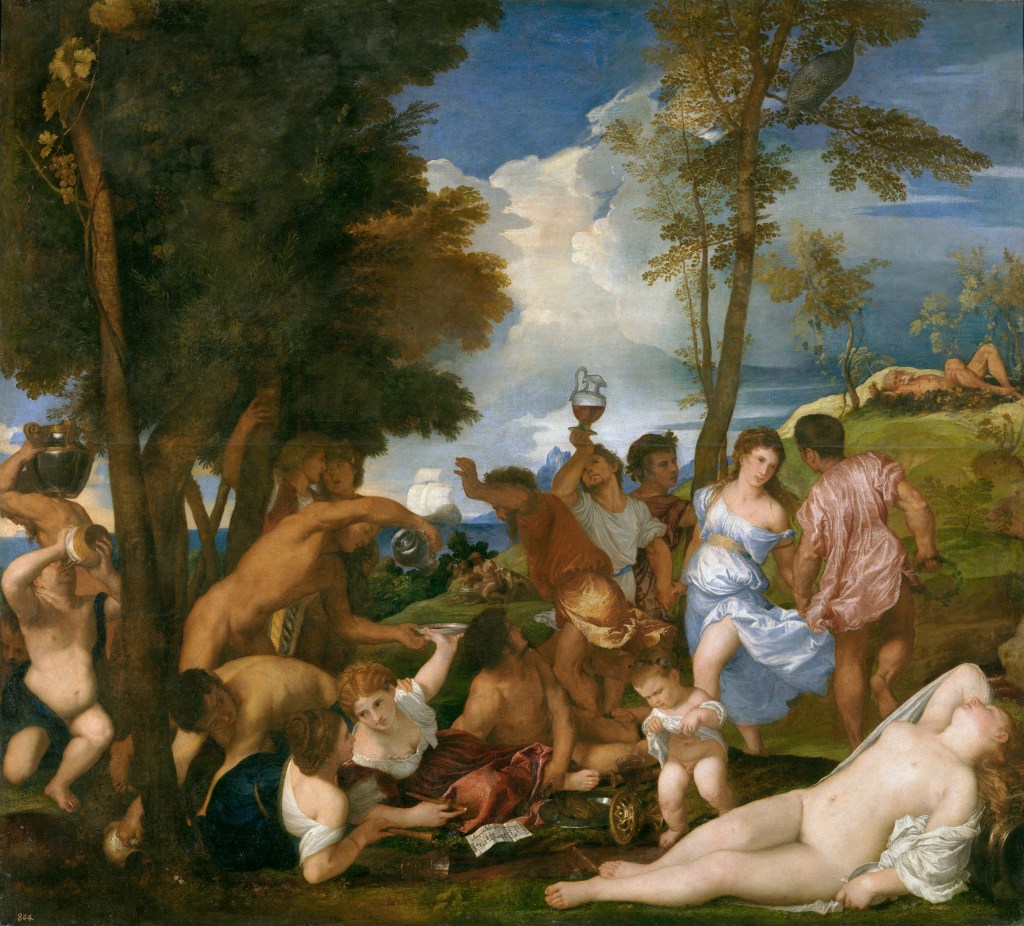
- What stikes me about the Bacchanal of the Andrians is that in spite of the nudity you don’t feel violated or shocked. It is done with dignity and to me feels as though the subject is more allegorical than anything. I am drawn to the women talking and the baby dancing, as if they are in their own world.
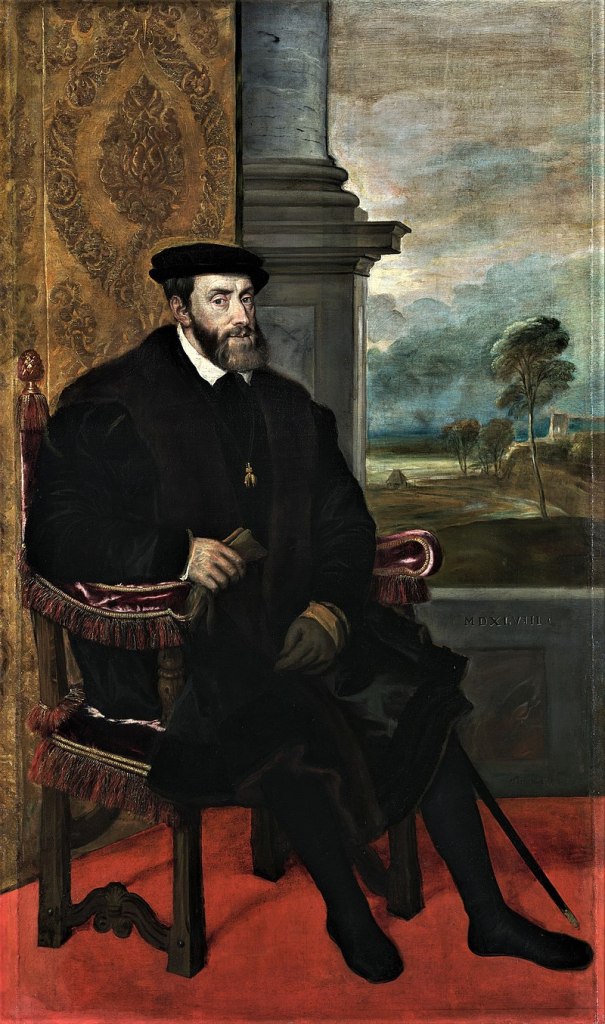
His work with Federigo Gonzaga led Titian to be introduced to Holy Roman Emperor Charles V (King of Spain and heir to Austrian-German Hapsburg family.) Charles insisted that Titian was the only one who could paint his portrait.
Titian also painted Pope Paul III (Farnese)
- History in Motion: Emperor Charles V was a Catholic, but when his troops passed through Rome in an Italian conquest, they turned against their commanders and began to Sack Rome. This disaster essentially ended The Renaissance era in Rome and set the city back for some time. It was a vicious attack.
- It was during this time that the Pope (Clement) was all but kidnapped by Charles V and was pressured to not grant Henry VIII of England his divorce/annulment as Emperor Charles was the nephew of Henry’s wife Catherine of Aragon…Art and History go hand in hand for a great deal of drama.
Titian traveled to the imperial court of Charles V at Augsburg in 1548 and 1551, where he became a superstar of portraiture for the Hapsburgs and their court.
In the latter part of his career Titian’s most important patron, was Charles V’s song King Philip II of Spain. Philip commissioned many mythological paintings and portraits.
What sets Titian apart…
- Titian, like Giorgione before him, was one of the first artists to paint ‘al primera’ – or directly on the canvas with little to no sketchwork as a guide.
- His paint surface is known for colorful, loose, brushwork and the dragging and smudging of the paint over the canvas. This creates nuanced effects and vibrant movement.
- His scenes are emotionally charged and bringing the viewer into a conversation with the painting
- His style is distinguished by exceptional use of color and light.
- Much of this has to do with Titian’s use of oil paints, which have more vibrancy and flexibility on surface for controlling painting structure. Titian was a master of oils.
- In his lifetime he was second only to Michelangelo in his fame and success
- Fun fact: Titian and Michelangelo most likely met once in Rome (according to historian and artist Giorgio Vasari, who is said to have arranged the meeting). It seems Michelangelo was impressed with Titian’s work but did wonder about the lack of ‘drawing’ by Venetians.
- He was the first painter to paint primarily for an overseas audience (even a mail order style business as he continued to work in Venice mostly)
- His bold, brilliant colors and loose brushwork style inspired the next generation of artists including Vermeer, Caravaggio, Peter Paul Rubens, Rembrandt as well as many Impressionists like Manet.
- Titian moved from The High Renaissance to early Mannerism (period after The Renaissance)
- It is estimated he painted over 400 works in his lifetime (wow!) and 300 of those survive.
- You can see works by Titian throughout the world including The National Gallery in the UK and Venice’s Accademia.
We’ll be exploring several of Titian’s paintings in-depth in a future Master of Venice course study.
Personal life:
Titian was married to Cecelia and had four children. He died in 1576 in Venice – and his legacy remains imprinted in the art world forever!
While Titian’s poesies are often his most reproduced, I personally enjoy his religious art because as a person of faith his movement and color really bring alive the stories and characters from scripture.
Don’t forget to subscribe for updated posts. You can also follow us on Facebook
 Art Expeditions
[…] For more about Titian […]
LikeLike