
Today on Medieval Monday we are going to explore the magnificent work of Sienese artist Duccio.
Duccio is one of the forefathers of The Renaissance given his use of depth (in the absence of linear perspective) and detail in his storytelling motifs.
Duccio di Buoninsegna was born circa 1255 in the area of Siena, Tuscany where he was active until the early 14th century.
During his lifetime, Siena was a flourishing Medieval stronghold with self-goverment known to provide for the poor and strive towards the highest ideals of a ‘good government’ in society. If you are interested to learn more about Siena, check out a travel article I wrote on American Nomad.
While there is little record about the exact details of his life, it is belived he studied under Cimbaue and potentially traveled to Constantinopole to learn from a Byzantine master.
- Duccio’s works were akin to Byzantine style with gold backgrounds and religious scenes, but he pushed the boundaries in his artistic style by softening his figures (compared to the sharp lines in Byzantine art).
- He used modeling to play with light and dark colors, which helped reveal figures in unique ways underneath heavy drapery
- His composition techniques made hands, faces and feet more rounded and three dimensional with a warmth in color
- He was one of the first painters to put figures into architectural settings and in doing so helped build the foundation to leading to linear perspective, exploring depth and space
- As a precursor to The Sacra Conversazione, his figures seem to interact tenderly with one another in prayerful conversation
- Duccio balances his works with a striking naturalism and otherworldliness. The subjects might be in natural setting, but are ethereal and have a heavenly breath to them.
- Duccio influenced contemporaries like Simone Martini and The Lorenzetti brothers.
- As of 2023, the most expensive painting every purchased by The Metropolitan Museum in New York was a Duccio ($45 million in 2004)
Duccio’s Art:
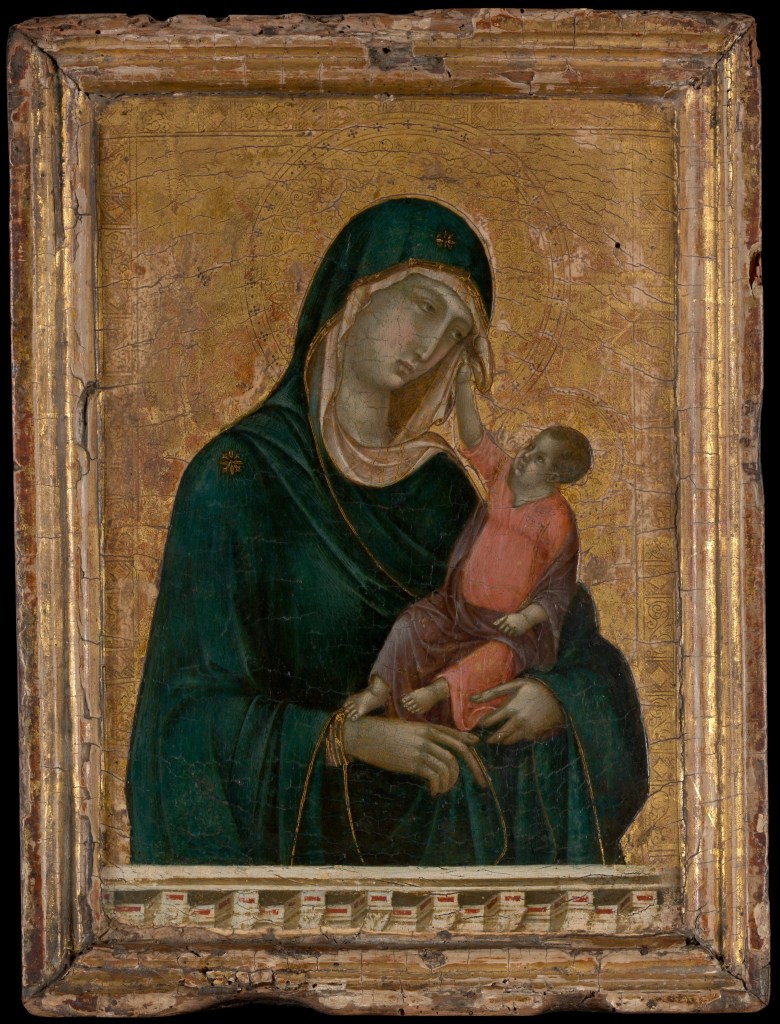
This beautiful masterpiece – The Madonna and Child is housed at The Met
This work is more than just art, it was a cherished icon by the faithful. It was meant to be held and prayed with. The painting is still in the original frame and has burn holes form the holy candles placed by beside it by the faithful.
The painting was meant to be knelt before to capture the full essence of the ‘ethereal’ and heaven coming down to earth.
This work is very intimate in showing the relationship between Jesus and his mother. Her long figures (a common symbol The Virgin Mary) indicate that she is always able to extend her hand to help everyone and can ‘carry Christ child’
Jesus is shown as a loving son who with a curiosity as he pulls back his mother’s veil.
Even today this storytelling remainds the faithful that Jesus not only took on humanity, but relished in his life and love for those around him in his love for us. He trusted his mother completely – not just as a stern protector – but in a love and care that we all long for in our relationships with our families and as people of faith – a deeper intimate relationship with God.
Learn more here on The Met site.

The masterful Nativity with the Prophets Isaiah and Ezekiel was painted between 1308-1311. It is housed today in Washington’s National Gallery.
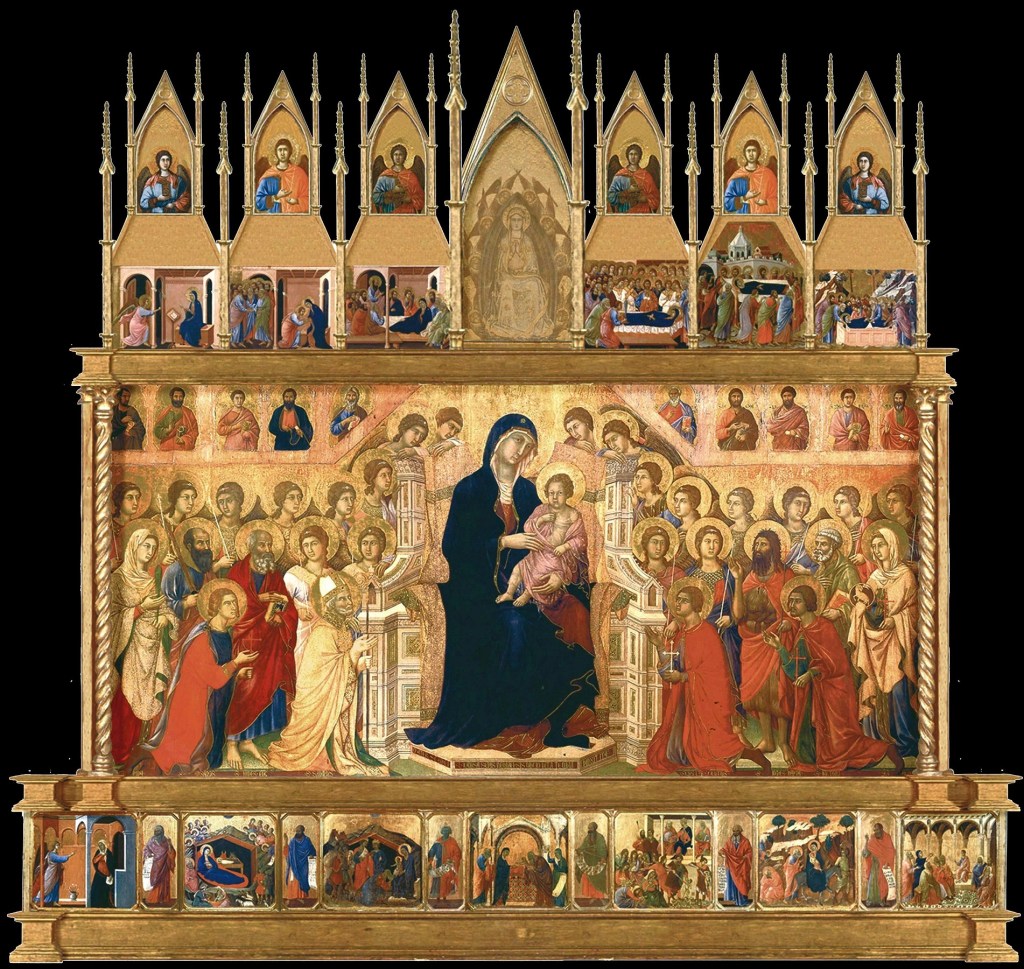
The panel is one of two pieces of the two-sided altarpiece known as the Maesta, which dominated the main altar in the gorgeous Siena cathedral for 200 years. Maesta means majesty in Italian
- The Maesta altarpiece remained in Siena’s Duomo until 1771, when it was dismantled to distribute the pieces between two altars. Sadly they were sawn up and some paintings damaged in the process. Many of the panels remain in the Siena Duomo Museum, but others are in museums like The National Gallery in DC
- In this section of the panel you see two Hebrew prophets – Isaiah and Ezekiel (identified by the text of their works on the scrolls they hold). Both are included as they foretold Jesus’s birth.
- In the centerpiece is the Holy Family, along with saints and angels.
This piece of art was extremely important historically to the Sienese…Mary is Siena’s patron saint and the devotion to her had a strong civic and religious dimension. Before it was installed in 1311, Duccio’s altarpiece was paraded through Siena as a triumphant testament to the city, it’s art and to honor it’s patron saint.
- Musicians were hired to perform as the work was triumphantly paraded throughout the city. Priests, monks, city officials, women and children all followed, ringing bells and adoring the work.
- To celebrate the occasion, shops were closed all day and alms given to the poor.
Learn more on NGA website

How Maesta would look if all panels together:
We’ll top off today’s Duccio overview with a piece I saw in person The Uffizi in Florence: The Ruccelai Altarpiece.

Named after The Ruccelai Chapel, where it was originally housed, this work is the largest painting on wood in the 13th century. It was commission by a Florentine confraternity Compagnia dei Laudesi that met in the church of Santa Maria Novella (in Florence). This confraternity met to sing praises of the Blessed Virgin Mary and this was commissioned to honor her.
What is striking is the use of architectural detail in the carved wooden thrown. Angels hold a banner, covering Mary’s shoulders to symbolize her honor and status as The Queen of Heaven.
The Christ Child is clothed in rich red cloth to signify his sacrifice.
Foreshortening is used here – which was uinque at the time and sets Duccio apart from his peers in his ability to add a spatial depth to compositions.
Duccio was influenced by Byzantium, which is a bit unique in Tuscan art at the time, as it was moving away from gold and Byzantine elements. And yet Duccio used this early Medieval style unlike any other.
Thanks for taking time to join Art Expeditions on this journey. To learn more about Duccio I recommend this book, Duccio and the Origins of Western Painting
Don’t forget to SUBSCRIBE to the BLOG and ADD US on Facebook
Art Expeditions is helmed by art lover and historian, Adele Lassiter…thanks for following
 Art Expeditions