Welcome to Renaissance Wednesday…Today we’re traveling back in time to the 15th century in Florence to meet Master of the Renaissance, Andrea del Verrocchio.
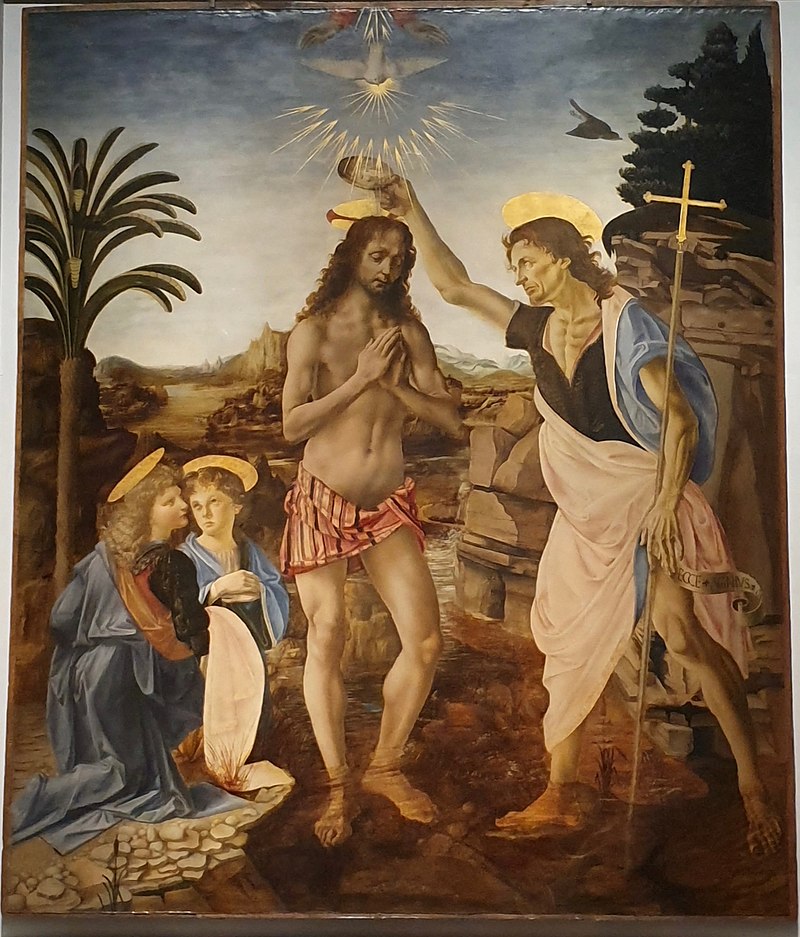
In his Baptism of Christ (image above), which is housed in The Uffizi Gallery in Florence, Verrochio shows his skill in portraying perspective and the human physique. Verrocchio was predominantly a sculptor and you can see his background in creating human form in 3D translating to paint.
The figures of Jesus and John the Baptist are very realistic and pay careful attention to the human form. Jesus stands contra posta (with most weight on one leg) – imitating real life standing pose. John the Baptist reaches out, leading towards Christ to baptize him.
Christ is looking down towards the ground in a pose of humility, while John looks up to heaven.
The Holy Spirit, represented by a dove, draws down on Christ, while God the Father is represented as hands coming down from heaven.
The two angels/attendants on the bottom left hand corner are actually a composition by Verrocchio’s apprentice, Leonardo da Vinci (yeah that Leonardo)
I start with this painting because it symbolizes the amazing depth of Verrocchio as a painter and in my opinion his direct influence on Leonardo da Vinci, who eventually surpassed his master in acclaim.
Who was Verrocchio?
Born in Florence around 1435, his father was a tile and brick mater (and later tax collector).
It is believed that he trained with master painter Fra Fillppo Lippi (we’ll meet him in a future post) and potentially Donatello.
While little is recorded about his personal life, it is known he never married and financially supported his family as his commissions increased.
He was a member of the Guild of St. Luke, an important art guild in Florence. St. Luke is the Patron Saint of Artists as it is believed St. Luke as the first iconographer (painter of icons)
The Medici family were fans of Verrocchio and commissioned several works by him.
Eventually Verrocchio opened his own studio in Florence where he began to train artists including Lorenzo di Credi and most notably Leonardo Da Vinci.
Major Renaissance contemporaries like Botticelli, Fillippino Lippi (son of Fra Lippi) and Luca Signorelli, Perugino (Raphael’s teacher) also entered Verrocchio’s studio.
He left Florence for Venice at the end of his life to work on a commission of a statue of Bartolomeo Colleoni.
He left his Florentine workshop to Lorenzo di Credi.
Verrocchio died in Venice in 1488.
As a Painter:
He was active in training the next generation of Florentine painters and many of his students assisted Verrocchio on his completed works. Many of his artworks with done in tandem with his students including the aforementioned Baptism of Christ (with Leonardo da Vinci)
- Art historian (and Renaissance artist) Giorgio Vasari claimed that Verrocchio never touched a bruch again after seeing Leonardo’s work on The Baptism of Christ because his pupil surpassed him. Vasari is a decent source of the time, but also was known to embellish a bit, so this story is not 100% accurate, but gives you an idea of Verrocchio and his influence as a teacher.

In this Madonna and Child look at the detail of her clothing and richness of color. A precursor in style (in my opinion) to later artists like Leonardo da Vinci.
Verrocchio is a master of human physique and capturing realism in human form in painting…look at the feet of Jesus and Mary’s face – you feel as though you could step into the painting.
As a Sculptor:
Verrocchio was considered a master sculptor and worked on many projects in Florence (and in Venice later in life).
- In 1465, he worked on the lavabo of the Old Sacristy of San Lorenzo Church in Florence
- He was commissioned to create the funerary monument for Cosimo de’Medici for his crypt under the altar at San Lorenzo (the Medici’s family church in Florence)
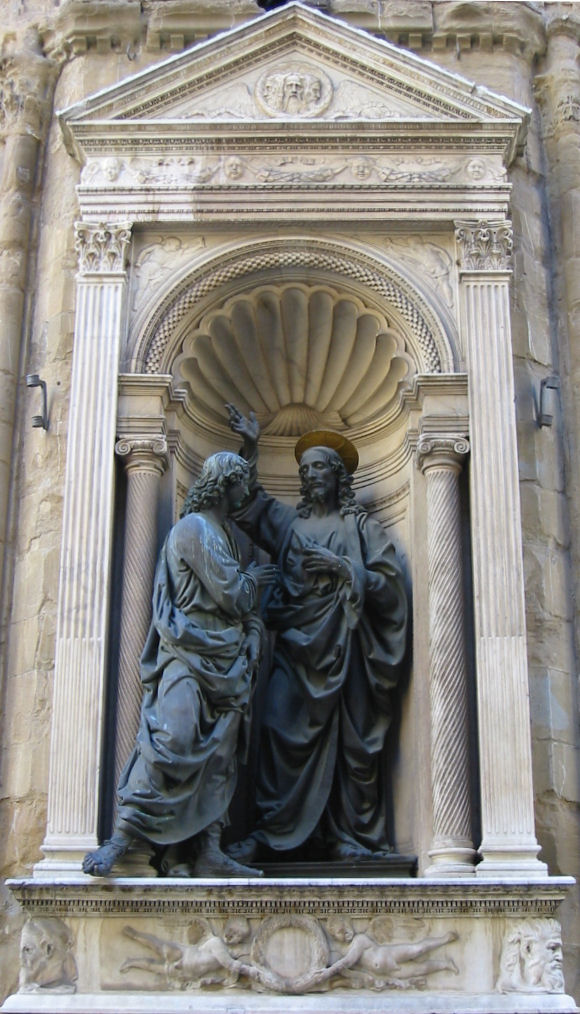
- The Tribunale della Mercanzia (judicial organ of the Guilds in Florence) commissioned a bronze group portraying Christ and St. Thomas for Orsanmichele
Melancholia_i (talk) (Uploads) – credit
Verrocchio was commissioned by Piero de’Medici to create a bronze David ( a popular theme for sculpture as Donatello and Michelangelo also received David commissions). David was an unofficial patron of the city of Florence who identified with his underdog status.

Verrocchio’s last major project was an equestrian statue of Bartolomeo Colleoni in Venice.
Colleoni, who served Venice for many years left money to the city on the condition a statue of him be commissioned and set up in St. Mark’s Square. The Republic accepted the money, but as statues were not permitted in the Piazza it would instead be placed in an open space in front of the Scuola (school/confraternity) of San Marco.
Verrocchio died before the commission was completed and it was finished by Alessandro Leopardi. We’ll be learning more about this in a future Masters of Venice post.
- The Master of Venice is our FREE course learning about the history and legacy of Venetian Art. Learn more here.
Thanks for taking time to join this expedition into Renaissance Art. Don’t forget to SUBSCRIBE for updated posts. We are also on facebook
 Art Expeditions