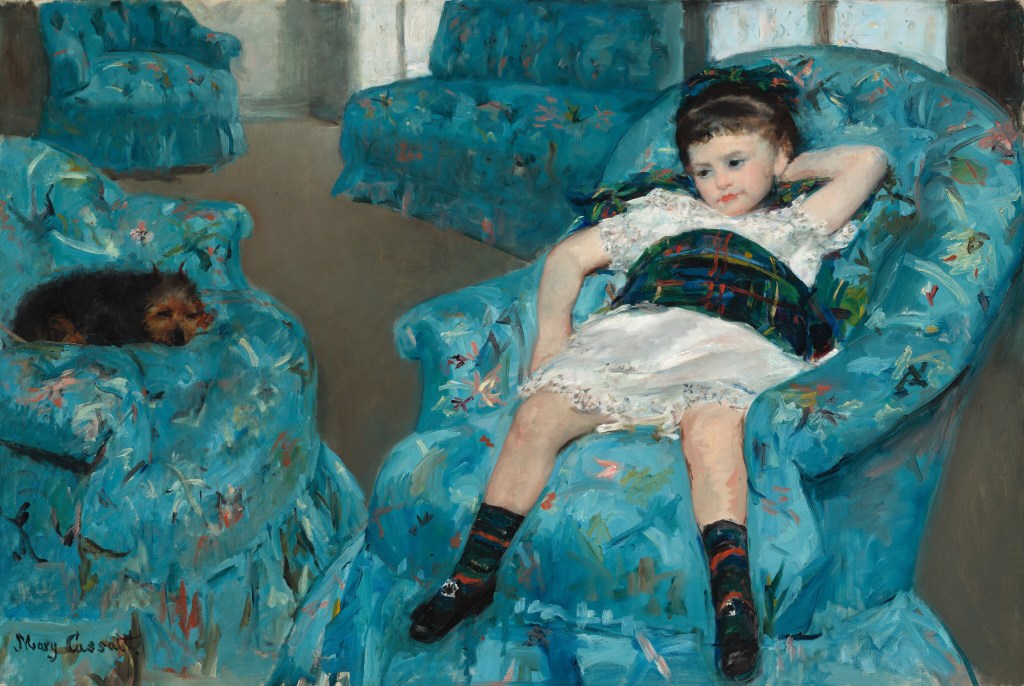
Today on Impressionism Friday we’re going to meet Mary Cassatt – one of the most important early Impressionists and a trailblazer for female artists.
Born on May 22, 1844 in Alleghency City (now Pittsburgh) PA into an upper-middle-class family, from a young age Mary was exposed to arts and culture. Her father, Robert Simpson Cassatt, was a successful stockbroker and land speculator and her mother, Katherine was well-educated. Katherine’s intellect and focus on equal education for women had a profound influence on Mary.
Mary was one of 7 children (two died in infancy)…her distant cousin was renowned American portraitist and painter, Robert Henri.
The Cassatt family viewed travel as a foundation of education and Mary spent five years of her young life traveling throughout Europe, where she was exposed to masters of art and contemporary geniuses like Camille Corot and Gustave Courbet.
During the 1855 World’s Fair in Paris she first saw the works of Pissarro and Degas, whom she would later work with in Paris.
The Cassatts eventually moved to Philadelphia, where at age fifteen, Mary enrolled at the prestigious Pennsylvania Academy of Fine Art. Only twenty percent of students were female, and the majority of the female students did not plan to take up art professionally. The men however were trained to become professional masters. Thomas Eakins, for instance, was one of Mary’s classmates in the school.
Mary grew impatient witht he slow pace of her instruction at The Academy. She felt “there was no teaching” at the Academy as female students could not used live models and there was a patronizing attitude.
Mary knew she wanted to make a self-sufficient career as an artist. After her father relented (he opposed the idea), she moved with her mother and family friends to Paris in 1866 (they were her chaperones) as she began to study with Jean-Leon Gerome – a master hyper realistic. Thomas Eakins began to study with him a few months later.
Cassatt also obtained her permit to became a copyist at the Louvre. These copyists would paint copies of masterworks that could be sold. But more importantly it allowed artsts to learn from their predecessors and connect with other emerging and established artists. Ex. Manet, Morisot and others were copyists.
Initially Cassatt did not seek to go against the grain of art expectations. She like many other Impressionists wanted to be accepted by The Salon. She worked for ten years to find favor, but the results were mixed and she grew frustrated.
With the outbreak of the Franco-Prussian War in 1870, Cassatt briefly returned home to the United States, where she entered a period of reflection.
While she sold some of her art, Cassatt also questioned her future in art. She was determined to make an independent living and that meant giving up art to have a more stable prospect she might have to give up art. She wrote in a letter of July 1871, “I have given up my studio and torn up my father’s portrait and have not touched a brush for six weeks, nor ever will again until I see some prospect of getting back to Europe. I am very anxious to go out west next fall and get some employment, but have not decided where.”
This shows the struggle and conflict of an artist who even with immense talent struggled to make a living or make sense of the art world she tried to navigate. Fortunately for us, Cassatt didn’t stop painting.
In 1871, God gave a bit of grace, as her work attracted the attention of Roman Catholic Bishop Michael Domenec of Pittsburgh. She ocmmissioned her to travel to Parma in Italy, to paint two copies by Correggio in Parma. Remember this was before the internet and to copy you had to see it in person or have an etching or not the best quality photograph (still emerging and in black and white) – so you had to travel to copy or do it by memory.
She traveled to Parma with fellow Philadelphia artist Emily Sartain.
In Parma, Cassatt found great success and accolade by the Italian community. After completing her work for the Bishop, she traveled to Spain to paint and study Spanish masters there.
In 1874 she was drawn back to France and found a stuido space, with she shared with Abigail May Alcott (sister of Louisa May Alcott – author of Little Women).
Cassatt continued to be frustrated with the strict Salon conventions.
It was during this time she developed a deep friendship and working partnership with Edgar Degas. He invited her to show her works with the Impressionists in 1877. She found a niche in this group, where Cassatt and her friend Berthe Morisot were the only female members (which actually was progressive for the time).
Cassatt admired Degas mastery of pastels and they worked together often…they each had studios within walking distance. Cassatt and Degas both considered themselves figure painters. Cassatt, like Morisot recognized that painting the seemingly ordinary in the lives of women and children was actually extraordinary.
She is known for her tender portrayals of women and children, but also worked on unique portraits and scenes of life in Paris and beyond.
- Cassatt never married as she was focused on her career (and never met the right person) but wanted to feature mothers and their love and devotion in a relevant and important way.
- She was influenced by the Renaissance depictions of the Madonna and Child in their intimacy the connection of Mary’s love as a mother and Jesus’s trust in Mary as a son. She translated this concept of ‘intimacy of motherhood/childhood’ into her paintings.
Like many artists of the time, Cassatt became enamored with Japanese woodcuts and she began to experiment with the medium after 1890
Mary Cassatt was a huge advocate of art museums and worked as an advisor and friend to many American art museums.
Her friend Louisine Havemeyer became Cassatt’s most important client. Cassatt also introduced Havemeyer to Degas…Havemeyer when ga-ga for Degas works – purchasing important paintings and sculptures like his dancers. Louisine donated the Cassatt and her Degas collection to The Met in NYC
I was blessed to visit it recently and you will be awestruck by room after room of Degas and Cassatt masterpieces.
Later in her life, Cassatt focused on Women’s Suffrage and petitioning for the Right for Women to vote.
She died in 1926, a titan in art and a trailblazer for women artists.
You can seen her art in many US and European collections including…The National Gallery in DC, The Met and other smaller and regional art museums.

The Boating Party (above) at the NGA in DC has almost a Gauguin feel to it. I love her use of color and lines. You feel as though you are on the boat and feeling the movement on the water.

I think they could easily turn Mary Cassatt’s life story into a mini-series – what an inspiration and how we can all identify with the struggle to chase your dream and find success in it. She captures the essence of what it means to be human in her works with grace, poise and an invitation to have a conversation with each art work.
For more about Mary Cassatt:
I recommend: Mary Cassatt – A Life on Amazon
 Art Expeditions