Today on The Masters of Venice we are going to meet one of my favorite Venetian artists – Paolo Caliari, better known as Veronese.
Contemporary to Tintoretto, Veronese straddled the High Renaissance style of Venice focused on bright colors and perfect symmetry as well as the emerging pre-Baroque/late-Renaissance style of Mannerism.
Let’s pause here for a second…in art history we often throw around terms and group artists by genre and eras like Medieval, Renaissance, Impressionism…you get the drift…but it is important to recognize that in each historical art period there are spectrums of styles within Renaissance art or Baroque, etc…
In The Renaissance, different countries and regions embraced or cultivated unique Renaissance ideas and art movements that spread back and forth throughout several centuries.
Venice was a bit slower to fully move into The Renaissance because The Venetian Republic was extremely powerful and stable (really until 1797 when Napoleon conquered Venice.) This meant several things with art innovation:
- There wasn’t an innate need to simply reject or return to a past because in the minds of Venetians they were already a golden melting pot of ideas that art through trade and their cultured history. The Venetians were more interested in cultivating beautiful and impactful art that glorified the unique Venetian Republic or stealing pieces of art from territories and conquests in the east.
- Fresco painting was difficult in Venice given their wet climate. Many frescoes by amazing artists like Giorgione were washed away by the lagoon waters and sea air…so mosaic work continued to be important as glass mosaic tiles did much better in the Venetian landscape.
- Venice might not have been the first to embrace The Renaissance Style, Venice transformed art in The Renaissance and because the light of Renaissance innovation when Florence and Rome were besieged instablility.
- The Sack of Rome in 1527 all but ended The Renaissance in Rome. The destruction and loss from an invading Christian army under a Catholic King – Charles V of Holy Roman Empire was brutal and led to a downfall in Rome as a cultural arts hub for several generations until the rise of the Baroque era.
- In the aftermath of this sack, a new style of Renaissance art emerged. Some art historians group mannerism as a separate movement, but generally it is an extension of The Renaissance leading to The Baroque Art of the 17th century.
What is Mannerism: The Renaissance as a whole put a great deal of focus on symmetry and proportion to create a mathematically perfect approximation of beauty based on classical ideals…Mannerism didn’t outright reject this but also realized the world isn’t perfect and wanted to focus their details and compositions in a more emotional breadth using intentionally unbalanced composition. Both styles reveal a unique realism – as not everythin we experience visually is proportional…Both Renaissance and Mannerism styles sought to bring meaning and deeper connection to life themes through art and utilized symbolism and style to draw the viewer in.
With The Sack of Rome, Mannerism took root, and even Renaissance masters, Michelangelo and Raphael moved towards this mannerism style later in their careers. Compare Michelangelo’s Sistine Chapel Ceiling to the Sistine Chapel Last Judgment to get a sense of this shift.
I bring this up, because Venice’s Renaissance blossomed through almost 1600 and even with introduction of Mannerism styles the turmoil of Rome and Florence did not hit Venice – allowing artists like Titian, Tintoretto and Veronese to blend High Renaissance to Mannerism and beyond in a purely High Venetian style.
- Venice did not suffer instability during this time and continued to evolve and grow in the High Renaissance movement. Venice was one of the first artistic centers in The Renaissance to embrace oil paints. It is believed that Leonardo da Vinci (a Florentine) discovered oils during a visit to Venice and began to use them almost exclusively. *Although artists, like Veronese continued to occasionnally use fresco for elaborate ceiling or wall projects as this technique could be ‘fused’ with the plaster.
- Oil paints originated in The Netherlands, but The Venetians were the first to fully embrace oils in Italy – partially because they provided more flexibility in painting in their unique climate.
- Venetians unlike Florentine artists were always more comfortable using a painterly style that was more fluid and not as structured.
The Bellini Family with Antonello da Messina and Carpaccio helped build the foundations of The Venetian Renaissance…Giorgione and Titian ushered in The High Renaissance and cemented Venice on the worldwide map as a center of art.
These artists ushered in the next generation of Venice masters like Tintoretto, Bassano and Veronese who were not afraid to showcase their unique styles while still following in the footsteps of their forefathers like Titian.
Who was Veronese:
Born in 1528 in Verona as Paolo Caliari, to a stonecutter father, named Gabriele and mother Caterina, he became known as Veronese from his birthplace, although he continued to sign his works occasionally with his family name (from his mother’s side), Caliari.
At the time of his birth, Verona was the largest Venetian province in the mainland area known as The Veneto.
From an early age, Veronese demonstrated an immense artistic talent. By 1541, he began an apprenticeship with Veronese master artist Antonio Badile. Paolo Veronese would eventually marry Badile’s daughter.
In 1544, Veronese began to apprentice with another well known artist in the area – Geiovanni Francesco Caroto. He left to study in Parma for a time, where he was introduced to Mannerism.
Veronese’s natural talent was so superb that he quickly eclipsed his teachers and by his late teens was painting commissions for churches in Verona.
His work caught the eye of the powerful, Giustiniani family, whoasked him to paint the altarpiece for their chapel in the church of San Francesco della Vigna, which was being rebuilt by master Venetian architect Sansovino (we’ll meet him later in the course).
In 1552, Cardinal Ercole Gonzaga, a member of the influential Gonzaga family of Mantua hired Veronese to paint an altarpiece for The Mantua Cathedral.
His time in Mantua afforded Veronese the chance to study the celielings of influential painter Giulio Romano, which would later influence Veronese’s ceiling paintings in Venice.
Veronese in Venice
In 1553, Veronese moved to Venice after obtaining a state commission to paint a frescoed ceiling in the Hall of the Council of Ten and adjoining room in The Doge’s Palace, replacing previous art that was destroyed during a palace fire in 1553.
His skill and artistry became renowned in Venice to the point respected artists like Tintoretto feared Veronese as prime competition.
One area that sets Veronese apart is his use of a technique called trompe-l’oeil – a trick of the eye, which is particularly powerful when used on ceiling frescoes to expand space.
- Key term: Tromple L’Oeil: French for “deceives the eye” is a type of optical illusion used to trick the eye into thinking that a flat surface like a wall is actually three-dimensional. It creates a photorealistic style and has been used by artists as far back as Greco-Roman times to achieve a realism of style. It varies from linear perspective, as the distortion and foreshortening of elements make the scene feel alive. Veronese used this in select works, as did other Renaissance artists like Michelangelo at The Vatican’s Sistine Chapel.
- The tromphe l’oeil Renaissance master, Corregio, who was from Parma, also influenced Veronese’s ‘tricking of the eye’ during his time in the Parma area.
Highlights of his work:
The Wedding Feast at Cana:

On June 6,1562, the Black Monks of the Order of Saint Benedict commissioned Veronese to create a large monumental painting to decorate the refectory in the monastery’s new reflectory on the island of San Giorgio (near Venice).
The monastery, which you can still visit today is an architectural wonder designed by famous architect Andrea Palladio, is on the magical island of San Giorgio, which is a fun day trip.
The painting however today is housed in The Louvre. When Napoleon invaded Venice he stole many of The Venetian artistic treasures. While most were returned to Venice after the 1815 Congress of Vienna (following downfall of Napoleon) The Wedding at Cana remains in the Louvre.
The monks who commissioned the painting were specific in their requests (to represent): “the history of the banquet of Christ’s miracle at Cana, in Galilee, creating the number of human figures that be fully accomodated.”
So while so have criticized this painting for having so many figures and a theatrical appearance – the monks themselves asked for this demonstration and allowed Veronese’s inventive talent to have fun in the creation. To me it is respectful and if anything shows how Christ longs to eat and break bread in the middle of our feasts – be it times of celebration or solitude and I appreciate the somewhat theatrical intepretation.
The painting is one of the largest of the era at over 30 feet. Today it takes up an entire wall in The Louvre.
This work is characterized by it’s drama and theatrical setting.
The terrace and stairs that occupy the space with chairs and people crowding in at the feast is similar to a Venetian theater stage in Venice at the time.
It took six years to complete and is luminous in color…it has been described as having a grandiose choral effect – music of painting with it’s movement and rich vivid use of color.
Christ and his Mother are identified in the center of the painting with their serene and almost stagnant interaction. Halos identify their holiness and miraculous work, but the actual miracle takes place in the bottom right hand corner of the scene.
- My thoughts: From a religious art standpoint, I think the symbolism is that Christ and his Mother, are always present and able to help, but don’t have to physically be present in human form to enact miracles. They are here, but the still and unmoved Christ reminds me of “heaven and earth shall pass away, but my word will not.” Christ is in the center of everything and is the center of the feast, whether acknowledged or not.
- I would think as a monk the idea of ‘dining’ with Christ in the reflectory and thinking about his stability of power int he middle of this movement would be good food for thought for contemplation.
- I don’t know what Veronese intended but that is the amazing thing about having a ‘conversation’ with art. It can inspire and move you in unique ways. It is important to know the intent of an artist, but often the intent is to invite you to think and come to your own conclusions.
- It merges the religious themes with daily life – which is truly what Christ did when he comes to earth – eating and drinking and seeing ‘communion’ even in seeming mundane things like a Wedding Feast. I find it refreshing .
- Some find the painting as a reflection of Venetian glory and opulence as almost a divine right as a Republic, but I think, while it does include the beauty and healthy pride of this culture, it is not mean to be a painting that diminishes the spiritual.
- I enjoyed reading this interpretation of the painting at The University of Rochester by Kate H. Hanson

Perhaps the highlight of this vast painting is Veronese’s tribute to storied art contemporaries of his time. The Musical Quartet in the lower center of the painting includes portaits of:
Titian (far right in red)
Jacopo Bassano (next to Titian)
Tintoretto (next to Bassano)
Veronese (self portrait)
There are over 100 people in this painting – just want the monks called for.
The Feast of the House of Levi:
A sumptuous feast of color and drama – The Feast of the House of Levi is one of the largest canvas of the 16th century at 18.37 by 42.95 feet. Like his Wedding at Cana, Veronese crafts a theatrical scene with immense color, secular humor and religious depth that invites the viewer to join the feast.
The painting is now housed in Venice’s Accademia Gallery, but was originally commissioned by the monks at The Basilica of Santi Giovanni e Paolo in Venice in 1573 to replace a Last Supper scene by Titian that was tragically lost in a fire.
While this work is now known as The Feast of the House of Levi – in truth it is a Last Supper painting.
Veronese painted this expansive scene to represent The Last Supper – a popular theme in refectories because this is where monks would take their meals (a refectory is a dining area in monasteries, schools, etc…)
Veronese had a large canvas and decided to add as many characters into The Last Supper scene as possible – similar to his Wedding at Cana.
Tintoretto had done a similar work in his commission for a church – with more than simply the 12 Disciples featured…but as this was the time great chaos with the Protestant Reformation and Catholic Counter-Reformation, Veronese was criticized by The Inquistion for not following the statues for religious church art at The Council of Trent.
He appeared before the Inquistors and said: “it seemed that the painting is large and it could hold many figures and we all painters are all a little mad.”
The Inquistion accepted his argument they still wanted him to change a few areas of the painting to comply with the Council of Trent…it was instead decided by Veronese that he would simply change the title to The Feast of the House of Levi, where the number of people would make sense.
The revised title comes from an episode in the Gospel according to St. Luke – Chapter 5, in which Jesus is invited to a banquet.
- This seems odd and draconian, but historically this was actually meant to ‘reform’ the church who had received complaints for being to secular with art from Protestanism. The idea was that for strictly religious commissions they had to follow certain accuracies to ensure the story lined up biblically. It’s a bit much but this was a trying time and The Catholic Church and rise of Protestanism was a battleground. Thankfully we can enjoy the beauty of the art and religious themes together today without an Inquistion!
- It can help to interpret this painting through the lenses of The Last Supper accounts in The Gospels, but within any feast in the Gospels like the Feast of Cana or Levi – they usually foreshadow the ultimate Christian feast – The Eucharist enacted during The Last Supper
Apotheosis of Venice

One of the most prestigious works of Veronese..commissioned for the Ducal Palace in 1583 was a triumphant allegory of ‘Venice.’ In art Venice as a Republic is often portrayed as a triumphant queen.
This 30 foot oil painting is on the ceiling in one of many salas (rooms) of The Ducal Palace (Doge’s Palace – the seat of Venetian Republic)
In this work, Veronese shows his ability to create seamless illusionism and foreshortening. He was exposed to this sort of work during his time in Parma, where he studied trompe l’oeil master Corregio’s work.
The story in paint tells of Venice personified being entrhoned on clouds and being crowned in glory.
Notice the serpentine columns that stand tall in the background – these are Solomonic Columns and are modeled after the Columns at St. Peter’s Basilica that are said to be from The Temple of Solomon in Jerusalem.
This is a popular theme in Renaissance art as Solomonic Columns can symbolize God’s divine government and judgment.
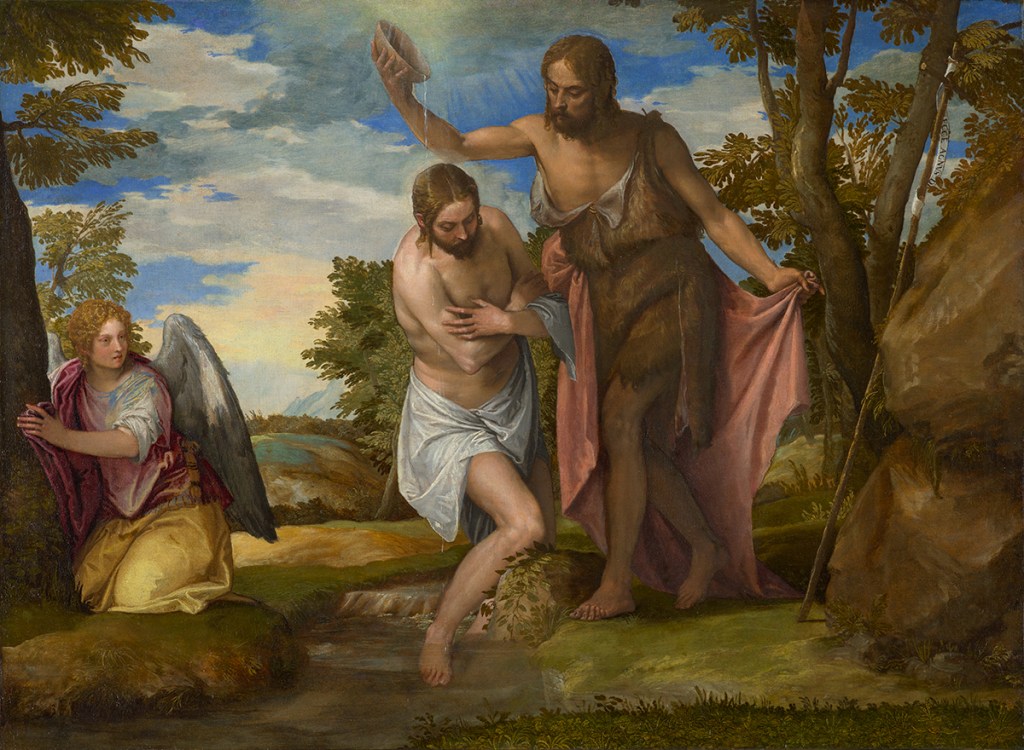
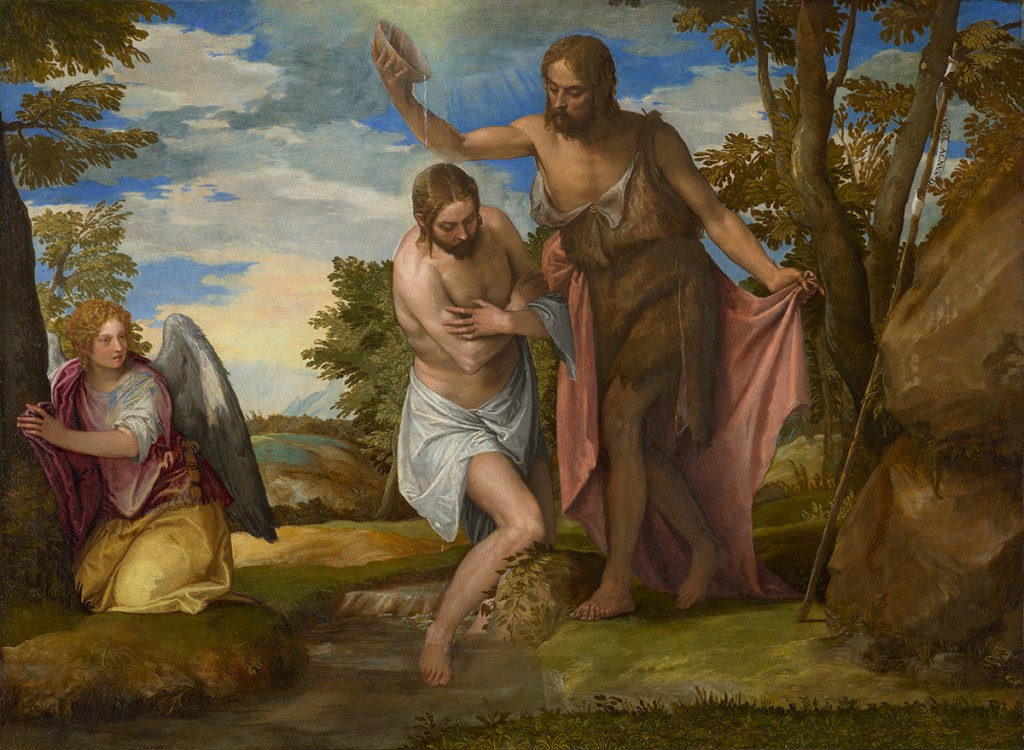
While not one of his most famous works, I love Veronese’s Baptism of Christ at my local art museum – The North Carolina Museum of Art.
I have stared into it for hours, taking in the detail and the realism of the water and spiritual conversation of this important moment when God declares Christ as his beloved son.
John the Baptist is adorned in his camel hair, but is confident in his call as a servant. Jesus is humble as he kneels and accepts the water and light that pour on him.
I love realistic the waer in the river appears -it is lifelike and has a cleansing quality to it.
The sky is alive with blues and gorgeous clouds, yet ‘God’s light is also coming out of the darker clouds where the constrast of light and dark, though subtle draws you to the top center of the painting.
How does this painting speak to you?
Veronese died in 1588 from a pulmonary infection, leaving a legacy as one of the true masters of Venice.
To learn more about Veronese…
Book: Paolo Veronese – A Master in His Workshop in Venice
Don’t forget to SUBSCRIBE for the latest blog posts in The Masters of Venice Series
Follow us on Facebook for daily art history!
 Art Expeditions
[…] His Mantuan masterpiece, The Camera degli Sposi (Wedding Chamber) in the city palace (Palazzo Ducale) is a a triumph of Renaissance art and inspired many subsequent artists like Corregio and Veronese. […]
LikeLike
[…] We focused on Paolo Veronese during our Masters of Venice class last year. He was one of the finest Venetian painters to come of the late Renaissance. Learn more about Veronese here. […]
LikeLike