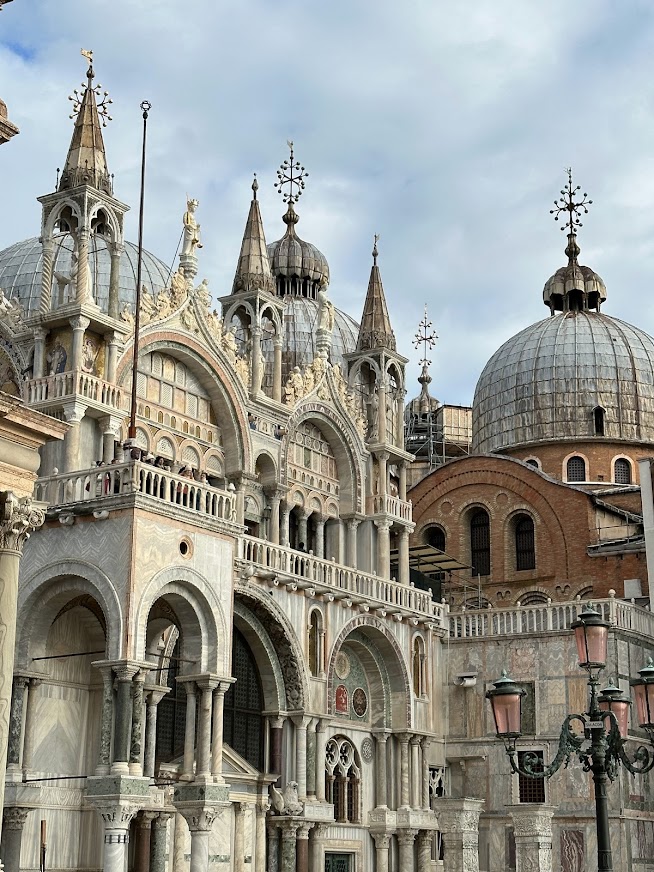
Today we’re traveling to one of the most beautiful examples of Byzantine-Romanesque architecture to come out of The Medieval Era.
A few weeks ago we learned about the influence of Byzantium (The Eastern Roman Empire, which did not fall in 476 as did the Western Roman Empire) in Ravenna with the Church of San Vitale.
North-Eastern Italy was strongly tied to Byzantium until the Fall of the Eastern Roman Empire in 1453. No region in Europe, perhaps, was more influenced by Byzantine artistic motifs like mosaics and iconography in The Middle Ages than the Veneto area (greater Venice).
Venice’s unique mix of East and Western influences from Romanesque to Byzantinum makes its architecture some of the most captivating in Europe. It is unique and purely Venetian in style – a reflection of the strength of the Republic of Venice as a trading center and the melting pot of culture and ideas from east to west that flowed through the city and Veneto region.
- Art Expeditions has been on a historical tour of the art and culture of Venice in our FREE Masters of Venice course ( a series of blog lessons and videos) – you can access the course information here.
In The Masters of Venice course we gave a brief introduction to the history and drama of the founding of St. Mark’s and highlighted a few of the treasures of The Basilica.
Today, on Medieval Monday, I wanted to drive a bit deeper into the specific Medieval wonders of the Basilica and the treasures that lie within this beautiful place of worship and pilgrimage.
For an art history lover – nothing can quite prepare you for St. Mark’s. When I toured the Basilica in January of 2023, I knew the history and had studied pictures of the mosaics and art, but as I first stepped into St. Mark’s Square I knew nothing could prepare me for the wonder of St. Mark’s.
The facade is unlike any other church I’ve seen, with a unique mix of Byzantine and Eastern Influences, countless mosaics and gilding, delicate Romanesque and sturdy Gothic features. The setting takes your breath away.
The designers of St. Mark’s wanted to create a new Hagia Sophia to rival Constantinople. The Venetians traded heavily with the Byzantine Capital and for many years were allies, and yet Venice as not satisfied in the shadow of Constantinople. They wanted to show that they were a major player on the Adriatic and beyond and a free Christian Republic in the face of continued threats from other regions.
Short history of St. Mark’s:
It starts with a body snatching…The invasion of the body snatchers of Venice…
In 828 AD it was decided that Venice would send an expedition to rescue (ahem steal) the body of St. Mark from his resting place in Alexandria Egypt and in turn bury him in a new and grand church in his honor in Venice.
The reasoning behind this was not unfounded. St. Mark, the Evangelist (author of The Gospel of Mark) was martyred in Alexandria Egypt and it was an important veneration site for Christians.
For many years Egypt had been a Christian society until it was taken over by Muslim invaders. The Muslims were not concerned with saints relics and often destroyed them. This is not to be disrespectful of another culture, but a fact of conquest and the instability of the time.
Venice wanted to ‘rescue’ St. Mark to venerate this important saint and restore his peaceful resting in a Christian city, but their choosing St. Mark of all the saints to adopt also ties into a legend of St. Mark and Venice that had given rise in the local lore.
An apocryphal (not in the Bible) story tells that when St. Mark was evangelizing, his ship got caught in a storm near Venice. He found refuge in the Venetian Lagoon and proclaimed this would be his resting place.
Venetian merchants traded with Alexandria and other countries and cities on The Mediterranean. It was not uncommon for Venetian pilgrims to visit the relics of St. Mark in Alexandria, while in the area for trade. Two Venetian merchants, Buono da Malamocco and Rustico da Torcello were businessmen who went to Alexandria to worship the relics of St. Mark in the church dedicated to him.
It was at this time they learned from the church monk, Staurazio and Alexandrian priest, Theodore that the church was going to be destroyed and profaned by Muslims to build a mosque. The merchants removed the remains of St. Mark and got past Muslim officials by hiding his body in a vat of pork (which was not Kosher for Muslim faithful)
The story goes that on the way back to Venice, they were caught in a storm and St. Mark appeared to them, calming the storm and helping them to get to Venice with his body!
You can’t make this drama up – Art History is like Netflix – full of intrigue and non stop action.
Building St. Mark’s Basilica:
With St. Mark now in Venice the city needed to build a house of worship worthy to honor the Evangelist.
The present day St. Mark’s was built in the 11th century AD, and was preceded by two other churches on the site.
The original church – Partricpazio Church was sadly damaged beyond repair during one of only two uprisings against a Doge in the history of Venice. Following the damage to Participazio Church, another similar structure was built that was then damaged by a fire.
Fire was a common threat for churches in this era, especially if they were not built with stone and other more defensible materials.
Miraculously St. Mark’s body was not destroyed during either demise and the foundations of the original churches can still be seen in the depths of the current St. Mark’s.
Building on the third, and current St. Mark’s Basilica begain under the proclamation and support of Doge Contarini (a doge is like a constitutional monarch in the Venetian Republic) in 1063 and was consecrated in 1094.
The present structure was modeled after another Medieval Church – The Church of the Holy Apostles in Constantinople, which sadly was destroyed after the invasion of the Ottomon Turks in 1453.
St. Mark’s has a Greek Cross Style – popular in Byzantium at the time.
- Greek-cross plan, church plan in the form of a Greek cross, with a square central mass and four arms of equal length. The Greek-cross plan was widely used in Byzantine architecture and in Western churches inspired by Byzantine examples. (source)
It also has similiarites with Constantinople’s Hagia Sophia in terms of Byzantine mosaic style and dome structure.
- Note: When you visit most Medieval Churches today most of them are a mix of styles, because like your local parish or even civic building over time you add on and make adjustments to the needs of the congregation/people. St. Mark’s retains it’s Byzantine and Medieval Roots, but the Facade and other areas of the interior continued to be tweaked and added on into the Renaissance and beyond.
- The mosaic work began in 1071 with a master plan of mosaic cycles from the Old to New Testaments and story of St. Mark and other Saints…the vast majority of the mosaics were completed by the 12th century.
- Marble facade and cupolas were added in the 13th century so the church could be seen at a greater distance.
- St.Mark’s is build on one of the lowest areas of Venice – which seems counter intuitive, but at the time this was one of the best areas for construction.
Much of St. Mark’s art was taken from Constantinople, which Venice sacked during The Fourth Crusade.
This was a terrible tragedy in the history of Europe as Constantinople was a Christian city and the damage no doubt weakened the Byzantine capital for years to come.
I won’t delve too deep into the history here, but the reasoning behind the sack, was that Constantinople had blamed Venice for an invasion that Venice had nothing to do with. Constantinople held many Venetians living in the city at the time hostage and even though peace ws achieved in subsequent years, the revenge of Venice seethed and culminated in ‘The Sack.’
Venice took countless treasures from Constantinople and many are in St. Marks.
Today we’re going to highlight a few of the TREASURES of St. Mark’s
- As I’ve mentioned in previous feature articles I’ve written on the Basilica on American Nomad (our sister travel site) and The Masters of Venice, it would take a series of books just to go through all the art and unique mosaic cycles within St. Mark’s.
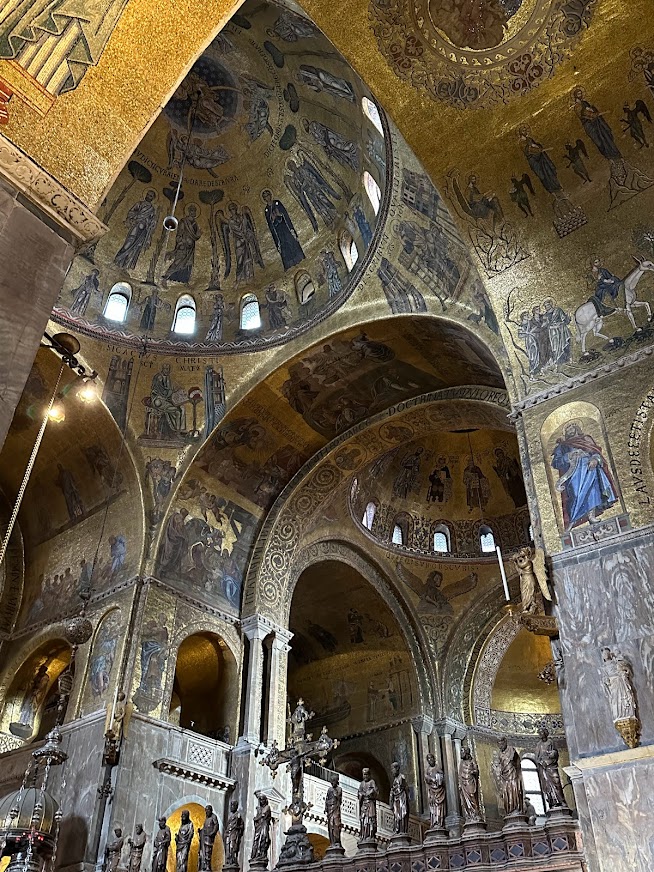
- When you first enter the interior of the building, you’ll be blown away and humbled with the staggering amount of mosaic images of Old Testament scenes and lives of the Saints, we’ll start our journey in the doorway of St. Mark.
The Flood Mosaic:
One of my favorite mosaics in the entrance area (narthex) of St. Mark’s is a series of narratives about Noah and The Flood. In the early Christian church, most could not read or write – and if they could they may not own a Bible, so it was important to educate through art and create Biblical narratives that were easy to ‘read’ in artistic form.
The Byzantine Empire was strict about iconography and how religious art should look, not to reject artistic creativity, but to ensure that each member of the Body of Christ could walk in a church anywhere in the empire and understand the Biblical story and recognize the characters. It may seem flat to us today, but at the time this was a groundbreaking way to introduce The Gospel and allow the faithful to connect with the stories on a personal level as they worshipped.
- It is interesting to note that the narthex/entrance area of St. Mark’s was meant to prepare the faithful for the mindblowing display of mosaics and spiritual art awaiting them in the main Basilica. This area is vivid and overwhelming in awe but also prepares you for what is to come when you enter the grandeur of the interior of the Basilica’s church.

Study the image above and you are able to see the story of Noah and the Ark in vivid detail. I love how the animals are displayed getting onto the ark, including a lion that resembles the lion of St. Mark.
- St. Mark is often seen as a lion in religious art…this comes from The Book of Revelation (4.7) where it is believed the four characters described by St. John (author of Revelation) refer to the four Gospel writers. You will often see imagery of St. Mark as a lion in churches throughout the world. St. Mark is the patron of Venice and you will see The Winged Lion of St. Mark throughout the city. Learn more here.

- St. Marks has over 1.5 football fields worth of gold mosaic!
- These mosaics are made with gold and glass tesserae
- Tesserae: a small block of stone, tile, glass, or other material used in the construction of a mosaic.
- Mosaics are an ancient art, but Christian churches were the first to consistently decorate cathedral walls with mosaics. Having the mosaic on the wall versus the floor (where damage could more easily occur) allowed mosaicists to create scenes with glass and gold that were otherwise not used in mosaics of the Greco-Roman era.
Our Lady of Nicopeia Icon:
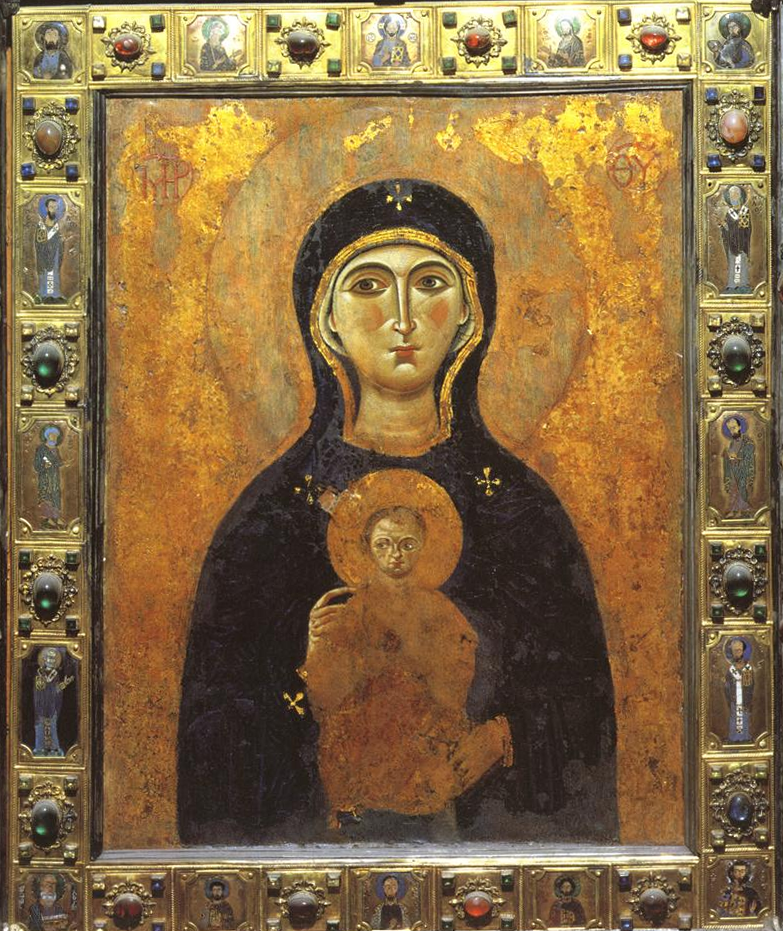
One of the great treasures of St. Mark is a holy icon of Our Lady of Nicopeia (Our Lady of Victory)
This icon was stolen during The Sack of Constantinople and has been an important icon for veneration in Venetian life ever since.
The icon used to be used in Constantinople when going out into battle as a pray for Mary’s intercession (praying on a person’s behalf) to her son Jesus. The idea is that Mary, who at Cana asked Jesus to act in turning the water into wine, is a powerful intercessor. This was known as Our Lady of Victory.
For many years, Venetians believed this icon was painted by St. Luke.
The Gospel writer was believed to be an artist (which I don’t doubt given the historical tradition), but this particular icon was actually done by Luke of Constantinople…a wellknown and established iconographer based in Byzantium. Learn more here.
This icon is not only beautiful, but is interwoven with Venetian history. The icon was often brought out during times of plague and war and continues to be an important icon to Venetians today.
The Pala d’Oro
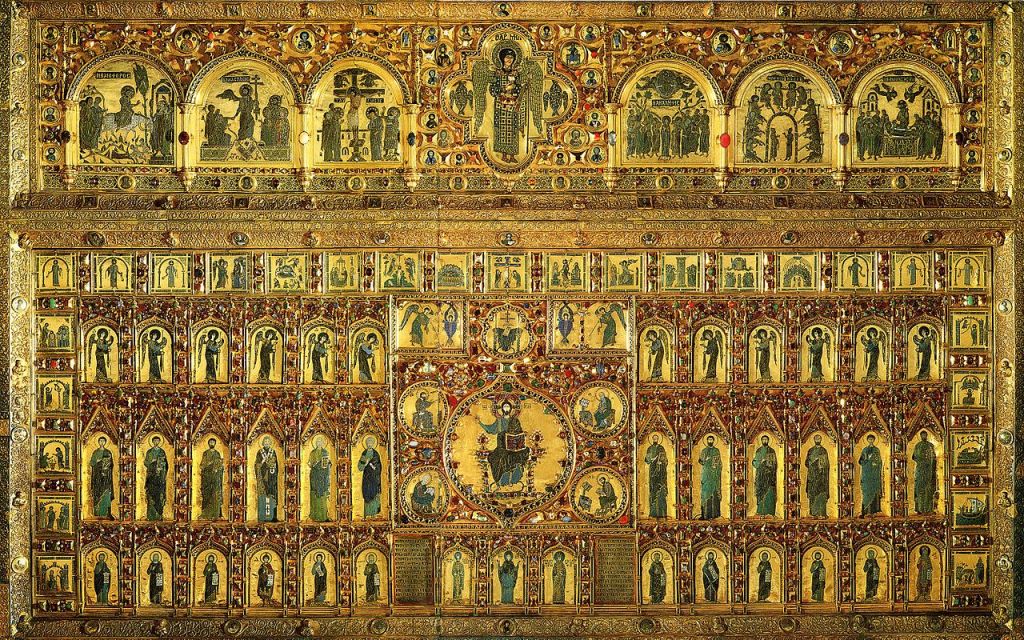
Literal translation is the Golden Pail or Golden Cloth. This high altar retable of St. Mark’s Basilica is one of the finest examples of Byzantine enamel style with both the front and rear sides decorated.
- What is Byzantine enamel style: also known as Cloisonism (not be confused with later Closison movement in 19th/20th centuries), The Byzantines perfected a form of enameling where gold strips are soldered to a metal base plate making the outline of an image. The recessed spaces between the gold filigreed wire are then filled with a colored glass paste that fills up the negative space int he deisgn with whatever color chosen.
It was originally commissioned in 976 by Doge Oresolo and initially made up of precious stones and several enamels that told lives of saints. It continued to be expanded in 1005 by Doge Falier and again in 1345, when the goldsmith giovanni Paolo Bonsegna completed the altarpiece (done by Andrea Dandolo). The Gothic style frame was added to the piece with more precious gems.
Today the Pala d’Ora includes over 1900 precious stones and countless gold. This was not to be showy as much as to give Glory to God as the altar was the central spot of turning the bread and wine into the Body of Christ (Eucharist). And of course civic pride as well.
- Altarpiece is over 9 feet wide and 2 feet tall
- It is made up of 187 enamel plaques and 1927 gems
- It is made of gold and silver
- It tells the stories of saints and the Blessed Mother is featured
- It also features Doge Falier
The Treasury Museum of San Marco:
When you tour St. Mark’s you must stop in The Treasury Museum which houses many of the greatest historical treasures and relics in the Basilica, including a fragment of The True Cross, which was featured in church processions and documented in Gentile and Giovanni Bellini’s Procession Paintings.

While these are not strictly Medieveal – The Four Horses of St. Mark’s which guarded the church for many years, and are now in the Basilica Museum are a treasure of the church and people of Venice.
Sadly they too were taken from Constantinople during the 1204 Sack, but have become ensconsed in the myth of Venice.
Genoa said it would take those horses falling to shake the Republic of Venice, which is why Napoleon probably removed them when he invaded in 1797 and took them temporarily to Paris (luckily they were returned to Venice.
The horses are Roman and date to the 2nd or 3rd century AD and were modeled after the famous Equestrian Statue of Marcus Aurelius in Rome (c. 175). It is believed they were moved to Constaninople at a later date. They are mostly copper with a bit of bronze.
For centuries they were on the Hippodrome of Constantinople.
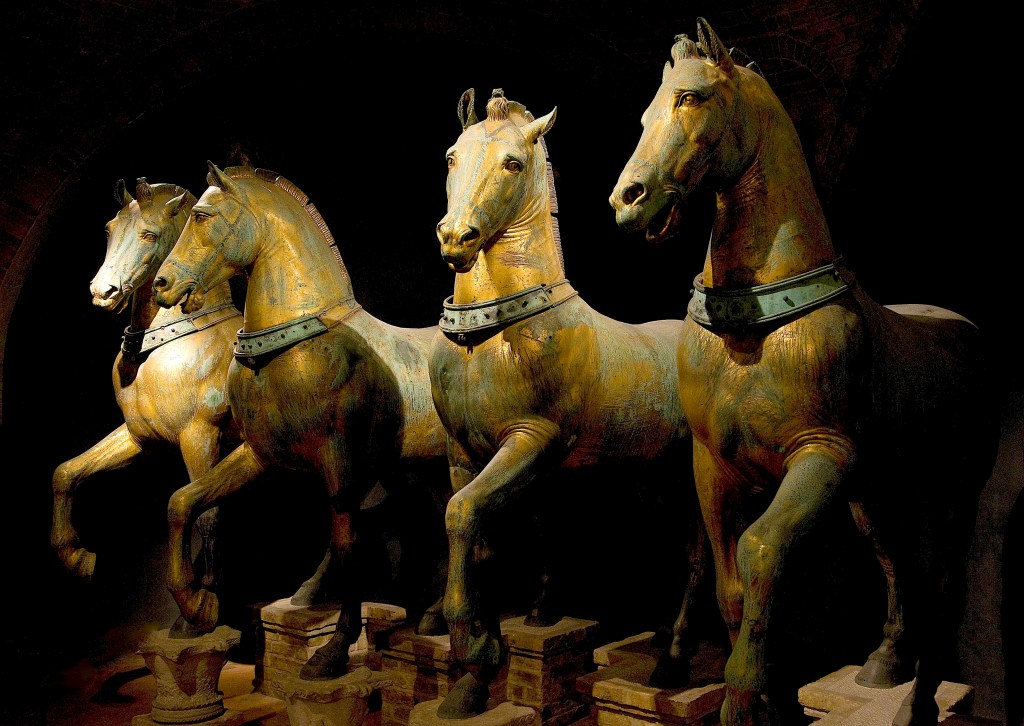
Copies of the original horses are now on the exterior of St. Mark’s Basilica.
While this is just one tesserae of information in a sea of mosaics, I hope you enjoyed this edition of Medieval Monday and learned a bit about St. Mark’s.
For more information check out their official website.
 Art Expeditions