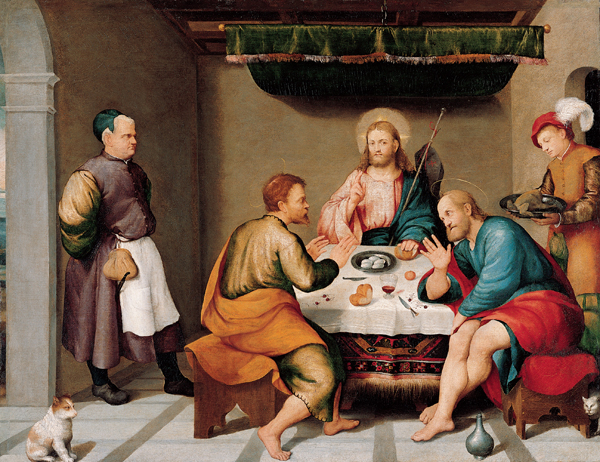
Today on The Masters of Venice we’re going to meet late Renaissance artist, Jacopo Bassano; a contemporary of Titian, Veronese and Tintoretto, Bassano is one of the titans of Venetian art.
Though not as famous as Titian, Bassano was well-regarded by his peers and influenced later generations of artists. As we learned in our last lesson, Veronese admired Bassano as one of the great Venetian painters as evidenced by including a portrait of Bassano in The Wedding at Cana.
Bassano’s immense talent was an ability to quickly learn and adapt the convergence of High Renaissance styles emerging from artists like Germany’s Durer to Italian based painters as they delved into Mannerism and other styles.
Bassano is one of the first artists to usher in a new style of naturalism, that became popular in The Veneto (mainland of Venice).
His night scenes and use of light in dark in such masterpieces as his Baptism of Christ (The Met) broke new ground in Italian art and was often copied in the later generation.
Jacopo Bassano was born around 1510 in the mainland Venetian city of Bassano al Grappa.
His father Francesco il Vecchio (il vecchio means the elder in Italian fyi) was a successful painter in Bassano al Grappa, where he established a flourishing famly workshop.
Jacopo decided to move to Venice to further his art education circa 1530, where he studied under well known painter Bonifazio de Pitati (also known as Bonifazio de Veronese – but not the same as Veronese we refer to).
It was during this time Jacopo was introduced to artists like Titian and il Pordenone among others. Early on, Jacopo was deft to study and take on various styles and not only master them, but also bring his own unique stamp into the works. He dabbled in High Renaissance styles that continued to seek symmetry as well as the emerging Mannerism style that was quick to reject perfect form and embrace asymmetrical compositions.
Though Jacopo found early success in Venice, his father’s death in 1539 prompted him to return to his hometown on the mainland. Jacopo took over his father’s studio for the rest of his life worked mostly in Bassano al Grappa.
He married and had four children, who were also artists: Leandro, Francesco, Giovanni and Girolamo. His sons were also successful artists. We’ll dive into their careers in a future post
While other Venetian artists like Giovanni Bellini had brought a certain naturalism to their Biblical scenes, with nature playing a key role in the composition, Jacopo Bassano brought this a step further. He developed a naturalism in Biblical scenes where the stories also have a genre-like emphasis on domestic settings and animals. This was a new style in the 16th-century, which brought acute attention to naturalistic detail where figures are engaged in everyday activities.
While it might not appear revolutionary to our eyes, at the time, Bassano’s mastery of melding the traditional style of Venetian Biblical Drama with a heightened domestic simplicity was unique.
His ability to bring ordinary and even mundane aspects of life into Biblical scenes influenced Baroque master Caravaggio.
The reasoning behind Bassano’s domestication and ordinary character in his Biblical storytelling? Bassano wanted to invite the faithful to ponder the art in devotion – helping them to see themselves in the Biblical stories and relate the lessons and morals to their own lives.
Art historian Giorgio Vasari commented…“very beautiful” and can be found “dispersed throughout Venice, and they are held in high esteem—especially the little works with animals of all kinds.”
- Vasari slighted Bassano a bit because Florentine art did not place a high value on the ‘genre’ aspect that Bassano could create in his works. Florentine artists would create natural landscapes often with Roman Ruins or palaces. Genre painting depicts everyday life and was popular in in Northern Europe but not as accepted in Florence and other areas of Italy. Learn more about ‘Genre Painting’ here.
If you follow the course of Bassano’s career you see that he is not afraid to experiment with new styles and is quick to pick up on the latest ideas from the various regions of Italian city-states. He was influed by Mannerist Parmigianno who was known for not paying attention to natural form if it meant he could create an elegant image. Ex: Parmigianno’s Lady with the Long Neck at The Uffizi in Florence.
He also studied prints by German artist Albrecht Durer as well as hearkening to Rome’s star Raphael.
- Bassano was one of the first artists to paint a nocture – or painting in a nighttime landscape with artificial lighting that would become a heavy fixture of later Baroque masters like Caravaggio as well as the Northern European artists of the late 16th century and beyond. (Think Rembrandt)
- These nocturne scenes became very popular in Bassano and Venice
Featured works by Bassano:
I featured his Supper at Emmaus at the top of the post because I think it perfectly highlights the depth of Bassano’s ability absorb the domesticity of a scene and still keep the mastery of the Venetian form.
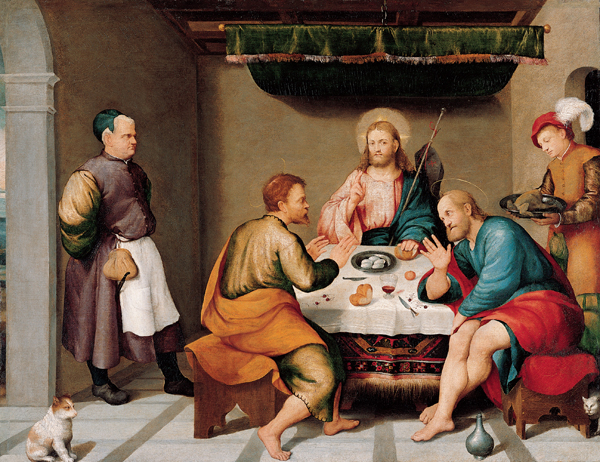
The bright colors is akin to Titian or Veronese. Christ is in the center of the story, but is just off center enough to make you feel as though you are stepping into the home to join the dinner table.
The men are in deep conversation and so intertwined with the ordinary around them that they fail to recognize the extraordinary in their presence. Christ is risen and his about to reveal himself in the breaking of the bread.
I love the cat and dog who see to look at one another from each side of the room.
Dogs usually represent fidelity in art. Cats have different meanings, but often refer to ‘catching the devil (a mouse) in a trap.’ In this case I think the cat and dog are just part of the scene and play on the sentiments of the viewer…this looks like my house! It reminds the faithful of Christ’s presence in the Eucharist and in the ordinary around them.
The men at the table are in deep discussion, most likely about the things that happened in Jerusalem…they are so focused on the past they don’t see the present and future before them…Christ is right there. Life is alive right now. It has a depth that though humble at first glance would stir deep devotion.
- In reading this article from The Kimbell Museum of Art in Dallas, I learned that Bassano tweaked this work a few times before completing it. Oil paints provide more flexibility to make changes mid-painting, which was revolutionary at the time (and still amazing for modern artists)
The Baptism of Christ:
Housed at The Met, Bassano’s Baptism of Christ is unlike any Baptism scene I have ever seen. If you compare it Veronese’s in our last lecture there is a 180 difference in perspective.
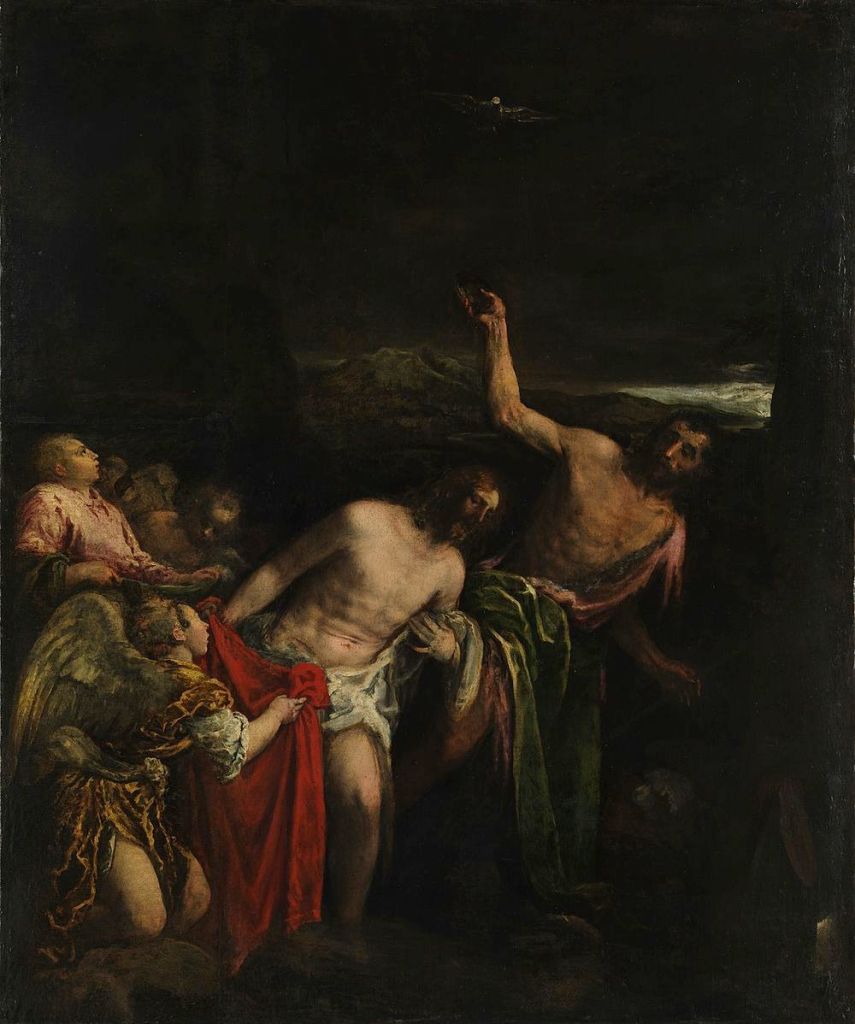
This nocturne feels more like The Agony in the Garden – it is dark and the angel seems to be supporting Christ as he leans into Baptism, accepting it but feeling more like his Agony (if this cup should pass from me)
Bassano is obviously well versed in his theology and open to diving deep into religious themes. Bassano sees The Baptism as akin to Good Friday – a blessing and grace from God, but with Jesus’s Baptism he begins to face his road to cavalry. It is something that is beautiful, but also difficult to take on the cross and enter ‘the desert’ and his mission.
This is an interesting take and profound to contemplate.
His darks and lights, feel borrowed a bit from Titian (a master of painting in black when needed), but also a forerunner to later Northern European artists like Rembrandt. The movement of the figures has an almost Rubens feel.
Bassano no doubt was quite to learn from Durer and his use of light and dark…

This image of The Good Samaritan from London’s National Gallery is haunting. I feel the pain of the Good Samaritan pulling the injured man up.
The story comes from The Gospel of Luke (Chapter 10) and tells of a Jewish man who was traveling from Jericho to Jerusalem when he was robbed and left for dead. A Rabbi and Levite pass by as they do not want to get involved, but a Samaritan stops and shows compassion. This story is tantamount in the Christian faith about loving our enemies and neighbors.
Bassano may have been the first Italian to paint this story, and returned to the theme several times.
The dogs are licking the mans wounds, which reminds me of another Biblical story of the homeless beggar Lazarus who’s wounds were licked by dogs, and his master wouldn’t lift a finger to help him. Luke 16
We’ll visit the legacy of Bassano’s family in our next lesson before we move into the heart of Venice in the 17th and 18th centuries with masters Tiepolo and Canaletto.
Don’t forget to SUBSCRIBE for updated posts and lessons
Follow Art Expeditions on Facebook
 Art Expeditions