Today on Renaissance Wednesday we’re traveling to Northern Italy in the late 15th century to meet on of the masters of the Italian Renaissance, Andrea Mantegna.
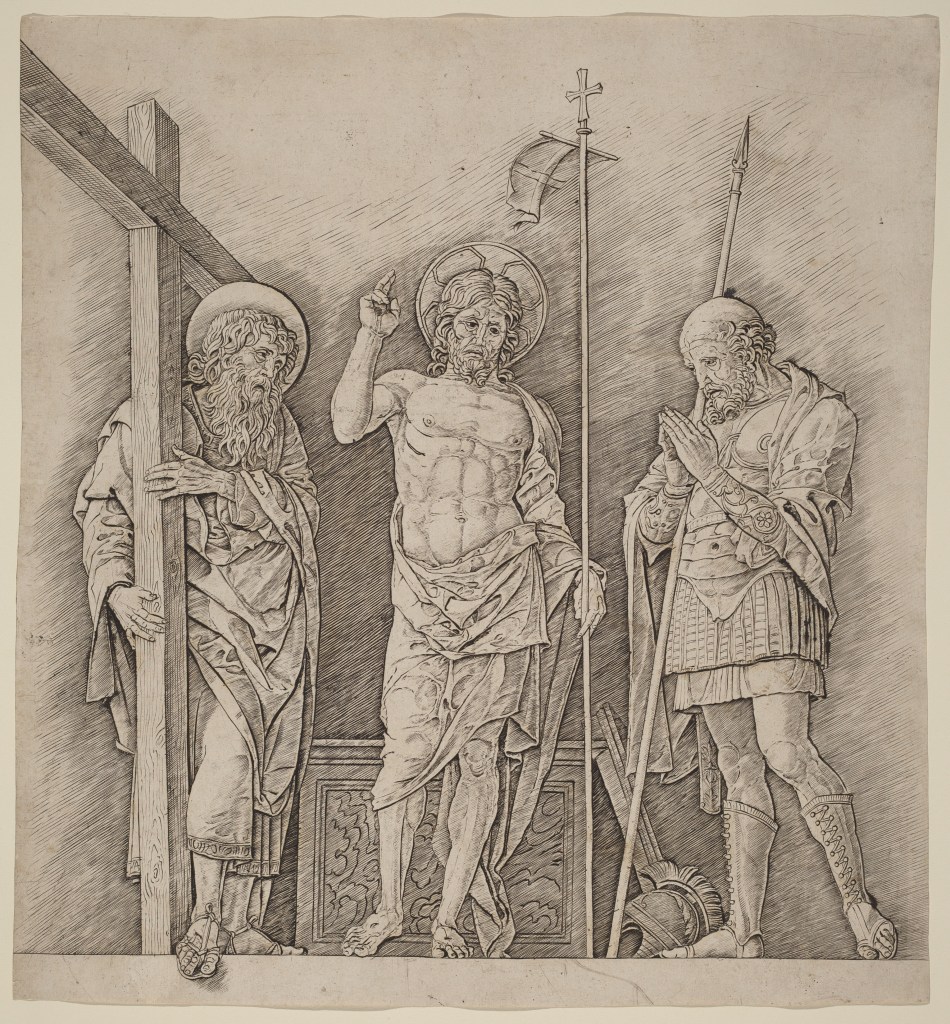
Before we dive in, a note on the image above: I selected the opening image of Mantegna’s Risen Christ from The National Gallery in DC because I wanted you to see the command of perspective and detail that Mantegna achieves in his art. Very few can compare with the structure and depth Mantegna was able to create in his work.
The Renaissance focused on classical antiquity and expressing a realistic interpretation in the human form. The idea that humanity is made in God’s image and the beauty of the human form in art is certainly seen in The Risen Christ. By placing St. Andrews foot over the foundation line of the painting – there is a fooling of the eye to give the appearance that he is stepping towards us and this painting is a 3D image. This was groundbreaking in the early Renaissance.
Who was Mantegna?
Andrea Mantegna was born in 1431 in Isola di Carturo in the Venetian Republic close to the city of Padua as the second son of a carpenter, Biagio.
Padua was a bustling city and home to one of the oldest colleges in present day Italy. Late Medieval giants like Petrarch and Dante taught at the University…Padua was a crossroads of intellect, humanism and ideation; a perfect spot for young Andrea to grow into his artistic talents.
At age eleven, Andrea became the apprentice of Paduan painter and history buff Francesco Squarcione.
Squarcione was highly regarded throughout Italy…137 students passed through his school including future Tuscan Masters like Paolo Uccello, Filippo Lippi and even Donatello.
What made Squarcione unique and proto-Renaissance artist himself, was Squarcione’s focus on the study of classical art.
Squarcione was passionate about ancient art and traveled throughout the Italian Peninsula and to Greece collecting antique statues, reliefs, vases and more to bring back to his studio for study and admiration.
This emphasis on Classicism, along with his exposure to Florentine works by his classmates, deeply impacted Mantegna’s artist vision.
Like his teacher, Mantegna fell in love with archaeology and traveled to sites to study ancient sculptures. He created a statuesque style of painting that is deeply realistic in muscular composition, but also stoic like statues of old.
Mantegna married Nicolosia Bellini, the daughter of Bellini family patriarch, Jacopo.
Mantegna would work with The Bellinis from time to time and was influenced by his father in law, who was a mentor to him.
Perhaps his biggest influence in developing his unique style were studying the works of Donatello in Padua at The Basilica of St. Anthony.
Early works:
- One of his earliest commissions was a cycle of frescoes of St. James in the Ovetari Chapel in Padua. His fresco work was set in the worm’s eye perspective. Sadly this gorgeous chapel filled with gorgeous art from Mantegna and other contemporary Paduan artists was badly damaged and mostly destroyed during an Allied Bombing in 1944.
- This bombing was an accident, as The Allies worked ot avoid damaging artistic and historical masterpieces, but accidents happen and sadly art is lost and destroyed in war.
- Luckily we have images of the art before the destruction.
*Worm’s Eye: a view of an object from below, as though the observer were a worm; the opposite of a bird’s eye view. It can be used to make an object look tall, strong, and mighty while the viewer feels childlike and awed by the grandeur of the scene. It commonly uses three-point perspective, with one vanishing point on top, one on the left and one on the right.
Here is a colored version of a black and white photo of the Ovetari Chapel before it was destroyed.

Mantegna was commissioned for a number of altarpieces in Padua including the San Luca Altarpiece with St. Luke and other saints, for the church of S. Giustina.
It is now in the Brera Gallery in Milan.
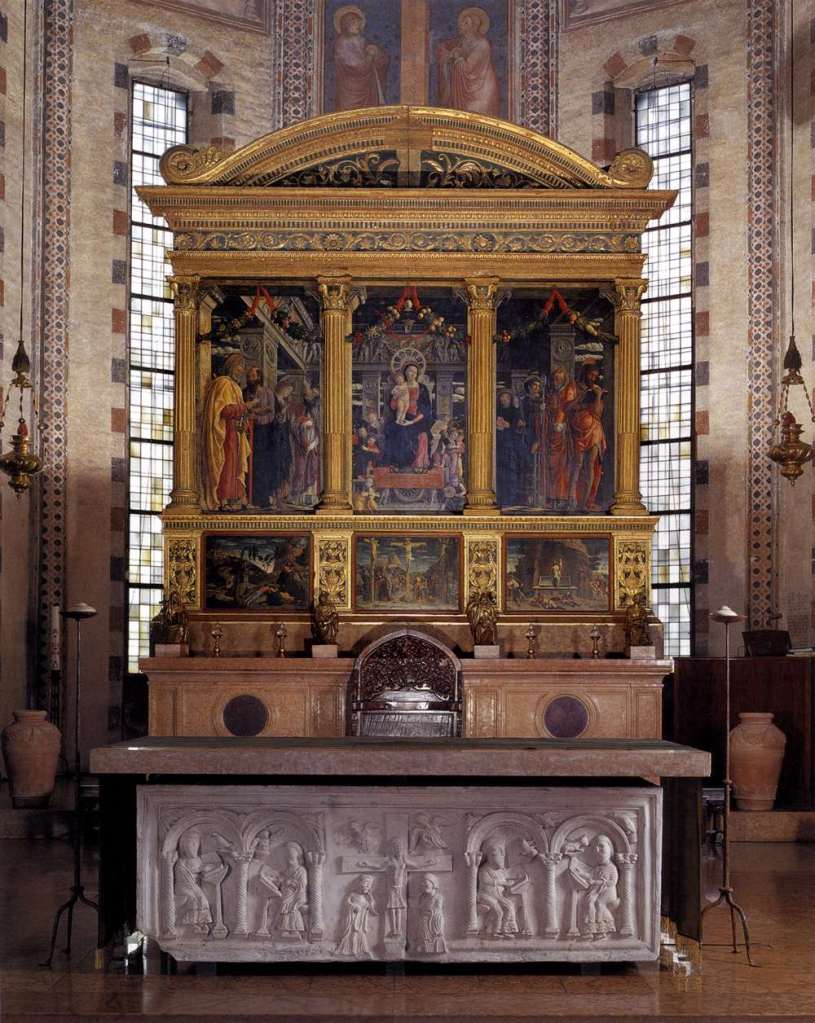
Mantegna also contributed to the art of The Basilica of San Zeno in Verona (not far from Venice and Padua) from 1457-1460.
Commissioned by the Abbot Gregorio Correr. In the center the Madonna is enthroned with the Christ Child. This is done according tot he Byzantine iconography of Victorious Madonna, surrounded by angels and eight saints: Peter, Paul, John the Evangelist, and Zeno on the left, and Benedict, Lawrence, Gregory and John the Baptist on the right.
The composition is highly detailed with classicial elements; a frieze with angels holding garlands remind viewers of the classical sarcophagus.
The altar frame was designed by Mantegna and is stunning.
- Many consider Mantegna’s San Zeno altarpiece the first example of true Renaissance art in Verona.
In 1460, The Marquis Ludovico III Gonzaga, the ruling family of Mantua recruited Mantegna to enter his service as a court artist. Mantegna took the job, residing for a time outside of Mantua in Goito. In 1466, he and his entire family moved to Mantua together (he was commuting before then). His salary of 75 lire a month was so large at the time it demonstrates the value of Mantegna and his renown as an artists.
Mantegna made a lasting impact in Mantua and completed many important commissions for the Gonzaga family.
His Mantuan masterpiece, The Camera degli Sposi (Wedding Chamber) in the city palace (Palazzo Ducale) is a a triumph of Renaissance art and inspired many subsequent artists like Corregio and Veronese.
While the luminous frescoes that line the walls with almost a Baroque feel, inspite of Mantegna’s Classicism, cast a spell…the true treasure here is the painted oculus.

This tromphe d’oeil (fool of the eye) – makes it seem as though the ceiling opens up like the oculus at the Pantheon in Rome with the sky pouring in light as cherub like figures peek inside.
Mantegna faced adversity in Mantua after finishing the Camera degli Sposi. His son, Bernardino died, followed by his patron, the Marchese Lucovico and his wife Barbara. For a time no state art was commissioned and Mantegna grew rightly irritable and sad. It was only after the election of Francesco II of the House of Gonzaga did artistic commissions recommence. This allowed Mantegna to build a stately home in town that you can still visit today.
In 1488, Mantegna was called by Pope Innocent VIII to paint frescoes in the Chapel Belvedere in the Vatican, which included the now destroyed Baptism of Christ.
Ironically it was his trip to Rome that moved him away from his romanticized views of Classicism, instead painting bitter visions of antiquity. He returned to Mantua where he found support with the new Marchesa, the cultured and intelligent Isabella d’Este.
In 1492, he created the epic nine tempera pictures of the Triumphs of Caesar, which were sold in 1628 along witht he bulk of Mantuan art treasures to art collector King Charles of England. The slightly damaged Triumph of Caesar is now housed in Hampton Court Palace in England today.
His legacy:
Mantegna was a titan of the Early Renaissance. His classical taste was at times deemed too statuesque and austere, but his detail was astonishing. His influence touched artists like his brother in law Giovanni Bellini as well as Albrecht Durer who was introduced to Mantegna’s work during two trips to Italy. Even Leonardo da Vinci was inspired by Mantegna’s use of decorations with festoons and fruit.
His most important contributions to the advancement of artisitic technique include his introduction of spacial illusionism in frescoes and sacra conversazione.
His style of ceiling decoration was copied and became the standard for nearly three centuries of artists after him.
My observations:
Mantegna helped lay the groundwork for the Northern Italian Renaissance, but he also wasn’t afraid to break boundaries as needed. While it is a tragic painting one of the most interesting works of Mantegna in my opinion is The Lamentation over the Dead Christ. It shocks the viewer into uneasiness and realism unlike any other Italian Renaissance paining I’ve seen. The perspective, while most symmetrical is not fully symmetrical. It makes you feel as you too are kneeling at the feet of Christ.
- There is some speculation that the figures at the left might have been added in later, but I think Mantegna put them in the scene. Either way it is a striking and heartbreaking painting that shows his depth as an artist.

Thanks for stopping by on Renaissance Wednesday! Don’t forget to SUBSCRIBE to the Latest Blog Posts
 Art Expeditions