
Today on Impressionism Friday we’re going to learn about argubably the most famous of the Impressionists – Claude Monet.
Monet’s unique Impressionistic style changed the art world forever and he continues to be a beloved artist and inspiration for creators today.
It was seeing Monet’s works at my local museum growing up (The North Carolina Museum of Art) that piqued my interest in Impressionism and a desire to learn how to paint landscapes. As an artist I still find my niche in the Impressionism/Post Impressionism style. Monet is a great teacher of visualizing color and creating landscapes that while not photorealistic represent the true feel and scope of that scene.
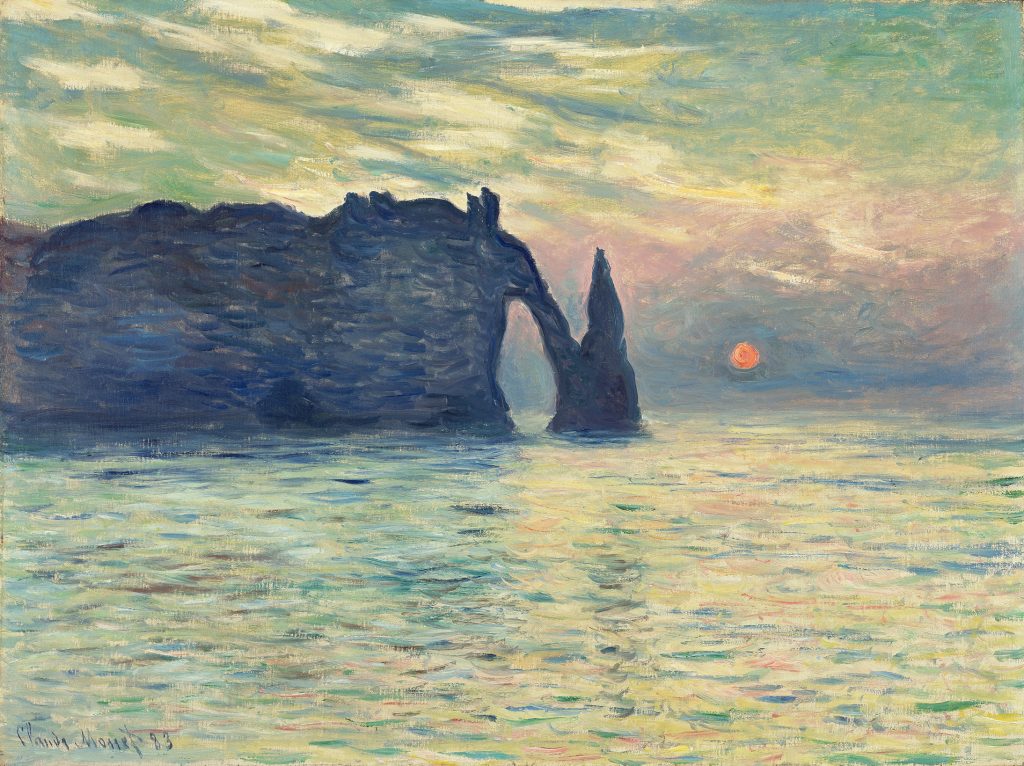
While we’ll return to Monet and his works again in the future as we delve deeper into Impressionism on Art Expeditions, I wanted to prime our ‘canvas’ with an overview of his life and showcase a few important works by Monet.
Biography:
Born in Paris on November 14th, 1840, Monet moved to La Havre in Normandy at a young age and spent most of his youth in the wild scenic coastal landscape. In La Havre, Monet becae interested in the outdoors and drawing from an early age. Normandy’s landscape heavily influenced his work as an artist later in his career, with many of his favorite scenes painted directly from Normandy’s countryside.
While Monet’s mother, Louise-Justin Aubree Monet was supportive and encouraged her son to pursue his art, his father was apprehensive of art as a career. His father wanted Monet to become a businessman…while it is easy to roll our eyes at this recurring them of parents not supporting their children’s painting dreams, logically you can see why his dad worried. Art was a difficult profession and unless you were accepted by The Academy and received commissions it would be hard to make a living.
Thankfully Monet wasn’t afraid of the risk and pursued his artistic dreams with fortitude and resilience.
Monet was very close with his mother and it was a time of mourning for him when she died when he was only sixteen years old.
He moved in with his wealthy widowed aunt, Marie-Jeanne Lecadre, who saw his talent and supported his artistic goals.
Monet first studied with Jacques-Francois Ochard, who was a former student of Napoleonic painter Jacques-Louis David.
It was meeting artist Eugene Boudin in 1858 that spurred the course of Monet’s shift to what would end up being plein-air Impressionism.
Boudin was an established painter (we’ll meet him in a future expedition post), who encouraged Monet to develop his own techniques and paint ‘en plein air’ – out of doors.
The innovation of tube paints made this outdoors painting (mobile painting if you will) possible. Boudin would take Monet on outdoor excurcisions and they’d paint together.
Monet later referred to Boudin has his “master” and he “owed everything to him.”
Monet studied at the Academie Suisse for a time where he met Camille Pissarro in 1859.
However this was cut short when Monet was drafted for military service in the French territory of Algiers in Northern Africa.
The unique culture and vivid colors of North Africa left a lasting impact on Monet who said of this time: “contained the geme of my future researches (color and style).”
Poor health forced Monet home and he ended up paying a fee to end his service.
It was during this time he met another artist, Johan Barthold Jongkind who also served as a mentor to Monet.
Monet’s father finally relented and allowed him to enter the Charles Gleyre Studio where he met Renoir and Bazille.
Frederic Bazille and Monet became best friends and they traveled together in search of painting motifs. Monet also often painted alongside of Renoir and Alfred Sisley, both of whom desired to articulate new standards of beauty in conventional subjects.
Though Monet had early success with The Paris Salon in 1865 with La Pointe de la Heve at Low Tide and Mouth of the Seine at Honfleur, he was soon rejected by the establishment as being too radical when he submitted his important Le dejeuner sur l’herbe in 1866.
He eventually stopped trying to fit in with the established Salon, rather plotting his own course with the emerging group of what would become The Impressionists.
- In 1865, Claude began a relationship with a model, Camille Doncieux and in 1867 she gave birth to his child Jean. When Claude decided to marry her his father cut him off financially. Fortunately his aunt allowed him to move into her home at Sainte-Adresse.
- He eventually reunited with Camille later that year and moved to Etreat, which would be the backdrop of many of his formidable landscapes (Mount Etreat)
Franco Prussian War and Death of Bazille:
The Franco Prussian War forced France and the artistic community into chaos.
Monet and his family found exile in the Netherlands and London (where he painted his famous Houses of Parliment series) in order to avoid conscription.
Whille in London, Monet reconnected with Pissarro and also met James McNeill Whistler. It was in London, Monet befriended his first and primary art dealer Paul Durand-Ruel.
In 1871, with Monet’s father’s death he returned to France and settled for a time in the Paris suburb of Argenteuil. He acquired a sailboat to paint on the river and also worked on his famed Argenteuil Garden Series here.
Unfortunately his dear friend, Bazille died in the Franco-Prussian War, which continues to be a stolen life of what would have undoubtedly become one of the most important Impressionists and artists of the 19th-century and beyond.
The Founding of Impressionism…
Monet accidentally created ‘Impressionism,’ and it all starts with a painting and a critic.
In 1874, a group of ‘Impressionists’ – Monet, Renoir, Pissarro, Sisley, Degas, Morisot and even founder of Modern Art, Cezanne began to exhibit their work independently and decided to organize a show.
The first show in 1874 featured over 30 artists who were fed up with the stringent Academic Salon.
One of Monet’s works in the exhibit was a painting he called: Impression, Sunrise.

In truth the work had been untitled but organizers asked Monet to give it a title for showcase purposes. The name Impression, Sunrise was an afterthought but it stuck.
At the exhibition a few art critics came to make fun of the movement and these rogue artists, including Louis Leroy who wrote a hostile review of Impression, Sunrise and dubbed these artists as ‘Impressionists.’
The name stuck and while it makes sense artistically given many of the Impressionists were seeking impressions of reality versus perfect realism, Monet actually regretted creating the term.
The Impressionists would showcase eight times in total from 1874-1886. The only Impressionist in all eight of the exhibitions was Camille Pissarro.
The Death of Camille…
- In 1878, Camille was diagnosed with uterine cancer and died the next year. Monet turned to art to paint studies of his deceased wife.
He began a friendship that would eventually lead to marriage with Alice Hoschede (a widow). They married in 1892.
Giverny:
In 1883, Monet and his family moved to a rented house and gardens in Giverny. This enabled him to have domestic stability, a painting studio (in the barn) and small orchards and garden that would end up inspiring his most famous scenes – of waterlilies and the Japanese Bridge.
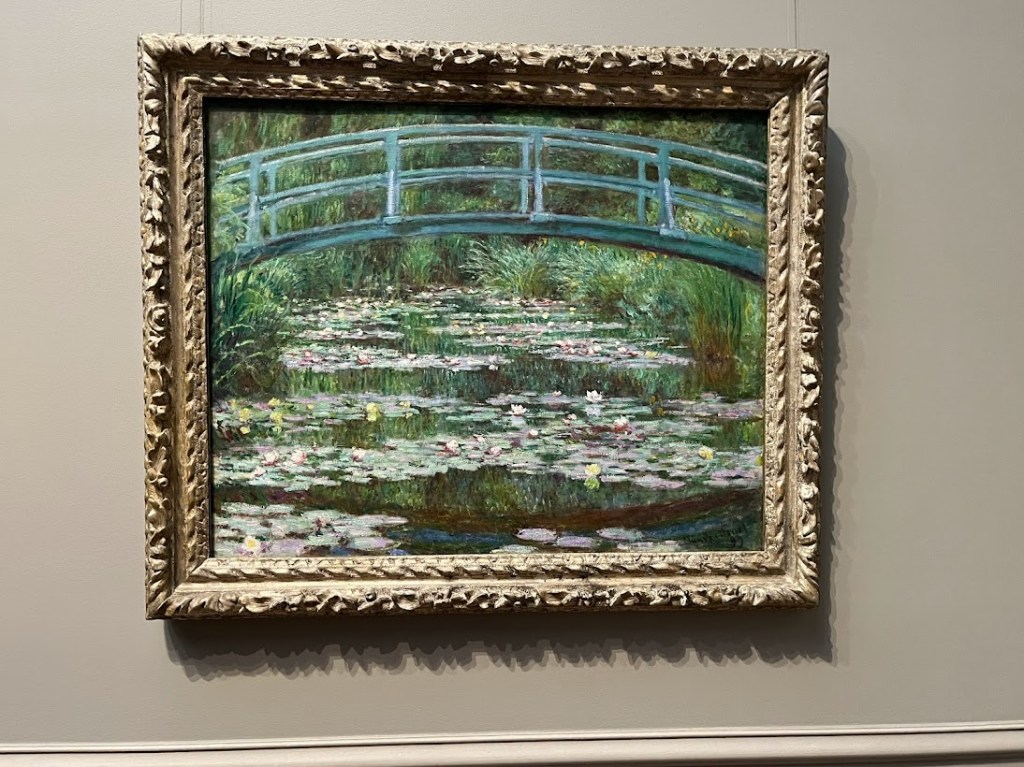
From 1889 and onwards for roughly twenty years, depicting waterliles became an obsession of sorts for Monet as he sought to depict various colors and lights based on the time of day.
Monet never stopped exploring colors and working to depict light and color in palpable ways on his palatte.
In his later years his poor eyesight plagued him and yet he continued to paint. Some may see these paintings as blurry, and yet his color even in the haze is striking and haunting.
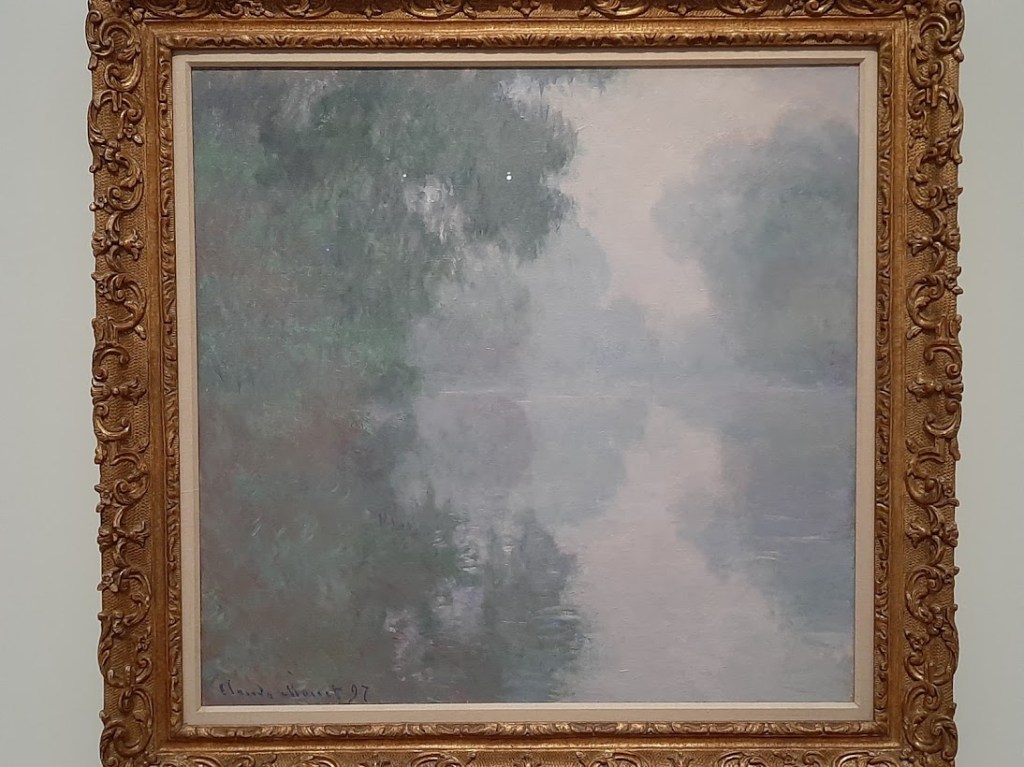
Monet lived across generations of change in France and in Europe. He endured the horrors of war and social upheaval of industrialization, which also allowed him to new technologies like photography come to life.
He died of lung cancer on December 5, 1926 at the age of 86 and is buried in Giverny’s church cemetery.
Monet’s home, garden and water lily pond were bequeathed by his son Michel to the French Academy of Fine Arts in 1966 and you can tour the gardens and house today (a goal of mine in the coming years!)
- Method and Style:
- Monet’s understanding of the effects of light on the local color of objects and effects of the juxtaposition of colors and how they are perceived helped found the foundations of Impressionism and influence additional movements in the Post-Impressionism area.
- As much as Monet’s art may feel like an Impression, it has a scientific leaning in composition as Monet works tirelessly to capture the color and light in a way that gives the essence of the scene and breathes life into the work.
We’ll continue to dive into Monet again in future posts, but until then I hope this quick introduction to Monet get’s you excited to learn more about Art and Impressionism!
Don’t forget to Subscribe to the Blog
We are also on Facebook
 Art Expeditions