Today on The Masters of Venice we are going to meet renowned Renaissance sculptor Jacopo Sansovino. His impact on Venetian life can still be seen today in St. Mark’s Square, which he helped redesign in the 1500s.
Biography:
Born in Florence in 1486 as Jacopo Tatti, he began to study with master architect and sculptor Andrea Sansovino in Florence in 1502.
Andrea Sansovino made an important impact as a father figure to Jacopo, who adopted Andrea’s suname of Sansovino early in his career.
When Andrea Sansovino was called to Rome in 1505, Jacopo stayed behind in Florence to work with a local sculptor, but later that year he followed his master to Rome, accompanied by esteemed Florentine architect Giuliano da Sangallo.
While in Rome, Jacopo was exposed to treasures of antiquity and classical sculpture, as well art by titans of The Roman Renaissance like Raphael.
As part of his studies, Sansovino began to copy Classical sculptures. During his time in Rome, one of the great archaeological finds of the generation was unearthed when the historic Laocoon sculpture of antiquity was found buried outside of Rome. The statue had been referenced by Pliny the Elder, and was well known, but assumed destroyed after 476 AD Barbarian invasions. Pope Julius II (who commisssioned The Sistine Chapel and rebuilding of St. Peter’s Basilica) asked Michelangelo to go to the site to confirm the find.
The Laocoon can been seen in The Vatican Museums today. You will also discover copies throughout Europe. This was a pre-Christian prototype for agony and sacrifice for country…Laocoon was a Trojan in the Greek Epic Cycle, and he was mentioned by Sophocles and more famously by Virgil. In Virgil, Laocoön who was killed with both his sons after attempting to expose the ruse of the Trojan Horse by striking it with a spear.
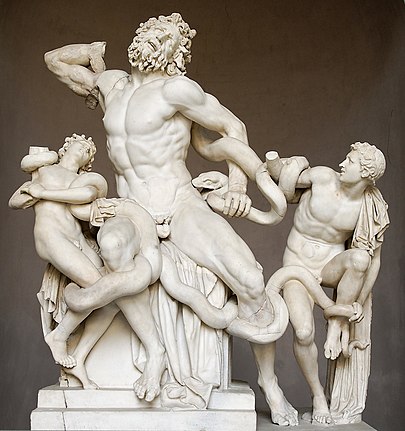
To celebrate this historic find, a contest was held for emerging sculptures to copy the newly excavated Laocoon. Contest judges included architect Donato Bramante and artist and architect Raphael Jacopo won the contest, receiving praise in Rome’s art community.
During the course of the next decade he worked in Rome and his native Florence.
- In 1511 in Florence he received a commission for marble sculptures of St. James for the Duomo and a Bacchus (in Bargello)
- His proposals for sculpture ot adorn the facade of the Church of San Lorenzo were rejected by Michelangelo (in charge). Sansovino wrote a bitter letter to michelangelo in protest in 1518.
Sansovino would have most likely remained in Rome had it not been for the brutal 1527 Sack of Rome, when the forces of supposedly Catholic monarch Charles of the Holy Roman Empire’s troops destroyed Rome in the worst sack since The Barbarian invasions of the 5th century.
The Sack of Rome ended The Renaissance in Rome and many talented artists fled to other areas including Venice.
Venice, however as a ‘Serene Republic’ with stable government at the time was able to continue and grow into their own unique Venetian Renaissance.
Sansovino did not intend to make Venice his final home, but en route to work for the King of France, Francois I, he stopped in Venice. He was immediately adopted by influential patricians who in 1529, recruited him to serve as the Proto (chief architect) of the Piazza San Marco.
Much of what we see of modern day St. Mark’s Piazza is thanks to the vision of Sansovino who was tasked to update the square and make modifications.
For the remaining 30 + years of Sansovino’s life, he helped create many of the most iconic and important architectural and sculptural projects in Venice including:
- Rusticated Zecca (Formerly the Public MinT, Artist and Art Historian called this Sansovino’s best work in Venice
- Loggetta and sculptures adjoining the Campanile in St. Mark’s Square
- Various reliefs and statues for The Basilica of San Marco
- He worked on rebuilding and renovating a numbr of churches, palaces and institutional buildings in Venice
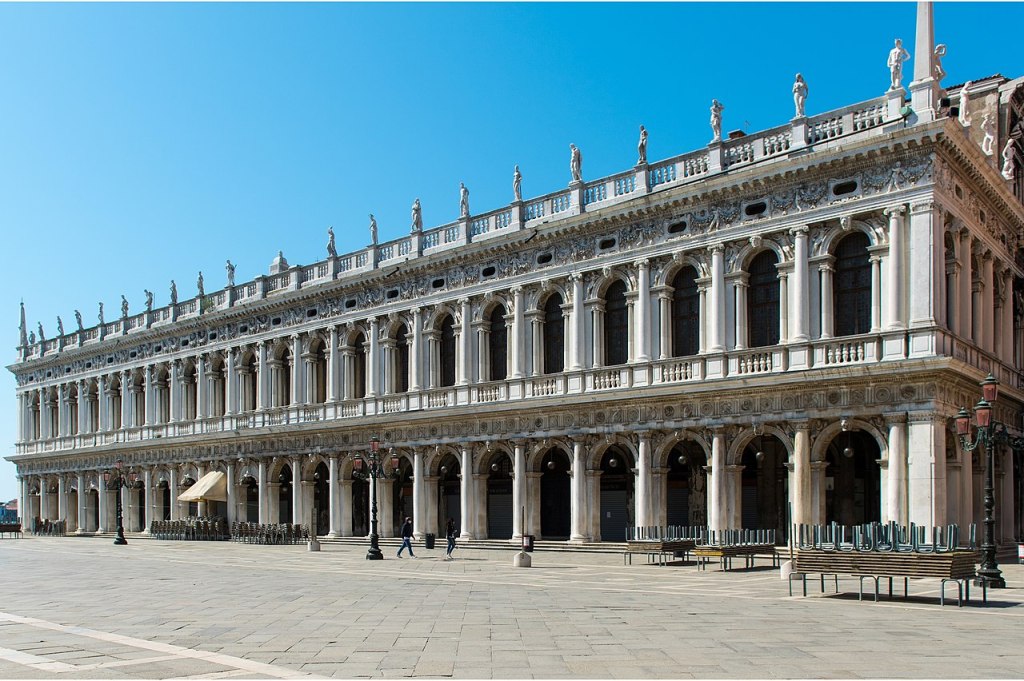
His masterpiece is considered The Library of Saint Mark’s – The Biblioteca Marciana, which stands in front of the Doge’s Palace across from the piazzetta.
This masterpiece was fraught with much difficulty – taking over fifty years and 30,000 ducats to complete.
During the 15th-16th century, Venice held one of the best collections of classical works in Europe. Petrarch himself donated his personal library to Venice in the 13th century (sadly his collection is now lost).
By the late 1400s there was a need to build a library to honor and protect this collection. The project got full traction with Doge Andrea Gritti in 1537. He recruited Jacopo Sansovino (the Proto of San Marco) to create and build a design to harmonize with the classical Roman Style of the surrounding Venetian architecture.
Sansovino had a bold vision and originally wanted to include a majestic dome that would counterbalance the Domes of St. Mark’s. As brilliant of an architect as Sansovino was, building domes, especially in watery and humid Venice was not easy work. As the construction was close to completion it collapsed. The Doge was furious and ordered Sansovino arrested. He could not be released until he peronally repaid for the damages. It was only for the intercession of friends like Titian who advocated for Sansovino that he was released and allowed to rebuild.
To thank Titian, Veronese, Palladio and Aretino for their support during his arrest, he put them on the Sacristy Door at St. Mark’s along with a self portrait.

This time around he nixed the dome and instead created an arcade style building with decoration continuing until 1560.
- Sansovino built the first 16 arcades and additions were made after his death.
The interior features artwork by masters like Veronese and Tintoretto as well as sculpture by Alessandro Vittoria and others.
The Renaissance architect Andrea Palladio described Sansovino’s work on The Library as “perhaps the richest and most ornate building that there has been since ancient times up until now”
Don’t forget to subscribe to the Art Expeditions to follow our adventures into The Masters of Venice and beyond.
 Art Expeditions