Today on Medieval Monday we’re going to dive into one of the most popular architectural trends in The Middle Ages – Romanesque Architecture.
When thinking about Medieval architecture we typically assume that Romanesque was one specific style of design that was eventually replaced by the Gothic style (which later emerged in France)…this is only partially true.
As I learned in an online course with Medieval expert Dr. Cook (I recommend his course The Cathedral on Wondrium) that Romanesque, though often termed as a ‘style of architecture,’ is really more a movement in architecture during a period of time. It is more useful to think of Romanesque as inspired by Roman style and borrowed from Roman structures of antiquity (hence the name ‘Roman-esque’ or Roman-like) to construct buildings that fit into a variety of cultures.
While Gothic typically has a more structured tone (though not all Gothic structures look the same by any means), Romanesque can vary widely by geographical region and cultural influence.
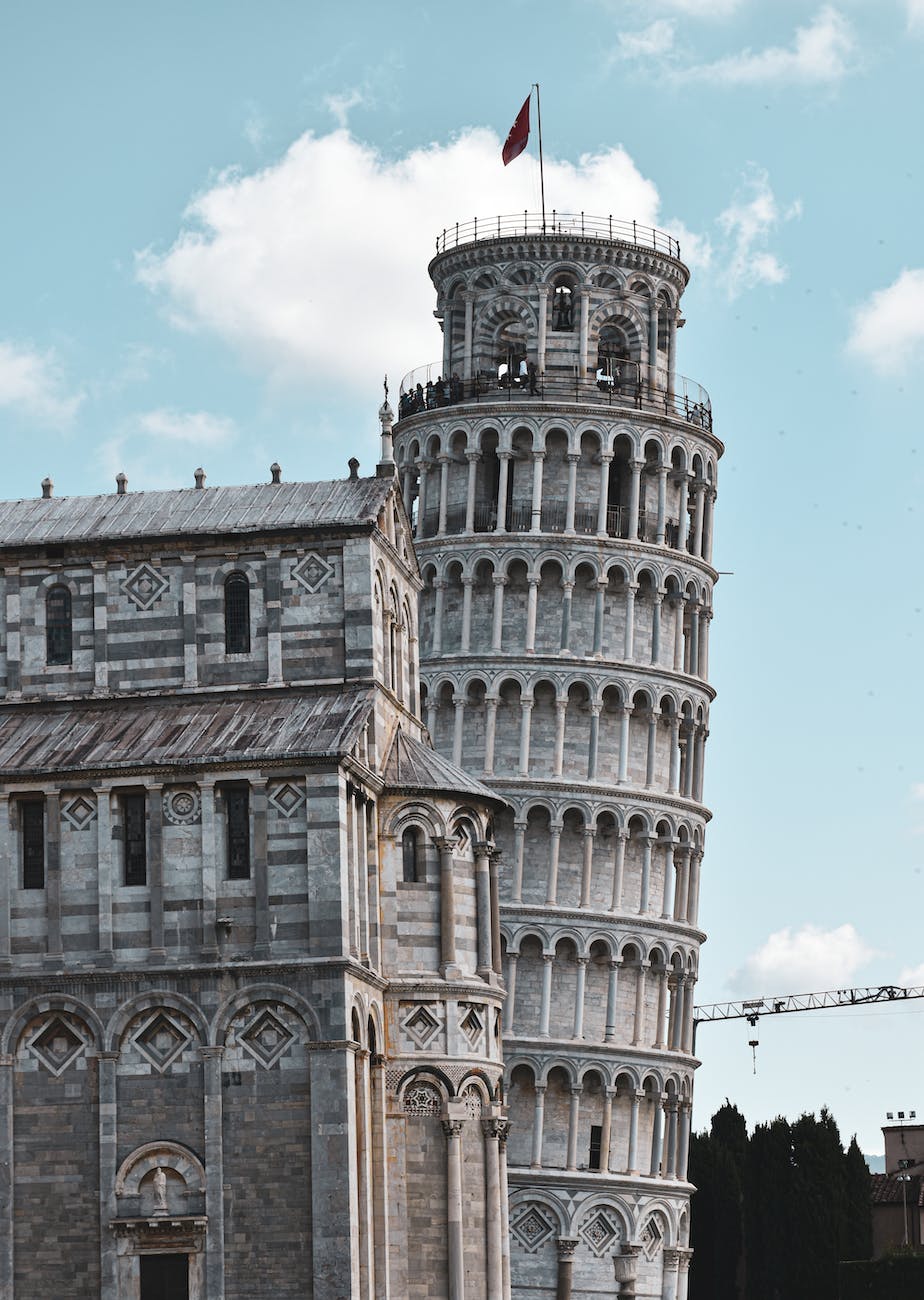
For example: I selected a photograph of The Leaning Tower of Pisa – this is an example of Romanesque! Compare that structure to the Cathedral at Autun in France.

So if Romanesque isn’t an exact blueprint for architectural style, then how do we identify it? Let’s explore common elements do we see in Romanesque churches:
- Romanesque architecture is characterized by towering round arches, massive stone and brickwork, small windows, thick walls
- They are usually very dark inside as putting windows in could have weakened the walls…there is a spiritual element to to the darkness of Romanesque churches…in a spiritual sense, darkness can quiet the mind and be more conducive to prayerful contemplation (think about how you might close your eyes to pray) and this was important to the monks, clergy and parishioners of theses churches.
- Drawing on the architecture of Rome, Byzantine art and biblical stories of the life of Christ, Romanesque churches and castles dominated the landscape of Medieval Europe
- Early Romanesque (or pre-Romanesque) finds its foundations in two rulers:
- Charlemagne – who reigned in the 8th-9th century as the first Holy Roman Emperor helped to united Europe and was a builder of infrastructure. He implemented a building campaign to fix or replace ruins and infrastructure that had been ravaged by centuries of Barbarian invasions. This was the beginning of a Carolingian architecture and early Romanesque.
- At the time they decided to follow the classical blueprints of the Roman architecture including Basilicas – they created their own unique style, but ti was copied on the Roman like structures of the past.
- He reigned in 8th-9th century – Carolingian architecture, which emerged into Romanesque.
- Otto the Great- one of Chalemagne’s Saxon successors continued this building campaign and Romanesque from this period is dubbed ‘Ottonian’. It continued to borrow from Greek and Roman as well as the Byzantine Empire
- Charlemagne – who reigned in the 8th-9th century as the first Holy Roman Emperor helped to united Europe and was a builder of infrastructure. He implemented a building campaign to fix or replace ruins and infrastructure that had been ravaged by centuries of Barbarian invasions. This was the beginning of a Carolingian architecture and early Romanesque.
- Romanesque is designed to have an imposing style that is meant to intimidate and inspire. It churches it reflects the glory of God, while Romanesque castles were also fortresses and designed to invoke glory and fear to avert invasion.
- Many Romanesque buildings have towers with octagonal spires that reach towards the heavens and stone buttreses that extend off the buildings to give their thick walls support
- Romanesque churches use a basilica style Latin Cross floor plan in a cruciform shape...with common elements:
- Apse: a dome or half dome at the front of the auditorium
- Ambulatory: a walkway
- Tympanum (semicircular area usually enclosing a sculpture, located above a door or window)
- Transept : The “wings” of a basilica, usually about two-thirds of the way from west to east, that make the bulding into a sape of a cross; horizontal section of a cathedral that went across the ambulatory to form a cross
- Romanesque buildings are known for their round, vaulting arches. Long hallways are encased in semicircular barrel vauts and a long series of arches are placed next to one another to create a soaring space.
- Vaulting: An arched structure of stone, brick, or reinforced concrete, forming a supporting structure of a ceiling or roof.
- Barrel vaulting: Barrel vault – An architecture tunnel vault or barrel vault is a semicircular arch extended in depth: a continuous series of arches, one behind the other. The simplest form of an architecture vault, consisting of a continuous surface of semicircular or pointed sections.
- When barrel vaults are combined into a square formation, they’re known as groin vaults. Gothic architects departed from this Romanesque feature in their preference for pointed arches, sometimes referred to as ribbed vaults. In all cases, these arcading—or successive—arches were supported by columns that wouldn’t have felt too out of place in ancient Rome.
The height of Romanesque was in the 10th-11th centuries, but it continued to influence Gothic and Renaissance structures.
Where can I see Romanesque architecture today:
When studying historical church architecture it is important to recognize that major churches in Europe were built to serve community – be it a monastic community, parish community, etc…and many were added onto or renovated in the the centuries after they were initially built to either reflect changing styles or need for additional space, structual changes, etc…
Add in wars, along with The French Revolutions anti-clericism which destroyed many features and treasures in French churches like Cluny we don’t have a ton of pure Romanesque examples left. But you can see Romanesque traces throughout Europe.
The majority of surviving Romanesque churches are in the European countryside, where the sparse population didn’t have a need to constantly rebuilt and remodel.
Here is a list of a few prime examples of Romanesque Churches you can visit in Europe today:

- Cluny: Was once the largest church in the world until St. Peter’s was built in the Renaissance-Baroque eras. It was devastated during The French Revolution but you can still visit part of the church today.

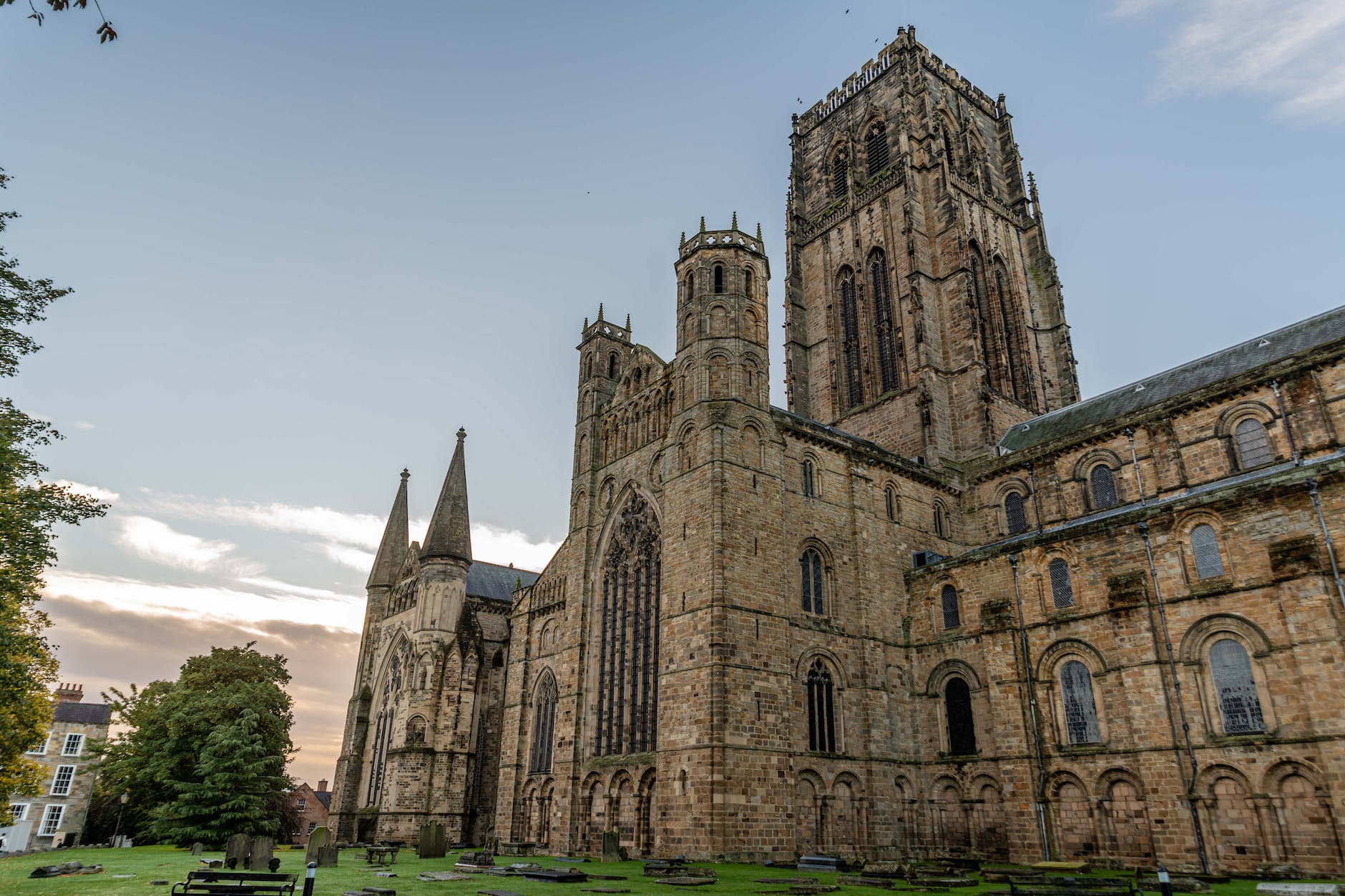
- Durham Cathedral: late 11th century; England; Stands like a mighty fortress and an example of Norman Romanesque, named after the invading Normans who took over England in 1066 and brought the dominant Romanesque influence with them.
- Durham Cathedral features soaring bell towers, zig-zag decoratons and round arches
- The church honors St. Cuthbert
- Interesting fact: many Medieval and Renaissance churches were built to honor a saint or The Virgin Mary. A relic(s) made a church a popular pilgrimmage site, where the faithful traveled to venerate the saint. You wanted to build a church worthy of this ‘relic’ and the saints.
- San Miniato al Monte Abbey in Florence, Italy…named after a popular local saint, Miniato, this is on of the prettiest church sites and architectural wonders in Florence. Built in the 11th-13th cnetury, it is Italian Romanesque in tone with finely crafted marble in perfect geometric symmetery symbolizing the perfection of God.

- The Cathedral of Santiago de Compostela in Spain, one of the most important pilgrimmage sites in Europe (the Way to St. James, who is buried here), has large drum columns with attached shafts that support a barrel vault – one of the examples of the Romanesque roots of the church.
Romanesque buildings:
Outside of churches, there were many Romanesque castles and fortresses in Europe including examples like:
The Tower of London
San Gimignano (city outside of Florence)
In the coming Medieval Monday features we’ll ‘travel’ to several of these Romanesque wonders for an in depth tour.
Recommended viewing:
The Cathedral with Dr. Cook on Wondrium/The Great Courses (included with monthly streaming edition)
Don’t forget to subscribe to the Art Expeditions blog
 Art Expeditions