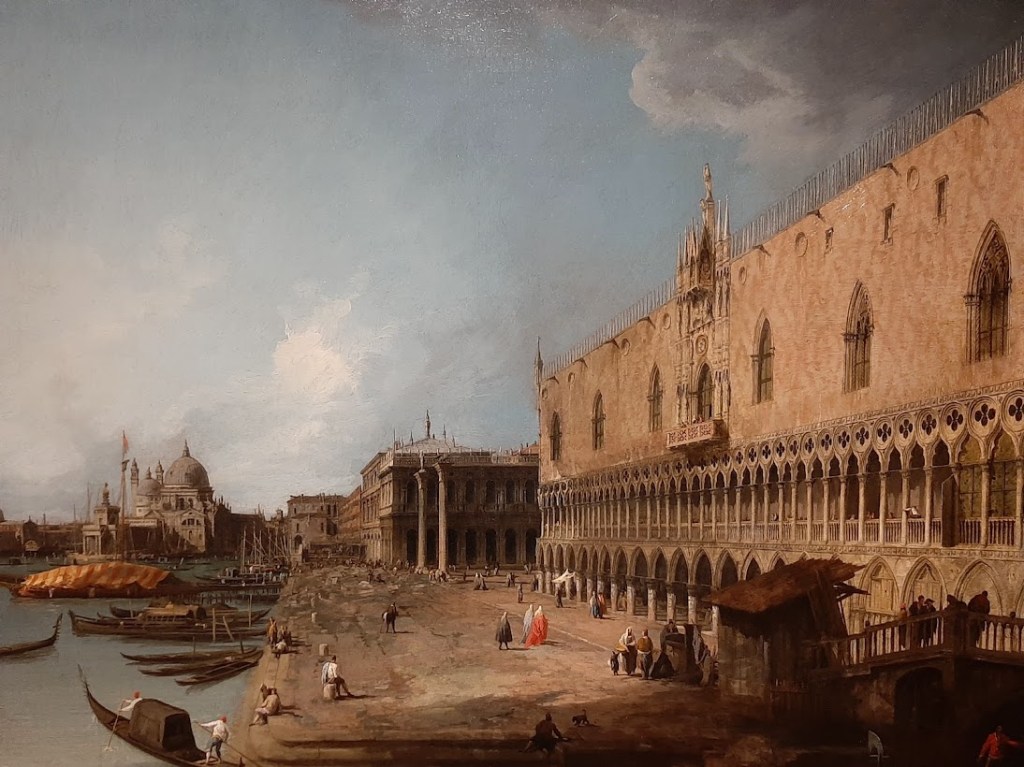
Today on the Masters of Venice, we’re beginning our survey of 18th-century Venetian Art with one of my favorite artists – Canaletto.
I was first introduced to Canaletto in elementary school during a field trip to The North Carolina Museum of Art. The curator who led our tour was passionate about art and the museum; she helped the art and history come alive. I still remember learning about the Grand Canal of Venice and the detailed mastery of Canaletto.
I hopeful that in providing content on Art Expeditions I help inspire you with a deeper admiration for art and a curiosity to explore the museums and art history from your hometown to the canals of Venice.
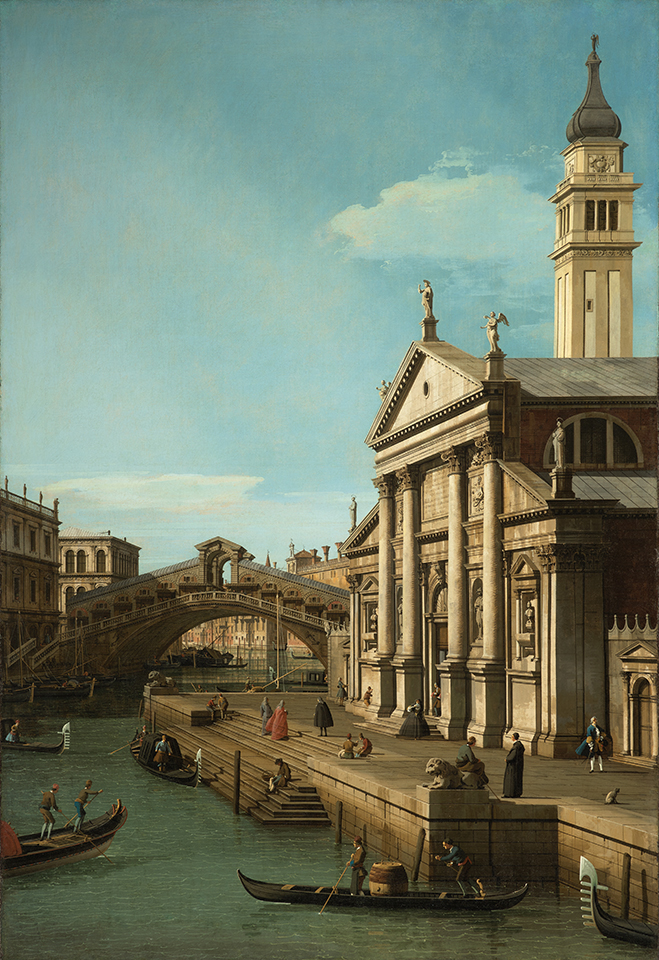
Canaletto’s what I dub ‘photo realistic style’ of painting has the mastery of Renaissance perspective, combined with vibrant Venetian colors with the dramatic air of late Baroque into Rococo.
Canaletto follows the great tradition of Venetian pastoral scenes and city scapes introduced by the likes of Bellini, Giorgione and Titian, and Bassano.
I personally see how Canaletto might have influenced later landscape painters in the nineteenth century with his detailed architectural buildings against the deep blue Venetian Lagoon and whimsical skies.
Some classify Canaletto as Rococo, but I think Canaletto worked in a separate subset of Venetian View Painters.
It is interesting to note, that while Canaletto was highly regarded by British patrons in his lifetime, Venetians often looked down at Canaletto’s work because it focuses so heavily on the mundane ‘postcard’ ordinary with such detail. Thankfully that view has changed and he continues to be one of the most celebrated late-Venetian Masters.
When you see a painting by Canaletto it is usally easy to identify because the scene is so realistic and vibrant. You feel as though you could walk into the streets of Venice and the scene would come alive.
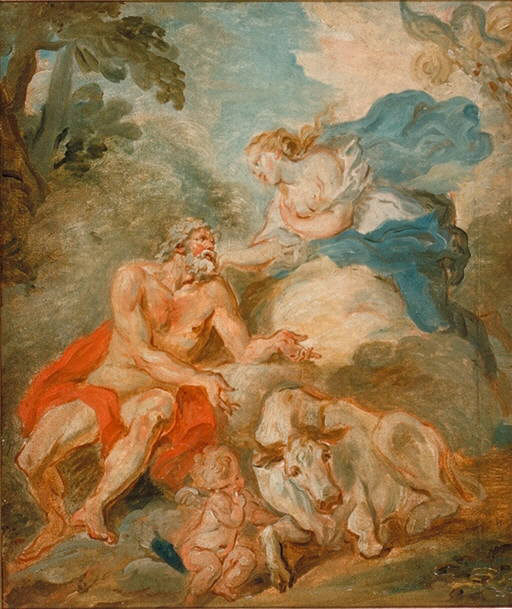
Compare Canaletto’s image with contemporary Rococo painter, French master Fragonard…you’ll instantly understand why I don’t group Canaletto squarely in the Rococo movement. Tiepolo, however – a master of Venice alongside of Canaletto leans deeper into The Rococo style, which a purely Venetian flair of course. We’ll meet him in our next lesson.
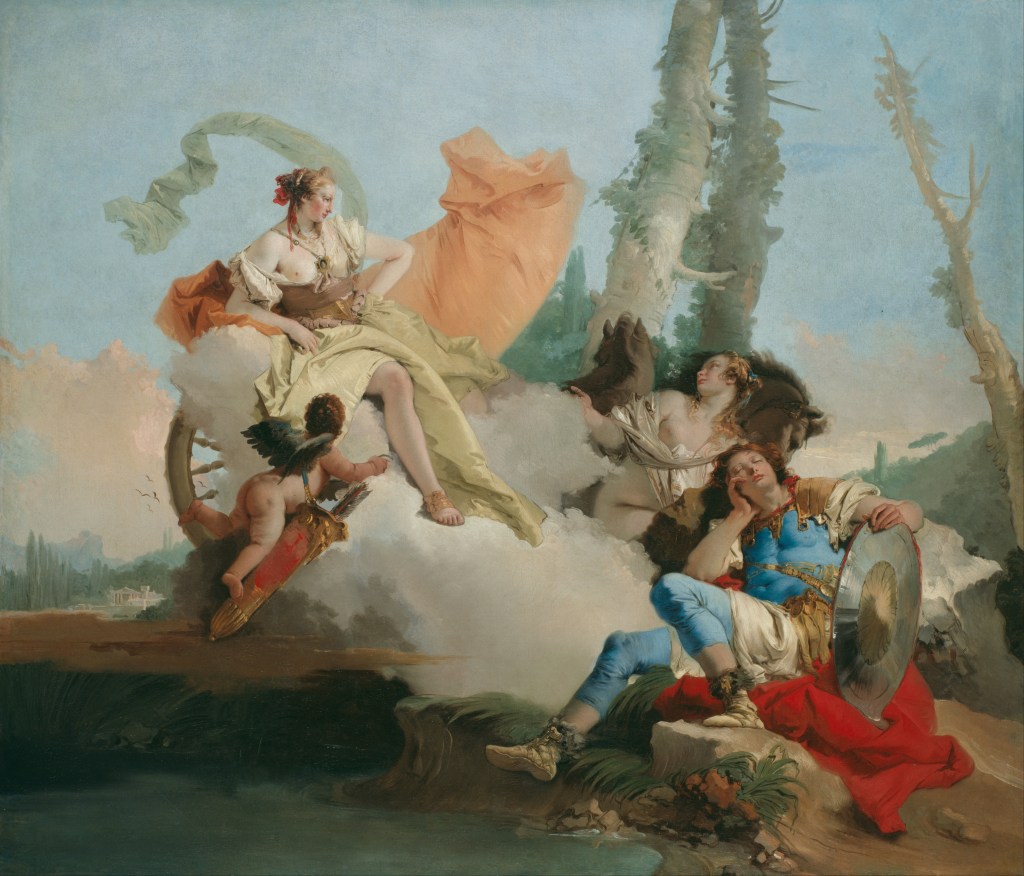
Notice the differential styles between Canaletto and his Venetian contemporary Tiepolo…Both are excellent artists, but with unique perspectives as they put paint to canvas.
Canaletto Biography:
Giovanni Antonio Canal was born in Venice in October 1697. His father, Bernardo Canal was a painter of theactrical scenery and an early Venice ‘view painter.’ Venice hosted its first opera circa 1607 and was one of the top cities in Europe for music and the arts. Vivaldi was a late Baroque musician from Venice who might have crossed paths with a young Canaletto.
Canaletto began his career apprenticing with his father as a theater designer. In 1719-20, he accompanied his father to Rome to help create scenes for two operas by Alessandro Scarlatti, which headlined The Roman Carnival of 1720.
- Fun fact, many opera seasons were originally tied to Carnival…the period leading up to Lent and also known in New Orleans as Mardi Gras.
During this time, Canaletto decided to leave the theatre and focus on draw and paint views of architectrual studies. He registered with the Venetian Artist Guild in 1720 as a pittor di vedute – or view painter. He added the ‘etto’ – little Canal to his work to distinguish him work from his father’s.
I always smile, because Canaletto is the perfect name for this painter who so often painted the canals of Venice.
In the mid-1720s, Canaletto met Owen McSwiney, a bankrupt opera impresario living in Italy as an agent for various English noblement in commissioning of pictures. It was McSwiney who introduced Caneletto to his client, The Duke of Richmond. This began a long success of being a sought after artist by English patrons.
Quick career timeline:
- In 1728, he began working with Joseph Smith, an art collector and English businessman living in Venice. Smith admired Canaletto’s work and became his principal agent and patron.
- Smith acquired nearly fifty paintings, 150 drawings and 15 now rare etchings of Canaletto’s work
- The etchings were sold to King George III in 1763
- Smith acquired nearly fifty paintings, 150 drawings and 15 now rare etchings of Canaletto’s work
- The period of 1730-1742 was fruitful, as many of his best known and well recognized art works were created during this time. The majority of his art was sold to tourists and wealthy English patrons.
- After 1742, Canaletto entered a second period of style, where he continued to create AMAZING works but he became more focused on accuracy and a historical record of that particular scene. He worked hard to capture the exact light, life and the buildings of Venice with perceptiveness and luminosity. While this may not have earned him strong accoclades from fellow Venetians at the time, this detail and radiance of history and art now is the legacy of Canaletto being of the greatest topographical painters of all time.
- While he did not strictly influence Impressionists, it is interesting how Canaletto was moving to that realistic focus on light and the time of day and capturing the moment, over 100 years before Corot to Monet.
- Paint tubes weren’t invented then, so it is likely he would sketch the scene and then return to his studio to complete the paining.
- While he did not strictly influence Impressionists, it is interesting how Canaletto was moving to that realistic focus on light and the time of day and capturing the moment, over 100 years before Corot to Monet.
- The War of Austrian Succession in 1741, limited the number of foreign visitors to Venice. During this time Canaletto struggled to sell his art to English patrons. However Joseph Smith continued to encourage him, suggesting that Canaletto focus on drawing and etchings.
- Etchings were a good money maker for artists if they would negotiate with printers to resell prints. Etchings could be copied and help raise global awareness of an artist.
- In 1746, Canaletto departed for England, where he continued to work as one of the expatriate Venetian artists there. His name and work were widely known in England, especially among the elite, which helped him find success while abroad.
- He returned to Venice in 1755, where he continued to paint and worked as a teacher, and was elected to the Venetian Academy. His students included his nephew, Bernado Bellotto, as well as Francesco Guardi, Michele Marieschi, Gabriele Bella and Giuseppe Moretti….Followers of his style included Guiseppe Bernardino Bison.
- In 1763, he was appointed prior of the Collegio dei Pittori…
- He died in 1763
His works were sold across Europe including to Catherine the Great in Russia! Today you can find them in the US from The MET to The National Gallery, The NCMA, Columbia Museum of Art and other major art museums.


Don’t forget to follow Art Expeditions for more art history and travel!
 Art Expeditions