
Today on Renaissance Wednesday we’re going to learn about one of the most important Renaissance master artists of Florence: Ghirlandaio.
Born in Florence on June 2, 1448 as Domenico di Tommaso Curradi di Doffo Bigordi, he took on the professional name of Domenico Ghirlandaio.
He was the eldest of six children born to Tomassao Bigordi, a silk trader and goldsmith, and his first wife Antonia di ser Paolo Paoli. Sadly only Domenico and his brothers Davide and Benedetto survived into adulthood. They had a strong bond and worked frequently in the same studio together as artists.
After the death of his mother, his father remarried and had to more children, including Domenico’s half sister Alessandra who married the painter Bastiano Mainardi in 1494.
Domenico first trained with his father as a goldsmith, hence his moniker ‘Ghirlandaio,’ which means ‘garland maker’
In the Renaissance, many would take their father’s profession as their surname (ex: Tintoretto’s father was a dyer).
Domenico’s father was renowned for creating metallic garland-like headdressesworn by Florentine women.
Domenico showed an early talent for portraiture, painting quick studies of his father’s clients as they came into the studio.
He began to study with Alesso Baldovinetti to study painting and mosaics, before apprenticing with Andrea Verrocchio, who also trained Leonardo da Vinci.
Contempories of Ghirlandaio included Sandro Botticelli (Venus and Primavera fame) and Umbrian painter Perugino, who taught Raphael.
Important works and his style:
Ghirlandaio quickly became renowned for his frescoes, which were colorful and realistic.
- Ghirlandaio’s earliest known commission came from the Commune (aka Independent City) of San Gimignano just outside of Florence, to decorate the Chapel of Santa Fina in the Collegiate Church. The frescoes were completed between 1477 to 1478 and depict two miraciouls events associated with the death of Saint Fina.
- In 1480 he completed is masterful St. Jerome in his Study to pair with Botticelli’s Saint Augustine in His Study for the beautiful Chruch of the Ognissanti in Florence.
- You may remember Giotto (an earlier Art Expeditions – Renaissance Wednesday post) also painted for the Ognissati.
- St. Jerome – the first person to translate The Bible into the Latin Vulgate was a learned scholar and popular saint. He is usually seen at his desk transcribing scripture surrounded by books…you can often find him with a skull and crucifix (though not in Ghirlandaio’s interpretation); he is often accompanied by his pet lion.
- The story is that St. Jerone took a thorn out of the lion’s paw and they became inseparable.
- When you look at Ghirlandaio’s portrait of St. Jerome, one thing that strikes me is the tenderness in Jerome’s expression. There is a joy and an invitation to join him in his study. Many interpretations of Jerome show him fully focused on his work and he appears stern. I love how Ghirlandaio endears St. Jerome and invites us to follow his lessons on our road to sainthood.
- Also notice the details like the wood inlay in the lamp and scrolls, his cardinal’s hat, specs and hour glass (reminding us that life is short and to measure our days)..such depth and luminosity

In 1481, Ghirlandaio was sent as a team of Florentine and Umbrian painters to Rome to paint the walls of The Sistine Chapel for Pope Sixtus IV.
This project was actually a peace offering after Lorenzo de Medici (de facto ruler of Florence) had been in a battle with Pope Sixtus IV for years. It all goes back to something known as the Pazzi Conspiracy, which was a terrible innocent in which The Pazzi Family killed Lorenzo’s brother (ahem under order of Sixtus) during the Easter Mass.
If you want real drama that puts HBO to shame simply read about the history of The Medici and Italian city-states.
With this peace offering we get some fo the greatest artistic treasures of all time.
When thinking about The Sistine Chapel at the Vatican, many only think about Michelangelo – and that is understandable. His Sistine Chapel ceiling, commissioned a generation later, is stunning…but when you visit The Sistine Chapel, don’t forget to look on the lower walls and revel in the majesty of works by Ghirlandaio, Botticell, Perugino and more.
In this project, Ghirlandaio painted the Vocation of the Apostles and the now lost Resurrection of Christ.
- He returned to Tuscany in 1482-85 and working on a series of projects including the Sassetti Chapel of Santa Trinita.
- He was then asked to renew the frescoes in the choir of Santa Maria Novella
Ghirlandaio and his brothers trained many artists including Michelangelo who passed through his school.
- I love Michelangelo, but study this amazing artist and you’ll learn he could be difficult to work with. Michelangelo wanted people to believe he was mostly self taught, and to paraphrase thought he and Ghirlandaio were oil and water. That being said, Michelangelo no doubt learned about fresco painting from Ghirlandaio)
Ghirlandaio painted several important versions of The Last Supper in Florence including at San Marco (convent) and The Ognissanti in Florence. Both have similar elements, but are striking different.
His images pay homage to a similar format created decades before by Andrea del Castagno, who has Judas seated alone on the opposite side of the table.
Ghirlandaio’s use of dynamic conversation and expressions in his Last Supper’s makes you feel as though you are stepping into the scene and about to enter the dialogue.
Leonardo da Vinci was familiar with Ghirlandaio’s work and may be be influenced by the style in creating his own iconic Last Supper

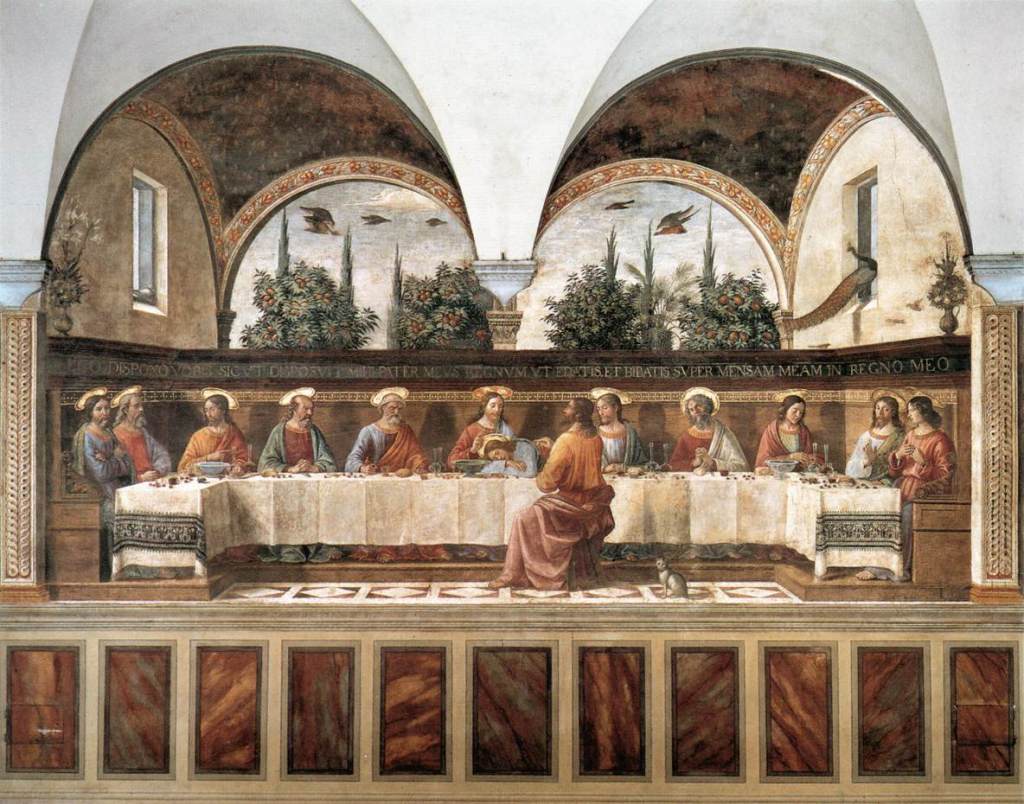
Notice that Judas can be identified because he has no halo and a cat is behind him. In some Renaissance art a cat about to catch a mouse, or standing behind a villian is symbolic. The devil is a ‘mouse’ and the cat sets its trap to catch the evil.
- Several things that are amazing about this interpretation of The Last Supper is the architectural precision and depth created to feel as though this flat wall has been extended into an entirely different room and additionally there is another world outside of the inner room – a heavenly real.
- Notice the Peacok – a symbolism of sacrifice and resurrection in religious art
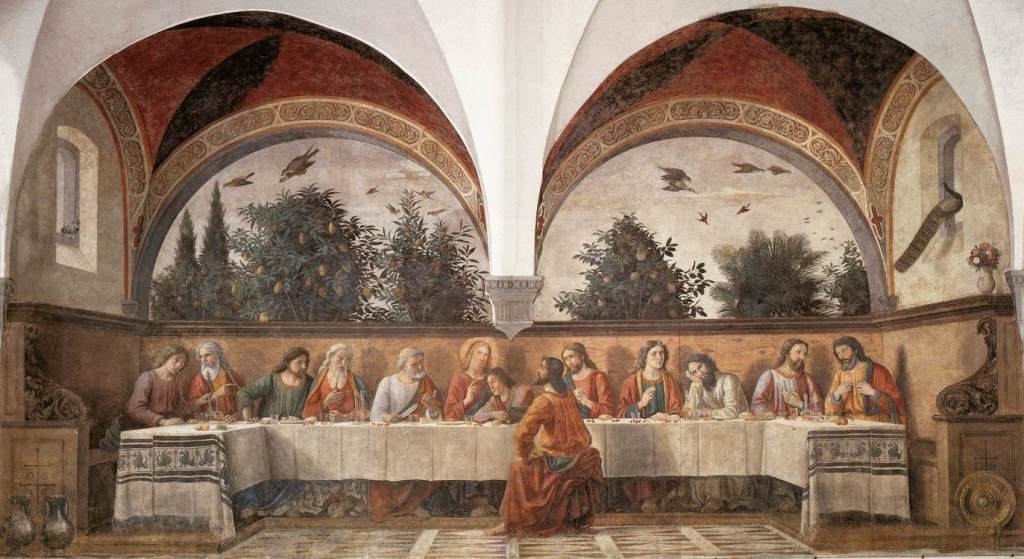
This Ognissanti version is similar to the San Marco, but does not have the same placement of figures (similar but unique) and the cat is missing. Only Christ has a halo in this verson as well.
Ghirlandaio is an amazing artist who made a deep impact on The Renaissance style…he worked with some of the greatest of The Renaissance artists like Botticelli, Perugino and (ahem) Michelangelo.
Don’t forget to SUBSCRIBE to the Blog for more more ART-Ventures on Art Expeditions
Written by art lover and historian, Adele L.
 Art Expeditions