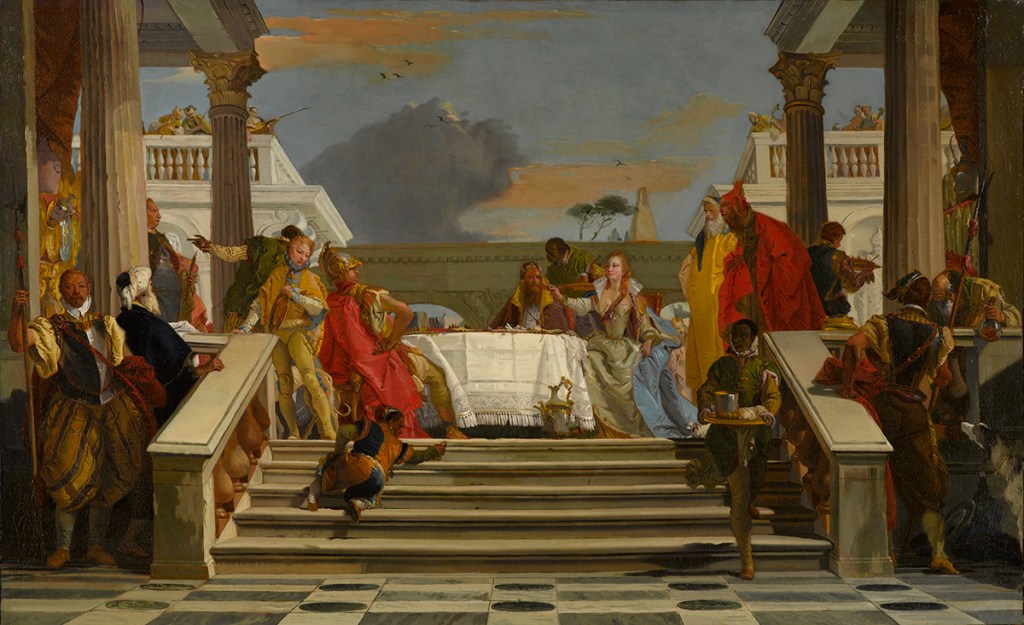
Today on The Masters of Venice, we are going to meet the great Rococo painter Tiepolo.
We learned about Rococo in a previous lesson. It emerged in France in the 18th century as a rebuff to The Baroque drama of Louis XIV’s Palace at Versailles in France. Both styles are known for their drama and ornate over the top details, but Rococo varies in tone – it leans into whimsical allegorical tales and inneudos. In France Rococo was made famous by artists like Fragonard and Boucher.
Venetian Baroque still has the element of fantasy and beauty of traditional Rococo, but it also is purely Venetian in tone. The Venetians had long embraced luminous vibrant color and their allegorical scenes had movement and innate storytelling.
Tiepolo takes the form of Rococo and meld it with The Venetian tradition…
In the 18th-century, Venice had lost much of its power and was living off the wealth of ages past. It had developed a tourism economy, but the light of the golden era of Venice seemed to be darkening.
.Venice had soared to artistic heights after The Sack of Rome in 1527 led many artists to flee to Venice. While Venice continued to be an admired center for art, it lost its dominance as the age of Veronese and Tintoretto died out.
During the Baroque era, Rome had a resurgence with artists like Caravaggio,the Carraci brothers and sculptor Bernini.
The Baroque Style of Rome leaned heavily into allegorical ceiling paintings for the aristocratic elite filled with drama.
This theme continued into Rococo with theatrical images of ancient history, myth, scriptures and sacred legends portrayed over the top with whimsical flair. Whereas Baroque treated these subjected with a certain seriousness – Rococo wasn’t afraid to as The Met Museum quotes:
“the genial departures from convention and brilliant use of costumed splendor, celebrates the notion of artistic caprice and fantasy.”
Rococo is in a way ‘staged fiction,’ beautiful and meant to softly satiate the viewer with pastels and a near glow of serpendity and fantasy in the work.
Ironically, The Rococo’s almost laissez faire exurbence aligns closely to the fate ofVenice in the 18th century – a waning power that instead of worrying about tomorrow would enjo the fruits they had acquired…
Tiepolo wasted afraid to bring the ‘theatre’ to his artwork, but I’ll argue there is a deeper depth of perception and style in his paintings than other Rococo artists.
- I’ll pause here for a brief moment to admit my bias…while I can appreciate Rococo as an artistic style and there are many Rococo paintings I enjoy, it is my least favorite style of European art. However I challenge myself to move past my set opinions regarding Rococo when I enter a museum, like The Frick in New York, which has a large Fragonard collection and give the painting time to speak to me. I’ve found that while I still gravitate towards other styles, by being open to the understanding the history behind the art and “listening” (taking five minutes in silence to look at a painting in detail) I have a deeper respect for Rococo.
- That being said, I’ve always enjoyed Tiepolo and I think it is because he successfully incorporates the pastels and bold colors into daring scenes, but you still feel a connection with the characters. There is a deeper meaning in many of his works, which I personally love.
Tiepolo’s Biography:
Born on March 5th 1696 in the Republic of Venice, Tiepolo is considered by art historians to be one of the greatest painters of eigthteenth-century Europe. He revitalized the art scene in Venice, making it once again a major artistic hub for the best and brightest of Italian painters.
Michael Levey says of Tiepolo: “(he was) the greatest decorative painter of 18th-century Europe, as well as its most able craftsman.”
Giovanni Battista Tiepolo was the youngest of six children of Domenico and Orsetta Tiepolo. His father was a shipping merchant, who died when he was just a year old.
This left a huge burden on his mother, who brought up a family of young children on her own.
Showing a propensity for artistic talent, he became a pupil of established Venetian artist Gregorio Lazzariniin 1710. Lazzarini was known for an eclectic style, painting mythologial, religious and historical scenes. He was as an accomplished portrait painter
In addition to Lazzarini, Tiepolo was influenced by the earlier generations of Venetian artists like Veronese and Tintoretto. Like Tintoretto, who was know for his furious fast brushwork, Tiepolo later adopted a more fluid brushwork style as well.
Career Highlights
- Tiepolo’s earliest known commission was his 1715 work on the Church of the Ospedoletto in Venice painting spandels as part of the interior decoration.
- A spandrel is a roughly triangular space, usually found in pairs between the top of an arch and a rectangular frame
- Also in 1715, he was hired by Doge Giovanni II Gornaro to hang pictures in The Ducal Palace, and paint a few commissions for Doge Giovanni II as well.
- Circa 1719, Tiepolo traveled to Massanzago, a village near Padua, to paint famed publisher Giambattista Baglione’s villa. Tiepolo depicted the Triumph of Aurora on the ceiling and the Myth of Phaethon on the walls. In these works you can see Tiepolo utilize a method of ‘fluid spatial illusion,’ a form of tromphe d’oeil that woul become common in his later works.
- In 1719, Tiepolo married Maria Cecilia Guardi, a noblewomen who was the brother of Francesco and Giovanni Guardi, who we’ll meet in our next lecture.
- The couple had nine children (four daughters and three sons survived to adulthood)
- His sons, Domenico and Lorenzo became painters in his father’s studio and achieved their own success as well in the Rococo school of art.
- From 1726-1728, Tiepolo decorated the cathedral at Udine and the palace of the Archbishop there.
- Undine is a city in northeastern Italy, approximately 90 minutes from Venice, near the present day Slovenian border
- He depicted scenes from the life of Abraham and his descendants in the Book of Genesis. The work is alive with color and light-heatred in mood, despite the heavy subject manner.
- Fun fact: Tiepolo used a cooler palette than other Venetian painters to fool the eye with a more convincing effect of daylight.
- He continued to work heavily in The Veneto region until 1750, when Tiepolo was invited to move to Wurzburg in Germany. The period of 1750-1753 is known as ‘The Wurzburg Residenz’
- Word of Tiepolo’s talent as an artist had traveled throughout Europe, making him an in demand painter locally in Venice and abroad.
- Tiepolo’s art dealer and friend, Francesco Algarotti helped introduce Tiepolo’s work to Prince Bishop Karl Philip von Greiffenklau. The prince admired Tiepolo’s work and invitedhim to Wurzburg in Novemeber 1750 for a commission at the prince’s New Residenz palace (completed 1744)
- Tiepolo remained in Germany for 3 years, working on a serices of fantastical palace ceiling paintings.
- During this time he also worked with his sons to fresco the Kaisersaal salon. The massive ceiling fresco opens up from the grand entrance staircase (Treepnhaus) designed by Balthasar Neumann.
- The majority of these works were mythological scenes, including: Allegory of the Planets and Continents featuring Apollo embarking on his daily course amid the planets.

- By 1753, Tiepolo returned to Venice and continued to work locally throughout The Veneto (City of Venice and mainland environs)
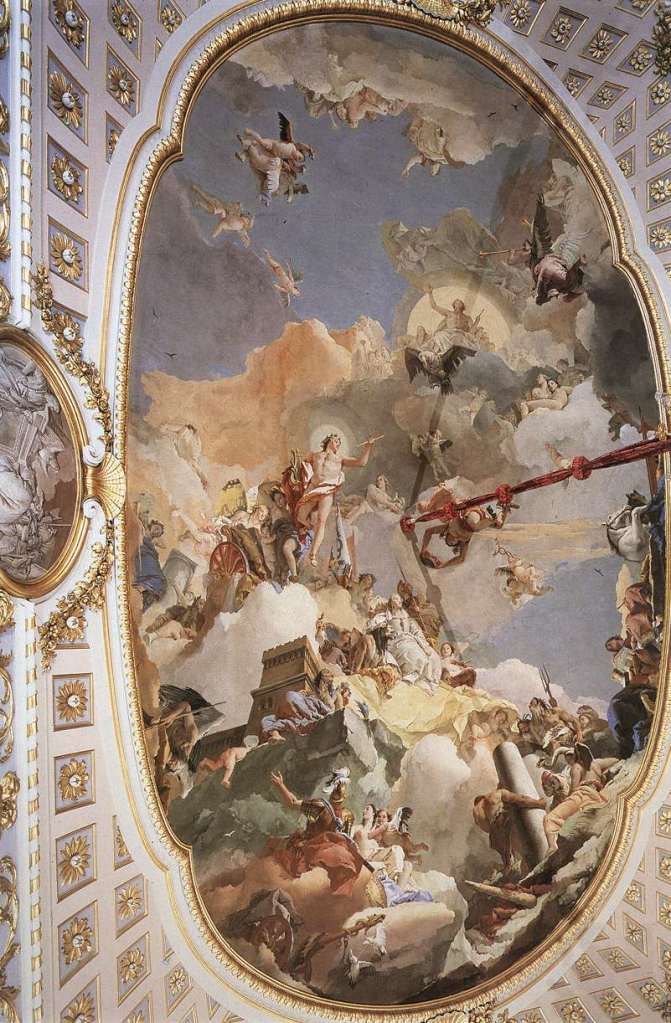
- During the 1760s, Tiepolotraveled to Spain to paint a commission for Charles III’s throne room of the Royal Place of Madrid – The Apoethosis of Spain, with allegorial depictions of Spanish dominance in Europe and the Americas.
- While in Madrid, Tiepolo also worked on several private commisions of allegorcial paintings. Though Tiepolo found success in Spain, jealousy from other artists and a Neoclassicism movement caused several of his works produced for the Church of S. Pascual at Aranjuez to be replaced.
- Inside the history: While many artists today vie for clicks and likes on social media and sell on Etsy, in Tiepolo’s time you needed commissions from wealthy patrons or to be awarded a role as an artist for example, The Court Painter for King Charles III of Spain. There was stiff competition for these positions and jealousy no doubt when certain artists found favor over others.
- While in Madrid, Tiepolo also worked on several private commisions of allegorcial paintings. Though Tiepolo found success in Spain, jealousy from other artists and a Neoclassicism movement caused several of his works produced for the Church of S. Pascual at Aranjuez to be replaced.
Death and Legacy:
- Tiepolo died in Madrid as the art world had begun to move from Rococo to a severe neo-classical style as The Enlightenment and new rationalism thought took hold. By the end of the 18th-century, monarcharic power in France fell and England lost America in Revolution. The dainty and spirited heavenly images of angels and allegorical whimsy didn’t sit well with the late 18th century palette.
- Tiepoloe’s son, Domenico (who when by Giandomenico to honor his father’s first name), moved to a more objective and realistic style in his later career.
- That being said, the legacy of Tiepolo continues to dazzle the art world today. His use color, trompe d’oeil to bring you into the scene is striking and has a living pulse because simple whimsy and flight of fancy. While his bold and dramatic scenes of mythology and historical figures may feel overwhelming when we see them today – remember that this was an age before movie theatres and television. Art and the theatre of art was something to excite and tell a story – allowing you the viewer to become part of the scene, even if for a moment.
Resources:
 Art Expeditions