Last time on Medieval Monday we learned about the Romanesque period of Medieval architecture and influence in Europe.
Over the next few weeks we are going to visit several Romanesque buildings to dive deeper into Romanesque and the unique styles of architecture in this period.
To recap: Romanesque is NOT a style of architecture, although we often refer to it as such. Rather Romanesque is a period of The Middle Ages from the late 9th century to the 12th century. The height of Romanesque influence architecture was from 1000 AD to 1150 AD, when it is mostly replaced by the Gothic style of architecture. While many Romanesque buildings like Churches and Castles have similar designs, Romanesque is not a unified blueprint for one style of architecture – rather it is a mix of Roman like buildings melded with Byzantine and even Arab influences. Romanesque buildings are Roman like – with patterns influenced by Roman structures of old, but with Medieval elements as well.
The majority of Romanesque (think Roman like or Roman inspired) Churches share a common basilical form with barrel vaulting and thick walls. Romanesque lacks as many windows as the later Gothic.
While you may have very similar looking Gothic churches, you rarely find two exact copies of Romanesque…what you do find are similar features that unite the period. Read more here.
Romanesque Churches today are often found in the European countryside off the beaten path. This is because urban Romanesque churches were often remodeled with Gothic and later Baroque elements or were destroyed by fire, natural disaster and sadly war.
The greatest Medieval Romanesque Church of Cluny in France was eviserated by the anti-Christian movement during The French Revolution. It still stands, but much of the buildings and treasures of this Romanesque abbey remain. Cluny was the largest church in the world until the new (and current) St. Peter’s Basilica in Rome was built in the 1600s. Another reminder that The Middle Ages wasn’t very dark in terms of construction post 800 AD.
- Note: The Rise of Charlemagne as the first Holy Roman Emperor led to an organized building campaign across Europe in the Caroligian to Ottonian years of rule. Even several centuries after The Fall of the Western Empire there had not enough centralized power to take on massive public works projects like in the Romanesque period. Charlemagne was know for his focus on infrastructure and building projects…which continued throughout Europe even into other kingdoms in the subsequent centuries.
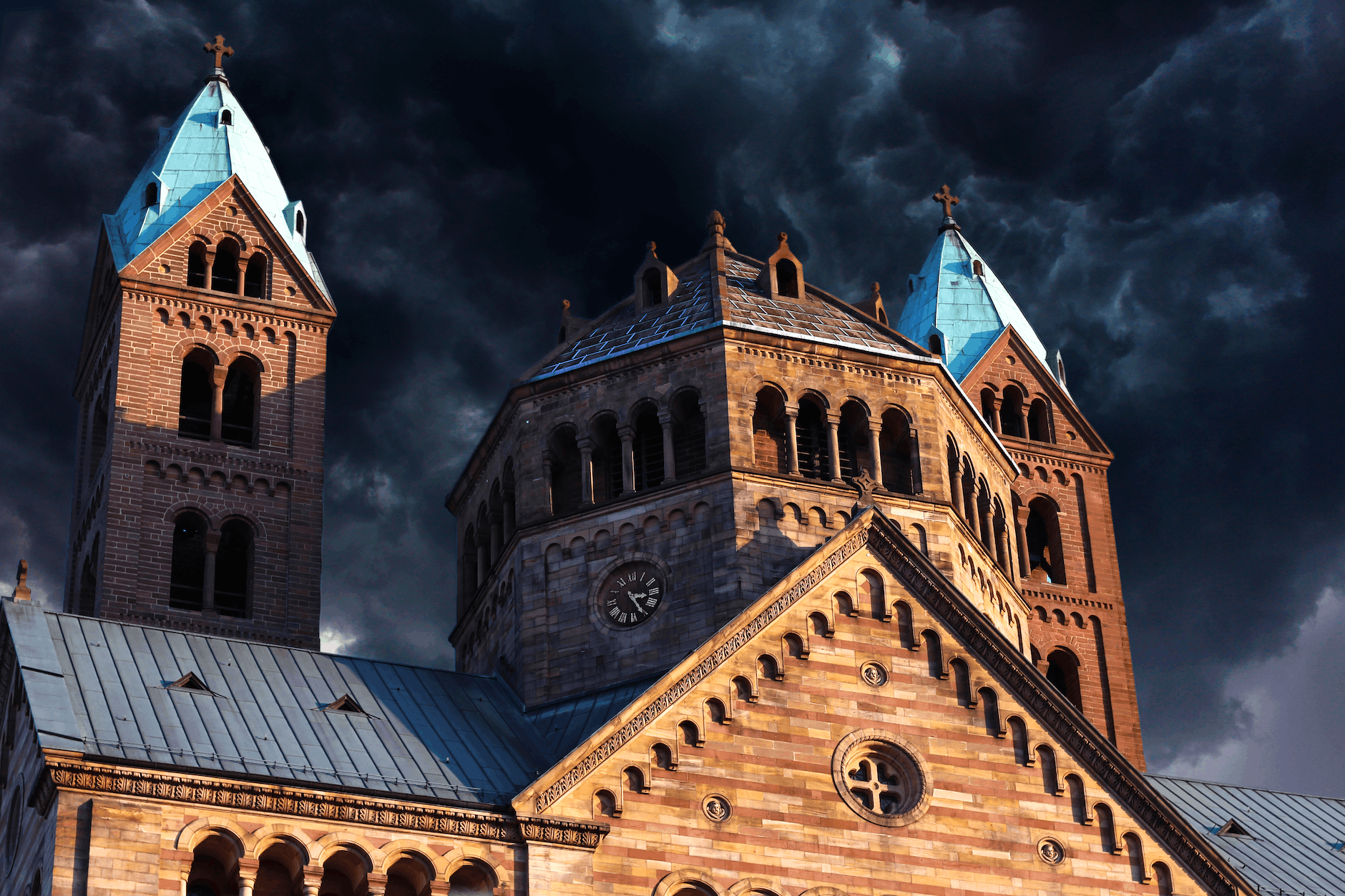
Today the largest remaining Romanesque church in Europe is Speyer Cathedral in southwest Germany. Today it is listed as a place of ‘Outstanding Universal Value’ by UNESCO as a World Heritage Site.
In the 11th-century, present day Germany was a stronghold for The Holy Roman Empire…
- The Holy Roman Empire was technically founded by Charlemagne when he was crowned on Christmas Day 800 AD by the Pope in Rome as Holy Roman Emperor and during this time contintued to hold territory even in modern-day Italy. After Charlemagne’s death, he split lands between his three sons and the Empire did not fully hold. However Otto I restored the Holy Roman Empire in the 10th century and considered his reign as a continuation of the Holy Roman Empire of Charlemagne. The Ottonian Holy Roman Empire, survived through various rulers until it collapsed in 1806). Read more here.
Speyer Cathedral was originally built by Emperor Konrad II in 1030 AD, after his imperial coronation, only to be expanded and mostly rebuilt circa 1090 by Henry IV following his reconicilliation with the Pope in 1077.
- Ironically the original Romanesque style church was also one of the grandest North of the Alps and at the time was the second largest vaulted building outside of Aachen (the church Charlemagne originally built and was later expanded). It is a shame he tore down that church instead of simply building a new church next door – alas it was taken over by an even more beautiful church we dare say, but hard not to mourn the beauty of the unseen gem that once was.
- The crypt and foundation is from the original church and gives visitors to Speyer and inside view into Speyer 1 as it is known today.
- The crypt at Speyer is the largest Romanesque columned church in Europe
Henry IV wanted Speyer to sow the abundance and imperial power of the Salian rule (1024-1125) in The Holy Roman Empire. While it may not be the holiest intention, many cities and kingdoms had stiff competition with one another. For instance, Henry VI wanted to built something to outshine France’s Cluny in scope and size. The idea was this would show more glory to God (but lets be real, humanity loves to compete and we still have the ‘whose castle is bigger’ today even in suburban America).
- Fun fact: at the time of Speyer I, the city of Speyer was a bustling metropolis of as many as 50,000 souls. The population still hovers around 50,000 (2023)
Speyer II
The layout is loosely based on the general layout of St. Michael’s of Hildesheim, an earlier Romanesque church (circa 1020 AD) which became the accepted style of Romanesque in the Rhineland. However Speyer expands on this form to create a powerful structure that soars towards heaven.
The original nave design was elevated by 16 feet in the new construction, and and the former church’s flat wooden ceiling was replaced with a groin vault of square bays. This was one of the earliest examples of bay systems in Europe (the other being Church of Sant Vicenc in Cardona in Spain).
- Groin vaults: intersection of two barrel vaults
- Bays (Romanesque): The double bay system of Speyer allowed support for the stone vaults.A vertical division of a building. In church architecture the term usually refers to the division of the nave into sections.
The Speyer Cathedral was one of the first churches to implement half-cylinder support columns verus the full-circle or square piers as support. The half-cylinder support provided more flexiblity and support and took up less space. Speyer also utilized pre-Gothic buttressing to carry the load of the structural weight.
Speyer was built with red and gold sandstone, creating a resplendent striated effect. They were able to carve the stone byfreezing it to allow the stone to be split when left outside during cold winters -that’s a lot of effort if you consider the amount of stone needed to build this church.
- Fun fact: Speyer Cathedral was one the first building to be constructed entirely of stone in Europe. Many buildings prior used a mix of materials, including a wooden ceiling, but Speyer successfull has a stone roof! Source.
Speyer incorporates decorative details including statues (many by Italian sculptors brought to aid in the project), and has geometrical details like squares, chevrons and circles. Geometrical perfection is a reflection of the perfection of God and His creation.
The completed church at Speyer Cathedral is over 439 feet in length and has a width of 123.42 feet.
Inside, the nave width is 45.93 feet and the nave height is 108 feet tall…
The western towers soar over 215 feet
The eastern towers rise to meet at 233.59 feet)
UNESCO considers Speyer a World Heritage Site because it maintains a strong Romanesque integrity and authenticity … “In terms of form and design, use and function Speyer Cathedral still expresses truthfully the essence of one of the most important Romanesque churches in Europe. The restoration history and methods document the evolution of the principles of restoration.” – UNESCO
When studying Medieval architecture I fall in love with the beauty, but the architectural jargon can be confusing. Here is a quick guide for key words and info about Speyer’s architecture.
Key words:
- Nave: the seating area of the church. In Western churches, the nave is of a rectangular shape and separated from the sanctuary. The word is derived from the Latin word “navis” meaning “ship” because the nave resembled the shape of the deck of a ship; and also because of the church’s function as an “ark of salvation”, like “Noah’s Ark”. Credit Speyer Cathedral has barrel vaulting with upper clerestory window area that lets in more life.
- Romanesque did not use stained glass, they instead relied on mosaics and internal frescos inside and the light pouring in would illuminate the church. Many Romanesque churches are darker by necessity (structual integrity prevented large windows) and by design to provide a more somber place for prayer.
- Transept: The transept of Speyer Cathedral is not as long as others in Europe. It still has arms that are typical of a cruciform church. A transept is a rectangular area which cuts across the main axis of a basilica like building giving it the shape of a Latin Cross. It usually serves to separate the main area of the building from the apse at the end.
- Apse: A circular area in a church that houses statues and relics. Henry IV added the innovated external arcade walkway outside the circular apse. This allowed parishioners and clergy to see views of the city and river from the east end.
- Towers and dome
- The initial design by Konrad II was flanked by four freestanding towers, two at each end. New innovations in engineering allowed the dome to be built on a frame of supports, a technique that would impact later periods like the Renaissance
- Crypt: As I alluded to early, The crypt is the largest in Europe and one of the only areas of the building virtually untouched by renovations in 1000 years.

Speyer doesn’t dazzle with ornate sculptures and decorations but with gorgeous architectural vaulting that would leave anyone breathless as they step inside.
Interested in planning your trip to Speyer? Here is a link to the official church website
I hope you enjoyed this mini time traveling Medieval adventure. For more art blogs and art travel don’t forget to subscribe to our blog.
 Art Expeditions