Today on Renaissance Wednesday we’re going to meet one of my favorite artists, Fra Angelico.
Born circa 1395 in the Tuscan region of Mugello in the town of Rupecanina as Guido di Pietro, Fra Angelico became one of the most important artists of the Early Renaissance.
- Fun fact: The Medici family was originally from Mugello before they moved to Florence, creating a dynasty there.
Little is known about Fra Angelico’s childhood. Between the years of 1420-1422, he became a Dominican friar and resided at the priory of San Domenico at Fiesole.
- Fun Fact: Fiesole is a historic city with Etruscan roots just outside of Florence. I recommend visiting the ruins of Fiesole while in Tuscany.
He took the name Fra Giovanni da Fiesole and signed many of his works this way. He was nicknamed Fra Angelico of Fiesole after showing amazing talent as an artist.
It is believed he had some artistic training before entering the monastery (he his recorded as being a lay painter in 1417). According to artist and art historian Vasari, Fra Angelico received training as an illuminator with his older brother Benedetto who also a Dominican friar.
- Illuminator
From 1408-1418, he served as a friar in Cortona, where he painted frescoes, which were mostly destroyed in later years.
Between 1418-36, he returned to Fiesole and painted among other works The Fiesole altarpiece
In 1436 many of the Fiesole monks moved to the new San Marco convent in Florence, which was in part funded by Cosimo de’Medici ‘il Vecchio’ (the elder) – the founding member of the de’Medici banking dynasty in Florence.
Moving to Florence put Fra Angelico in the heart of the burgeoning Renaissance. In 1436, Brunnelleschi’s Duomo dome was completed as the first octagonal dome in history to be built without a temporary wooden support frame. Also during this time Masolino and Massachio had put linear perspective into painting.
Fra Angelico took the concepts developed by Massachio and Brunelleschi and not only made them his own, but advanced the style even further helping to forge the foundation for the second generation of the Renaissance artists who followed him.
Fra Angelico’s most famous commission are a series of frescoes he did for the San Marco Convent (Florence)
Cosimo de’Medici was a deeply religious man and had a cell reserved at San Marco for deep prayer and silent contemplation. Cosimo suggested that Fra Angelico paint each of the convents cells in the Chapter House
His frescoes remain in San Marco today, which is now a museum and a MUST-SEE in Florence.
- Interesting history: The fiery preacher Savonarola (who we learned about in our Botticelli feature) was the head prior at San Marco and would have seen the Fra Angelico frescoes in his own cell.
Fra Angelico was a deeply spiritual man and put his whole heart of God into his painting. He wanted to create art that would move the viewer into a deeper relationship with God and portray deep truths about faith and God’s grace for humanity.
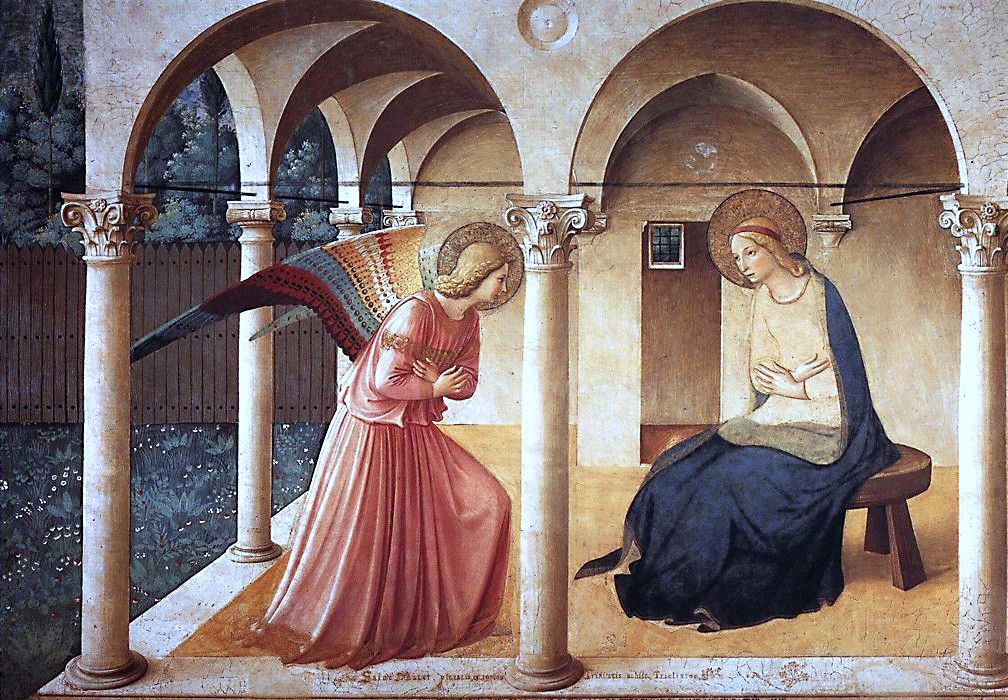
Outside of the Blessed Mother and Child, The Annunciation is one of the most popular themes in art. In the Renaissance, you will notice similarities in each annunciation that reveal spiritual truths and help engagge the viewer with the story.
Fra Angelico’s Annunication is one of the most widely reproduced art prints in the world. Many churches have it inside their parish for spiritual reflection. Even if you don’t know much about Renaissance art you’ve probably encountered this image before.
The Annunciation comes from Luke 1:26-28, when the Angel Gabriel announces that Mary is to bear Jesus – Mary has to agree to this, God doesn’t force her. Mary’s yes to God in The Annunication is a reminder for all faithful to say ‘yes’ to God even if it isn’t easy.
Fra Angelico’s Annunication was positioned on the upper floor of San Marco in front of the staircase as a ‘trompe d’oeil’ to create an illusionary window which looked out onto a garden and cloistered area. In this way, the artist brought the sacred scene of the Annunciation into the monks’ perceived world of physical reality.
Mary is enclosed in a cloistered area, an enclosed garden. This symbolizes her purity. The garden also symbolizes Mary as a New Eve (a common theme in art) because through her ‘yes’ to God, Adam and Eve’s original sin would be overcome through the bith of God incarnate, Jesus Christ.
You’ll notice Mary is often found with an expression of surprise, as if she was interrupted from reading the scriptures. Fra Angelico does not include this, but instead puts the focus on Mary’s expression.
Notice how her expression indicates she is actively listening to Gabriel, and yet she keeps her arms closed as a show of discernment. Mary both seeks to understand ‘how can this be,’ while also being open to trusting God’s will.
Gabriel meets her in this pose, but leaning in respectfully with the request. Even as an Archangel Gabriel is not afraid to humble himself before Mary because he recognizes God’s work in humanity.
Like many other renditions of The Annunciation, Fra Angelico depicts the Archangel Gabriel with multi-colored wings. The colors are glorious.
- Notice that the light feels supernatural, it’s not completely natural. Mary’s shadow is alluded to, but Gabriel, as a heavenly figure without shadow.
I love the way the trees and the fencing peek through in the background. The fencing looks like it could be in our backyard today.
Notice the mini window, within a cell at the back of the painting – that in my opinion reflects the monastery and their own prayer cells nearby.
What do you see?
- Fra Angelico would paint The Annunication multiple times throughout his career, but this rendition is his most popular.

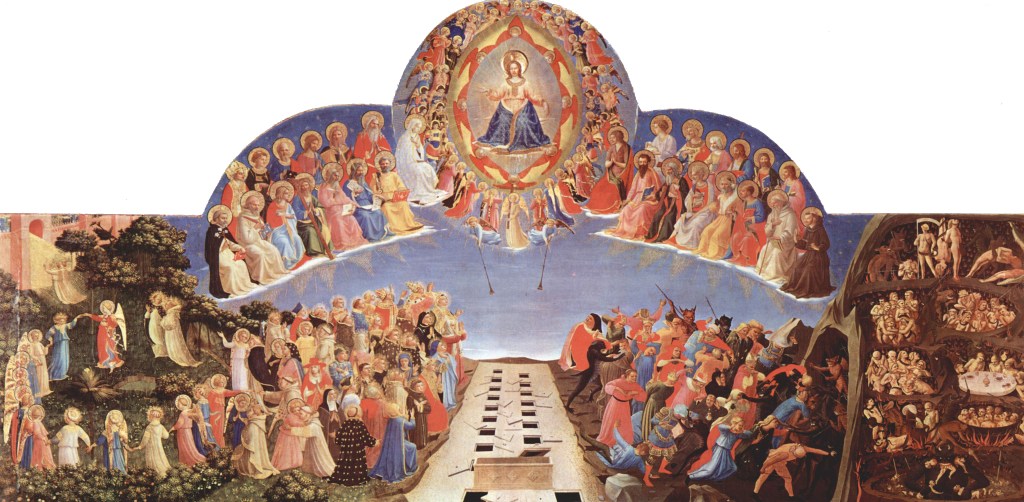
In 1445, Fra Angelico’s ‘angelic painting’ style earned an invitation to Rome, when Pope Eugene IV asked him to paint the original St. Peter’s Basilica, which later was torn down and rebuilt in the Renaissance-Baroque era.
- The original St. Peter’s was built by Constantine and had structural damages that eventually required the building of a new church.
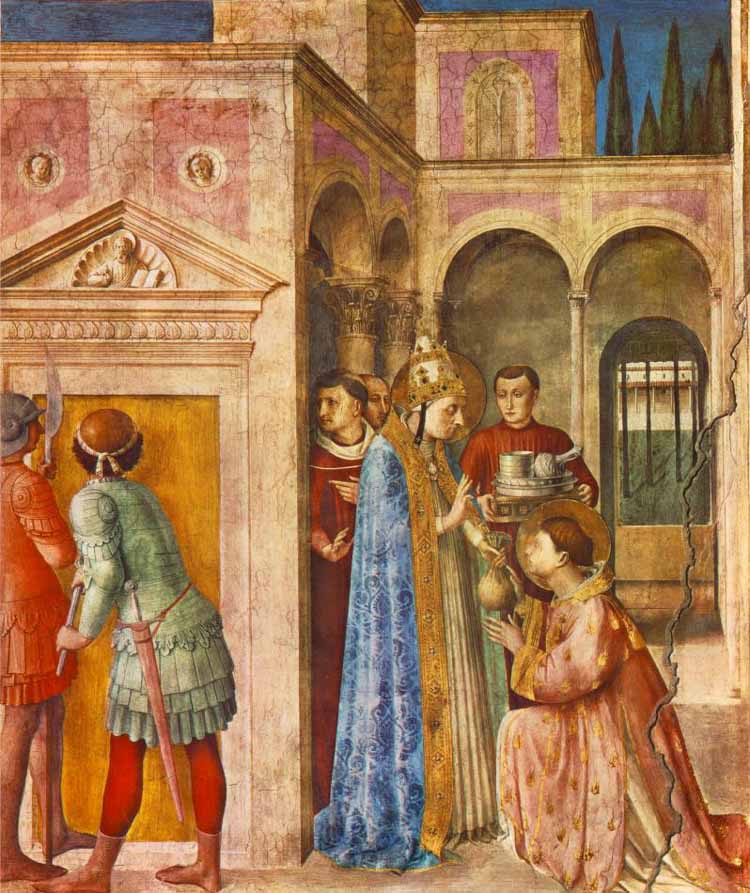
He also painted frescoes for the Niccoline Chapel for Nicholas V. These feature scenes from the lives of martyred deacons.
Fra Angelico also did works at Orvieto Cathedral before returning to Fiesole later in life.
He was in Rome, possibly working on the St. Nicholas Chapel he died. He as buried in the church of Santa Maria sopra Minerva. His epitaph reads:
When singing my praise, don’t liken my talents to those of Apelles.
Say, rather, that, in the name of Christ, I gave all I had to the poor.The deeds that count on Earth are not the ones that count in Heaven.
I, Giovanni, am the flower of Tuscany.
In addition to his talent as an artist, which was indeed ‘angelic,’ Fra Angelico was seen as a holy man with saintly virtue in his lifetime. He was humble and faithful and showed grace to all. Fra Angelico earned the title of Blessed Fra Angelico by Pope John Paul II (now a beatifed saint).
Pope John Paul II said of Fra Angelico:
“Angelico was reported to say “He who does Christ’s work must stay with Christ always”. This motto earned him the epithet “Blessed Angelico”, because of the perfect integrity of his life and the almost divine beauty of the images he painted, to a superlative extent those of the Blessed Virgin Mary.”
He is a patron of Catholic artists (1984 – Pope John Paul II
Blessed Fra Angelico as prolific in his lifetime and I hope to do a course specifically on his works soon. But hopefully this opened you up to the art of this amazing artist.
You can find his works in many US museums, as well as The Prado in Spain, The Louvre (Paris) and throughout Italy and beyond.
Helpful resources:
Don’t forget to subscribe for the latest art history blog posts
 Art Expeditions