
Today on Renaissance Wednesday we’re going to get to know more about one of the most famous artistic geniuses of all time – Michelangelo.
Many of us are familiar with Michelangelo from high school history class, or perhaps you’ve been lucky enough to see his iconic works like David or Pieta in Italy.
We could dedicate an entire course just on Michelangelo – his career spanned 80+ years and he lived through the heart of the Renaissance into the tranistion style of Mannerism (post-Sack of Rome 1527).
He created some of the world’s most important artwork and yet Michelangelo’s dream of completing a tomb project for Pope Julius II eluded him.
His contemporaries acknowledged that Michelangelo’s artistic gifts were from God – sure he had training, but Michelangelo possessed an innate talent.
Biography:
Michelangelo Buonarroti, was born on March 6th, 1475 in Caprese about forty miles from Florence, to Lodovico Buonnarroti. His father was temporarily stationed in Caprese to work as a Florentine government agent.
The family moved back to Florence when he was one month old. His mother died when he was only six. As we see so often in our bios of artists, Michelangelo was drawn to the arts at an early age, but his father felt with their social status it was not the best pursuit for Michelangelo. After all you want to make sure your child can provide for themself with a trade.
However Michelangelo’s talent was so extraordinary that at age thirteen he eventually was allowed to apprentice with Domenico Ghirlandaio (we met him a few weeks ago), the most important painter in Florence at the time.
Less than a year later, Michelangelo left Ghirlandaio (apparently they were a bit of oil and water); Although Michelangelo tried to dust Ghirlandaio off his resume, it is important to note that it was with Ghirlandaio that Michelangelo was exposed to fresco painting, which would no doubt help him move to the medium for The Sistine Chapel.
Michelangelo was invited to join an acady for aspiring artists under the protection of Lorenzo de’Medici – Lorenzo the Magnificent.
The Medici Gardens at the time (later relocated by Medici family) were filled with statues from antiquity from the person Medici collections.
These were specifically in place to allow artists like Michelangelo to study without fear of pleasing patrons. They were encouraged to develop their own style.
At age 16 he created the Madonna della Scala ( Madonna of the Stairs), which was a low relief schiacciato carving that was inspired by Donatello (Donatello invented schiacciato low relief style).
This work is forges Michelangelo’s unique style and is full of emotion and depth.
At only twenty-three years of age, Michelangelo was commissioned by French Abbot Jean de Bilheres for this burial chamber at the old St. Peter’s, for a Pieta.
A pieta is an interpretation of Mary holding the crucified Jesus – in sorrow. This form of artistic representation became popular in Germany in the Middle Ages and spread to Italy.
Michelangelo did such a good job in his Pieta often we hear ‘pieta’ and only think of Michelangelo, but keep in mind there are many pietas by different artists.
The Pieta, which is now housed in the Vatican in the new St. Peter’s Basilica (St. Peter’s was rebuilt beginning in Michelangelo’s lifetime due to structural damage in the original Constantine era structure), is Michelangelo’s only signed work.
Legend has it that when it debuted, Michelangelo overheard several men debating who did it and Michelangelo was not named. So he signed his name on Mary’s sash so there would be no doubt.
The David:
Michelangelo’s David is now universally known along with The Mona Lisa or Starry Night as one of the most used images of art in the world. When I visited Florence, street vendors sold shirts with Michelangelo in swim trunks with bubble gum. As the Italians say…’Allora’ (oh well)
I’d always admired The David, but it was not my favorite Michelangelo work in art history. I was more interested in The Sistine Chapel or Pieta, but once you see David in person at The Accademia you will be amazed. It is breathtaking.
The David was commissioned for the Florentine Cathedral – The Duomo to be mounted high on the church facade.
The overseers of the office of works for the Florence Cathedral originally commissioned other artists to create the statueof David, including sculptor Agostino di Duccio who contracted for the job in 1464.
Marble was provided from a quarry in Carrara. Agostino only got as far as the beginning to shape feet, legs and torso before he quit.
In 1476, they picked the project back up and asked Antonio Rossellinio to take up where Agostino left off, but Rossellino was terminated.
My tour guide in Italy explained that this particular block of marble was considered difficult to work with and too ‘veiny’ – veins that are found in marble as you begin to carve it.
Michelangelo was not deterred when he came on for the project – to him every piece of marble had a statue waiting to emerge and it was up to him to ‘listen’ if you will to the marble and free the statue within.
It took him three years to create (1501-1504).
The statue was instantly marveled as a triumph of sculpture. It was so large though they realized they couldn’t get it on the Duomo and to be fair it needed to be fully accessible to the public.
David has long been a patron and viewed as a spiritual protector of Florence. The David was placed in front of the Palazzo Vecchio in the Piazza del Signoria until the 19th century, which it was moved to The Accademia museum where it is today.
A copy of the David is still in the Piazza del Signoria to ‘guard’ Florence.
This David was unlike Donatello’s and early interpretations because David is not a young boy, but rather a grown man who is primed for Battle.
There is nothing to indicate this is David other than the tool he has over his shoulder. Michelangelo’s David shows the confidence of the hero but also the natural fear and trepidation of moving towards his foe in battle. This natural fear is shown in his raised veins – a sign of tension. David’s eyes a mix of fortitude and sorrow. There is no turning back after this.
The Sistine Chapel and ‘Lost Tomb’
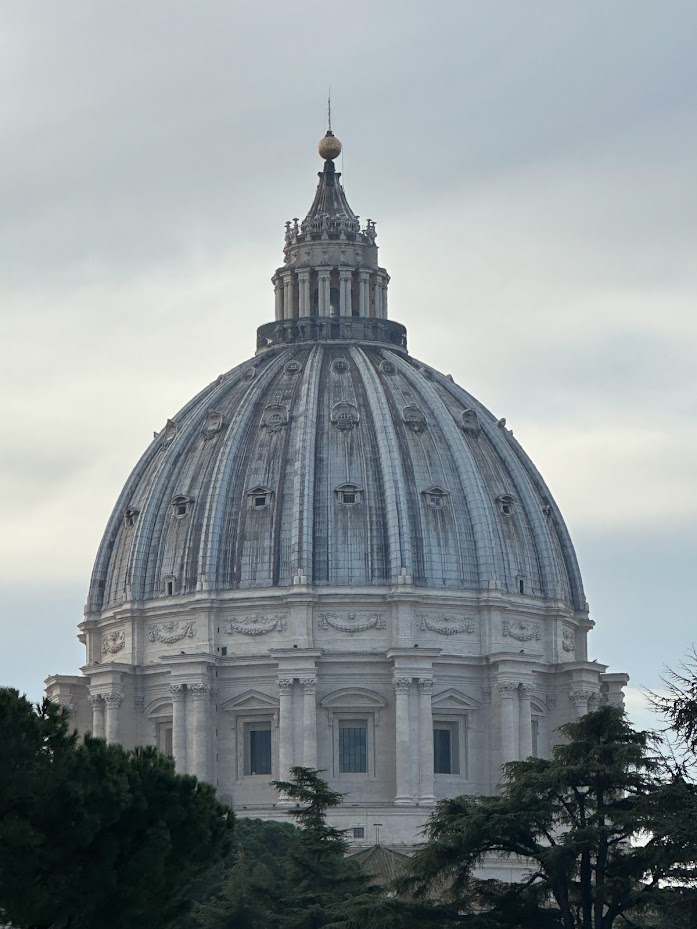
In 1506, Pope Julius II recruited Michelangelo to design his tomb for a project in the rebuilding of St. Peter’s Basilica.
Donato Bramante was tasked with rebuilding St. Peter’s from 1444-1514, and eventually Michelangelo and even Raphael would play a role in the design before it took on a fully Baroque feel with Bernini in the 17th-century.
Pope Julius is an interesting man – he was not afraid to ride into battle and fight for Papal Territories as a solider, but was also was a patron of the arts and wanted Rome to return to his former glory. At the time of Julius II – Rome was a cow pasture and backwater town other than The Vatican. Even The Colosseum was used for cattle.
We have to thank Julius II for commissioning and working on rebuilding so many treasures in The Vatican and beyond. It was Julius II who first started The Vatican Museums to collect history and art.
Julius II was also not afraid to get a bit over the top -his tomb project in St. Peter’s was to be massive. He wanted Michelangelo to create one of the biggest tombs you can imagine with dozens of statues and detailed sculpture.
It might seem ostentatious, but to Michelangelo this was his life’s dream – near free rein to create a massive stone building project with multiple sculptures.
He even ordered the marble for the project and began drawing extensive plans and beginning work on the sculptures including ‘The Slaves’ – now at The Louvre.
But God laughs when we make plans – and perhaps humbled Julius II a bit…
As the marble was arriving in Rome, Julius II asked Michelangelo to paint a series of frescoes on the Sistine Chapel ceiling and put the tomb project on hold until the Sistine Chapel was done.
Michelangelo flat out refused. He said ‘I’m a sculptor, not a painter,’ but Julius II was insistent.
Michelangelo even fled Rome to Florence to avoid the fresco project. But eventually acquiesced and started the commission.
Other than his brief time with Ghirlandaio, Michelangelo had never painted in fresco before and this was a new challenge.
We’ll dive into The Sistine Chapel in detail next week…
It took Michelangelo only four years to complete the massive project.
When he finally returned to his ‘dream job’ of the tomb, Julius II died and his heirs and successor weren’t putting it high on the priority list. Eventually Julius II was moved to an entire church outside of St. Peter’s entirely- San Pietro en Vitoli.
The unfinished vision of the tomb, does end with a magnificent Moses. You’ll notice Moses has horns in many Renaissance depictions -which is more of a crown and has a biblical symbolism (so NOT the devil)

Michelangelo died in 1564 in Rome, having seen the pinnacle of The Renaissance, its near end following The Sack of Rome and exile of The Medici…he worked until the end.
Don’t forget to subscribe for more art history posts!
 Art Expeditions