
Last time on Medieval Monday we were introduced to the Gothic Style of architecture.
Today we’re traveling to Paris to visit one of the most historic churches in the city – and one that is often overlooked by tourists…Saint Denis. To be fair, Paris is filled with beautiful churches from Notre Dame (which is being restored after the tragic fire in 2019) and Sainte Chappelle…but if you happen to visit Paris I challenge you to make a pilgrimmage stop at Saint Denis.
Historians conclusively agree that Saint Denis is the birth of the Gothic church.
Built in 1140, Saint Denis created a new form of architecture that would sweep Europe (and the world) even today.
Background:
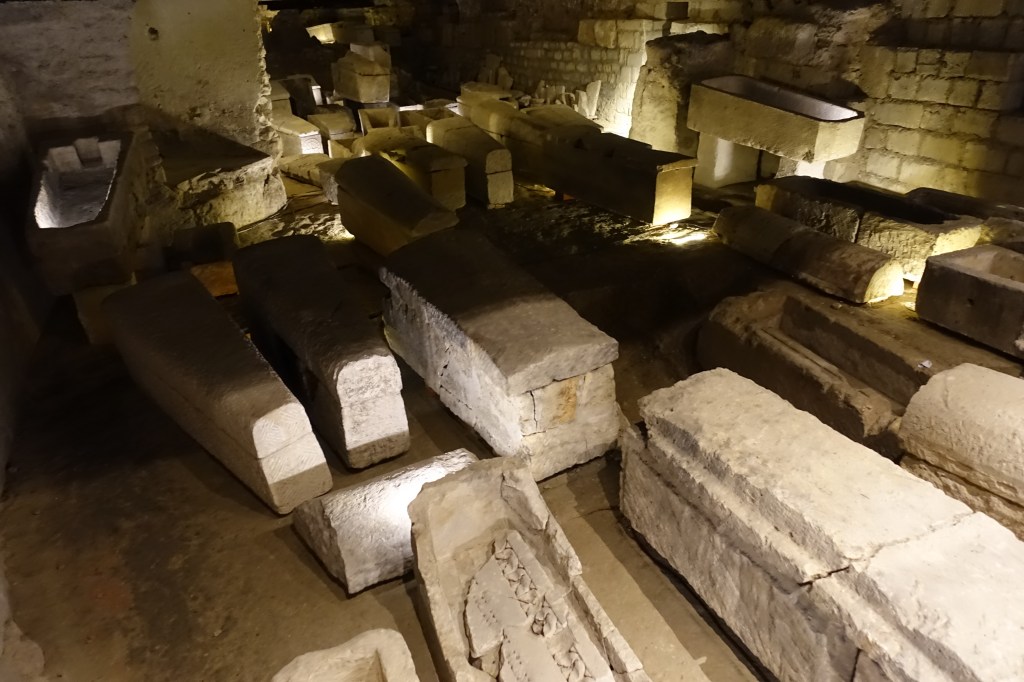
A church has been on the site of Saint Denis since at least the 9th century, with evidence showing a pre-Carolingian church under the 9th century crypt (still underneath the 12th-century structure).
Saint Denis was the church where many of the Kings of France were initially buried.
It is named after an important French martyr – Saint Denis, who’s relics are in the church.
Who was Saint Denis: He was a 3rd or 4th century martyr. Legend has it that he was beheaded on a hill in Paris (Montmartre – which means the Mount of the Martyr). Saint Denis was not satisfied by his location of death and proposed burial near Montmartre so he picked up his head and took it where he wanted to be buried – right at the location of the present Saint Denis Church.
The present-day Saint Denis was the dream of Abbot Suger who wanted to create a church that would rival Hagia Sophia in Constantinople and even The Temple of Solomon.
Little is known about Suger’s origin, except that he had a humble beginning. He was smart and was able to attend a school attached to the original monastery of Saint Denis, where his classmate was the future Louis VII of France. They became close friends. In fact when Louis VII and his then wife Eleanor of Acquaintane (later married to Henry II of England) went to The Holy Land, Louis trusted Suger to run France on his behalf.
Suger was no architect but was a visionary that worked to get the church off the ground. We don’t have records about the original architectural team…we do know that Suger didn’t meet a problem he wasn’t willing to solve. When the builders struggled to find stone proper for construction, Suger found a way to get it.
Suger was influenced by the concept of Physical Light leading to Spiritual Light. By having an abundance of Stained Glass windows to allow the light in it would help symbolize Gods light and lead the faithful closer to God.
Suger (using the theology of Pseudo Dionysius – an early Christian author) He belived God is to be discovered – God might not reveal himself to use in a miraculous way every day, but he gives us signs and wonders to lead us closer in relationship (my paraphrase).
Miraculously it only took four years to build Saint-Denis.
The church originally had two towers in the front, but unfortunately structural issues in the 1900s forced the left facing (if you look at it head on)to be dismantled.
As you enter the church you’ll noticed The Last Judgment on the facade.
As we’ve discussed before, it is common to have Last Judgment scenes as you enter a church to remind you of God’s mercy and to keep you on the right path so you can be among the saved.
Suger’s idea was that when one enters Saint-Denis, one is entering paradise because in receiving communion in the Catholic/Orthodox (and some Anglo-Luthern traditions) you are fully receiving the body and blood of Christ allowing you to be one with the saints in heaven. During the Mass the idea that heaven opens up in the breaking of the bread would reflect the idea of paradise on earth, even in the broken state of the fallen world.
Some Romanesque (and Gothic) Last Judgments are scary and literally put the fear of hell into you, but this Last Judgment is a bit calmer. While it still warns of falling away, the emphasis on The Holy Trinity and communion of Christ with his Saints is encouraging.
Christ sits with outstretched arms (to mimic crucifixion) with the Disciples on his left and right. The Holy Trinity is displayed towards the Rose window…the idea of the rose being a symbol of heaven itself.
You’ll notice Suger humbly praying at Christ’s foot. He is featured in a few other ‘selfie’ moments in the church as well – always humbly but also wanting to leave a reminder of his crowning achievment.
Souls rise fromtheir graves towards the trinity. The warning of judgment is seen in the wise and foolish virgins from the Biblical story about those who ran out of oil because they did not prepare for the return of the bridegroom. The virgins represent members of the church and Christ is the bridegroom. So if you are foolish and don’t turn to Christ who will lose the ‘oil’ to light your soul spiritually.
Saint Denis is a mix of early Gothic to high Gothic as it was tweaked over the years. One best examples of early Gothic in the church includes The East End. This was built on top of a Carolingian crypt – 9th century. The East End has a revolutionary architectural feature for the time – a double ambulatory(the rounded aisle or aisles surrounding the apse of a cathedral). Most churches only had one ambulatory, but Suger’s church has two together to add a spaciousness and lightness that opens up the interior.
The other thing you’ll notice is the amazing windows and light flooding in, which is a stark contrast to earlier Gothic. The windows are as big as the pointed arches they set. Chapels now become staging areas for light – stained glass illuminates with color, while also bringing to life Biblical stories.
- My observation: early monks and religious would create illuminated manuscripts like The Book of Kells on paper – but stain glass in a way projects that illumination to the entire congregation in the church. The light pouring through the stories also brings in the ‘spiritual light’ and God’s living presence through scriptures. These are the sorts of details that would have been important during The Medieval period.
You’ll notice a lot of Old Testmament stories in the stained glass, especially involving Moses. Like the mosaics we have seen in churches like St. Mark’s in Venice, Stained Glass storytelling is vivid and rich in symbolism. The stories depicted are intended to be easily recognizable to the viewer.

Suger saw these symbols as a way to see the signs of God and move into a deeper relationship with God.
In addition to the spiritual and architectural marvels of the church, Saint Denis is a destination for French royal history buffs. All but three of Frances monarchs from 987-the French Revolution (1789) are buried here. There are also Carolingian rulers like Charles Martel and Clovis…
Sadly The French Revolution led to many of the churches including Saint Denis being desecrated.
I’ll leave you with a few images of Saint Denis.

Resources:
Watch – The Cathedral on Wondrium (also available on Amazon) by William R. Cook – he is amazing and I learned a lot from his course
 Art Expeditions