
In our last Renaissance Art Expedition we got to know the genius of Michelangelo. Today we’re going to survey one of Michelangelo’s most important works – The Sistine Chapel.
Michelangelo’s depiction of God’s creation of Adam is so imbued in our artistic culture that when you think of the creation this image of God reaching out to Adam and putting life into his limp body usually comes to mind.
I was blessed to have a wonderful high school history teacher who was an impassioned expert on The Renaissance. He did an indepth unit on Michelangelo’s work in The Sistine Chapel. I made it a goal in tenth grade to get to Rome and The Vatican City one day to see The Sistine Chapel…well it took nearly twenty-five years, but I finally made it in January 2023.
My jaw literally dropped and if you can be in a state of art euphoria I was there. It is overwhelming and spiritually moving.
Photography is not allowed in The Sistine Chapel (it is in other areas of The Vatican), so I’ll be using common right images in this article. They have banned photography since the 1980s because of fears of damage from flash photography. With the advent of smart phones that don’t damage photos this isn’t as much of a concern, but with this series of masterpieces you cannot be too careful.
While one blog is not sufficient to cover the wonders of The Sistine Chapel, we’ll do our best to hit the highlights here.
Quick Tip: If you are planning a visit (or a return trip) – it is helpful to study the art before hand and even carry a book with you about the art (a pocket guide) because you will be overwhelmed by masterful images from the best of the best of Renaissance Art.
The Sistine Chapel features works not only by Michelangelo, but also: Ghirlandaio, Botticelli, Rosselli and more.
Our tour guide gave us an overview prior to entering the chapel with a map of the paintings and details. Once inside you must be respectful and quiet. Though this is an art lovers paradise, it is also a venerated spiritual spot – The Pope’s private chapel and where the Cardinals elect a pope at conclave.
- Papal Conclave: (white smoke = pope, black smoke= no pope)
The Sistine Chapel was built between 1473 to 1481 under Pope Sixtus IV – hence the name ‘Sistine’ – it comes from Sixtus because he built the chapel.
Since that time it has been a place of religious (Mass and the Sacraments as needed) and Papal Activity.
The building itself is fairly plain in structure, but this allows it to be beautiful decorated with interior frescoes.
- Sixtus IV was at odds with Lorenzo de Medici (The Magnificent) over a bank loan that The Medici refused the Papal States. This led to a mini series of battles and the death of Lorenzo’s brother Giulio (The Pazzi Conspiracy), but thankfully peace was brokered between Sixtus IV and Lorenzo. As part of this tenuous peace, Lorenzo the Magnificent sent many of Florence and Umbria’s best artists to Rome to paint the Sistine Chapel.
Many are surprised that Michelangelo is not the only artist featured in The Sistine Chapel. His frescoes were so revolutionary that it is easy to overlook the other masters in the chapel…but don’t. It reminds me of my trip to the MOMA in NYC and everyone hovers in front of Starry Night but fails to see the Cezanne beside it. Give your permission to enjoy it all, even if it is a quick glance.
- While I normally recommend focusing on a few paintings and taking your time in a museum, with The Sistine Chapel you really need to look at everyone – even briefly because the stories go together from Old Testament to New Testament. You also only get around 20 minutes inside (due to crowds) so I recommend soaking it all in and then there is no shame in either returning a second time while in Rome and also purchasing one of the high resolution professional photo books from The Vatican shops that have each paiting and detail laid out.
Early Frescoes: 1482-83: Series of frescoes on the lower (side interior walls) depicting scenes from The Life of Christ and Life of Moses, offset with papal portraits and trompe-l’oeil drapery below.
Let’s take a quick tour of the ‘walls’…
Southern Wall:
- Moses Leaving for Egypt: Pietro Perugino and assistants
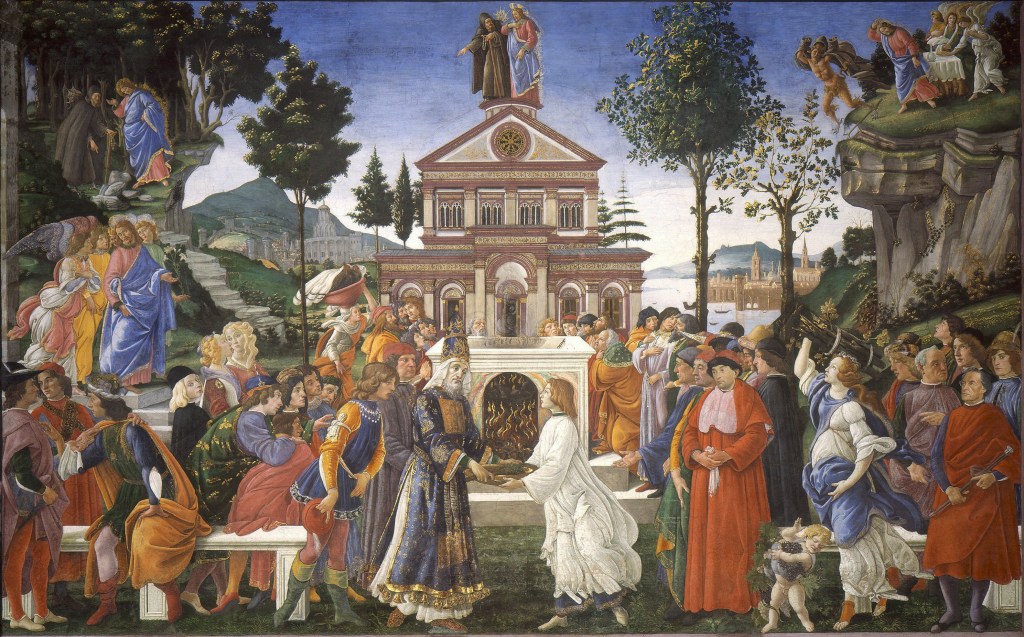
- The Trials of Moses: Botticelli and his assistants
- The Crossing of the Red Sea: this is up for debate, while many attribute to Ghirlandaio and other Rosselli or Biagio di Antonio Tucci
- Descent from Mount Sinai: Rosselli or Piero di Cosimo
- Punishment of the Rebels: Sandro Botticelli
- Testament and Death of Moses: Luca Signorelli or Bartolomeo della Gatta
- Many of the artists worked with workshops or partnered with other artists in the project, hence the debates about who did what in certain instances.
Northern Wall:
- The Baptism of Christ: Perugino and assistants
- Temptations of Christ: Botticelli
- Vocation of the Apostles: Ghirlandaio
- Sermon on the Mount: attributed to Rosselli
- Delivery of the Keys: Perugino
- The Last Supper: Cosimo Rosselli
Eastern Wall:
- Resurrection of Christ: Hendrick van den Broeck – this was painted over Ghirlandaio’s original in 1572
- Disputation over Moses’ Body by Matteo da Lecce- this was painted over Luca Signorelli’s original in 1574
Michelangelo’s Frescoes:

Quick recap:
In our previous lesson about Michelangelo we discussed –
- Michelangelo was in the middle of designing and preparing to carve the marble for Pope Julius II’s tomb in the new St. Peter’s Basilica. This was SUPPOSED to be the crowning achievement of Michelangelo’s career and showcase his sculptural genius…but God had other plans
- As Michelangelo was about to receive the Carrara marble for the tomb project in Rome, Pope Julius asked Michelangelo to delay the work to paint the Sistine Chapel ceiling instead.
- Michelangelo protested: ‘I’m a sculptor, not a fresco painter.’ But the Pope wouldn’t take no for an answer. Michelangelo fled to Florence until he finally agreed to Pope Julius II’s request in 1508
- Prior to completing The Sistine Chapel, Michelangelo never painted a fresco before expect as an assistant with Ghirlandaio, who painted frescoes in the chapel years earlier (Michelangelo was not present on that project)
It is interesting to note that Pope Julius was related to Pope Sixtus IV (della Rovere family) who build the chapel.
To paint the ceiling Michelangelo had to engineer his own scaffolding device. He created a flat wooden platflom on brackets built out from holes in the wall,high up near the top of the windows. He painted in a standing position…not lying on his back as myth would have it.
Michelangelo was not afraid of bright colors, which is evident in his Holy Family work at The Uffizi in Florence
Pope Julius II and his staff of theologians created the sequence of stories from Genesis for Michelangelo to paint, but Michelangelo was very devout and spiritually aware of themes and storytelling, which he put to use in his representation.
Prior to Michelangelo’s Sistine Chapel God the Father was usually portrayed as clouds with a hand reaching down, but not in a human body. But as God said we are created in His image, Michelangelo depicts God the Father as a strong human with empathy and power as he creates the world.
Quick Facts:
Architectural and framework painted on the ceiling looks real but is actually a tromphe d’oeil to subdivide the ceiling.
The Sistine Chapel Ceiling by Michelangelo includes over 5,000 square feet of painted frescoes, which he did in only four years! (1508-1512)
- Along the central section of the ceiling Michelangelo depicted nine scenes from the Book of Genesis, organized into three groups of related scenes that come from The Book of Genesis. There are four large panels and five smaller ones in this sequence.
- First Group: God creating the Heavens and the Earth

- Second Group: God creating Adam and Eve, and their disobedience and expulsion for the Garden of Eden
- Third Group: Plight of humanity and the family of Noah
- On the corners of each small scene are five male nudes, painted as if they are real – they are much larger than the Biblical Scenes, which remind us we are looking in on the story.
- On the area of the vault that curves down towards the walls, Michelangelo had 26 additional fields to paint:
- in the largest fields, bordering the Biblical characters he introduced seven Old Testament Old Testament prophets, alternating with five pagan sibyls that foreshadowed Christianity (a common theme in religious art from the era).
- These are the largest figures on the ceiling
- in the largest fields, bordering the Biblical characters he introduced seven Old Testament Old Testament prophets, alternating with five pagan sibyls that foreshadowed Christianity (a common theme in religious art from the era).
- In the spandrels and lunettes above the windows he painted the ancestors of Christ
- In the pendentive corners (curved triangular corners) – he painted four narrative scenes from the Old Testament interpreted as prefiguring Christian salvation
There are over 300 figures in Michelangelo’s Ceiling Frescoes
- Important symbolism: Historically in churches a Choir separated the laity from the clergy. The Fall is actually right above the choir gate symbolically showing the separation of God and Man
- Above the altar, a mysterious form revolves in a more constricted space – we don’t see theface of God here, but he is present. Think about The Eucharist in Christianity as the Body and Blood of Christ – truly present with Christ and yet mysterious. Holy Mystery.
The Last Judgement: In our next Renaissance Wednesday we’ll dive deeper into Michelangelo’s ‘The Last Judgement’ at The Sistine Chapel, but here are a few quick facts:
- It was painted between 1535 to 1541 and is stylistically different than his earlier works. This is because post Sack of Rome (1527), The Renaissance all but ended in Rome and moved on to Venice (which if you follow The Masters of Venice continued to shine into the early 1600s with the High Venetian Renaissance).
Don’t forget to subscribe to Art Expeditions post and join our Adventures in ART
Helpful resources:
 Art Expeditions