
Today on Impressionism Friday we’re going to meet versatile painter Edgar Degas, who dabbled in Impressionism and Realism to create his masterful series of dancers to race horses, portraits and beyond.
I’ve always been taken with Degas breadth of talent as an artist. Though he is considered a founding member of Impressionism, participating in several of the Impressionist Exhibitions, Degas rejected the term. He preferred to be called a ‘realist.’
Like his contemporary Manet, Degas also leaned heavily into figure painting and interior scenes. Unlike Monet who is known for en plein air landscapes, Degas works often are figures inside a dance studio, or interior scenes painted in a studio.
Degas had the technical drawing ability of a draftsman with the vision of Impressionism perspective, which makes his work highly technical and still fluid as it comes to life on the canvas.
Degas leaned into several recurrent themes in his art including:
- Ballet dancers and The Ballet
- Figure painting (outside of ballerinas) – including washerwomen and nudes
- Racehorses and racing jockeys
- Portraits that bring in a strong realism and psychological element, from Women drinking Absinthe to his realistic self-portraits.
Initially Degas wanted to be a history painter, which demanded rigorous technical and classical art training. He shifted in his early thirties to be a ‘contemporary history painter’ – bearing the soul of contemporary life on canvas with the classical mentality that provides a psychological depth to each work of art.
Biography:
Degas was born in Paris on July 19th, 1834 to a moderately wealthy family. Interestingly enough, Degas’s mother was of Creole descent from New Orleans. Degas actually spent some time in Louisiana and you can stay in his family’s home, which is now a bed and breakfast and museum.
His father’s side of the family were bankers, with some relatives in Italy as well. His original family name was De Gas, but Degas shortened it for simplicity.
He began painting from an early age, and by his eighteenth birthday turned a room in his home into an artist’s studio.
He registered as a copyist at The Louvre Museum to learn from ‘the masters.’
- At the time aspiring artists could register to be copyists at The Louvre, where they could copy famous paintings in the collection, which would be in turn sold to tourists and those wanting a ‘copy’ of a Louvre work. The majority of artists throughout history often learned by copying the masters for technique. So don’t feel ashamed if you are learning by ‘tracing’ first in your artistic journey. Degas to Morisot and beyond did the same thing to gain technical style and inspiration.
Though Degas’ father supported his talent, he like any dutiful parent wanted to make sure his son had a viable career. Degas senior pressed his son to attend law school.
Though Edgar did enroll he did not apply much effort to his studies, instead focusing on art.
In 1855, he was encouraged by Master artist, Jean-Auguste-Dominique Ingres, who advised him: “draw lines, young man, and still more lines, both from life and from memory, and you will become a good artist.”
In April 1855, Degas was admitted to the Ecole des Beaux-Arts, where he studied drawing with Louis Lamothe. This proved to be a good partnership and Degas flourished in his studies.
In July 1856, Degas traveled to Italy to visit his aunt’s family in Naples and take the ‘grand tour’ of Italian art. He drew and painted copies of works by Michelangelo, Titian, Raphael and more.
Returning to France in 1859, Degas moved into a Paris studio large enough for him to work on large canvas. He initially focused on historical paintings, but after the 1870 Franco-Prussian War he moved closer to contemporary subjects and Impressionistic styling.
In 1872, Degas stayed in New Orleans with is brother Rene and extended family who lived there. His A Cotton Office in New Orleans is one of his most famous works from this period.
Unfortunately, Degas learned that his brother was in severe debt. To help Rene, Degas sold his house and an art collection he had inherited to pay off his brother’s debts.
For the first time in his life, Degas was fully dependent on art sales to secure his income.
It was also around this time that Degas became disenchanted by the rigidity of the Salon and in 1874 showed his work with what would be known as the first Impressionist exhibition.
Degas took a leading role in organizing the exhibitions, which were more of a refusal of The Salon versus intended to be strictly for Impressionists, although most who showcased leaned into that style.
Degas was fairly conservative in his values and even artistic pursuits, which at times isolated him from other Impressionists. Degas in general found himself to be a bit of a loner, as he didn’t want social life to distract from his pursuit in mastery of his art.
Other Mediums:
Degas was not afraid to pursue art in multiple mediums from charcoal to pastels to oil, as well as his adept ability in sculpture and taking on photography as an art form. Degas was one of the earlier artists to see photography as an artform and medium that could bring forth expression and depict the artistry and truth of the human condition.


Sculpture:
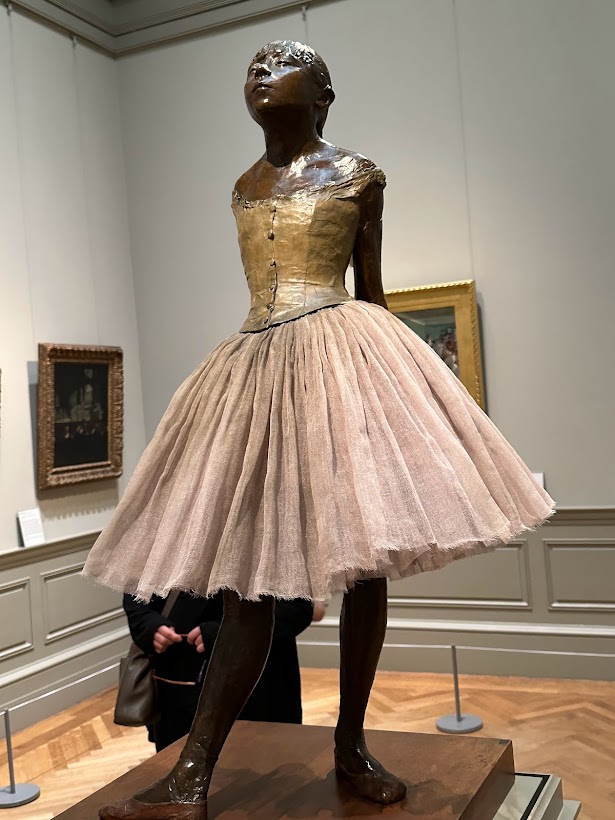
- He created over 150 sculptures from wax, clay and plastiline; his heirs authorized the casting of some 74 of his works into bronze so they could be sold. 52 of his original wax sculptures are now housed in the National Gallery of Art in Washington DC. Learn more about NGA collection here
Degas Support of Female Artists
Degas was a strong supporter of female Impressionist Mary Cassatt. Degas introduced Cassatt to pastels and engraving. Cassatt introduced Degas to American art collectors including her friend Louisine Havemeyer….who purchased countless Degas and bequeathed them to The Met Museum. This is one of the largest single collections of Degas in the US.
While the two sparred over women’s suffrage and The Dreyfus Affair, at the end of the day they had deep respect for one another as artists and as friends.
Degas also was a friend and admirer of Suzanne Valadon. He was the first person to purchase her art and taught her soft-ground etching.
Valadon was one of the popular models for Impressionists including Renoir, who featured her in many of his scenes.
Degas standing up for Valadon’s art was an early success for female artists.
Controversy:
In recent years, Degas has faced a bit of backlash for being a supposed misogynist. I want to challenge this preception a bit and provide a more nuanced and thoughtful dialogue there. While Degas, as a flawed human being as we all are, did have his severe faults at times, I think it is important to look at the time and context of his mindset and his actual actions as a person throughout his career.
I bring this up first because, while hindsight is 20/20 and I am often astounded by some of the accepted practices of 19th-century Paris to the USA and beyond…canceling the entire stroke of genius of Degas needs to be thoughtfully analyzed.
- For years we have been captivated by the fluidity and grace in the movement of the dancers in Degas dancer paintings and sculpture. These are still his most popular works and draw us in time and again. The issue with these paintings via modern perspective goes to the working conditions of the dancers in The Paris Ballet at the time Degas was painting them. These young girls were treated poorly and some trafficked as courtesans. That is a historical fact that is reprehensible. You can read more here.
- That being said, Degas did NOT abuse or engage with the dancers in this way. The greatest complaint of him is that he asked them to pose too long for his work as a sculptor. This however is not uncommon for artists even today and was not done maliciously from my research, but rather because Degas like many creative geniuses was so focused on the art he sometimes had to step back from the intensity of the creative moment. (think about parents asking their kids to pose multiple times on family trip)
- Degas said to his friend Ambroise Vollard of his love of painting the ballet: “They call me the painter of dancers, but they do not understand that the ballerina was for me a pretext to paint pretty fabrics and depict movements.” Degas liked the ballet because it was fluid as an art form – the body moving, but the movements were measured by form and lines and synchrony which could be paralleled in the quest for great art. Line and movement…
- Degas never married and has been said to have ‘hated women.’ This is a bit of a stretch. Degas chose not to marry because like many artists (or scientists, etc…) he believed that it would distract him from his mastery of art. Also, sadly at this time, women were not elevated at the same status as men, so things we judge as despicable today (like not allowing women to vote, etc..) was status quo at the time. This doesn’t make it right, but Degas was also within a generation and this doesn’t not make him inherently misogynistic.
- It is important to recall from our earlier study of Impressionist Mary Cassatt – Degas worked as her advocate and teacher. They were lifetime friends and collaborators – it seems unlikely that an independent and well studied talent like Mary Cassatt would call Degas a mentor and friend he was misogynistic. They did spar over suffrage, but at the end of the day mutual respect remained.
I bring this up because when we study art we often expect our artistic heroes to be perfect and unblemished. We can be shocked to find out our favorite artists are flawed. And it is important to wrestle with art and the morality of the artist behind fine art. In the case of Degas – he was a man who was extremely dedicated to his work and perhaps not the most outgoing of The Impressionists, however overall I think his talents and personhood (advocating for Mary Cassatt, friendship with Mrs. de Nittis) outweigh any squabbles the lens of today’s microscope.
Degas was not a perfect man, but as an artist he shines as a beacon of inspiration and wonder.
We’ll dive into more Degas works soon.
Don’t forget to subscribe to the blog for updated posts
 Art Expeditions