Over the next few weeks we’ll be diving deep into Renaissance art work at The Walters Art Museum in Baltimore.
Located in the heart of Baltimore’s historic Mount Vernon district, The Walters Art Museum houses one of the best collections of Renaissance art in The United States and beyond.
In the midst of The American Civil War, Baltimore businessman, William Thompson decided to leave for Europe. He began investing in art and building the beginnings of the collection. He son continued to collect masterworks by artists like Bellini and Veronese. The artwork was housed ‘salon style’ (wall to wall similar to the French salon art hanging). The museum’s foundation was expanded starting in the early 1900s as Henry Walters (son) wanted to leave the gallery as a legacy to the city of Baltimore.
It eventully opened to the public as a free museum in 1934 and has continued to grow in scope and size.
- Fun fact: The Walters Raphael painting Madonna of The Candleabra is considered to be first Raphael purchased for a museum collection in the US. We’ll be featuring this painting on Art Expeditions soon!
As a Renaissance art lover – I could have stayed in The Walters for days on end – each portrait, allegory or Renaissance scene tantalizes the senses.
- Pro tip: Many museum explorers can feel overwhelmed when looking at the Old Masters because there is the presumption you have to have to be a Ph.D to find joy in old masterworks. This is NOT true. While it helps to have a bit of understanding about the period and symbolism in Renaissance art – much of this is easy to access online or presented at the museum exhibitions. Truly you can appreciate the art and story telling in these works without any background. Remember much of the art was designed for beauty and to tell meaningful stories that touch human hearts. AKA you are the ideal person to enjoy fine art 🙂
- I loved hearing the oohs and aahs of casual museum goers of all backgrounds drawn into the art…Each for different reasons…Don’t be afraid to sit for a minute in a gallery and just let the are speak to you. Perhaps it will be the heavenly imagery of Mary’s love for the baby Jesus…or the drama of a mythological scene…Art is for everyone.
We’re starting this feature series on The Walters Renaissance Collection with one of my favorite pieces in the museum:
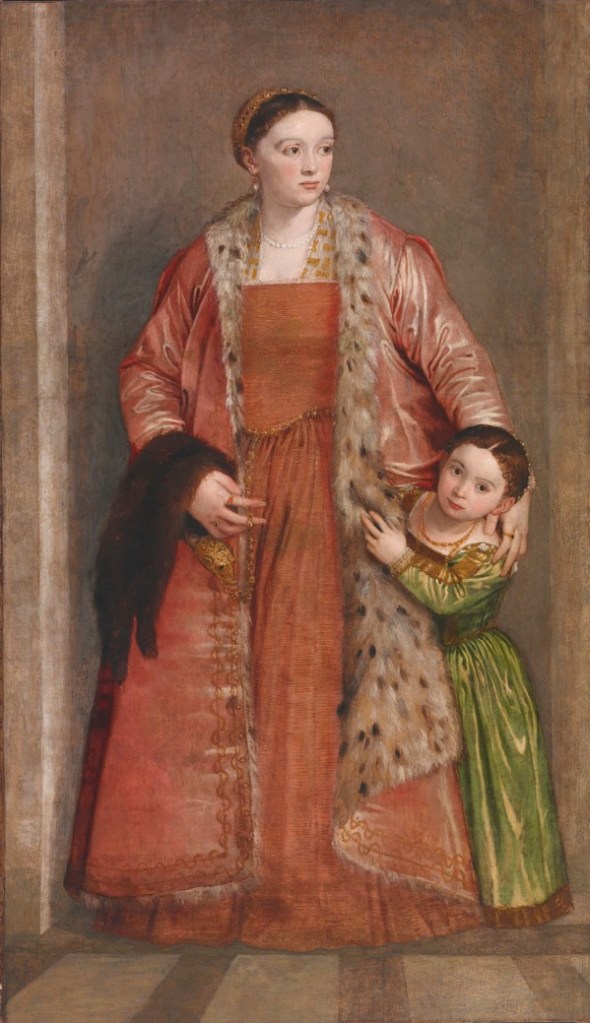
Veronese’s Portrait of Countess Livia and her Daughter…
You might remember encountering Veronese in the Art Expeditions Masters of Venice course…click here for the lesson.
Veronese was one of the preeminent artists to paint in the High Venetian Renaissance. His vibrant use of color and dynamism is legendary.
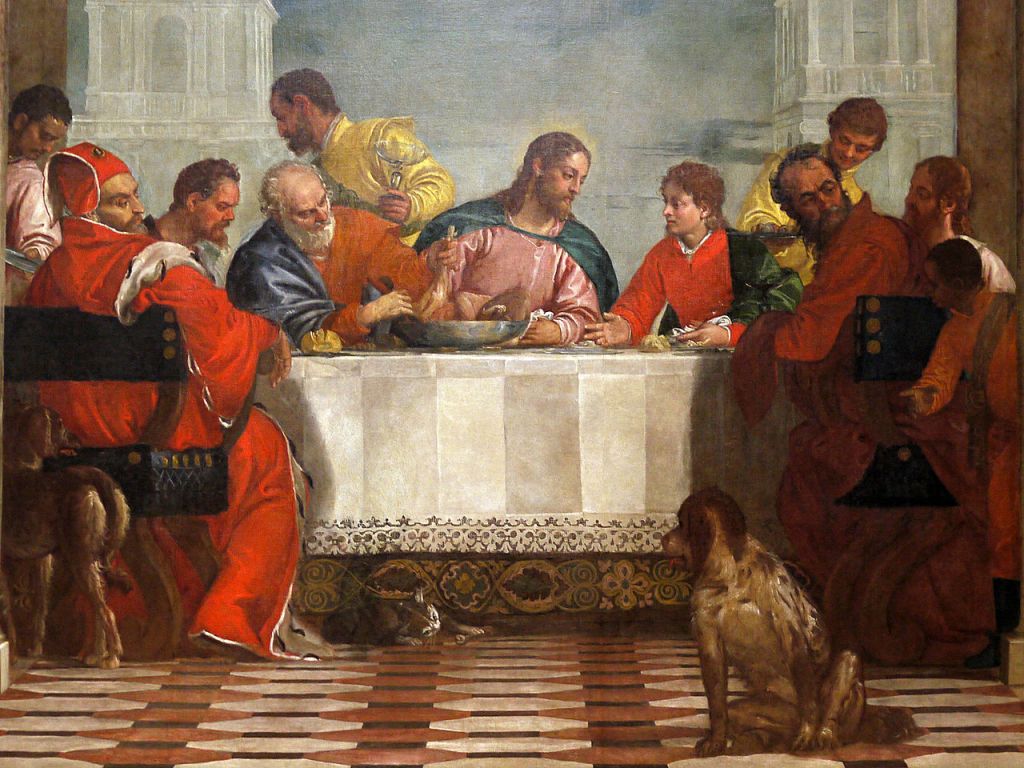
- Paolo Paolini (1528-1588) was originally from Verona before moving to Venice, where he became known as ‘Veronese’ – the man from Verona. He was one of the leading painters of the 16th-century’s High Venetian Renaissance. A master of color and action, Veronese excelled at large history paintings and Biblical works including the Feast of the House of Levi (Gallerie dell’Accademia in Florence). He was also an in demand portrait painter, as seen in today’s feature painting of Countess Livia and her daughter…
- Fun fact: His Feast in The House of Levi was originally painted as a Last Supper scene for a the dining hall of the Dominican monastery of Santi Giovanni e Paolo in Venice. The canvas large size of 18 x 42 feet inspired Veronese to fill The Last Supper scene with numerous figures – not entirely uncommon in a large work. However with the Catholic Reformation, it was decided that religious artwork should follow strict guidelines. Concern about the extra figures (not present in the Biblical scene originally) led to an inquistion about Veronese’s grand ‘Last Supper’ work. Veronese argued that he felt that since the canvas was large extra persons would necessary to fill the scene and feigned madness ‘we artists are all a little mad.’ He changed the name of the painting to The Feast of The House of Levi, which could have extra characters.
The Venetian School of Art, became an epicenter for portraiture. Veronese’s contemporary Titian was active throughout Europe, even painting a portrait of Philip of Spain that was sent to Queen Mary of England. Venice was a center of the art world and trade, which attracted the who’s who of society to seek out Venetian talents like Titian and Veronese to paint their portraits.
The majestic, full-length Portrait of Countess Livia da Porto Thiene and her Daughter Deidamia (or Porza)awes viewers as with it’s sumptuous grandeur. The figure of Livia feels as though she is standing before you, guarding the door as you approach her. She is confident and yet looks in the distance, matters on her mind.
Veronese counters the refined pose of The Countess with the playful wonder of her daughter, whose curiosity brings a depth and life to this painting that invites you into the beauty of the life of this family.
This portrait was originally paired with the partner portraits of her husband Count Issepo (Giuseppe) da Porto and their son Leonida. The portraits were originally in their palace in Vicenza, which was built by renowned architect Andrea Palladio (1508-1580)
The Palace in Vicenza were hung in custom niches to appear as the family was standing as keepers of the estate.
The partner painting is currently on view in The Uffiizi Gallery in Florence, Italy. I was lucky enough to see the painting during my visit to The Uffizi earlier this year.
This work depicts Count Giuseppe (or Iseppo) da Porto, together with his first-born son, Adriano, one of the seven children he had from his marriage with noblewoman Livia Thiene, which took place in 1545. They had seven children in total.
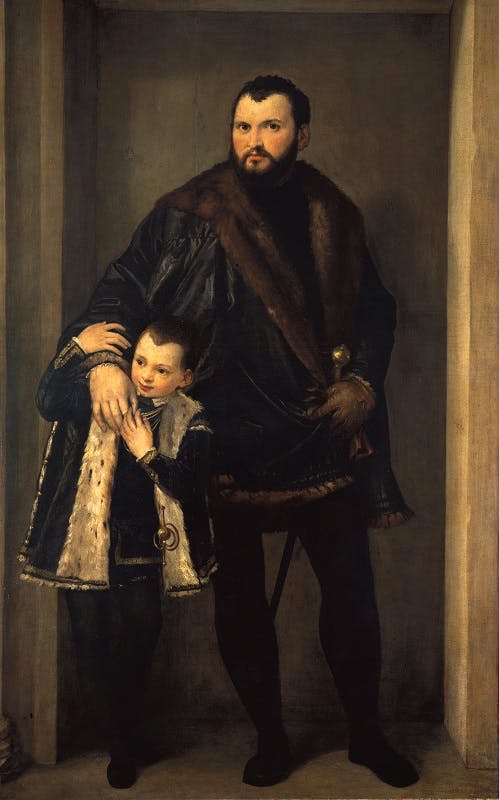
“The subjects represented here are set in a faux shaded niche and painted full length, following a style that was typical of artists between Brescia and Bergamo, such as Giovan Battista Moroni, who was an important inspiration for Veronese. Giuseppe da Porto is wearing a heavy black tunic, lined with fur and high on the leg. He is wearing a sword in his belt and a single glove, since he has removed the other to place his hand on the shoulder of his son, Adriano. The boy is also sumptuously dressed, with an ermine-lined jacket, decorated with gold embroidery.” – from Walters Art Museum website

Notice Veronese’s use of contrast from the realistic shadows against the illuminated light that shows the beauty of The Countess – Veronese perfectly balances realism with also the softness and vivacious color that lures viewers into the mesmerizing portrait.
The luxurious textures of her fine clothing feels as though it could come out of the portrait – Veronese uses painstaking detail to emulate the ornate fabric and finery of this well fashioned Countess.
One highlight is The Countess’s gown lined with marten fur. She seems to have a fullness underneath the layers of the coat as she pulls it over her dress. This was a popular visual trick to symbolize motherhood and expectation of future children.
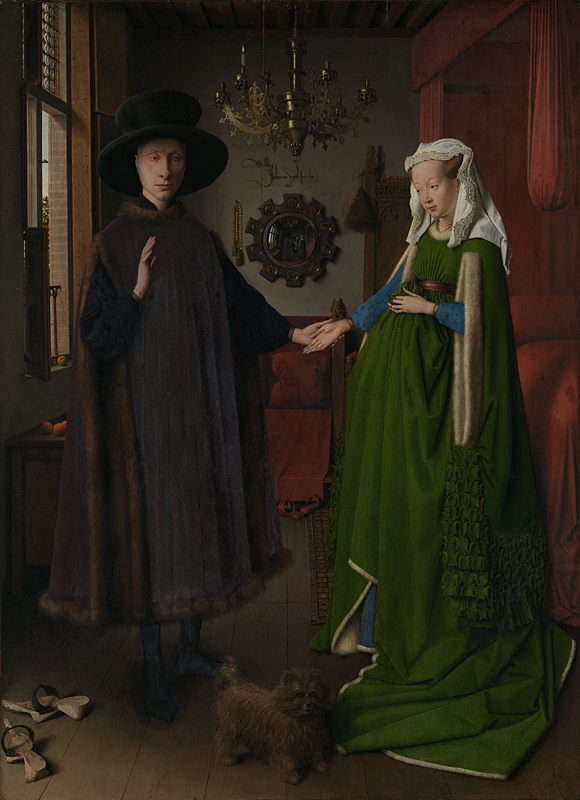
Early Renaissance Dutch painter, Jan Van Eyck uses a similar device in his Arnolofini Double Portrait.
Fun fact: Van Eyck was one of the first artists to use oil paints… Venetian art master, Antonello da Messina (generation before Veronese) was the first to bring oil paints to Venice after traveling in The Netherlands and also experimenting with oil paints in Naples (Italy). By the era of Veronese, oil paints had become the gold standard for painting in Venice and beyond. Oil allowed the detailed vivacious colors Veronese does so well.
The marten was a symbol in the Renaissance, as it was believed marten fur protected women in childbirth. This portrait was painted in 1552, the year The Countess gave birth to a child – so it seems she was pregnant while sitting for the portrait.

Notes from Walters Art Gallery website:
This portrait is a famous work from Veronese’s young period and includes fundamental elements of his style. The colour range is very well defined, with particular style characteristics, such as the bold iridescences, making it different from the tonal painting style of Veneto. The textured depiction of the sumptuous fabrics, furs and jewels is most important, making this piece one of the most extraordinary examples of 16th-century portrait painting.
Recommended reading:
Masterpieces of Italian Painting: The Walters Art Museum
Walters Art Museum website:
Don’t forget to subscribe to Art Expeditions for the latest posts and follow up on facebook for more art adventures
 Art Expeditions