
We’re kicking off the first Renaissance Wednesday of 2024 with a visit to my local museum, The North Carolina Museum of Art in Raleigh NC.
The NCMA holds the claim to be the first state funded art museum in the United States
The NCMA has a premier Italian Renaissance collection featuring master works from Giotto to Veronese. As a lover of all things Renaissance, I often return to The NCMA to admire the treasures in their collection. Many of these paintings feel like familiar friends, yet continue to reveal their majesty and new details with each viewing.
On today’s art expedition, let’s travel back to The Italian Renaissance via The NCMA’s master collection…
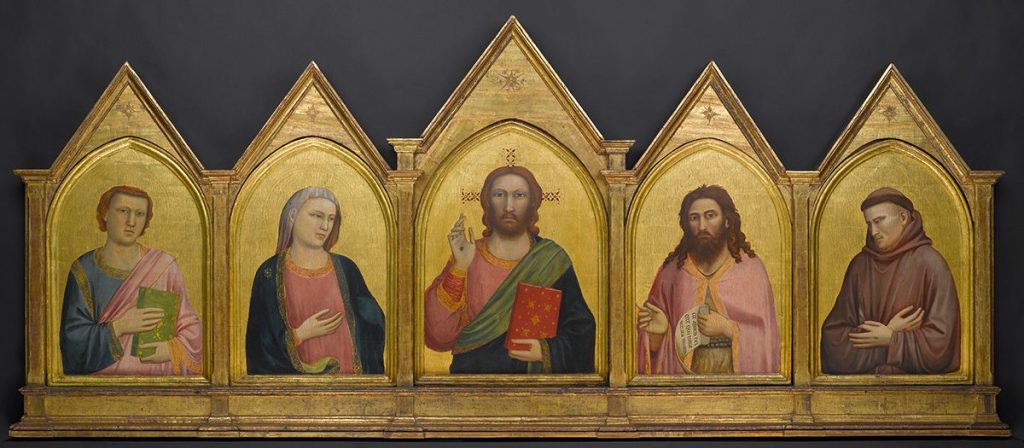
Though Giotto technically painted in the late Medieval Gothic period, his revolutionary style and depth in composition (even prior to the invention of linear perspective) leads many scholars to group Giotto with other Renaissance painters. Giotto is described as ‘The Father of The Italian Renaissance’.
Renaissance artist and art historian Giorgio Vasari writes that Giotto painted a fly on the wall that was so realistic that Giotto’s teacher Cimabue tried to brush it off!
The Peruzzi Altarpiece originally was in The Peruzzi Chapel in Santa Croce Basilica in Florence, Italy. Santa Croce is one of the most important churches in Florence and a place of pilgrimage for art lovers. Legend has it that Santa Croce was founded by St. Francis himself. Giotto painted chapels of four different Florentine families in the church of Santa Croce: Bardi Chapel (Life of St. Francis); Tosinghi Spinelli Chapel (Stories of the Holy Virgin), the lost Giugni Chapel (Stories of the Apostles) and The Peruzzi Chapel (Life of St. John the Baptist and St. John the Evangelist).
Santa Croce is the final resting place for many famed Italians including Michelangelo…Many churches like Santa Croce would have private chapels for patrons who donated funds to have a private place for their family to pray and be buried.
The Peruzzi Altarpiece is a three-foot tall, eight-foot wide altarpiece made from wood painted with tempera paint and gold leaf. While it has a realism akin to later Renaissance works, the gold leaf is an echo of the Byzantine influence of the late Gothic period.
This five panel altarpiece is called a polyptych (pol-ip-tik) – a polytych is a painting with more than three panels. It features Christ Blessing with St. John the Evangelist, the Virgin Mary and St. John the Baptist and St. Francis…
Now part of The NCMA’s permanent collection, The Peruzzi Altarpiece, is a direct link to the heart of Florentine life…Household names like Michelangelo would have been familiar with this and other Giotto works…How cool is it to stand in front of a work of art with such history. I challenge you to take a moment to imagine yourself going back in time and all the hundreds to thousands of Florentines who gazed upon this work of art.
Altar pieces like this always draw me in and stir my soul as they were originally designed to bring glory to God by being used as a backdrop during The Mass – where Catholics believe Christ is truly present in the Eucharist. How many people meditated and prayed in front of this altarpiece – in times of famine, war, hopes and joy.
When we think about the history and people outside of just the art it opens up doors to stories we never imagined and makes history come alive.
Sandro Botticelli: Adoration of the Christ Child
Circa 1490-1500

Thousands flock to Italy to see masterworks by Botticelli each year, but little known secret, The NCMA and many other US collections have exquisite Botticelli pieces including this treasure showing The Blessed Virgin Mary lovingly gaze on her son, with St. Joseph resting in the background.
This work, like many other Botticelli and Renaissance works is what is called a tondo. A tondo is a Renaissance term for a circular work of art, either a painting or a sculpture.
This work is full of religious symbolism combined with Botticelli’s masterful and delicate hand.
St. Joseph’s nap is not for lack of care in his duty as foster father to the Son of God, but rather in my eyes shows his trust in Mary to watch over Jesus and security in the presence of the infant child.
The background is a delight with what appears to be soldiers in the cityscape that is clearly inspired by Tuscany. While I can’t be certain, the fact The Holy Family is enclosed in an open air stable like building plays into the purity and uniqueness of this family – Christ has come into the world, but is not of it…The people in the background are a procession coming to meet the Christ Child…
What do you think?
To learn more about this Botticelli work here.
Giovanni Battista Cima da Conegliano: Virgin and Child in a Landscape
circa 1496-1499 (Oil on Panel)
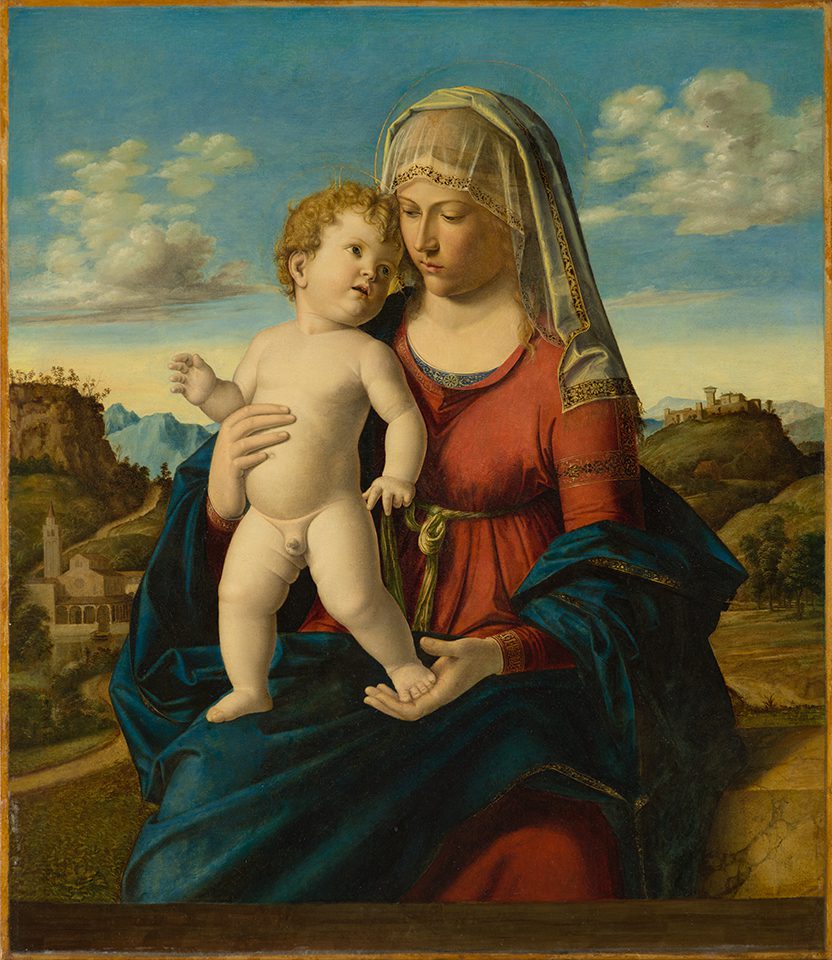
Hands down one of my favorite works at The NCMA – the rich colors and dynamic scene lead us to the care and love The Virgin Mary has for her son. Jesus is confident and at peace in her care and they lovingly look upon one another.
*Fun fact: This was chosen as the image for a US Postal Stamp in 1993
The artist, Cima, was trained by ‘Father of The Venetian Renaissance’ Giovanni Bellini (who we studied in the Masters of Venice course)…Bellini was one of the first artists to adopt oil paints, which he was introduced to by the artist Antonello da Messina…Bellini was also the first artist to set painting of The Virgin Mary out of doors and with these exterior backdrops. This seems common as we look at other Renaissance works, but it was a shift from the Byzantine Iconography of The Middle Ages.
I point this out as you can see where Cima is influenced by Bellini, in that this is an oil painting and the detailed and expansive landscape brings home the message that Jesus came to earth and his Mother and is part of the natural landscapes that early viewers would recognize.
Even with the glorious landscape however, the viewer is continually drawn back to the gaze of the Blessed Mother Mary…she is so in awe of her son. What I love about Venetian painters is the melding of emotion and realism…you can feel the emotion and movement in this work and yet it is also lifelike as you gaze on the detailed lace veiling Mary’s face.
*fun fact: oil paint took off as the medium of choice in Venice…Venice is a series of marshy islands that are connected by bridges and the humidity and dampness of the climate caused other paints like tempera to be destroyed over time through chipping and weather wear. Oil does much better in The Venetian climate and became the popular choice with Bellini to Titian in The Venetian Renaissance.
Paolo Veronese: The Baptism of Christ
1550-1560

This is hands down my favorite work in The Renaissance collection at NCMA…simply because I feel like I’m right there with Christ at His Baptism. There is an otherworldliness in the piece that Veronese masters with his colorful palette, but the natural details like the rocks and the clear water moving are flawless. As a person of faith, the imagery no doubt sparks a fire in the soul to contemplate Baptism and God’s grace. I’ve spent many hours just enjoying quiet meditation with this work.
We focused on Paolo Veronese during our Masters of Venice class last year. He was one of the finest Venetian painters to come of the late Renaissance. Learn more about Veronese here.
Francesco Francia:
Virgin and Child with Two Angels (circa 1495-1500)

This painting is a feast for the eyes. Francia is a master of color and has a softness and texture in his representation of the Virgin Mary that shows the strength of her motherhood, not other for Christ, but as an advocate – someone who feel confident approaching in spite of her stature.
Like many other depictions of The Virgin, Francia paints Mary with royal blue and red clothing. The blue is symbolic of Mary’s role as mother of God – and royalty. Blue paint at the time was made with lapis lazuli a very expensive gemstone mined only in Afghanistan. It would only be used in the most expensive of fabrics and paintings. Using it to clothe The Virgin Mary was paying homage to her saying ‘yes to God’ and queenship…The red symbolizes her own suffering – seeing her son die on the cross was no doubt horrific and has The Gospel of Luke 2:35 says: '(yea, a sword shall pierce through thy own soul also), that the thoughts of many hearts may be revealed’ (KJV)
Francia was friends with and influenced by Raphael, which I think you can see in this work.
Interestingly enough, The NCMA is home to a small very early Raphael.

Tintoretto:

The NCMA owns several works by Venetian master Tintoretto. Considered the last great Italian Renaissance painter by some scholars before Mannerism and Baroque styles emerged, Tintoretto was a prolific artist known for his fast and emotional painting style. Learn more about Tintoretto here.
Francesco Bassano:
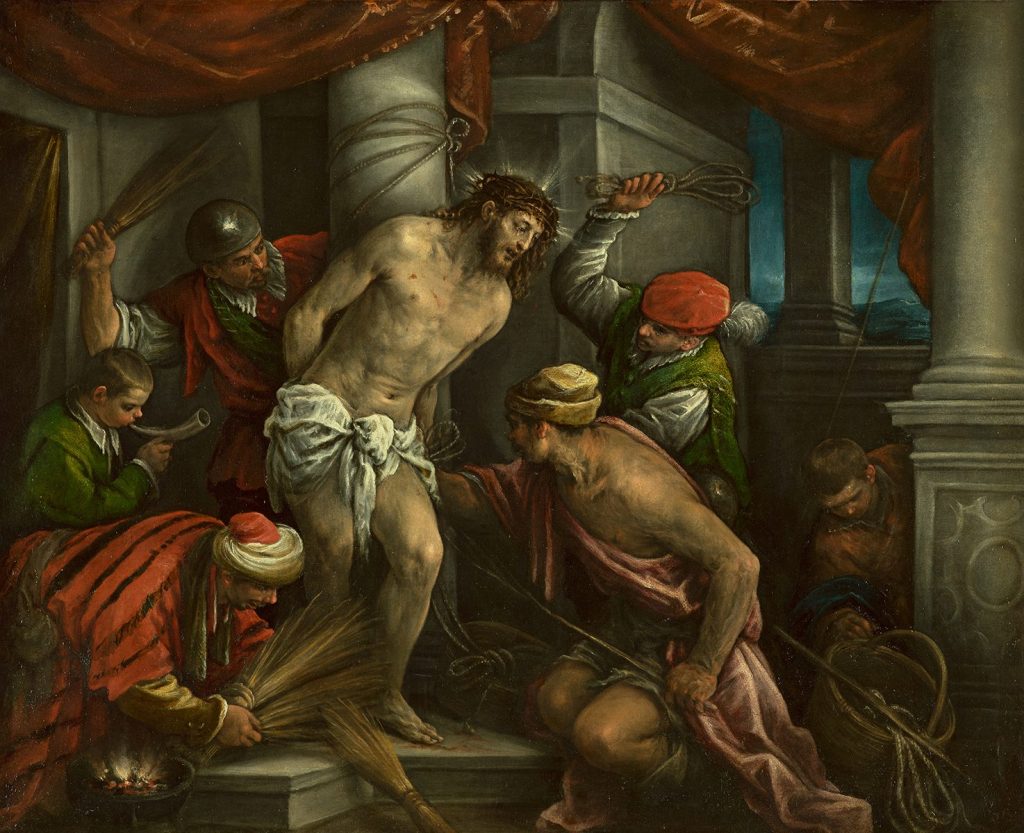
Bassano’s fluid painting style almost feels like a precursor to Manet centuries later. It still encompasses the Renaissance ideals, but you also see a shift in this late Venetian Renaissance piece. As we learned in The Masters of Venice course…The Bassano Family of artists were active in Venice throughout The Renaissance. Learn more here.
Andrea Sarto: Virgin and Child with St. John the Baptist
Sarto was a leading Florentine painter who was successful in adapting Leonardo da Vinci’s sfumato to a more lively and warmer style, which is evident in this glorious painting.

Ready to explore the wonders of over 5000 years of art at the North Carolina Museum of Art in Raleigh NC? Plan your visit here
Written by art lover Adele Lassiter
Don’t forget to follow Art Expeditions:
 Art Expeditions