

Art lovers, you are in for a treat! The North Carolina Museum of Art has a fantastic new exhibit: “The Book of Esther in the Age of Rembrandt.” Travel back in time to 17th-century Amsterdam and the Golden Age of Dutch Painting, where artists like Rembrandt, Aert de Gelder, and Jan Steen created timeless masterpieces. Their work drew inspiration from the world around them—from a passion for still lifes to the dramatic, biblically inspired scenes that united the Netherlands’ diverse faiths, including its Jewish, Catholic, and emerging Protestant populations.
One figure who captivated all of these groups was the biblical heroine Esther, who saved her people from annihilation during their captivity in ancient Persia. In a story of incredible courage, Esther rose to become Queen of Persia, married to King Ahasuerus (thought to be Xerxes I, who ruled from 486–465 BC). After the king banished his previous wife, Esther, with the guidance of her uncle Mordecai, concealed her Jewish faith, eventually winning the king’s favor and rescuing her people from a plot of destruction.
Why was this ancient story so resonant in 17th-century Amsterdam? As a major port city with diverse populations, Amsterdam had developed a strong tolerance for both Jews and Protestants. The story’s themes of resilience and faith resonated deeply for all religious groups in the city.
The Dutch Protestants saw themselves in Esther’s struggle against a powerful empire; their own fight against the Catholic Spanish Hapsburgs was a defining feature of their time. While their animosity had more to do with having the freedom to govern themselves than simply religion, Protestants banded together under the figure of Esther—a light with a heart of steel, unbreakable in her faith. Catholics, in turn, could also identify with Esther: a queen living as an outsider, able to blend in while never giving up her faith, even if it had to be practiced in secret.
Beyond the spiritual themes, the drama of Esther’s story could rival any modern-day hit miniseries. It is loaded with courtly intrigue, betrayal, faith, and hope. It is a timeless narrative whose universal themes allow us, no matter our background, to step into the characters’ shoes and become part of the story.

While the Dutch art market was largely shifting away from purely religious art (many Protestant sects disapproved of art in churches), the heroism and drama of Esther’s story ensured its continued prominence. This exhibit proves that point with over 120 works from around the globe, including paintings, prints, and drawings by Rembrandt, Aert de Gelder, Jan Lievens, and Jan Steen, among others. It also includes ceremonial art tied to both Judaism and Christianity in the Netherlands during this period. Each piece tells the story of how the biblical Queen Esther influenced the Dutch as an enduring symbol of triumph over adversity at a time of intense change in Europe.
Prior to its opening at the NCMA on September 20, 2025, the exhibition debuted at the Jewish Museum of New York. “Queen Esther’s story about resilience and courage in the face of persecution resonated widely in 17th-century Netherlands when Amsterdam became a safe haven for many,” said Abigail Rapoport, Curator of Judaica at Jewish Museum. “This exhibition explores how artists and patrons in Rembrandt’s time—Jewish and Christian—shaped imagery based on the Book of Esther, imagining the heroic Queen Esther as their own, as a young woman who gave voice to the voiceless at the risk of her safety. And Rembrandt’s talent for capturing human emotion imbued Esther with that much more meaning in his time.”

I’m blessed to live less than five minutes from the North Carolina Museum of Art (NCMA), the first state-funded public art museum in the United States. Its People’s Collection is free to the public and features a fantastic range of art, including works from Ancient Mesopotamia, Greece, and Egypt; one of the best Renaissance collections outside of major museums like the Met; Impressionist favorites like Monet and Pissarro; and a wonderful American Art Collection. The NCMA is particularly well known for its Jewish art collection, which explores the religious and artistic elements of Jewish culture. Several pieces from this permanent collection are featured in the Esther exhibit.
As a special exhibition, this is a ticketed event. If you’re local to Raleigh, I highly recommend investing in a membership, which covers the cost of all ticketed exhibitions.
The exhibit starts off by introducing the story of Esther. While I’ve read it at church, each encounter helps me dive deeper into the story with questions: Would I be as brave as Esther? What would motivate the villain Haman? I love reading scripture, but I also believe God created art as a way to deepen connection. Seeing these biblical scenes represented in art helps me strengthen my own faith and reflect on how the story’s truths resonate across time.
The Beginning of the Story:

Next up…
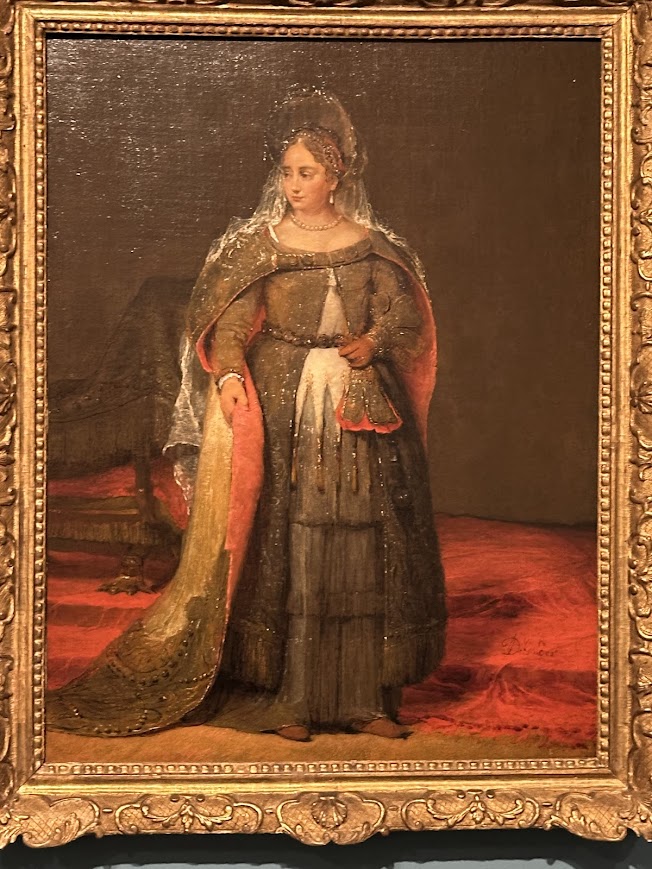
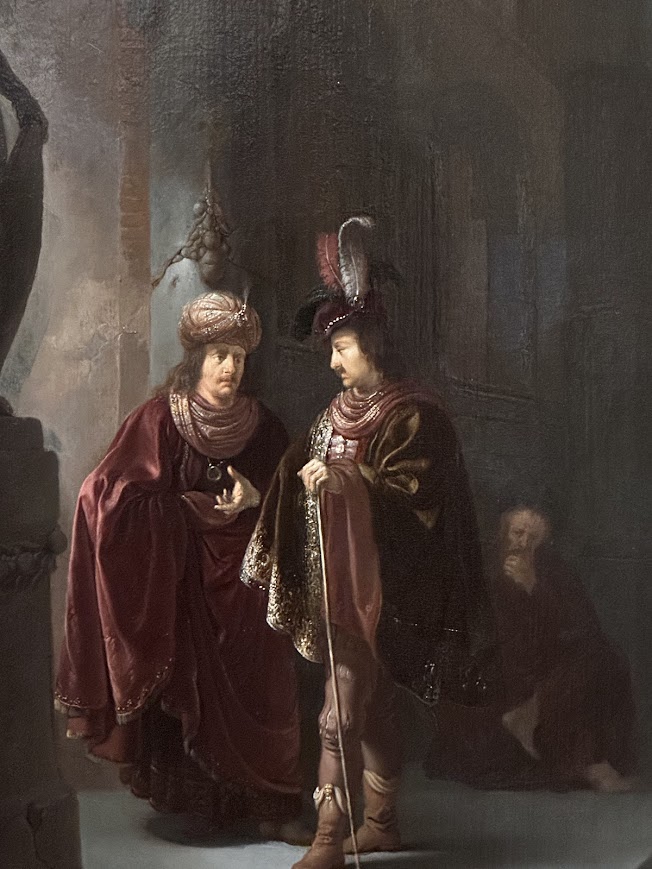

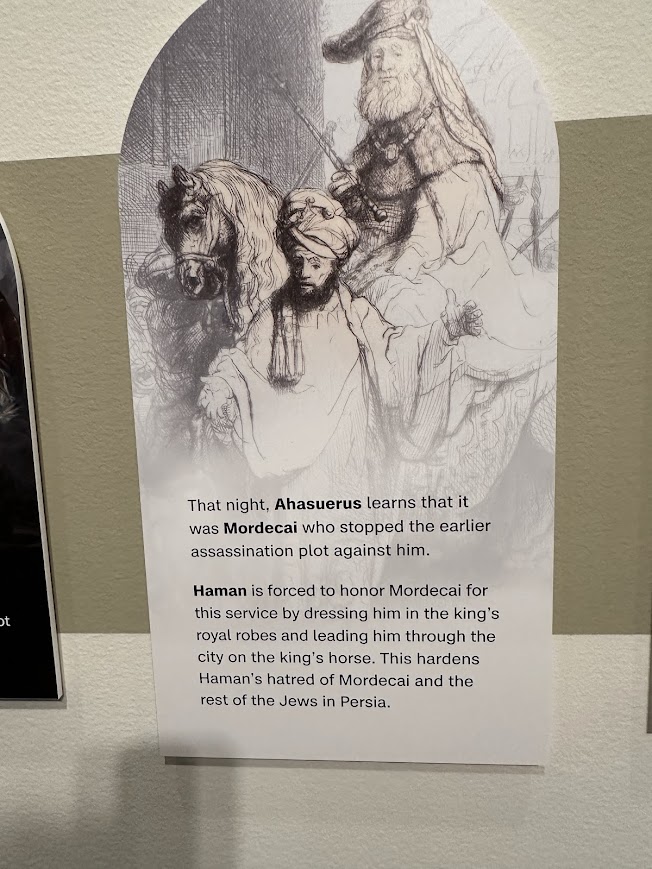
Each of these works weaves the tension and drama of the moment into masterful works of art…as you stand before each painting you feel yourself drawn into the story. The Dutch mastery of shadow and light pulling you into the darkness of Haman’s revenge and resilience of Mordecai and Esther.

In this moment of uncertainty, Esther directs Mordecai and the Jewish community to fast for three days as a rallying cry. On the third day she resolves to go to the king saying: “then I shall go to the king, though it is contrary to the law; and if I am to perish, I shall perish. (Esther 4:15)’

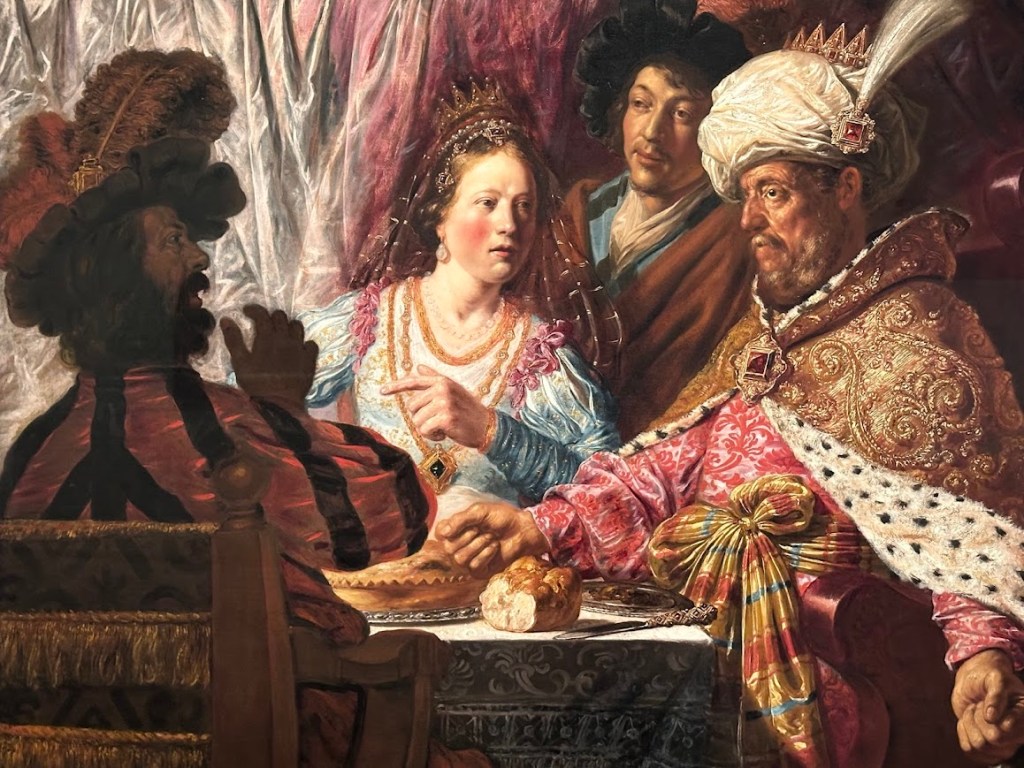
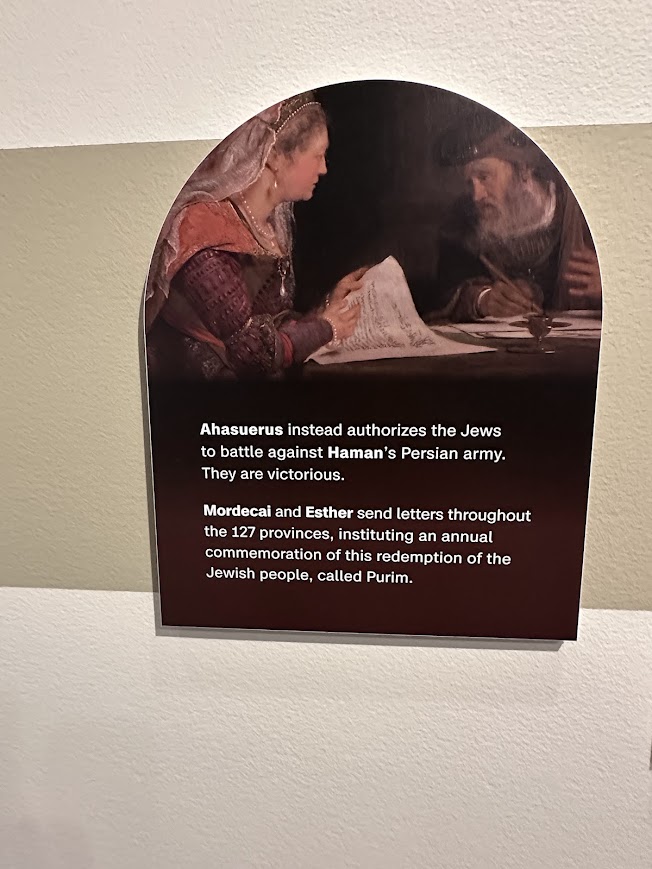
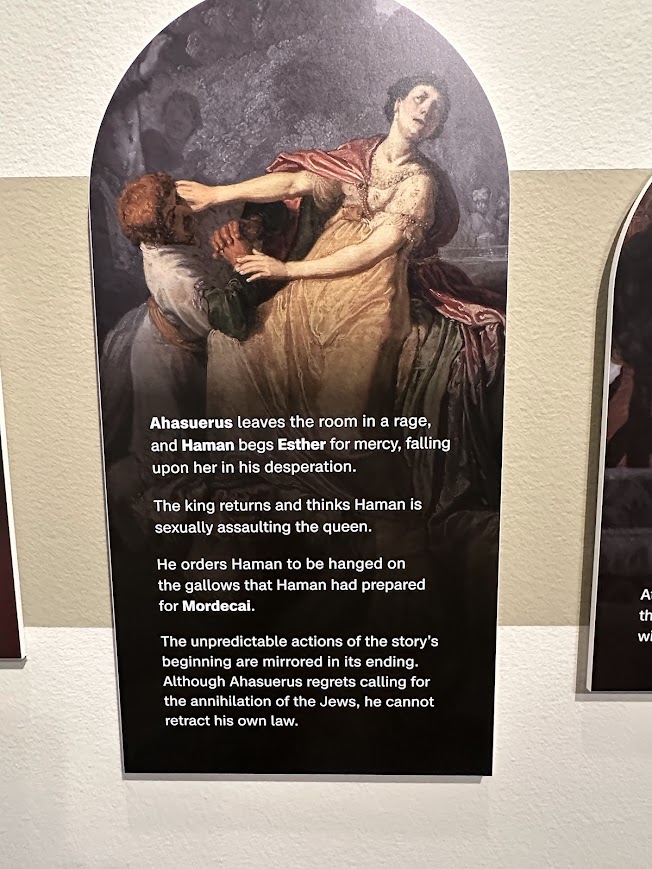
In the end, God uses circumstances to place Esther in a position to save the Jewish people. Yet, like the Virgin Mary, it is Esther’s decision to say ‘yes’—putting aside her fears and trusting God—that defines her as a heroic woman of faith. She chose to risk her own life to protect her people, knowing the King might punish her for her background as a Jew. This message of putting aside our fears and selfishness to pursue the greater good continues to resonate today for people of all faiths and beliefs.

In Judaism, the events of the Book of Esther are celebrated in the Jewish Holy Days of Purim. Purim is a joyous festival that celebrates this victory with feasting, costumes, and giving gifts. Friends of the Judaic Art Gallery at NCMA hosts Purim Celebrations at the museum each year – a time of community, heritage and hope! Learn more about Purim here.


Get to know Rembrandt:
Born in 1606 in Leiden, Netherlands, Rembrandt has rightfully earned a reputation as a pioneering master artist. While influenced by the chiaroscuro of Baroque master Caravaggio, Rembrandt—who never left the Netherlands—developed a unique style that transcends generations. While many Dutch artists of his day specialized in a single genre like Still Life or Portraiture, Rembrandt agilely moved across mediums and genres: portraiture (he painted 100 self-portraits in total), etchings, drawings, Biblical scenes, and more.
Moving to Amsterdam in 1631, he quickly became an in-demand portraitist. Sadly, Rembrandt faced many hardships. He and his beloved wife, Saskia, lost three of their four children in infancy; their son, Titus, was the only one who survived to adulthood. For all his professional success, he faced bankruptcy in 1669, forced to sell much of his art collection and personal belongings.
The NCMA is fortunate to have an Rembrandt portrait in their permanent collection.
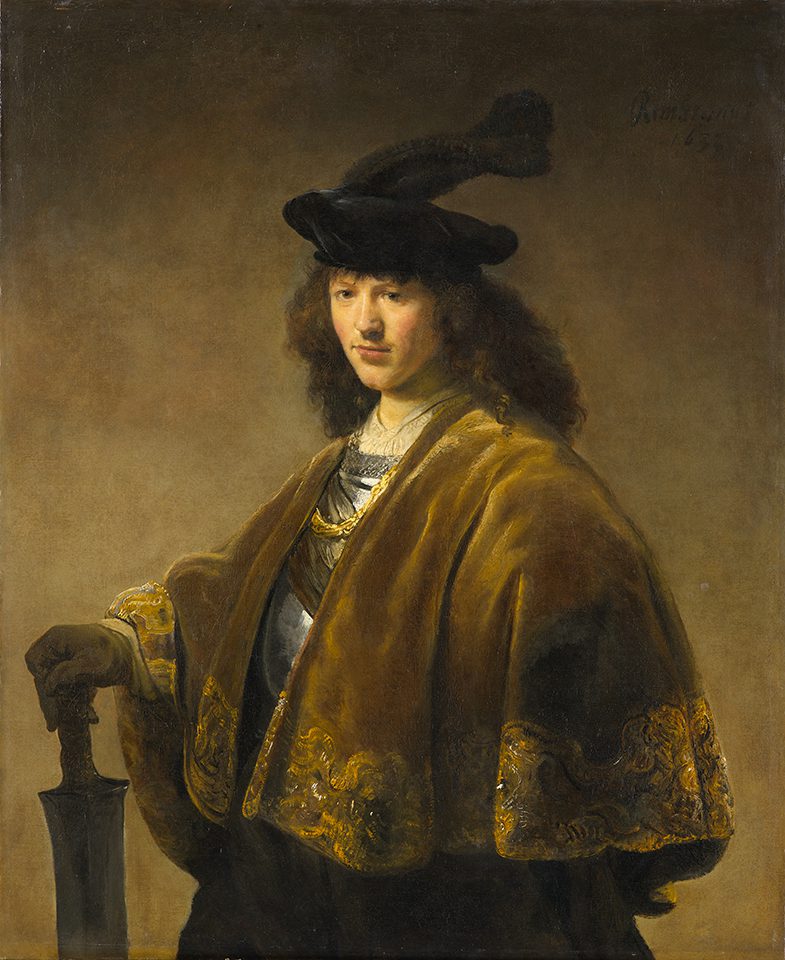
Rembrandt died on October 4, 1669, leaving an indelible mark on art forever. Fortunately we have the opportunity to connect with his legacy with artworks featured in museums across the United States and abroad…including the works featured in this exhibition.

Rembrandt and Esther…
The exhibit features several works by Rembrandt, the master of light and dark, including his famed portrait, ‘A Jewish Heroine’ (possibly Esther from the Hebrew Bible). This is one of only three portraits of Esther that Rembrandt painted; one is in the Pushkin in Moscow and could not be loaned for the show. A copy of that work is available as a reference to help explore Rembrandt’s depiction of Esther across his career.
Many artists would paint the same subject multiple times, whether for business reasons (think of prints today) or to play around with different thematic or artistic elements.
While touring the exhibit, I was surprised to learn that Rembrandt was in competition with another favorite artist of mine, Jan Lievens. The exhibit showcases two similar drawings—called tronies—that both artists created of Ahasuerus or guests at the dinner banquet. Troníes are experimental sketches done prior to painting a major scene, often used to explore facial types and exoticized costumes like robes and turbans—hence the nickname, ‘Turkish Tronies.’

The exhibit includes one of my favorite paintings from the NCMA’s permanent collection – Jan Lievens, The Feast of Esther (scroll up for image earlier in the post). This painting shows the climactic moment of the feast of Esther, when she reveals her Jewish identity to her husband, King Ahasuerus, and foils Haman’s plot against the Jews of Persia. Lievens does a masterful job creating drama and heightened emotion. I remember seeing this painting years ago during a school field trip, and the image has stuck with me ever since. Esther could have easily been executed for concealing her identity, but her bravery saved her people. This prompts us to reflect: Are we silent out of fear of speaking up? How can we be more like Esther or Mordecai—vigilant and faithful?
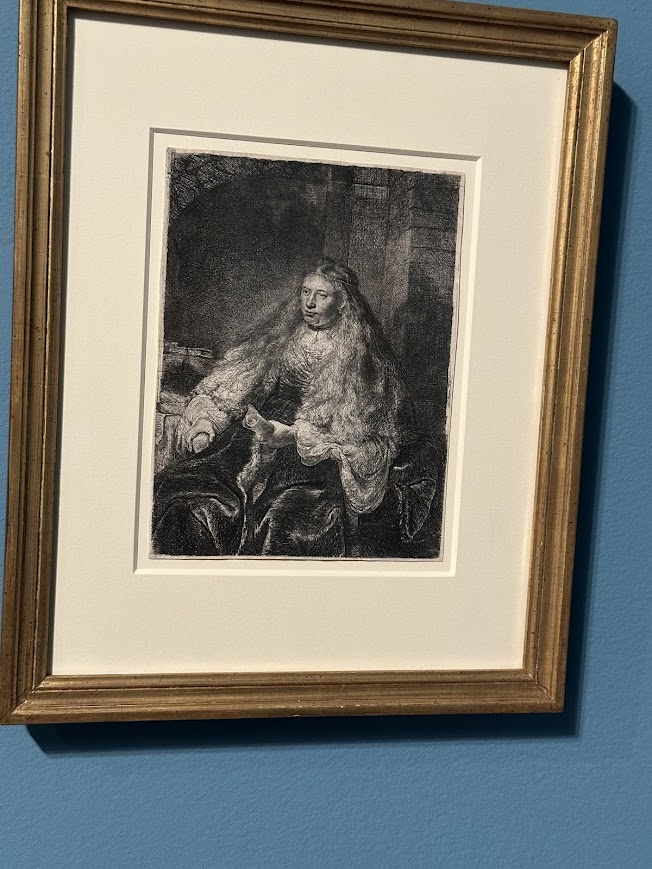
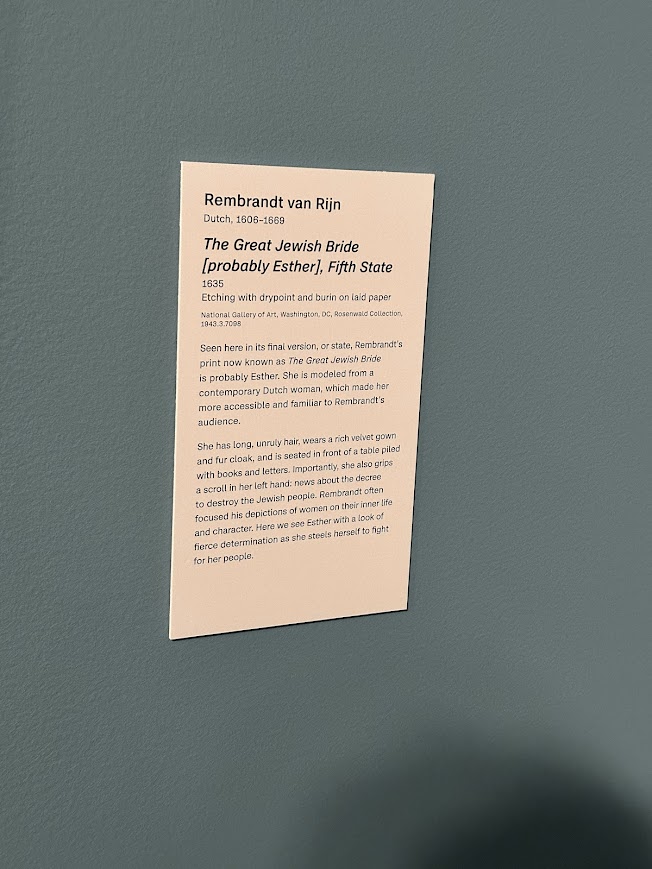
A consistent theme is the Dutch use of light and dark and lush, realistic, yet vibrant images that draw you in. Look at the foods and the guests’ expressions in the varying Feast of Esther scenes. The goal wasn’t to create a distant epic, but to invite us into the drama. You’ll find characters in the paintings looking directly at you, the “artistic guest,” inviting you to ask, “What is happening here?” and dig deeper into the visual beauty and hidden imagery. The paintings show how artists situated Queen Esther in the Dutch Republic, visualizing their world, their interest in the “exotic” (through the Feast scenes), their popular theatre performances of the story, and even how Purim celebrations unfolded in Rembrandt’s time. You’ll find that while the artists incorporate exotic themed clothing, which they no doubt encountered through Dutch trade with Turkey and the Ottoman Empire, most of these scenes have characters dressed in 17th-century style clothing. A portion of the exhibit shows how artists would paint women’s portraits as Esther. Jewish and Christian women alike, including Elizabeth Stuart, would pose for these “Esther” portraits. Many artists would paint the same subject multiple times, whether for business reasons (think of prints today) or to play around with different thematic or artistic elements. While we talk about the ‘Life of a Showgirl’ with Taylor Swift, the true cultural star of 17th-century art was the figure of Queen Esther.
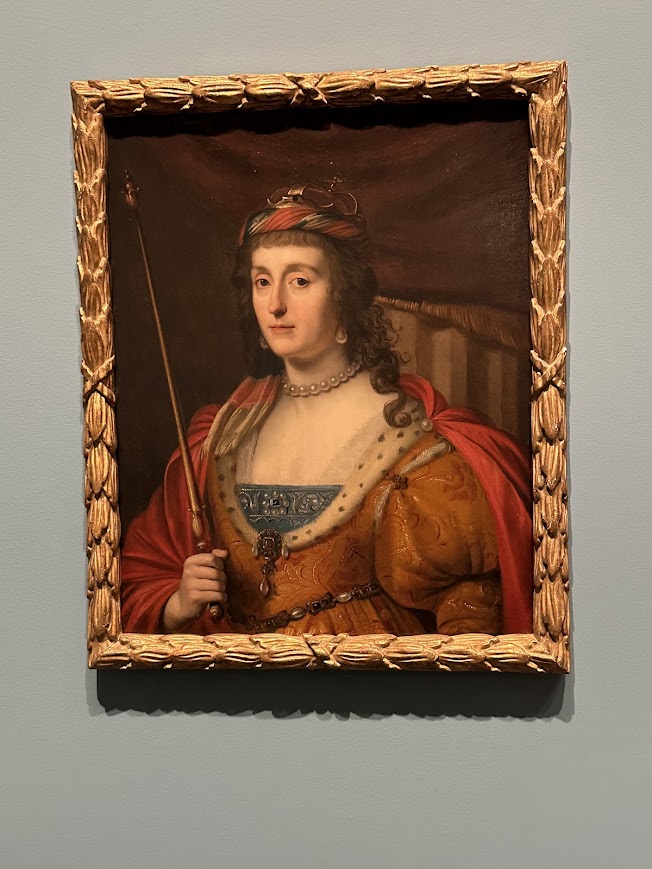
I’ll continue to feature specific exhibit works on the blog over the coming months. This is an exhibit you could easily spend several hours in and still hunger for more. Several pieces of religious art cannot be photographed as they are considered holy objects; the chance to see them in person and to recognize their importance to the Jewish faithful was particularly moving.
While Rembrandt is the OG (Original Great Dutch Painter) and certainly worth exploring, what truly sets this exhibit apart is the breadth of art, each piece providing its own nuance in the story of Esther and showing how it resonated with the bustling city of Amsterdam in the 1630s-50s.
Here are a few of my favorite paintings included in the exhibition:

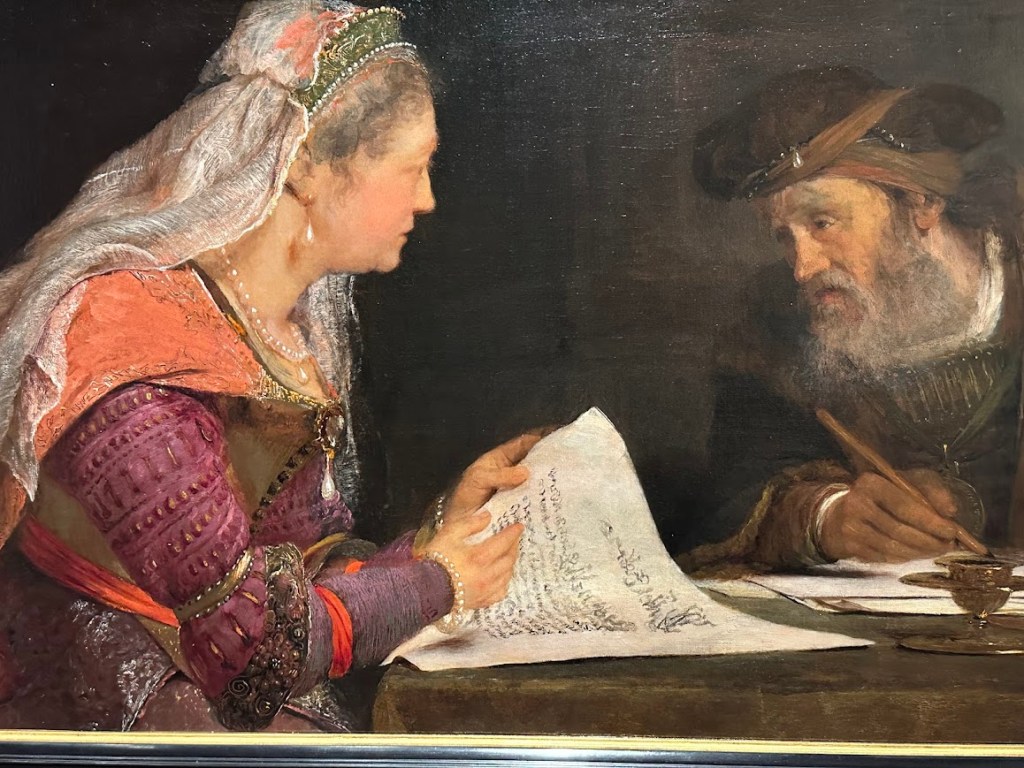
Esther and Mordecai, circa 1685 (Rhode Island School of Design Museum) by Aert de Gelder; Scenes of letter writing were popular in the Netherlands. Dutch intellectuals were a key part of what was called the ‘Republic of Letters,’ an international community that spread new ideas via written correspondence. This work shows an elderly Mordecai and scholarly Esther compose one of the letters of Purim, decreeing a day celebrating Jewish deliverance and instituting a holiday still celebrated today.
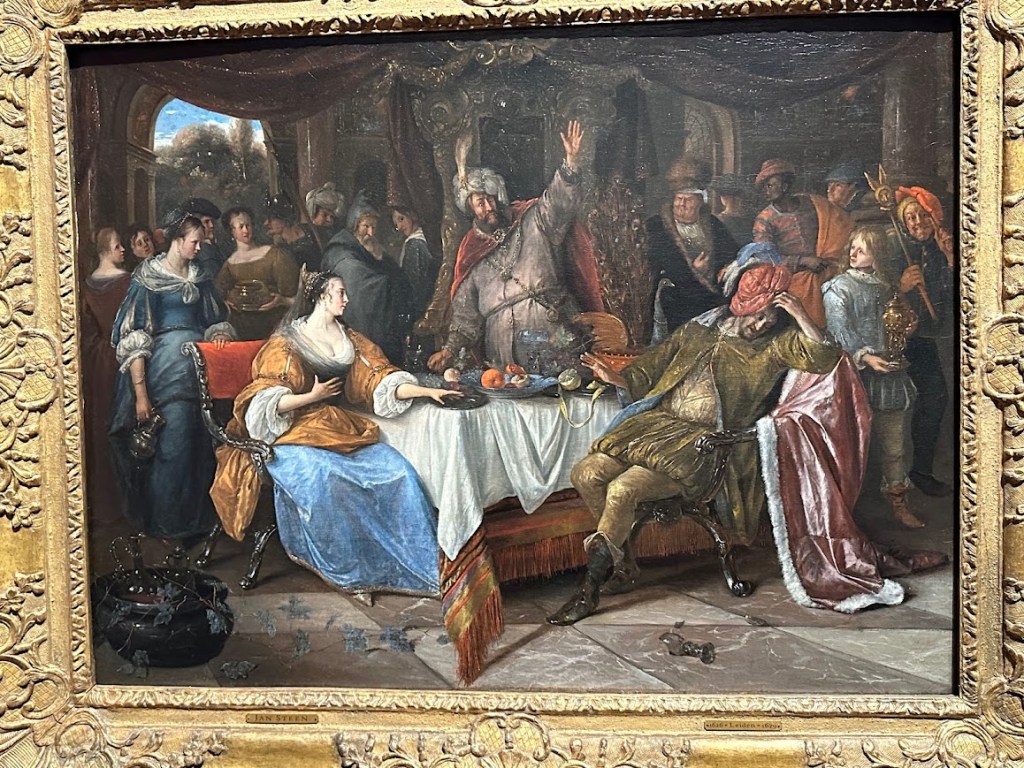
The Exhibition features several works by Golden Age Dutch Master Jan Steen. Born in 1626 in Leiden to a Catholic family that owned a brewery called the Red Halberd, His uncle was an artist and goldsmith, which may have inspired Steen to pursue art.
Steen left a legacy as one of the foremost Dutch masters. Steen created a signature style marked by his witty and chaotic scenes of everyday life and melodramatic depictions of Biblical scenes, including those from the Book of Esther. While his art is partially meant to entertain, he usually has a moral message related to a Dutch proverb or Biblical lesson.
In this work, he took inspiration from the many dramatic Esther plays that were performed in the Netherlands during his lifetime.
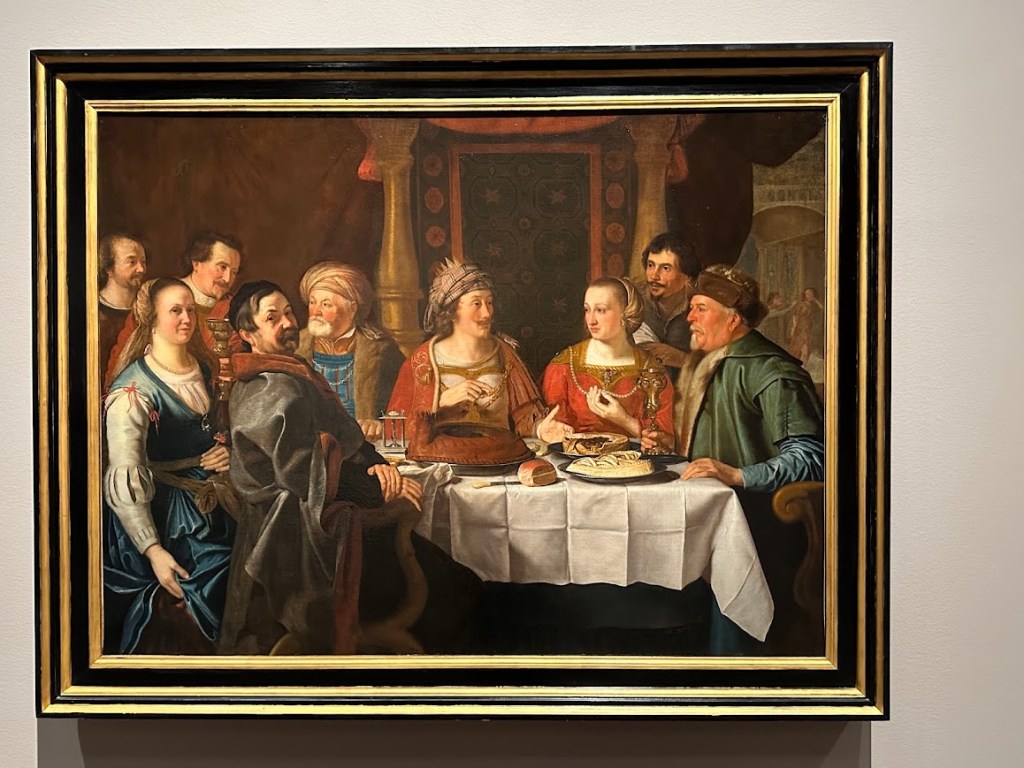
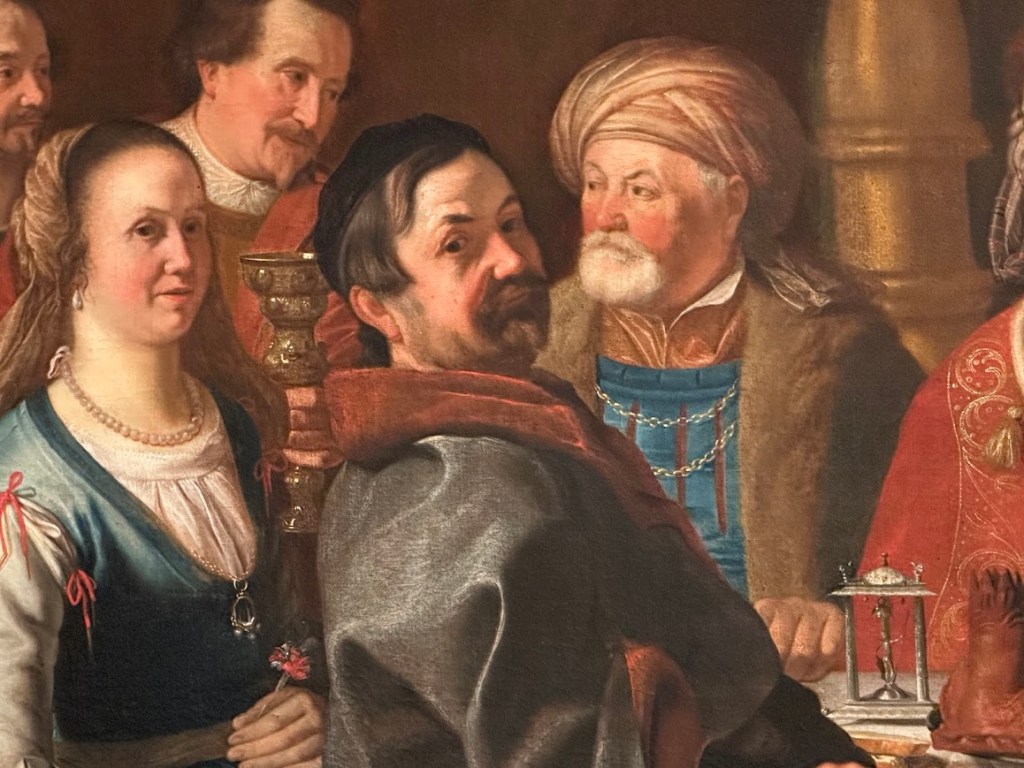
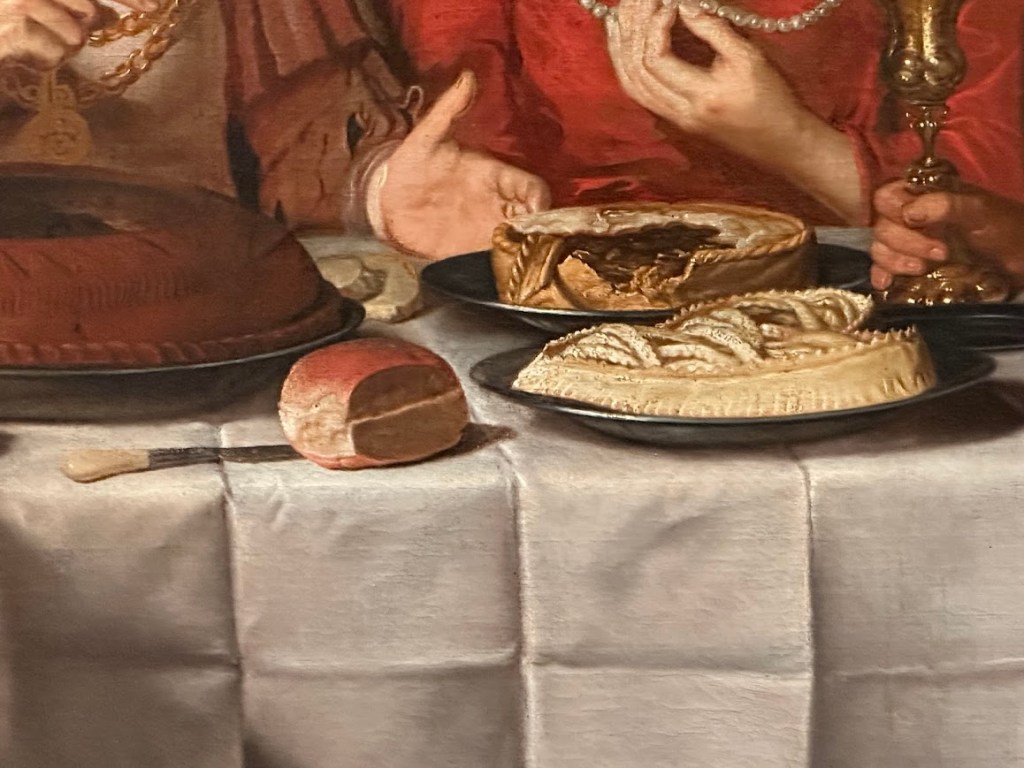
This Jacob Gernitsz von Hasselt painting instantly caught my eye…Known as The Wedding Meal of Grietje and Jochum, this painting exudes joy, curiosity, whimsy and invites you to join in the feast and hear the story of Esther and Ahasuerus. This painting depicts the wedding feast of his sister and her husband as newlywed Esther and Ahasuerus – filled with joy on their wedding day. I love the Dutch’s ability for realism and humor in their paintings. The gentleman looks to us knowingly – what stories does he have to tell? Look at the detail of the rich food on the table including a heart shaped pie to symbolize the love of the newlyweds. (from the collection of the Centraal Museum in Utrecht)
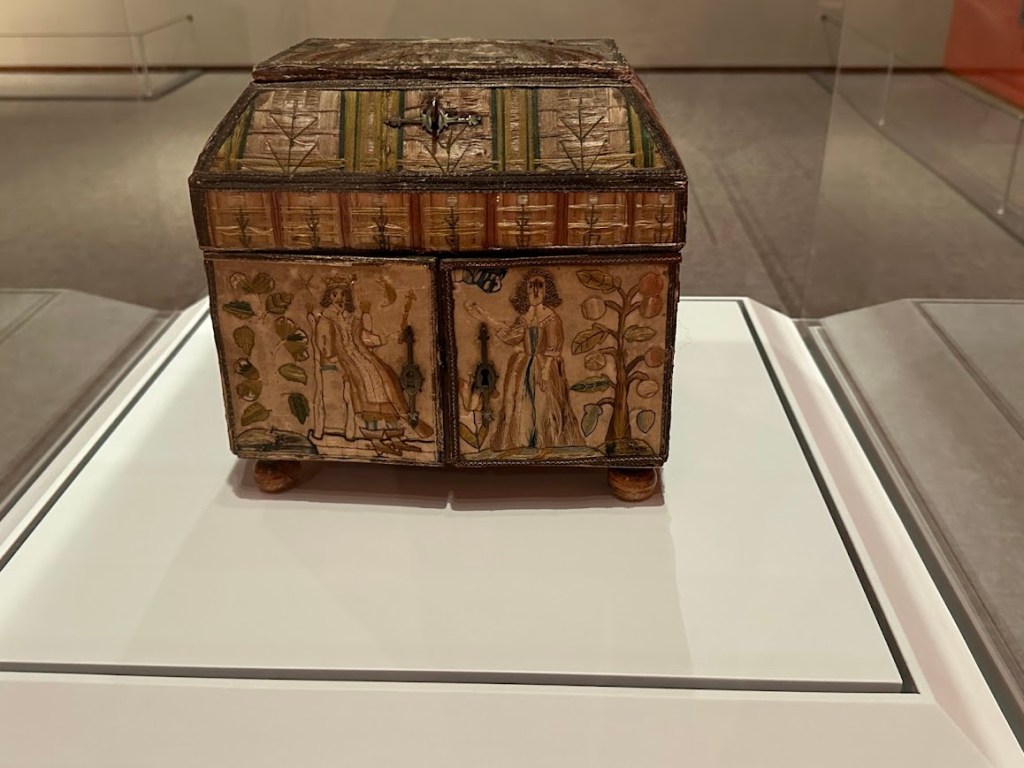
In addition to the paintings, the exhibition includes rare loans of Jewish ceremonial art from the Portuguese Synagogue in Amsterdam, including a lavishly decorated lectern cover and Esther scrolls made by Salom Italia, the most influential maker of scrolls in Rembrandt’s time. The exhibition includes loans from major institutions, among them the British Museum, The Victoria and Albert Museum, the National Gallery of Canada, the Rijksmuseum in Amsterdam, the Cleveland Museum of Art, the Isabella Stewart Gardner Museum, the National Gallery of Art in Washington, DC, the J. Paul Getty Museum, the North Carolina Museum of Art, and selections from the Jewish Museum’s own collections.
Planning Your Visit:
The NCMA is open Wednesday–Sunday, and you can reserve your tickets online. After touring the Book of Esther in the Age of Rembrandt exhibit, I highly recommend you spend several hours exploring the free permanent collections in the East and West Buildings. The NCMA also has a fabulous sculpture garden and miles of scenic walking trails.
Other articles about the exhibition:
New York Times: Want to be Alone with a Rembrandt and a Queen?
Thanks for taking time to join us on this Art Expedition! Don’t forget to subscribe to the blog
Follow Art Expeditions on Facebook…
Love travel, history and culture – check out our sister site...American Nomad Traveler on the web and on facebook
About Art Expeditions – Travel the World Through Art…
Art Expeditions is the passion project of artist and art history lover Adele Lassiter. When she’s not exploring art museums, you’ll find her blogging about history, cool travel destinations and hitting the open road.
Adele recently realized her her debut album American Nomad, which is available on adelelassiter.bandcamp.com
 Art Expeditions
[…] Posted on October 17, 2025October 17, 2025 by ynpgal77 The Book of Esther in the Age of Rembrandt […]
LikeLike