Today on Renaissance Wednesday we are going to focus on Master of Venice, Carlo Crivelli.
Born circa 1430 in the Veneto region to a family of painters, where he was exposed to the art work of early Venetian Renaissance masters like Vivarini, Squarcione and Mantegna (Paduan and brother in law of Bellini brothers).
It is believed that Crivelli studied in the studio of Vivarini under Squarcione before beginning his own Venetian studio…
He left Venice in 1458, moving to the marshland (Marches) of Ancona where he completed the majority of his works
While many contemporary Venetian artists like The Bellini Family embraced the newly emerging oil paints, Crivelli preferred to work in Tempera paint.
Crivelli leaned into what was considered the more conservative Late Gothic style with gold leaf gilded bacgrounds that combine the more formal Byzantium style of iconic art with the more realistic and detailed work of The Renaissance.
Crivelli’s art work is unique and not fully comparable to any other artist at the time. He forged his own style that is both ‘conservative’ in Renaissance terms and yet unique and distinguishable.
I was blessed to enjoy a Crivelli treasure during a trip to The Walter’s Art Museum in Baltimore, which has one of the best Renaissance collections in the United States.
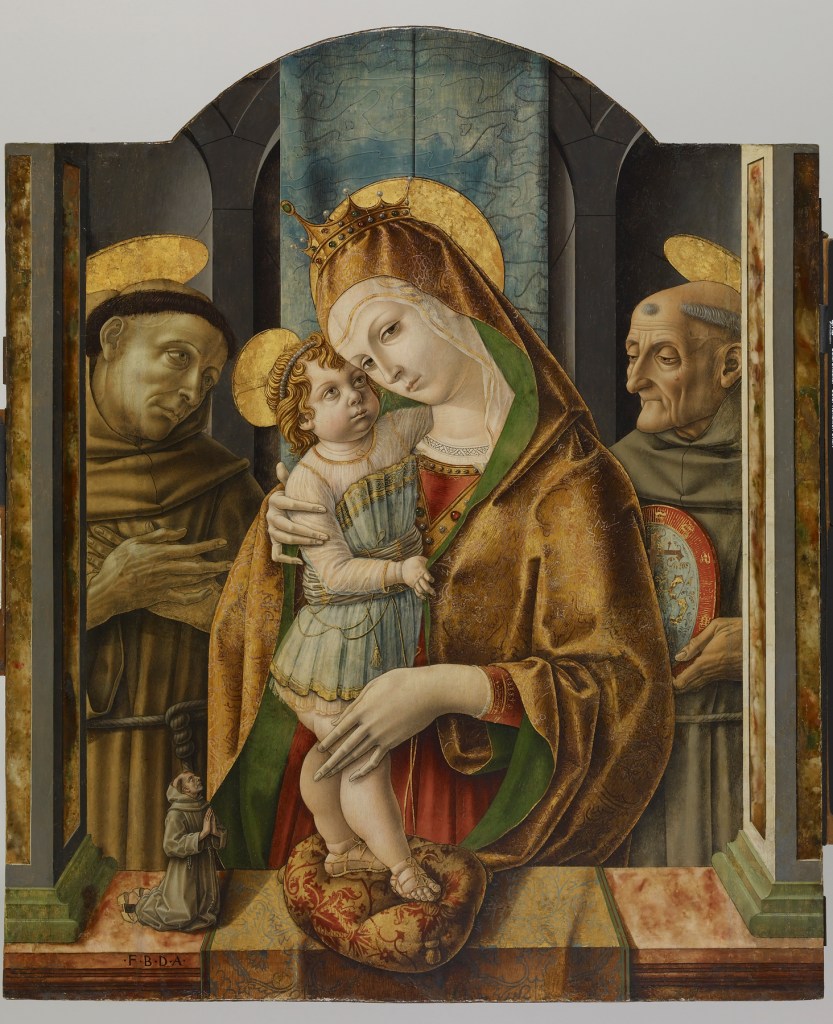
With so many amazing Renaissance masterpieces in one gallery, it was easy to get overwhelmed, but the Crivelli Virgin and Child with Saints and Donors grounded me and invited me into a ‘conversation with the art.’
I sat with this painting for about fifteen minutes…The Virgin Mother’s image is one of a regal joy…She is confident, yet reminds you of a friend ready to tell her story. Crivelli does a great job setting the scene and inviting us into the ‘Sacra Conversazione’ (scene with Blessed Mary and The Saints…)
This work features St. Francis on the left (facing panel) – who is identified by the stigmata (which are more muted in this painting, but still visible). Represented on the right is Franciscan Bernardino of Sienawho cares a symbol of IHS (the name of Christ), which was the saint’s special devotion.
In many Renaissance paintings The Infant Jesus is portrayed as naked as a symbol of his humanity and purity (nakedness – without stain), but Crivelli instead choosesto clothe baby Jesus in rich garments of gold trim and a strand of pearl in his hair. In researching the symbolism of pearls in sacred art, I learned that pearls often were symbols of royalty and purity. Which would tie into the parable ‘do not put pearls before swine…’
The Blessed Mother wears an intricate mantle of gold brocade and a jeweled crown as she is the Queen of Heaven. A light blue silk cloth in the background alludes to the royalty of Jesus and his Blessed Mother.
Notice the small kneeling figure looking up to Christ and The Virgin Mary…The inscription below reads F.B.D.A. and is a Franciscan donor named Fra Bernardino Ferretti (da Ancona).
The size of the panel is too small for a large church and designed for the altar of a small chapel or for private devotion.
It is believed this painting was designed for a private oratory or chapel at a convent in the Marches of Ancona.
The panel displays Crivelli’s original style of employing sharp outlines, splendid surface textures, and striking illusionistic effects, such as the cushion on which Christ stands that seems to extend into the viewer’s space. (from Walter’s Art Museum website)
Crivelli fell out of favor with the High Renaissance style…he was not mentioned in Vasari’s biography of artists (a mistake on his part, given Crivelli’s immense talent)…His renowned reemerged a bit during the Pre-Raphaelite School in the 1800s…
Today his art can be found in important art museums like The Walters to London’s National Gallery...
Don’t forget to to follow Art Expeditions for the latest art adventures…
Join us on facebook
 Art Expeditions