
Last time on Masters of Venice we learned about founder of The Venetian School, Veneziano as well as early Renaissance (late Gothic) Venetian painters The Vivarini Family and Alemagna. Click here for the last lesson.
Today we’re stepping fully into The Venetian Renaissance getting to know one of the most distinguished families of Italian painters in art history – The Bellini Family.
We’ll be delving into their art the next few lessons as The Bellini Family’s work was so innovative and spans nearly a century of Venetian art. While Veneziano helped form the Venetian School of Art – The Bellini Family perfected it and directly built a foundation of learning and artistic culture that influenced later masters like Giorgione and Titian.
Get to know the Bellini Family:
It starts with Jacopo Bellini who was born around 1400 and was the father to two artistic masterminds Gentile and Giovanni.
- Fun Art Fact: The Bellini family were some of the first artists to use oil paints that were originally developed in The Netherlands, but came to Venice through artists like Antonello da Messina (who worked with the Bellini family)
Jacopo Bellini was born in Venice circa 1400. He developed a passion for art and studied until late Gothic/early Renaissance artist Gentile da Fabriano during Fabriano’s sojourn in Venice from 1405-1420.
Fabriano was a powerhouse in art and open to exploring new styles and directions. Born in Umbria, Fabriano brought his multi-faceted skill set to Venice.
When Fabriano took up a commission in Florence for his now renowned Adoration of the Magi (one of my favorite pieces at The Uffizi Gallery in Florence), Jacopo followed his teacher to Florence (1423) and it was there he was introduced to linear perspective and other classical ideals in painting by masters such as: Donatello, Ghiberti, Masaccio and Paolo Uccello.
Infused with knowledge and inspiration, Jacopo eventually returned to Venice and set up a flourishing studio.
Why he embraced The Florentine Renaissance schol of thought, Jacopo was not afraid to incorporate Byzantine elements into his works like Madonna at Venice’s Accademia Gallery – which has gold leaf. He was an artist who wasn’t afraid to blend styles from Byzantine and International Gothic to Renissance influences to create a beautiful work of art.
It is easy to simply group artists by style or period, but often artists each have such a unique perspective even if they ascribe to a set formal style – it is important to look at works with a fresh eyes and think – what inspired this artist and ask ‘what is the painting speaking to me?’
- Pro Tip: While art often has an intended message in theme and symbolism by the painter – great art like a good novel often goes beyond black and white interpretation. It engages you to think and even draw your own conclusions based on what the painting says to you. That is why religious art is valued…it helps you to meditate on the mysteries of Scripture – be and be drawn into the scene. They same can be said for historical paintings – the history doesn’t change, but you can be drawn into the action as a participant. The canvas may be still but it is alive if you pause and just let the art speak to you. Having a knowledge of the language of art (symbols in icons or style) gives you an even deeper able to converse with the artist and their message and story within the painting.
Unfortunately much of Jacopo’s work is lost to time, but he does have several paintings in Italy.
The most important items Jacopo leaves us are his two books of drawings. He gave one to each of his sons and those eventually wound up in the Louvre (Paris) and British Museum (London)
Such drawings in the book include The Nativity, St. John Preaching and the Flagellation. These books show the progression of Jacopo as an artist and his experimentation with linear perspective.
Gentile
(pronounced gentil-lei) Born in 1429, this son of Jacopo became one of the most important painters in Italy and Venetian art.
He is best known for his detailed scenes of life in Venice and portraiture.
He was trained by his father and also worked with his brother in law Andrea Mantegna and was exposed to Donatello (during his time in Padua).
He was an official painter for the Doges’ and commissionend to paint a series at the Ducal Palace in Venice.
In his government capacity as a court painter, Gentile was selected to go to Constantinople (now Istanbul) after the fall of Constantinople and introduction of the new Islamic Ottoman regime. Venice was opposed to the Ottoman rule, but did not want to be at war with a powerful trading ally.
Interestingly enough, Sultan Mehmet II loved everything about Venice and its art and specifically asked for Gentile to paint his portrait. It now hangs in the National Gallery in London.
Both Gentile and his brother Giovanni are still considered to be some of the finest portrait painters in European history. Look at the detail and realism. It is almost photographic.

Gentile often collaborated with Giovanni. While Giovanni focused on Madonnas and other scenes, Gentile shined in his depictions of Venice and they have so much historical detail it can be used as a guide to what Venice was like in the era.
Here is an example of one of Gentile’s most famous works:

The Miracle of the Bridge at San Lorenzo (1500) depicts a miraculous event that took place on the first Sunday of Lent on March 3, 1370 where during a procession over the San Lorenzo bridge in Venice carrying a piece of The True Cross, the relic was accidentally pushed into the canal. The relic miraculously remained afloat, but evaded everyone who tried to rescue i from the water except Andrea Vendramin, The Guardian of the Grande of the Scuola Grande di San Giovanni Evangelista. This was a scuola (school in Italian, but is a fraternal and usually charitable organization). He threw himself in the water and the cross miraculous came to him.
Scuolas, along with the church and state were primary artistic patrons in Venice. These organizations adorned their buildings with art and between 1494-1510 Gentile was commissioned to paint a series of large narrative scnes known as the Cycle of the True Cross.
- Look at this image – the detail of the scene and Venetian life. The diversity of people in dress and even background as they frantically search for the cross. Andrea Vendramin seems to be floating angelically as the cross comes to him. A mix of intense realism and heavenly wonder
- True Cross: a fragment from the cross Christ was crucified on. The legend of the True Cross was popular in the Middle Ages and Renaissance. I say legend because it is not in The Bible, but does have truth to it as St. Helen did go to Jerusalem in search for relics and bring them back to Rome after her son Constantine legalized Christianity in the Roman Empire in 313 AD. Read more about The True Cross here.
Another important work by Gentile is The Procession of Saint Mark’s Square, which was completed by his brother Giovanni after Gentile died.
This amazing canvas took five years to complete (1496-1501)and was also part of a commission for the Scuola of San Giovanni.
It depicts an event that took place on April 25th, 1444 while members of the Scuola were processing in the Piazza San Marco (St. Mark’s Square)with the True Cross, when a miracle happened.
A tradesman from Brescia was in the square and knelt before the True Cross in prayer that his dying son might recover. When he retuned home he discovered the boy was completely well again.
The painting focuses on the miracle, but also is showing life in Venice in the era of Bellini – look at the details of The Basilica and that rich photographic realism…the croweds of people lined up.
- To me this painting by having so many people in the scene who are not even aware of the miracle, is a reminder that miracles happen around us all the time but do we care to notice or are we so caught up in the idea of waiting for a miracle we forget to see what is right in front of us. Granted that is my take on the painting. How does this painting speak to you.

You can find the True Cross series in Venice’s art museum ‘The Accademia’
Giovanni:
Giovanni is the best known of the Bellini family especially for his many Madonna’s and altarpieces. We learned a bit about Giovanni in the feature lesson – Sacra Conversazione, and how artists like Bellini used a scene of multiple saints throughout history as a spiritual and artistic tool for storytelling in The Renaissance.
Giovanni was one of the first Renaissance painters to fully embrace oil painting, which had been developed initially in The Netherlands and come to Venice by trade and also via Naples (da Messina used oils).
In fact Leonardo da Vinci was introduced to oils during a trip to Venice!
Giovanni was a diverse painter who focused on a number of state and church commissions.
His most famous work in his lifetime – paintings for The Great Council Hall of Venice were sadly destroyed by fire in 1577.
His early works were strictly religious and traditional in style, but he gradually evolved to include naturalism of setting and landscape into his religious and non religious scenes. This realism can be seen in the striking St. Francis, which I was blessed to see in person at The Frick in New York. Click here to see the painting.
What is masterful about Bellini is how he can repaint a subject – The Madonna and Child multiple times and each perspective is new and fresh. He takes on different aspects of her personality to draw us into her story and invite us into our own story with Christ and His Mother.
In the Madonna of the Trees (image at the top of the painting), Giovanni creates a unique stylistic shift with a banner behind the Blessed Mother and this natural landscape. It feels sweet and ethereal, yet grounded in a reality – humanity and divine together.
With many images of The Virgin you often see her wearing colors – blue, red and occasionally black and white
- Blue is a symbol of royalty. At the time blue was one of the most expensive paints because it was mixed with Lapis Lazuli, a gem that was from Afghanistan.
- Red has several symbolic meanings: blood for life and death (sacrifice) and also the earth
- Black is used as a sign of mourning
- White is a symbol of purity.
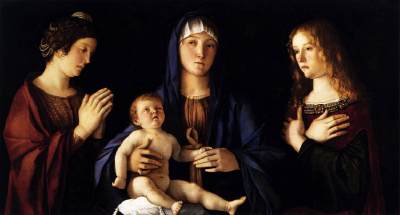
In this painting by Bellini is in The Accademia and gives a different story telling style than The Madonna of the Trees. Mary is deep in thought – her facial expression a mix of emotions from sorrow to peace in the moment. The saints, though in the Sacred Conversation are also deep in thought and seem to be content in the presence of Christ, but also sorrowful for his crucifixion and their own martyrdoms.
We’ll get to know more about The Bellinis as we focus on specific paintings in the coming weeks.
Before we leave today I’ll provide this image of what I think is Bellini’s greatest masterpiece in portraiture: Doge Loredan, which is in London’s National Gallery.

We’ll continue to delve into the Masters of Venice on Art Expeditions.
Don’t forget to Subscribe for updates and Bookmark the Masters of Venice course page here
Video lecture about The Bellini Family
 Art Expeditions
[…] Giovanni Bellini is a favorite on Art Expeditions and a featured artists in the Masters of Venice course. Click here to learn more […]
LikeLike