
Today on The Masters of Venice we are going to meet one of The Serene Republic’s most important artists – Vittore Carpaccio.
I was blessed to see a treasure troveof Carpaccio’s works while visiting The National Gallery in DC in December 2022. This exhibit included many of his most important works from Venice, and throughout Italy including The Lion of St. Mark (pictured above) and St. George slaying the Dragon.
I was familar with Carpachio before this exhibit, but not acutely aware of his immense talent in painting narrative drama. I was blown away by the exhibit and so grateful to see so much of his works in one spot. You can learn about this past exhibit here and the works featured in DC.
As I meandered through the exhibit, taking time to ‘converse’ with each painting (a few minutes of silent contemplation with a painting to let its imagery and message tell its story), I was moved by several recurring themes:
- Carpaccio’s use of detail to dramatize Venice and Biblical Stories as well as legends in a fusion of realism and fantasy. Each painting felt like a scene from the cinema. You expected each painting to come to life before you.
- Carpaccio was Venetian and his depictions of Venice reveal the details of life in the affluent trading city of his time, but there is also a unique realism that feels less refined than other Italian paintings. It has a kinship to Northern European paintings of The Renaissance that while detail oriented are also so realistic that blood and guts is not gracefully worked into the scene…it is painted as is and it feels like a Lord of the Rings cinema viewing.
- Carpaccio can paint a variety of styles from the delicate and refined portrait of The Virgin Reading to his more military saga scenes lik St. George and the Dragon
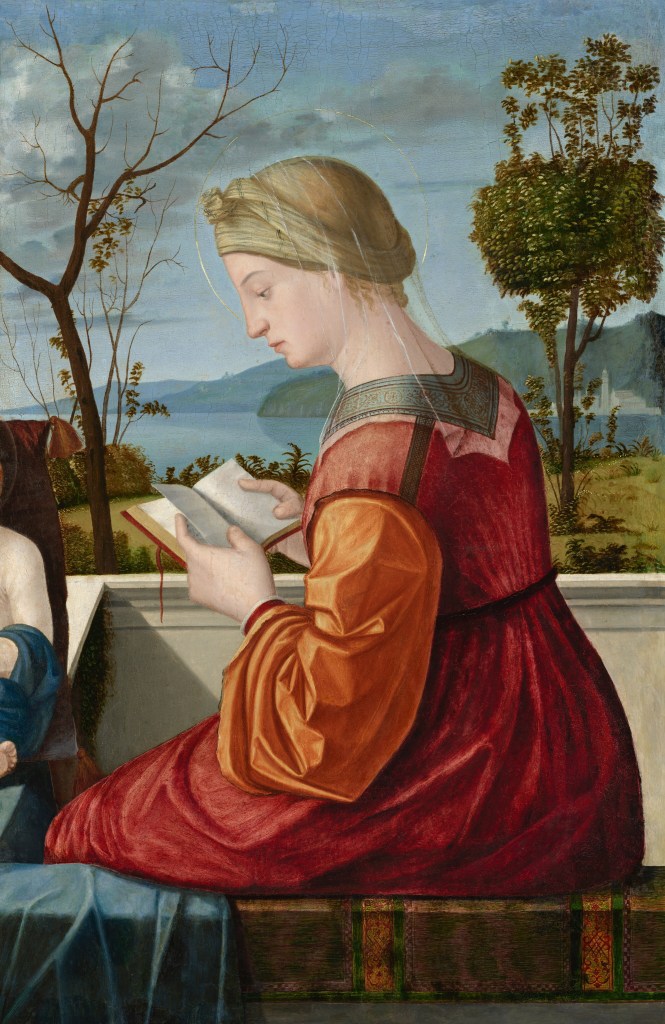
Housed in The National Gallery, this portrayal of The Virgin is extremely unique for The Renaissance. Instead of Mary looking out to the viewer, this Mary is in deep contemplation with her Holy Scriptures and only Jesus’s foot is seen in the left hand corner of the painting.
- The missing Jesus except for his foot, is most likely because the painting at some point was cut down.
Also unique is the impressive natural background and landscape surrounding Mary. She is not concerned with the world around her, but rather is secure with Jesus and her book.
Mary is also not wearing blue – a common color, but rather a vibrant orange red.
Trees often symbol the coming cross and also stability and renewal.
Contrast that with this image of St. George the Dragon Slayer, which is so graphic you feel as though you are watching Game of Thrones or a Knights of the Round Table Saga.
St. George was one of the most popular medieval and Renaissance saints (he even became the patron saint of England). He is seen to have the knightly valor and qualities of a good Christian who is not afraid to go into battle against real and spiritual dragons.

Who was Carpaccio?
Born in the area of Veneto known as Torcello (island off Venice) circa 1460, he trained with Venetian masters like Lazzaro Bastiani and Gentile Bellini. However his biggest influence was Antonello da Messina.
As we learned about in a previous lesson, Da Messina introduced Venice to oil painting and was heavily entrenchedin the Netherlandish style, which Da Messina was exposed to in Naples.
- Naples had a strong trade center as well and had a penchant for collecting Northern European art like Van Eyck and other masters.
Da Messina was only in Venice about a year, but his influence on both The Bellini family and Carpaccio was long lasting.
The Bellinis’ had set up a very success studio and school that taught painters like Carpaccio and later Giorgione and Titian. Their school provided Carpaccio with mentorship, but he soon created his own niche in Venice.
Carpaccio, like Gentile Bellini before him, was a master at story telling and creating large pictorial scenes of Venice and Biblical cycles.
He was commissioned to paint an important painting of St. Mark for The Ducal Palace (at top of page). As we’ve learned in previous lessons, St. Mark is the patron saint and protector of Venice. The symbol of St. Mark is a Winged Lion and this outstanding painting shows the mighty Mark guarding Venice and its Republic.
Carpaccio became known for his bold colors including deep vibrant reds. He had a command of perspective, bringing precise attention to every architectural detail. His themes of death and realism in the horrid decay of death (see St. George painting above) were also unique for an Italian at the time.
His most famous pictorial cycle is of The Legend of St. Ursula, which tells the story of the life of St. Ursula as depicted in the apocryphal Golden Legend.
- A cycle is a series of large paintings grouped together that tell a story or theme – usually Biblical or about the Christian saints
- Many of these cycles were commissioned for scuolas – or fraternal and civic organizations in Venice (many had a lot of power and clout)
- The Golden Legend is a common source for Medieval and Renaissance painting. It is based on a book from 1260, compiled by Jacobus de Voragine – a scholarly friar and later archbishop of Genoa. The book contains factual and some legendary accounts of the lifes of the saints (hagiography = bio of a saint), which became extremely popular in Europe and beyond. Read more about St. Ursula here.
- The cycle is housed in Venice’s Accademia today.

Like Antonello da Messina and Bellini Brothers, Carpaccio focuses on extreme detail and the ability of expanding ‘the room’ so though the painting is flat surfaced it feels three-dimensional.
You can feel this depth in his work – St. Augustine in His Study

In this painting the dog represents fidelity and loyalty.
Carpaccio’s use of light is staggering as you feel the natural light of the east window pouring in as St. Augustine is symbolically moved to stare into the light.
While this is my own interpretation, could it be that Carpaccio is showing a conversion of St. Augustine from being a strictly learned man (he was a genius and well regarded intellectual even before embracing Christianity) to recognizing a deeper wisdom and learning in the heart of God’s light? Just a thought.
Unfortunately later in his life Carpaccio fell out of favor among his contemporaries for being ‘too conservative’ in style, and yet his art remains as relevant today as it ever was.
Fun fact:
Carpaccio the artist is beloved in Venice…so much so that in the 1960s during a show to honor the Venetian painter, a local Venetian chef created a red beef dish named in honor of the artist.
The dish, Carpaccio is now a worldwide hit and if you do a Google search for ‘Carpaccio’ you’ll see recipes before the artist.
Don’t forget to subscribe as we continue to learn about The Masters of Venice
You can also follow us on facebook
Your Art Guide: Adele Lassiter started Art Expeditions to share her love of art museums and passion for art history with the world. If you’d like to support the page, consider joining Patreon.
 Art Expeditions
[…] Learn more about Carpaccio from an earlier blog post here […]
LikeLike