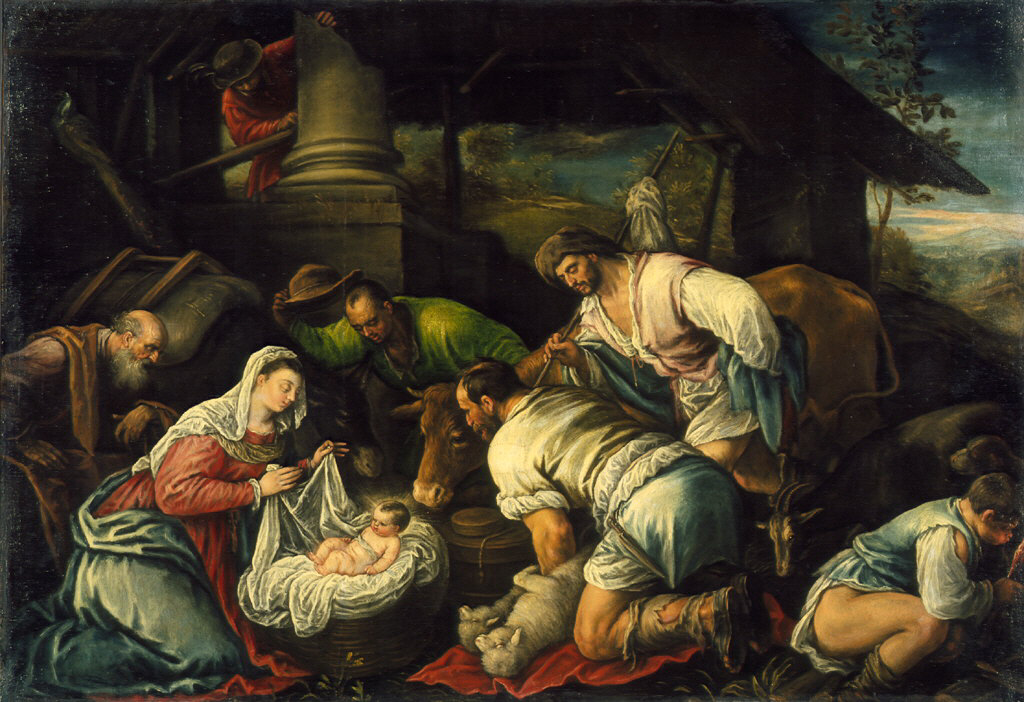
In our last lesson we met Master of Venice, Jacopo Bassano…Today I wanted to follow-up by introducing you his talented sons who continued the Bassano family tradition of painting that started in Jacopo’s father, Francesco il Vecchio’s workship decades before.
I am based in the Raleigh, NC area and enjoy visiting our amazing Renaissance and Italian collection at the North Carolina Museum of Art.
The NCMA is free to all (with the exception of traveling exhibitions or special events) and has one of the finest collections of Renaissance art outside of New York, Chicago and DC in the US.
It may sound silly, but as a person of faith I often enjoy sitting with these religious paintings and pondering the spiritual meanings as a form of prayer. This was the initial purpose of much of the religious art in the Medieval and Renaissance periods – a way for the faithful to learn and contemplate the mysteries of Christianity…much as Jewish faithful might light a Menorah as connection with the light of Christ.
There is something that stirs the mind and soul to think that for hundreds of years these Renaissance masterpieces by painters like Francesco Bassano (above) were used as devotional works and for the faithful to gaze up during Mass or personal reflection.
While we feel the past is often dead, how alive history becomes when we can sit with a painting and think about the real life person who put the paint on the canvas and the generations who have looked at this painting just like us. It really helps bring the art and history alive.
I preface with this because one of my favorite paintings at the NCMA is a work by Jacopo’s Bassano’s son, Francesco.
How often I have enjoyed sitting with this colorful masterpiece of Biblical storytelling. The emotions and interaction of the subjects in this painting are palpable and you feel as though you have stepped into the mystic reality of the scene.
Jacopo’s sons:
Jacopo who lived in the mainland Veneto (area of mainland near Venice) town of Grappa, inherited a flourishing art studio from his father, Francesco il Vecchio…Jacopo trained his four sons in the studio as well, and they continued the legacy of art.
We’ll start with Francesco Bassano, who painted The Adoration of the Shepherds above.
- The eldest son of Jacopo, Francesco moved to Venice to run a branch of the family’s art studio in the city. He was commissioned to paint a series of historical scenes in The Ducal Palace. He showed an immense talent for creating scnes in the Mannerist style with drama and echoing his father’s use of shadow and light. While he did not work with Tintoretto directly, Francesco’s vivid colors and painterly style has an air of Tintoretto as well.
- Sadly, Francesco battled depression and hypochrondia and died of suicide at only 43 years old. (born. 1549-death in 1592)
Leandro Bassano (June 10, 1557-April 15, 1622
- After his brother’s tragic death, Leandro continued the family legacy of painting and maintaining the Bassano studio
- Also known as Leandro dal Ponte, this adept painter followed in his father’s religious style and also established himself as an in deman portraitist.
- Leandro moved to Venice to helm the Venetian studio of The Bassano family, where he was introduced and influenced by Tintoretto. Several of his works actually attributed to Tintoretto based on a similar use of style, including his Portrait of an Old Man in the Museum of Fine Arts in Budapest
- However, Leando developed his own unique style. Unlike his father’s use of dense and robust brushstrokes, Leandro utilized fine brushwork, with cool, light colors, applied smoothly in well defined areas.
- You can find his works throughout the world today including The Ringling Museum in Florida and Indianapolis Museum of Art, Birmingham Museum of Art and Walters Museum of Art in Baltimore.

Girolamo da Ponte (June 3,1566-November 8, 1621)
He worked as a copyist of his father’s pictures and also contributed to several of his father’s and his brother, Leandro’s works including portraits of Sagredo
Giovanni Battista (1553-1613)
He was chiefly a copyist of his fathers works as those could be sold to patrons throughout Venice and beyond.
Don’t forget to SUBSCRIBE for more art blogs. We are also on facebook!
 Art Expeditions
[…] Bassano’s fluid painting style almost feels like a precursor to Manet centuries later. It still encompasses the Renaissance ideals, but you also see a shift in this late Venetian Renaissance piece. As we learned in The Masters of Venice course…The Bassano Family of artists were active in Venice throughout The Renaissance. Learn more here. […]
LikeLike