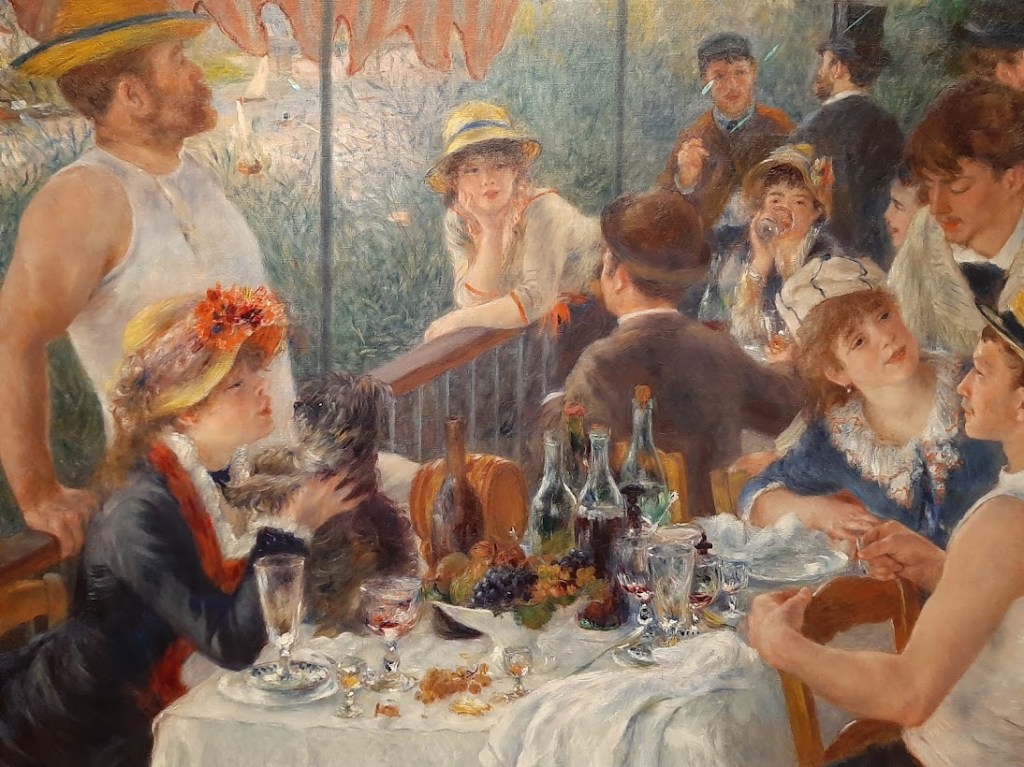
Today on Impressionism Friday we’re going to meet one of my favorite colorists Renoir.
I have always loved Renoir’s use of bold and bright colors. His city scenes are full of movement and a heightened realism mixed with Impressionism.
You feel as though you can walk into the scene and yet each Renoir feels like a dream.
I’ve been blessed to have seen many of his works in person from The National Gallery (DC and UK) to Minneapolis Museum of Art, exhibits in Nashville, The Art Institute of Chicago and recently at The Met and FRICK in NYC.
I’ve never been disappointed in Renoir – if anything his art brightens my spirit and have ‘a conversation’ with the characters in the painting.
While he has a distinct whimsical style, I’ve seen a depth in his capabilities across artworks. For instance, his portrayal of St. Mark’s Square in Venice reminded me of a JW Turner.
It shocked me when earlier this month I noticed that The Barnes Institute in Philadelphia is hosting a class ‘In Defense of Renoir.’
Why does Renoir need defending? I’ve trained with top art instructors and visited many renowned museums and have never heard anything bad about Renoir’s artwork. It shocked me a bit that The Barnes Institute, which is home to 181 Renoir paintings (more than any other museum in the world) would be concerned about ‘defending Renoir.”
After doing a bit of research, it turns out that a small group of activists protested in Boston a few years back about Renoir’s inability to paint. (They used coarser words, but I’ll leave it at that). A documentary was even made about Why people HATE Renoir’s paintings. The main argument is ‘he cannot paint,’ but the grander protest was why art museums buy works by dead artists versus contemporary artists.
My thoughts:
Protesting an artist, especially a master like Renoir, simply because you don’t like their style of painting is ridiculous, petty and silly. Sure I understand if there was a controversy (i.e. the paintings were stolen by Nazis and resold or depicted violence against women, etc…) but that’s not an issue with the paintings of Renoir.
While some may dislike his bold colors and dreamy motifs, claiming Renoir can’t paint is misguided. You may not enjoy his style, but there is no doubt he can draw and paint.
We all have preferences of art and artists we are drawn too. That is okay. We don’t have to love all artists and styles, but we need to at least be open to art that is outside our comfort zone and preference.
Ex: I know some who love Rothko! I personally don’t like his minimalist and the almost bare canvas I’ve seen. I can respect the themes of the paintings and ‘the written word’ beside the art explaining the motif, but it doesn’t draw me in like a Monet or Renoir. That is okay. I still think it deserves a spot at the museum and respect my friends who love Rothko.
Today we’re going to dive into Renoir’s life as an artist and study a few of my favorite works by Renoir. All I ask is you keep an open mind to Renoir…chances are you’ll fall in love with his amazing bold colors and bustling scenes like The Luncheon of the Boating Party (top image) above.
Getting to know Renoir:
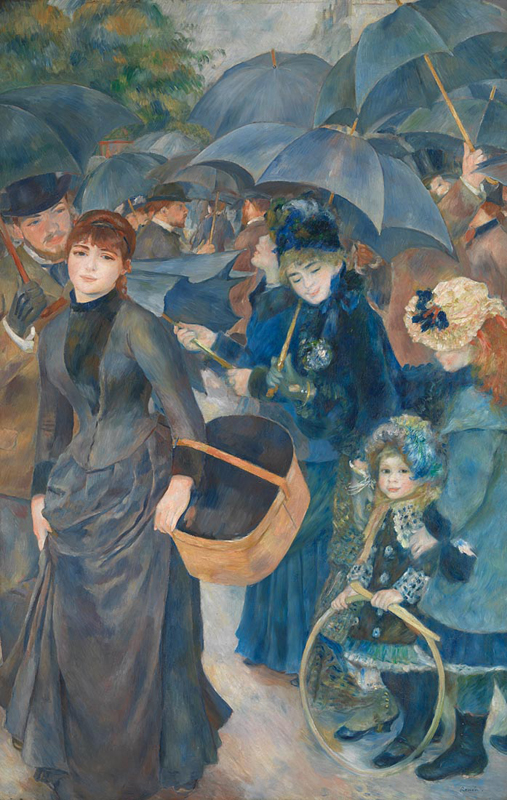
- painting above – I have this by my desk and often stare into the hart of the painting inbetween work calls – it is peaceful and calming and yet dark and mysterious – Renoir masterfully creates a crowd scene and yet we are draw to three faces: The lady with th ebaske to the left who seems at peace without an umbrella and is a calming face to the woman looking at the little girl tenderly and the little girl in the corner who seems to know our secret (we are not in the same plane as they are)…What are your thoughts?
Born on February 25th, 1841 in Limoges France, Renoir would become a innovator of The Impressionism movement.
His father was a tailor who moved the family to Paris in 1844 in searc of more favorable prospects. They settled in rue d’Argenteuil in central Paris, which afforded young Renoir the opportunity to visit the Louvre nearby.
He showed a natural talent for drawing at a young age, although his primary talent was singing! Sadly he was forced to give up his singing lessons due to the family’s financial circumstances. At age thirteen, Renoir was enrolled to purse an apprenticeship at a porcelain factory – this helped pave the way for his later art career.
Alas, who knows – if he had not pursued painting he might have starred at The Paris Opera. For our sake, I’m glad he stuck with art.
During his time at the porcelain factory, Renoir escaped to The Louvre in his fre to find inspiration and seek refuge in the art.
The owner of the factory recognized Renoir’s artistic talent and encouraged him. Renoir began to take lessons to prepare for entry into the major art school – The Ecole des Beaux Arts. He also gained still in painting the porcelain in the factory to prepare for his art studies until in 1858 the need for painters at the porcelain factory was eliminated by modern mechanical reproduction.
Renoir got a break in 1862 when he began to study under Charles Gleyre in Paris. In Gleyre’s school he met what his future co-Impressionists – Alfred Sisley, Federic Bazille and Claude Monet.
This time no doubt anchored and influenced him stylistically, but at this time, like Monet and other future Impressionists, Renoir still had the goal of being accepted by the Salon.
In the 1860s, Renoir struggled at times to purchase paint, but was featured in The Salon from 1864 to 1868, when he received recognition for his “Lise with a Parasol.”
- The painting depicts Lise Trehot, who he had a relationship with at the time.
This was unfortunately a time of great tumult in France with The Franco-Prussian War…Paris was devastated in the war both by the aftermath of the native French Communards (who took over the city during part of the war) and the invading Prussian army.
Frederic Bazille died in the war -a loss that forever impacted Impressionism.
Finding his own Artistic Path:
Renoir drew from a variety of artistic influences including:
- Manet
- Pissarro
- Eugene Delacroix (his colorism influenced Renoir)
- Corot – who we learned about a few weeks ago – he was a pre-Impressionist painter who believed in naturalism and dabbled in plein-air painting
- He also studied Rococco masters like Fragonard and Boucher – known for their allegorical and whimsical flair (popular in 18th century France).
Monet and Renoir continued to remain close friends and painting partners. They often painted side by side en plein air (ex: La Gernouillere, 1869)
By the mid-1880s Renoir had moved stylistically away from pure Impressionism. A trip to Italy seeing works by the old masters like Leonardo da Vinci, Titian and Raphael encouraged Renoir to apply a more formal technique to his portraits and figure paintings.
He spent a few years in his own return to Classicism, also dubbed ‘The Ingres Period’ after French Painter Ingres.
He returned to his thinly brushed color and Impressionism leanings by 1890.
Unfortunately a diagnoise of Rheumatoid Arthitis came in 1892, severely limited his mobility. He continued to paint, but required an assistant to place the brush in his hand.
Personal Life:
Renoir dated several of his models but finally settled down in 1890 marrying Aline Victorine Charigot, a dressmaker twenty years his junior. She can be seen in his Luncheon of the Boating Party as the lady in a hat with a dog.
He had three sons including Pierre who became a stage an film actor; Jean who became a renowned filmmaker; and Claude who became a cermaic artist.
- His great-grandson, Alexandre Renoir, is a professional artist as well.
Several months before his death in 1919,Renoir visited The Louvre and saw his paintings hanging with those of the old masters he admired and studied. No doubt this was the crowning moment of his career.
Renoir painted over 4000 paintings which can be seen throughout the world.
Artworks of Note:
I’ve included a few of my favorite Renoir works below: Each one tells a story and I feel as though I’m having a conversation with the painting and it’s subjects.
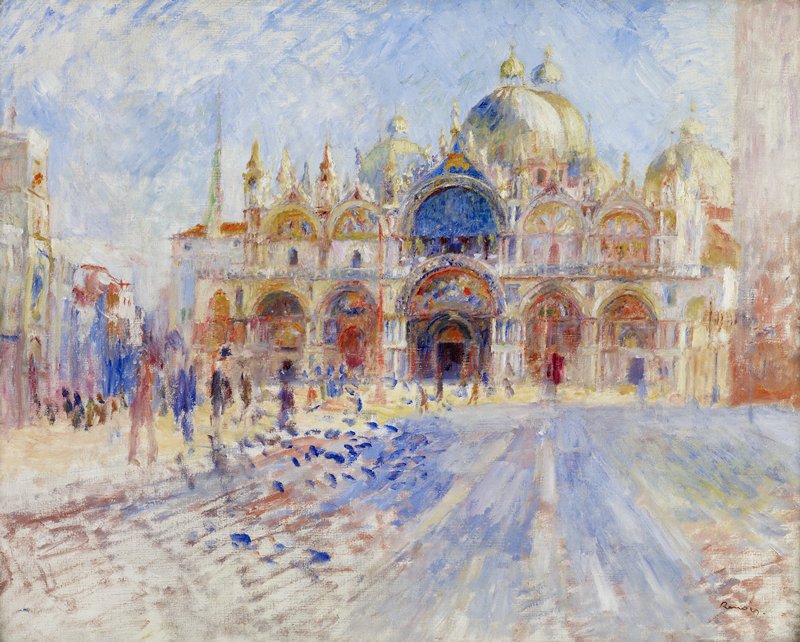
I saw this Renoir work at The Minneapolis Institute of Art – a wonderful museum and worth a visit. It struck me because at first glance I thought it might be a Turner, but it was only after I learned it was a Renoir I could see traces of his color and brushwork. I recently visited Venice and this captures the movement of San Marco so beautifully without being over detailed.
- If you want to learn more about Venetian Art – check out the FREE Masters of Venice Course here.
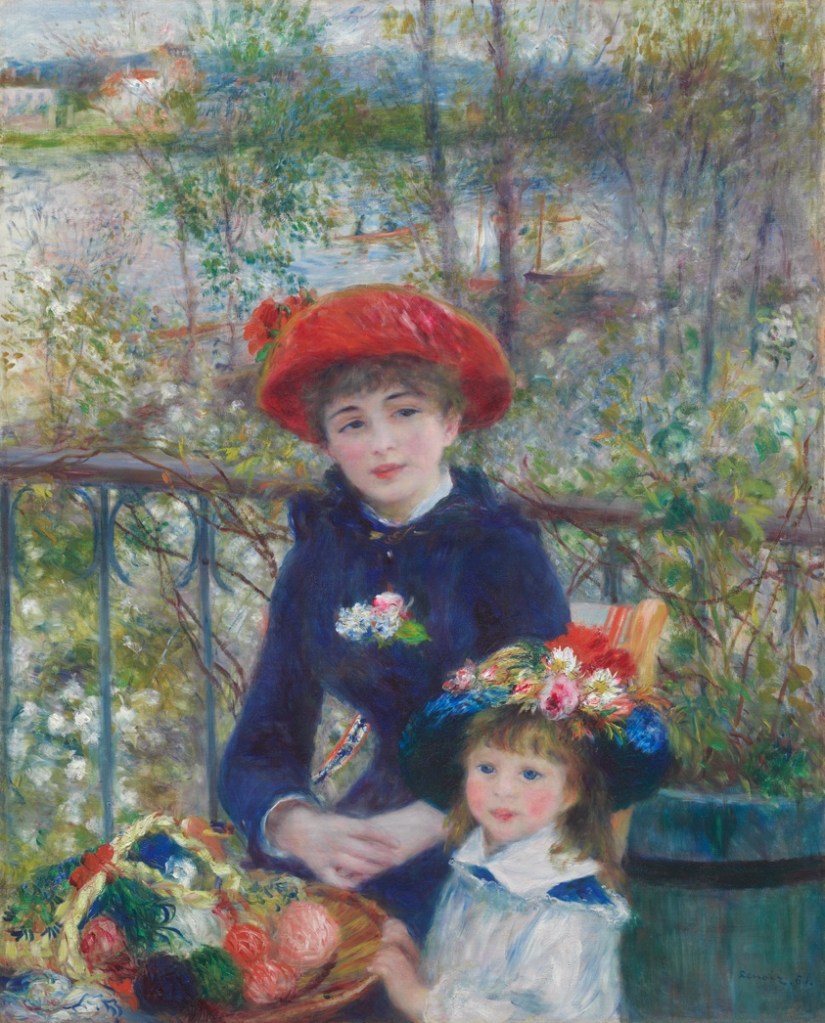
We’ll revisit Renoir again, but hope this primed your interest in learning more about his artwork.
Don’t forget to subscribe for future blog posts.
 Art Expeditions
Always a favorite – thanks so much! 🙂🌺
LikeLike
Renoir is one of my favorite Impressionists. I prefer him to Monet actually! I agree that saying he can’t paint is ridiculous. Of course, he can paint! People should be more precise if they want to protest…if they resent the musuem’s collecting ‘dead artists’ rather than contemporary ones, then say that!
LikeLike
Loved the paintings and the details about Renoir’s life. Thank you!
LikeLike