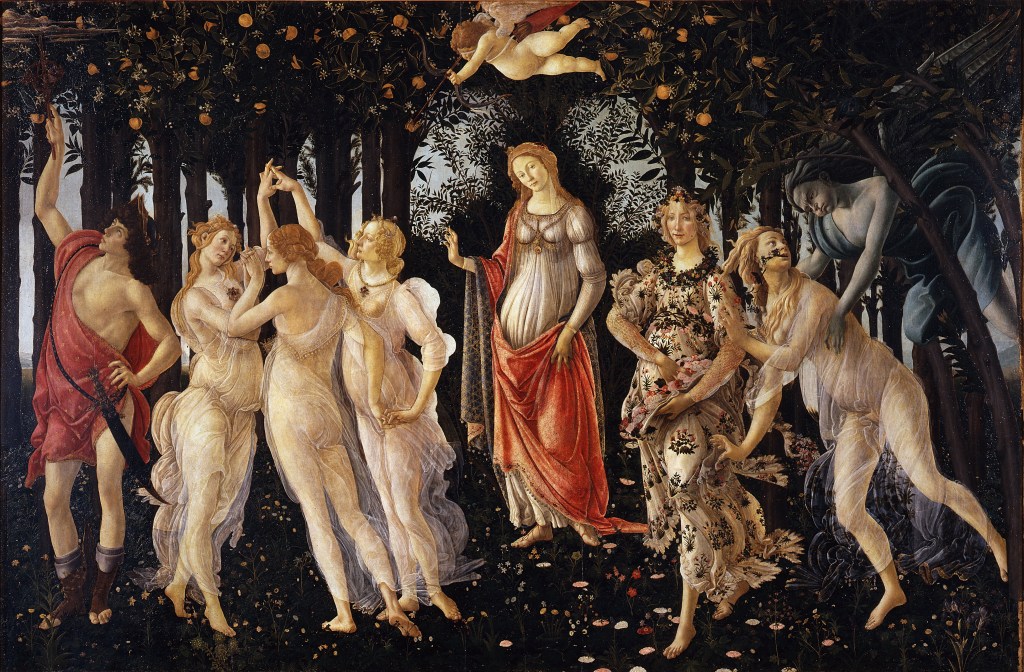
Today on Renaissance Wednesday we are traveling to Florence Italy in the 15th-century to meet one of my all-time favorite artists, Sandro Botticelli.
Botticelli’s paintings of Venus and Primavera are some of the most recognizable paintings in Western Art along with Michelangelo’s David and Leonardo da Vinci’s Mona Lisa.
Chances are you studied his Birth of Venus in high school history class. I was blessed to have an amazing World Civilization professor with a deep passion for art history. He first got me excited about Botticelli and Renaissance art.
The Birth of Venus is featured in in most history textbooks, because it was the first mythological nude painting since the Classical era. The Renaissance resurrected many classical themes from Greek and Roman mythology and artistic style.
For anyone who thinks history is boring and art is just about paintings in a museum, I challenge you to take just ten minutes and search “Medici – Florence Art” or “Botticelli and Florence.” Ten minutes of reading will turn into a lifetime addiction of art history sleuthing. Why? The fact Renaissance art history is a bit like Game of Thrones or a Renaissance version of the Young and the Restless…Wars, dynastic battles for land, arguments over religious zeal, innovation and hardship…Florentine history in the time of Botticelli is a drama for the ages.
- Don’t belive me? They actually created a series a few years back ‘The Medici’ with Dustin Hoffman and others that tells the story of The Medici dynasty in Florence and Sandro Botticelli has a role in the drama series.
Before we meet Botticelli, a little history recap:
The Middle Ages focused on the heart of the story with a formula of familar scenes and figures meant to instruct. This was not because they couldn’t paint or lacked insight in The Middle Ages into the human condition and humanism – remember Dante was a Medieval writer, however…
The Middle Ages required a more focused model for art because after the fall of the Western Empire, civilization in Western Europe was in chaos for several hundred years from Barbarian attacks and later Muslim incursions. Many could not read or write and having a standard in the church for mosaic storytelling and icon helped spread The Gospel message in a way that all people could relate to and learn without language or educational barriers.
There as also a real threat of Christianity falling under attack from Muslim conquest and the cult of Arianism – the church and states wanted to codify and ensure the art unified the people and the faithful. It may sound repressive, but it was actually a way to bring stability and education in a chaotic time.
They weren’t as concerned about depicting realism in Medieval interpretations because it wasn’t deemed necessary to getting the spiritual or political (depending on the art work) message across.
With all the chaos after the Fall of the Western Roman Empire, there was a move to focus on sin and the weight of penance, partially to remind the faithful that their suffering on this earth was picking up their cross to follow Jesus. This was still a focus of course in The Renaissance (and today as a Christian), but The Renaissance decided to place more weight on what I would refer to as a ‘resurrection people.’ The leaned into the fact that God so loved the world he sent his only son (in human form) to save the world from sin. The idea that yes man is broken, but is also made in God’s perfect image was a focus in The Renaissance movement of humanism.
In this humanism it became acceptable to portray the human body not as a sinful and terrible form, but rather made in the image of God and something to be celebrated.
Middle Ages scholars like Thomas Aquinas and Petrarch red the Classics of antiquity including Virgil and Plato. I bring this up because, The Middle Ages ensured that Classical Books were copied and saved. They valued them, but also recognized that from a learning standpoint stories about myths of pagan gods were potentially problematic for the faithful.
St. Thomas Aquinas believed that you could have a bridge between the ancient thought of great philosophers and minds like Aristotle, who were imbued with knowledge, but his generation could stand on top of their learning with the new knowledge and ultimate truth of Christianity. This was a bridge, where you could learn and study from pagans with the knowledge that you knew the ultimate Gospel Truth.
I lead with this pre-history because it helps us understand the shift from Medieval Classicism to the humanistic focused Classicism of The Renaissance.
Meet Botticelli:
Botticelli was born in The Republic of Florence circa 1445 on a street called Borgo Ognissanti to the tanner Mariano di Vanni d’Amedeo Fillpepi and mother Smeralda. He was the youngest of four siblings to survived into adulthood.
Florence has long been known for as a center for tanning and goldsmitheries. Even today you walk along The Ponte Vecchio (old bridge across The Arno River in Florence) and you’ll find Florentine gold shops. The city continues to be a center for leather (tanning is making of leather goods) today and you can take tours of local tanneries to learn about this ancient Florentine art.
In 1460, Botticelli’s father decided to end his tanning business and become a goldbeater with his son Antonio. This profession brought The Botticelli family in contact with many artists. Many Renaissance artists actually started their careers as goldsmiths before moving into other mediums like sculptor or fresco painting.
Botticelli initially trained as a goldsmith before beginning his career as a painter.
The Botticelli’s Ognissanti neighborhood was humble, but included several wealthy families including The Ruccelai and Vespucci (Amerigo Vespucci was Botticelli’s neighbor – aka the explorer America is named after).
Botticelli set up his studio in his home and received commissions from The Ruccelai, Vespucci and Medici families.
The name Botticelli, meaning little barrel, was the nickname Sandro’s brother Giovanni gave him because Sandro apparently had a round stature. By 1470, Sandro had formerly adopted the moniker. During this time it was not uncommon for artists to take on professional names – or use a nickname, just as a novelist might use a pen name.
Early Career:
Botticelli apprenticed with leading Florentine painter, Fra Fillippo Lippi from around 1461 to 1467. Fra Lippi, started off as a monk but in a bit of a scandal of the day fell in love with and married a nun. They were both given formal leave of their orders without too much hassle and Fra Lippi continued to be a well known painter after the ‘scandal.’ His son also became a leading artist.
Lippi was a favorite of The Medici family and no doubt this would apprenticeship would have opened doors for Sandro both creatively and socially.
In addition to Lippi’s influence, Botticelli also was inspired by other leading artists of his day – the Pollaiuolo brothers and Andrea del Verrocchio (who we met a few weeks ago). Verrocchio also instructed Leonardo da Vinci…
In 1467, Lippi left to work in Spoleto, while Botticelli stayed behind. Botticelli is believed to have opened his own studio by 1469, when he received a commission for a panel of Fortitude (now in the Uffizi in Florence). This work was to complete six of the seven virtues paintings already completed the year before by Piero del Pollaiuolo for The Tribunal Hall of the Piazza della Signoria in Florence.
If you have visited Florence, you’ll recognize the Piazza della Signoria as the square adjacent to the towered Palazzo Vecchio of Signoria and near the copy of David, as well as the entrances of The Uffizi.
This was the center of mercantile and government life in Florence in the 15th-century. The Tribunal Hall (now The Gucci Museum) ws the site where business disputes between Florentine merchants and the guilds (known as the Arts) administered disputes and justice. The Seven Virtues was (and continues to be) a popular theme for representing fairness in law and justice.
Botticelli was selected along with Pollaiuolo by the Tribunale di Mercanzia for the entire project, but Pollaiuolo relegated Botticelli to just one panel – Fortitude. This was an extremely prestigious commission and helped solidify Botticelli as an artist of merit.

In 1472, Botticelli took on his former master’s son, Fillippino Lippi as his first apprentice. They worked on several panels together including several Madonna and Child paintings, including the Madonna and Child with St. John the Baptist.
The younger Lippi would also rise to be a great Renaissance artist in his own right.
During 1470-1480, Botticelli remained busy creating masterworks like:
- Sacra conversazione altarpiece (now at The Uffizi)
- Madonna with Lilies and Eight Angels
- Saint Augustine was commissioned by the Vespucci family to pair with Ghirlandaio’s Saint Jerome (we met Ghirlandaio last time on Renaissance Wednesday – it is is interesting how Florence arts scene was a living history with art masters passing in the street)
Interesting to note that during this time, Botticelli was also commissioned by The Medici Family to create a large fresco of those executed for The Pazzi Conspiracy in the Florence Customs House.
- The Pazzi Conspiracy was one of the darkest times in Italian-Florentine history. Essentially Pope Sixtus IV wanted The Medici out of power because of a banking deal (the Medici wouldn’t finance a papal initiative). The Medici were deeply Catholic and religious, in spite of the sin of the day ‘usury’ (lending with interest) and did not want to start a war with the Pope, but unfortunately a war began on April 26th, 1478- Easter Sunday, when assasins for the Pazzi family, led by tried to kill Lorenzo ‘The Magnificent’ de’Medici right in the middle of Mass. His brother, Giuliano, was killed in this attack.
- Members of The Pazzi Family and their connections (even those who had nothing to do with the attack) were hunted down and executed.
- Botticelli was commissioned to paint each of the executed plot members as a warning to others who may try to rise up against The Medici.
- It is important to note that technically The Medici were not ‘rulers’ of The Republic, but they were power brokers behind the scenes.
- Eventually Pope Sixtus IV and Lorenzo came to a tenuous peace. To signify their laying down of arms, Lorenzo sent several of the finest Florentine painters to Rome to paint The Sistine Chapel including Ghirlandaio, Rosselli, Botticelli and Perugino (from Perugia – Perugino was Raphael’s teacher).
After the tragedy of the Pazzi Conspiracy and the tenuous peace of Florence and Pope Sixtus IV, great Tuscan masters were send on Lorenzo’s behalf to paint Pope Sixtus IV’s new Sistine Chapel. Sistine comes from ‘sixtus.’
Most of us automatically think about Michelangelo when we imagine The Sistine Chapel, but Michelangelo was only one of the artistic geniuses who painted the walls of this papal chapel.
The side walls of the Sistine Chapel depict both scenes from The Life of Moses and The Life of Christ.
Botticelli was handpicked for the project and contributed to three of the original large fourteen scenes, including: Temptations of Christ, Youth of Moses and Punishment of the Sons of Korah. He also painted several imagined portraits in the level above.
This was a huge commission for Botticelli and an important sign of peace between Florence and Rome. The people of Florence suffered during the Pazzi War as they could not receive communion and the sacraments.
- It is interesting to noted that two Medicis would end up as popes in the coming years; Lorenzo’s son (Giovanni) Leo X and his nephew (Giuliano’s son), Pope Clement VII.
Upon returning to Florence in 1482, Botticelli moved into his famed classical depictions of Primavera (1482), The Birth of Venus (c.1485), Venus and Mars (1485)
The Birth of Venus:
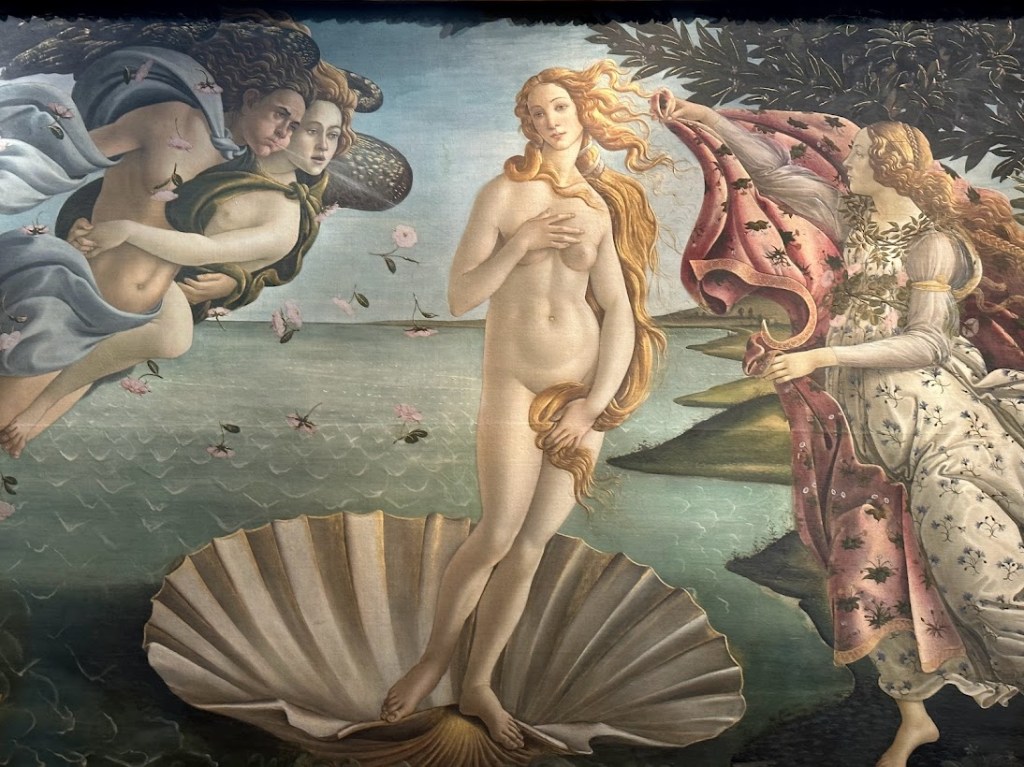
While this is one of the first paintings of a nude female depicted in Renaissance art, Botticelli’s rendition is not overtly sexual. It is rather meant to reflect perfect love and the ideals of love. Venus stands contrapposto with her weight on her left (our right) side, as if she is about to walk off the shell onto the beach. He is modest but confident, her hair and hands covering herself – not in shame, but that humble modesty. This perhaps makes this enduring is it captures an innocence.
Botticelli’s work as a colorist is vivid and shines through in his ethereal yet realistic potrayal of the protagonist of Venus. Gold is even added to her hair (it shimmers in the light) to show the splendor.
In creating this scene, Botticelli had no reference and had to use his imagination. He most likely had some influence from Classical statues of Venus in Rome, but also we see the shell (a symbol of Baptism in Christianity, and also used Greco-Roman works to depict Venus in antiquity) and the waves as almost a breath pulling her to shore.
The image is meant to depict Venus at her birth as she is brought to shore. The wind god Zephryrus blows at her with other female figures in the scene.
It is believed that this work was commission for a junior branch of The Medici Family (cousins of the main branch of Lorenzo the Magnificent) for their Villa di Castello, a country house outside of Florence.
His Primavera was also commissioned by the junior branch of the Medici, probably by Lorenzo di Pierfrancesco de’Medici or his cousin Giuliano de Medici (Lorenzo and Giuliano were popular Medici names…One of the patron saints of the Medici was Saint Lawrence – San Lorenzo, which was their home church in Florence).
Venus stands in the middle surrounded by other mythological figures like Flora and Zephr and Three Graces.
While The Birth of Venus is his most popular work, I personally prefer Primavera because it has such dynamism. My favorite character is Flora who stares at you with a confident whimsy inviting you into the scene.
Later Religious Works:
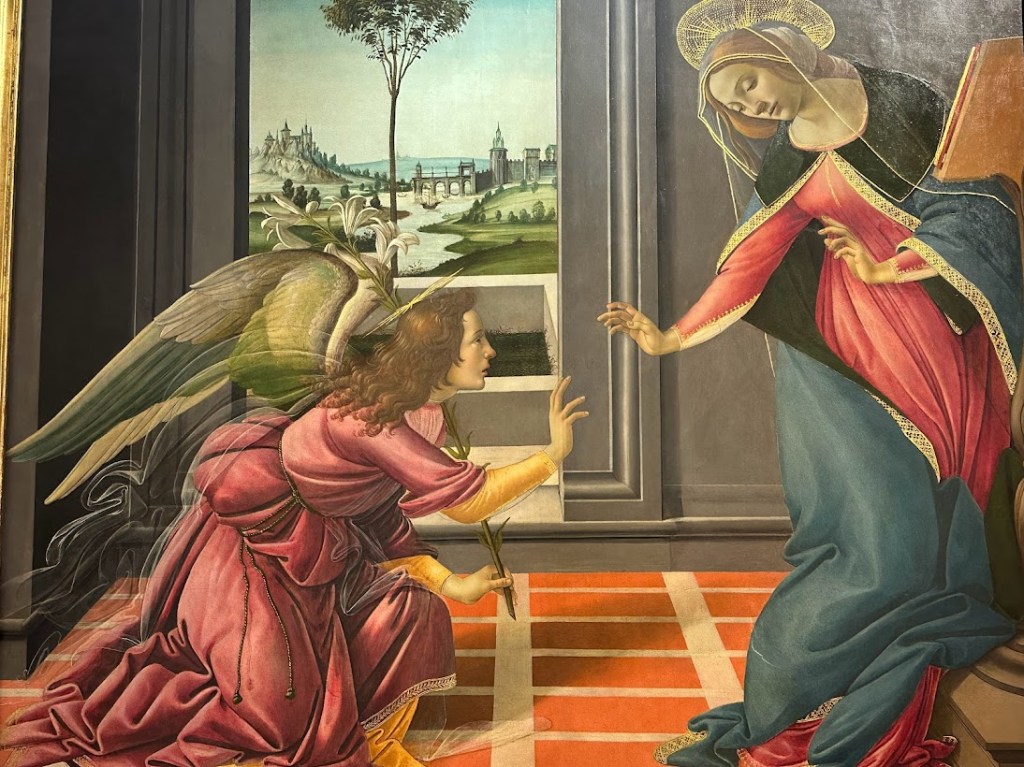
Botticelli primarily continued to paint Religious art through the remainder of his career and it is stunning
His Annunication his one of his best known works in the late 1480-early 1490s. It is in the Uffizi Gallery
- We refer to The Uffizi a lot here…The Uffizi is a major art museum housed in the historical offices of The Medici/Florentine government. It is one of the best art collections in the world. Learn more here.
Botticelli also received numerous commissions as a portrait painter, including several for the Vespucci family. I bring this up because Simonetta Vespucci is said to be Botticelli’s true love, but alas she was married and they could not be together. He is buried beside her at
He also painted Dante’s Divine Comedy on parchment. Dante was (and still is) a beloved Florentine who sadly was forced to flee Florence in the 1200s never to return. This legacy of abandoning Dante continues to haunt Florence who has worked to reclaim him as their native son.
- Fun fact: Dante’s Divine Comedy was so popular that it helped the Tuscan form of Italian to become the common language for trade in Italy. Modern day Italian comes mostly from the Tuscan dialect and much of this is owed to Dante writing his ‘Divine Comedy’ in his lingua franca in his era.
Savonarola and Botticelli:
I wont’ dive too deep into the deeply moralistic Dominican friar and controversial reformer, Girolamo Savonarola today – but it is important to give a bit of backstory as Botticelli became one of Savonarola’s ardent supporters.
Judging from the corruption Pope Sixtus IV showed in The Pazzi Conspiracy, not to mention the Rise of the Borgia pope Alexander VII (whose bad reputation is legendary), many of the Catholic faithful began to desire a reform to rid the church of the political influences.
Savonarola was a fire and brimstone preacher who called out The Pope and others for reform. It’s interesting because in studying Savonarola he seems moderate compared to even Luther. No doubt he had valid concerns and many even today can relate with his call to action. That being said, what undid Savonarola is he became an extremist, forcing people to burn their possessions in a ‘Bonfire of Vanities,’ among other questionable actions.
He claimed to be a prophet and when the prophecies didn’t come to pass (the end of the world), his support waned and he eventually was executed (burned at the stake). This article gives a good nuanced view of this fascinating character that essentially ended The Renaissance in Florence, shifting to Mannerism and other styles in the aftermath of this unusual time.
Botticelli is believed to have burned several of his works in the Bonfire of Vanities, which is a tragedy, but shows he was a deeply moral man searching for answers in a troubled world.
Botticelli continued to paint stories of antiquity (ancient history and moral allegory) as well as his religious works.
His later Mystical Nativity is concerned darker and has an apocalyptic tone. It is his only signed painting reading: ‘This picture, at the end of the year 1500, in the troubles of Italy, I, Alessandro, in the half-time after the time, painted, according to the eleventh [chapter] of Saint John, in the second woe of the Apocalypse, during the release of the devil for three and a half years; then he shall be bound in the twelfth [chapter] and we shall see [him buried] as in this picture’
Botticelli believed himself to be living during the Great Tribulation based on the upheavals in Europe at the time. This work is tied to his empathy for the executed Savonarola. In one sermon Savonarola preached, he set forth a vision that had come to him in which he saw an extraordinary heavenly crown. At its base were twelve hearts with twelve ribbons wrapped around them and written on these were the unique mystical qualities or privileges of the Virgin Mary. This description seems to influnce The Mystical Nativity

Botticelli died in 1510 in Florence.
Legacy
Today Botticelli is one of the most celebrated artists of The Renaissance, but for many centuries his work was overlooked as newer artists and styles drew attention away from Botticelli’s oeuvre. This changed with The Pre-Raphaelite movement of the 19th century (think Waterhouse and daring pictures of Ophelia) resurrected Botticelli’s importance and he has grown in popularity ever since.
Botticelli’s works can be found in museums throughou the world, but the largest collection of Botticelli paintings is found in Florence at The Uffizi Gallery including The Birth of Venus and Primavera.
I hope to do a course on The Uffizi soon, but you may enjoy this article I wrote about the museum for American Nomad Traveler.
The Uffizi is on the level with The Louvre (think The Renaissance version of The Louvre) and a must see museum for art lovers.
In the US, you’ll find Botticelli at major museums including
The North Carolina Museum of Art – Raleigh
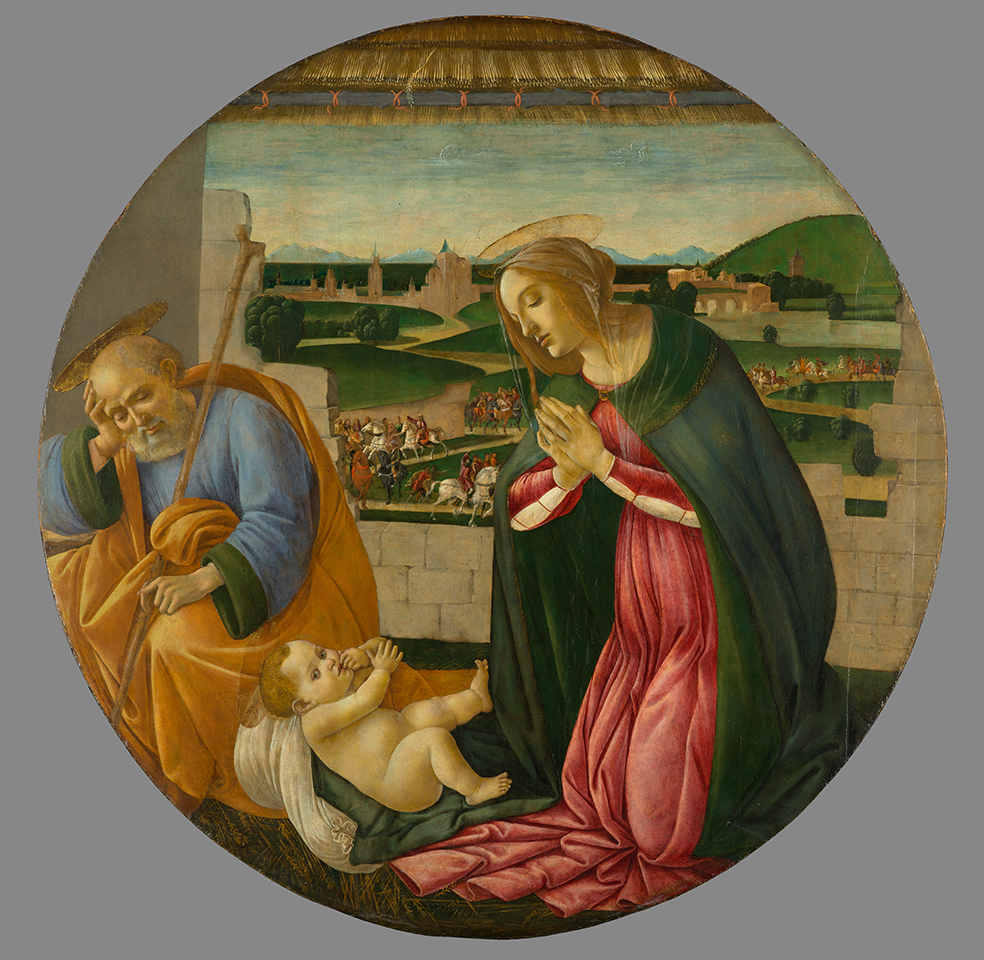
Columbia Art Museum in Columbia, SC (They have the only Botticelli wall fresco outside of Italy)
The MET
and others…
I hope you enjoyed this Renaissance Art Expedition…
Don’t forget to sign up for our blog and find us on Facebook.
We are also on Patreon!
Written by art lover and historian Adele L.
 Art Expeditions