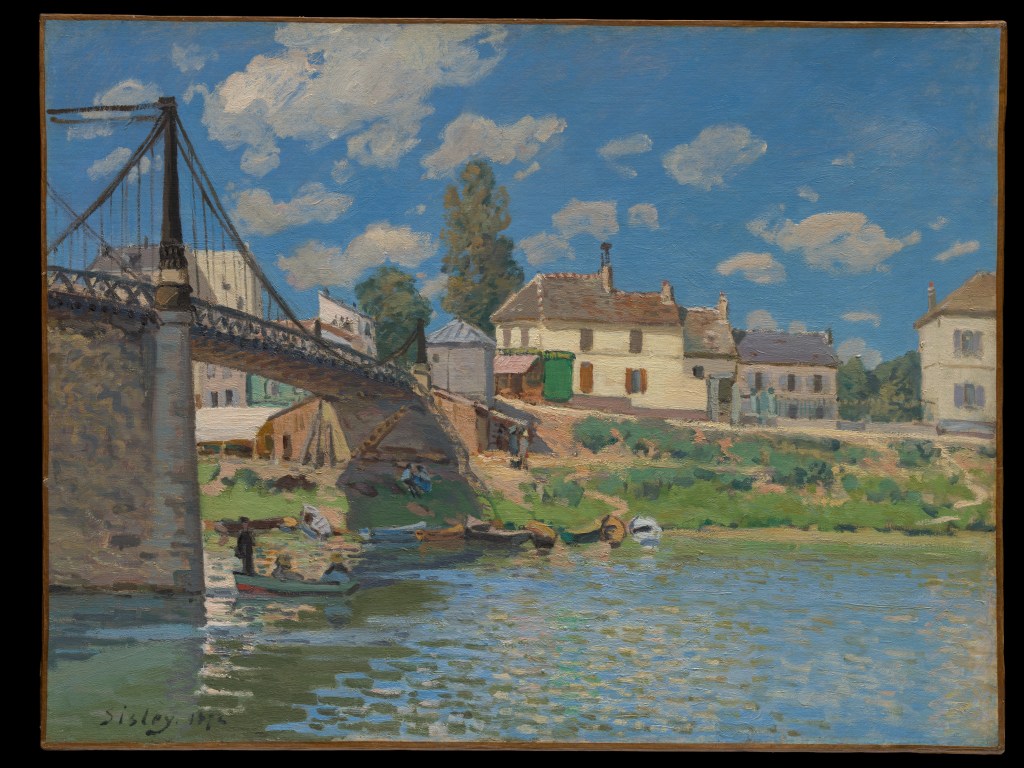
Today on Impressionism Friday we are taking an Art Expedition to 19th-century France where we’ll be getting to know a master of Impressionism – Alfred Sisley.
Sisley is a founding member of the school of Impressionism. His pastoral rural scenes of the countryside around Paris continue to dazzle and calm viewers today with their balanced ool and vibrant colors.
I was first introduced to Alfred Sisley at my local art museum, The North Carolina Museum of Art, during a school field trip. I was instantly attracted to Sisley’s use of color and mix of small and bold brushwork to create an impression of the banks of a river.
I’ve been blessed to have seen many other Sisley paintings in person over twenty years of art travels, with some of my favorite works located at The MET (NYC), National Gallery in London and Minneapolis Institute of Arts.
While his peer Pissarro an worked in and outside of Impressionism from Pointillism to Realism; Sisley found his niche in Impressionism en plein air landscapes and rarely strayed from his sweet spot. He found fullfillment en plein air Impressionism, capturing the moment and movement of light and drama everyday scenes.
Biography:
Sisley was born in 1839 in Paris to wealthy British parents. His father, William was in the silk trade, and his mother, Felicia Sell was a cultivated music connoisseur.
In 1857, Sisley was sent to London where he studied for a career in business, but his true passion was art. He returned to Paris in 1861 and enrolled at the Ecole des Beaux-Arts within the atelier (studio) of Swiss artist Marc-Charles-Gabriel Gleyre. You may remember from previous posts, that Renoir and Monet, as well as Bazille also studied with Gleyre.
Years before Impressionism took hold as a movement, these founding members would paint en plein air (outdoors) to capture the transient effects of sunlight with realism and depth.
Though ironic, many of these paintings were so realistic in brightness of color (think about how vivid amber grass is in the bright sun) with an intuitive feel of a scene versus detailed realism that many art viewers were unaccustomed to this boldness and brightness in works by Sisley and others.
This made it difficult to sell their work and they were often refused by the Salon in Paris.
Fortunately for Sisley his father supported him with a large allowance, which allowed him to paint without some of the financial strains of his contemporaries.
In 1866, Sisley met his future wife, Eugenie Lescouezec (also known as Marie), a Breton living in Paris. They had two children, a son Pierre (b. 1867) and daughter Jeanne (b. 1869)
At the time he met Eugenie, he lived near the Cafe Guerbois, a hotspot for many Parisian painters.
Sisley’s prospects seemed to be looking up when The Salon selected him for an exhibition in 1868, but unfortunately his appearance there did not bring him financial or critical successs. He would not participant in future Salon exhibitions.
In 1874, Sisley was a participant in what is now known as the first Impressionist Exhibition along with Monet, Morisot, Pissarro and others.
The 1870 Franco-Prussian War devastated Paris and most of France. Sisley who up to this time had much financial freedom thanks to the support of his father saw his security disappear. His father’s silk business tumbled in the war leaving the family destitute. For the first time, Sisley had to rely on the sale of his paintings to support his family.
He lived in near poverty the remainder of his career, as the value of his paintings did not rise until sadly after his death.
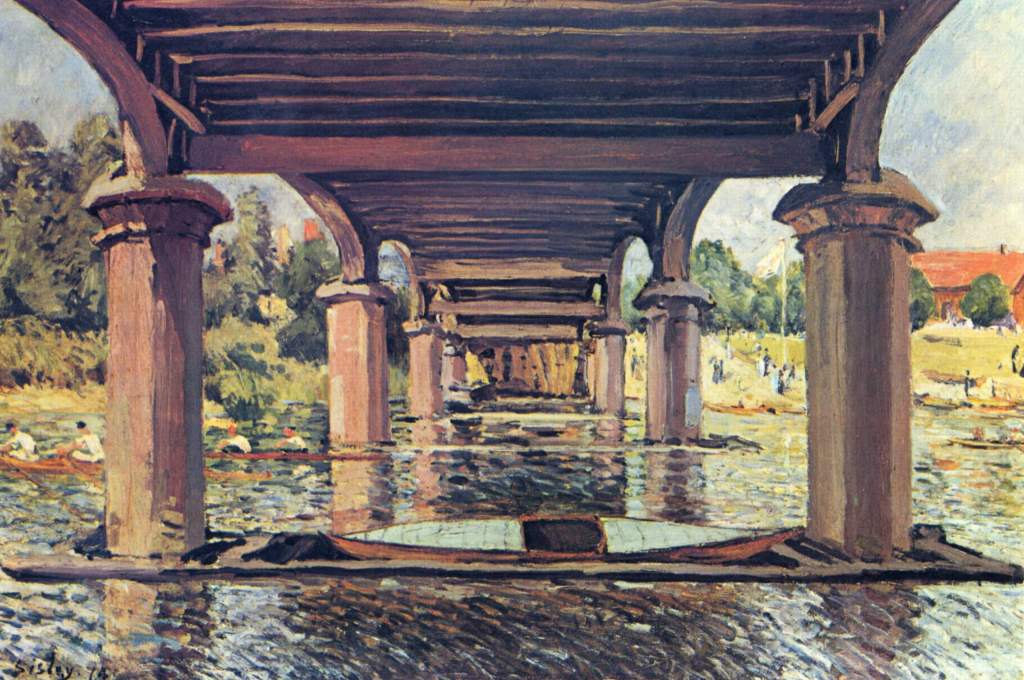
Fortunately he did have supportive patrons who backed him to make a few brief trips to Britain to paint. His series of The River Thames near Hampton Court continues to be one of his most renowned series of works.
His Hampton Court Bridge painting, where the south bank becomes Thames Ditton is iconic with art historian Kenneth Clark saying (it is) “a perfect moment of Impressionism)
Under the Hampton Court Bridge:
After 1880, Sisley moved his family to the small village of Moret-sur-Loing close to the forest of Fontatinebleau. You may remember learning about The Forest of Fontainebleau in an early Impressionism Friday post, when we discussed the origins of Impressionism and how the Barbizon School painted out of doors in The Forest of Fontainebleau. So Sisley was returning to the heart of the en plein air movement that began earlier in the century.
This area is prime for painting landscapes with wandering grass and forestland, and a constantly changing atmosphere.
Sisley traveled to his native England once more before his death, painting in Cardiff, before returning permanently to Fontainebleau.
He died at age 59 in 1899 in Moret sur Loring in France.

