In our past two Medieval Monday posts we’ve been exploring the era of Romanesque architecture that emerged in The Middle Ages as Europe began a rapid rebuilding of civic and church buildings under rulers like Charlemagne and Otto, with Romanesque becoming a movement (not a style, but movement inspired by Roman architecture)and reaching it’s height at the end of the 12th-century (around 1150, but was continued to be built depending on the population base.)
Last time we visited Speyer Cathedral in Germany, the largest Romanesque Church still standing in Europe (Cluny was larger before it’s near destruction in The French Revolution).
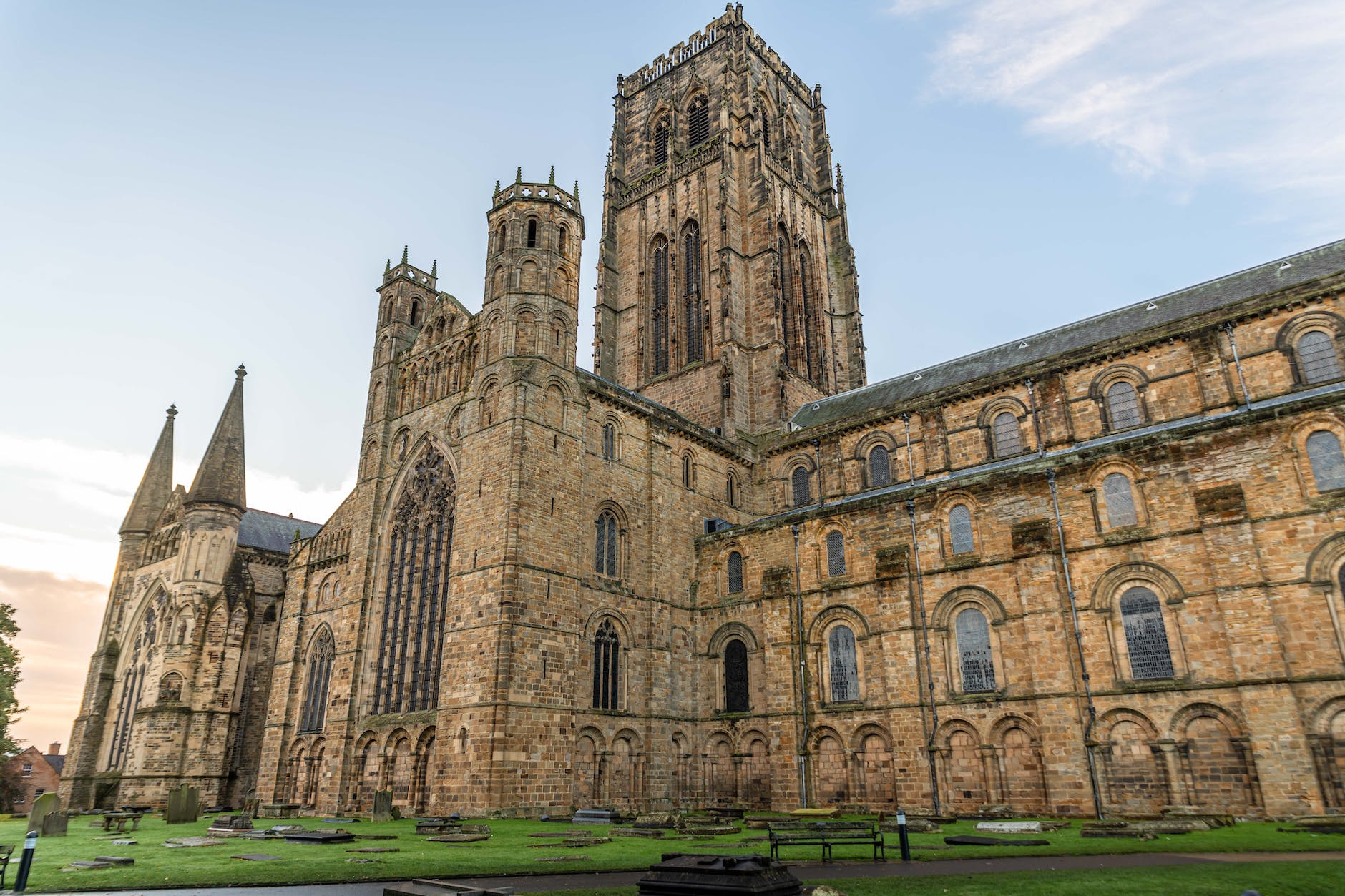
Today we’re going across the channel (The English Channel or French Channel depending on which side of the continent you are on – The English and French love a competition) to Durham England, where we’ll discover the marvelous Romanesque Cathedral at Durham.
Romanesque in England is often called ‘Norman’ because it first appeared after 1066 and the conquest of England by William, Duke of Normandy (William the Conqueror).
Normandy is in northern France, but William’s stock was mostly Viking blood that permanently settled in France and decided to adopt the French language and many of their customs. The Norman influence helped form the modern day English which prior to the Norman conquest was Germanic, but with The French Language and Latin influences in the Norman government of England, the vocabulary and some structure in English is Latinized. This makes English a unique and diverse language.
With the Normans came a building campaign and the style of choice for buildings like The Tower of London (original White Towers) to churches like Durham Cathedral was Romanesque inspired.
The Founding of Durham Cathedral:
Durham Cathedral’s foundation is closely tied to Lindisfarne, a monastery founded around 634 AD by Irish monk Saint Aidan. Lindisfarne was know for producing the beautiful illuminated manuscripts of Lindisfarne (Gospels).
The patron saint of Northumberia was Saint Cuthbert who was a monk and abbot at the monastery. Upon his death he was buried at Lindisfarne.
Sadly repeated Viking raids devastated Lindisfarne and the monks were forced to flee with St. Cuthbert’s relics.
The diocese of Lindisfarne had to remain itinerant until 882, when the monks briefly settled settled six miles north of Durham, but when Vikings tried to raid them again in the 900s the historical legend of the founding of Durham Cathedral begins.
Local legend states that the city of Durham and its cathedral was founded in 995 AD by a miraculous appearance from St. Cuthbert to monk Eadmer saying to take his coffin to Dun Holm. Eadmer understood they needed to move Cuthbert’s body, but he didn’t know where Dun Holm was until later that day, the monks came across a milkmaid at Mount Joy. She said that she was seeking her lost dun cow, which she had last seen at Dun Holm. They asked her to lead them to Dun Holm, a wooded hill-island formed by a tight gorge-like meander of the River Wear.
It is said when they arrive at the spot the coffin could not be moved further and they settled in the spot and Durham was born.
An early Durham Cathedral was built in 998 known as The White Church to hold the relics of St. Cuthbert. It quickly became an important pilgrimmage spot. Even, King Canute, the Viking leader who converted to Christianity, was one of the early pilgrims and granted many privileges and estates to the Durham monks.
Durham was quickly growing into a bustling city anchored by the church.
1066 William the Conqueror and the Norman rule came to England. Durham Cathedral would be rebuilt shortly thereafter as one of the grandest examples of Norman-Romanesque architecture.
- The present cathedral was commissioned by William the Conqueror under the direction of William de St-Calais who was appointed in 1080 as the first Prince-Bishop of Durham.
- In 1083, de St-Calais founded the Benedictine Priory of St. Cuthbert at Durham; the original Saxon church was demolished.
- One August 11, 1093 the foundation stone for the new cathedral was laid. The monks had to earn money for their own buildings (monastery housing), while the bishop took responsibility for completing the building of the cathedral. The cathedral was specifically build to house the bodies of St. Cuthbert and Venerable Bede and provide a proper place of pilgrimage.
- Durham Cathedral was completed in 1133
- Both Durham Cathedral and the adjoining Durham Castle are UNESCO World Heritage Sites
According to UNESCO: “It (Durham Cathedral) is the largest and finest example of Norman architecture in England. The innovative audacity of its vaulting foreshadowed Gothic architecture.”
- It is the oldest surviving building with a stone vaulted ceiling at such a large scale. The ability to build a large roof of stone rather than wood was a huge accomplishmentin engineering during The Middle Ages. (We saw this at Speyer Cathedral as well)
- Unlike other Romanesque churches that were remodeled completely, Durham retains his Norman architecture and the style remains in tact.
- Other Norman buildings in Britain were heavily modified, often beyond recognition. This is one of the world’s greatest examples of Romanesque architecture.
- The nave vault marks a shift in the history of architecture as a pointed arch (pre-Gothic) was successfully used as a structural element for the first time.
- The ribbed vault was introduced at Durham Cathedral: Rib vaults are more pleasing to the eye than groin vaults and look light and graceful rather than massive and solid. This innovative would became a key feature of Gothic when it emerges in France later in the 12th-century.

Sadly, Henry VIII in his break with Rome decided to attack and deconsecrate the monasteries, taking their wealth. The saints relics of St. Bede and St. Cuthbert were reburied outside the church. It is still a pilgrimmage site today.
- Fun fact: scenes of
Here are a few photos of Durham Cathedral


Learn more about Durham Cathedral here:
 Art Expeditions