
Today on Impressionism Friday, we’re getting to know pioneering American Impressionist, Frederick Childe Hassam, who painted dynamic cityscapes and resplendent landscapes and majestic seascapes.
- Childe is pronounced as ‘Child’
Born in his family home in a Boston suburb in 1859,
His father was a successful cutlery merchant in Boston and his mother came from Maine. Hassam came for a long line of native New Englanders. He was even a distant cousin of author Nathaniel Hawthorne…
Childe was first exposed to to art in the Mather Public School, where he showed some talent, but nothing to take extreme notice of.
In 1872, Childe was forced to drop out of high school after a disastrous fire destroyed his father’s business and much of Boston’s commercial district. His father arranged for him to take a job with publisher Little, Brown and Company as an accountant to help support the family.
Hassam struggled with numbers and was a poor fit for the accounting job. His father encouraged him to pursue a role that was more aligned with his artistic talent. In 1876, he started a position as an apprentice under wood engraver George Johnson.
He was an adept draftsman, producing designs for commercial engravings including letterheads and newspapers for companies.
In 1882, he became a free-lance illustrator (known as a “black-and-white man” in the trade). He established his first studio, where he specialized in illustrating children’s stories for magazines such as Scribner’s, The Century and Harpers.
In the evenings he attended the life class at the Boston Art Club and also briefly studied anatomy with William Rimmer at the Lowell Institute and took private lessons from the German-born painter Ignaz Gaugengigl.
Around 1879 he began to experiment with oils, but watercolors remained his preferred medium until later in his career.
In 1883, his good friend Celia Thaxter, suggested that he drop his first name Frederick and shorten his professional name to ‘Childe Hassam.’
Also in 1883, Hassam traveled with fellow Boston Art Club member, Edmund H. Garrett on a Grand European Tour. Together they traveled to Great Britain, The Netherlands, France, Italy, Switzerland and Spain…They studied the Old Masters and created watercolors of the European countryside. This was also when he was first introduced to the impressionism like watercolors of J.M.W. Turner.
- J.M.W. Turner is one of the most celebrated British painters, who created a unique style that has the essence of Impressionism and modern art,but was painted in the late 18th-mid 19th centuries. He also influenced Monet and others.
Upon returning to Boston, Hassam hosted a show of over seventy watercolors. He continued his work as a studio illustrator, but also began to paint en plein air. He joined the “Paint and Clay Club,” where he connected with other artists in a burgeoning New England art community.
In 1884, Hassam married Kathleen Maude Doane.
During this time, Hassam was particularly influenced by the circle of William Morris Hunt.
Inspired by the great French landscapist Jean-Baptiste Camille Corot and The Barbizon School, Hunt emphasized working directly from nature, where atmosphere and light could be studied and translated to canvas.
- Fun fact: William Morris Hunt’s brother, Richard Morris Hunt was architect to the most prominent families in the US…including designing George W. Vanderbilt II’s Biltmore Estate in Asheville NC (largest house in the US).
In the mid-1880s, Hassam began painting cityscapes in his favorite Boston haunts including Boston Common.
In 1886, Childe and Kathleen moved to Paris. He studied figure painting with Gustave Boulanger and Jules Lefebvre at the Academie Julian and exhibited his work at the Salons of 1887 and 1888.
In 1889, he opened a studio in Montmartre. The studio was filled with unsold canvas abandoned by the previous tenant – “un peintre fou” – or the mad painter as the concierge called him. This ‘mad painter’ was Renoir, who up to this point, Hassam was unfamilar with.
Seeing the unsold canvas he became fascinated by Renoir’s work and The Impressionism movement.
“I looked at these experiments in pure color and saw it was what I was trying to do myself,” Hassam recalled years later reflecting on the incident.
In late 1889, the Hassams moved back to the United States, settling in New York to be in the center of the American art scene. He found a studio apartment at Fifth Avenue and Seventeenth. He painted one of his first New York oils – Fifth Avenue in Winter.
He loved to watch the fashionable street as it was traveled by horse-drawn carriages and trolleys. He proclaimed that “New York is the most beautiful city in the world. There is no boulevard in all Paris that compares to our own Fifth Avenue.”

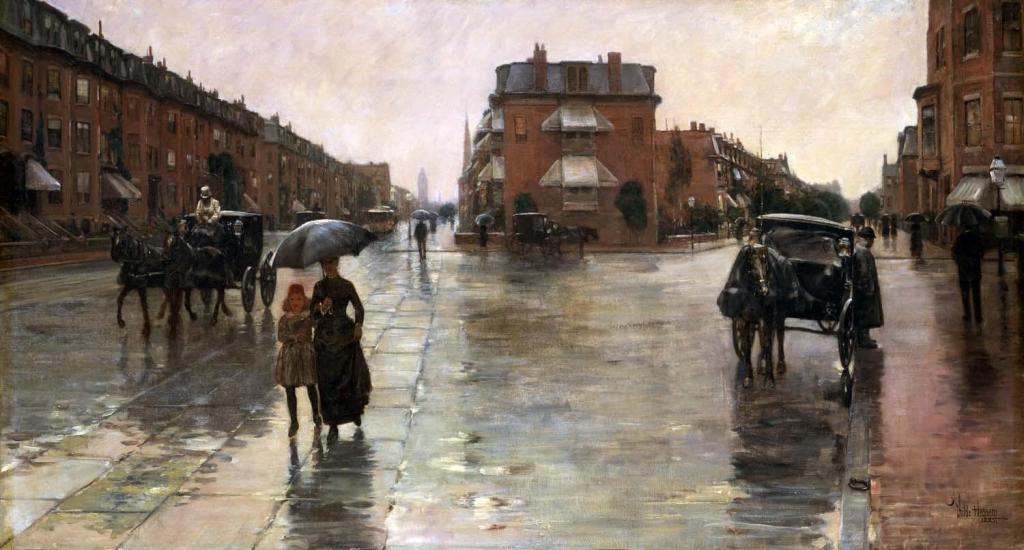
His ‘Rainy Day – Boston’ seems to take inspiration from Gustave Caillebotte’s Rainy Day Paris and is one of his most acclaimed paintings. You can see it at The Toledo Musem of Art (Ohio)
He developed close friendships with fellow American Impressionists including J. Alden Weir and John-Henry Twachtman. Through a mutual friend, Theodore Robinson, who was splitting his time between France and the US, Hassam, Twachtman and J. Alden Weir kept in close touch with Claude Monet in Giverny. The quartet of painters began to represent the core of American Impressionism and melding the glorious Impressionist style of Monet with their own unique American artistic eye.
Hassam, like Monet and Pissarro was adept at creating a variety of Impressionistic scenes – from the bustling city scenes of New York and Boston to the bucoloic and emphermal scenes of the American coastline of New England.
Some of Hassam’s most tantalizing scenes are his series of Appledore Island, the largest of the Isles of Shoals off New Hampshire…Appledore was a popular artist colony, where artists would gather at the cottage of poet and writer Celia Thaxter for salons with famous literary figures and artists.
Hassam says of his time at Appledore: “I spent some of my pleasantest summers…(and) where I met the best people in the country.”

In the 1890s, The Hassams traveled to Italy to study the Grand Masters in Naples, Rome and Florence, before traveling to France and on to England.
In 1897, Hassam became part of a group called The Ten, who took part in the secession of Impressionists from the Society of American Artists. While Hassam’s dreamy landscapes and active city scenes seem far from controversial in 2023, at the time he was one of the more radical of the Impressionist members in his adherance to broad, thick brushstrokes.
The Ten had their first show at the Durand-Ruel Gallery (fun-fact : Durand-Ruel was an art dealer from France who helped sell works by artists like Monet in Europe and abroad – including the US. Learn more about him here). The show received mixed critical reviews given the ‘experimental nature’ of Impressionism at the time. By this time, Hassam had begun to lean into Monet’s lighter palette with paler tones, which were inspired by the moods of nature. While some felt the scenes unrealistic, Hassam defended his haunting style – “subects suggest to me a color scheme and I just paint.”
My take: Impressionism
Impressionism isn’t as much about rejecting realism, but rather putting paint to palette that conveys the impression of a scene and the mood. When looking at a seascape by Hassam – the moody clouds and fire-red sun shrouded in blur might not be realistic, but it feels like a scene looks when you are there. Staring at the crashing waves and golden sun – you squint and the haze creates the ethereal colors. Impressionism is to me not a rejection of realism as much as conveying the nuanced realism of a scene and the life of the ever changing landscape. How often have you sat on a bench and just watched a simple sky change from a few clouds to crystal blue to the sunset. Impressionsim tries to meet reality in the fleeting memory of every moment.
Hassam never stopped painting and evolving as an artist. He continued to paint in the Impressionism style – letting the mood of the place guide him.
The Flag Series:

One of Hassam’s most recognizable series are a set of around thirty paintings known as ‘The Flag Series.’ Theise were begun in 1916, when America was on the precipice of World War I and and Europe had been in the trenches for several years. He was inspired by a ‘Preparedness Parade’ held on Fifth Avenue to raise money for the allied cause. His Flag paintings cover all seasons and nuances in weather and light conditions. The Avenue in the Rain (1917) is part of the White House collection and hung by President Obama at the entrance to the Oval Office.
Hassam died on August 27th 1935 – aged 75. He was survived by his wife Kathleen (d. 1946). Hassam’s legacy continues to shine as a beacon of American Impressionism. You can find his works in collections like The Met, The National Gallery and North Carolina Museum of Art and more.
Thanks for reading and don’t forget to subscribe for the latest Art Expeditions articles…
Also you can find us on facebook
 Art Expeditions
[…] Childe Hassam […]
LikeLike