As the solemnity of Holy Week unfolds, let’s turn our gaze to the powerful ways artists have captured the essence of the Easter story.
Palm Sunday:

This marvelous painting by by Sienese master Piero Lorenzetti depicts Christ’s Triumphal Entry into Jerusalem on Palm Sunday. While meditating on this painting, Christ is surrounded by this golden glow as the people surrounding him are clothed in earthen golden tones. It’s natural, yet provides this aura around Jesus. In spite of all the detail an pageantry in the background, our eyes are drawn to Christ with his cloak. The detail work of the palms, as the crowd cries out “Hosanna! Blessed is he who comes in the name of the Lord.
It was only after spending a few minutes drawn into the figure of Christ, my eyes peeled back and noticed the supporting cast of characters; the crowd laying down their garments and palms as Christ rides closer to the Jerusalem gate, paying homage to Christ as king. Yet Christ does not ride into Jerusalem on a chariot like Roman emperors, but a humble donkey. This humble mode of transport reminded me of a less celebrated donkey in scripture. In the Old Testament Book of Numbers, there is an account of Balaam, a diviner who is hired by King Balak of Moab to curse the Israelites. On his way to curse the Israelites, Balaam’s donkey sees an angel of the Lord and stops three times, eventually speaking to Balaam and condemning him for cursing Israel. No matter how hard he tries Balaam cannot curse Israel. Where there is no direct parallel between the scriptures, in looking at this painting, I meditated on the fact Jesus comes to bless Israel and yet he his crucified for doing God’s will. Yet even the curse of crucifixion cannot hold Christ, Jesus rises on the Third Day, triumphing over the curse of death. The journey of Holy Week, with its trials and suffering, ultimately reveals Christ’s true reign, a reign that promises his unwavering presence in our own moments of hardship.
About the artist: Piero Lorenzetti, along with his brother Ambrogio, was active in Siena from 1306 to 1345, where he was a proto-Renaissance artist who explored naturalism, experiments with three-dimensional and spatial arrangements. It is believed that he and his brother studied under the Sienese master Duccio before their likely deaths during the Black Death in 1348.
What was Palm Sunday: The events of Palm Sunday highlight a dramatic shift in perception. As Jesus rode into Jerusalem on a donkey, he was hailed with shouts of “Hosanna to the Son of David!” and met with eager anticipation. This triumphant welcome, however, was tragically short-lived, culminating in his crucifixion and death just days later. The following week brought the ultimate transformation: the Resurrection of Christ, his initial appearance being to the myrrh-bearing women. Learn more about Palm Sunday here.
The Last Supper
Luke 22:19-20; And he took bread, gave thanks and broke it, and gave it to them, saying, “This is my body given for you; do this in remembrance of me. In the same way, after the supper he took the cup, saying, “This cup is the new covenant in my blood, which is poured out for you.”
The Last Supper: Celebrated on the Thursday night of Holy Week.
The profound significance of the Last Supper lies in it being Jesus’ final meal with his disciples before his crucifixion, marking the established origin of the Eucharist. During this pivotal event, Catholics believe Jesus instituted the Eucharist, the sacrament in which bread and wine are transformed into his body and blood, commanding his followers to partake in remembrance of him. In blessing and sharing these elements with his apostles, Jesus presented his body and blood, offering a poignant foreshadowing of his sacrifice on the cross. Moreover, this act symbolized the institution of the New Covenant, superseding the Old Testament practice of the Passover lamb sacrifice. Beyond its sacramental and symbolic weight, the Last Supper also serves as a powerful testament to Jesus’ enduring teachings on humility and servanthood.
The Last Supper in Art:
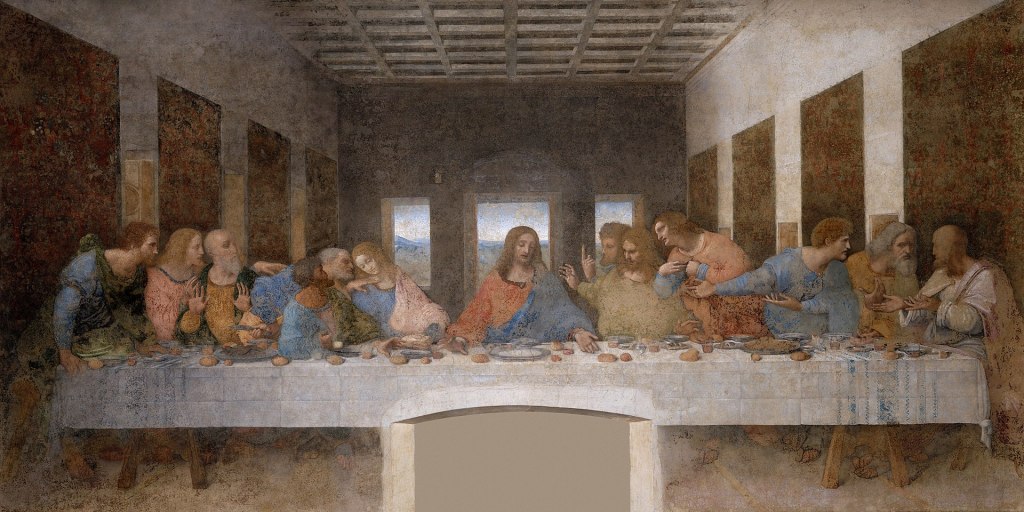
Throughout the history of art, the Last Supper has been a subject of countless painted interpretations. For many, the quintessential image is Leonardo da Vinci’s masterful Last Supper fresco. Notably, his linear depiction, presenting almost all the disciples seated on a single side of the table, became the prevailing compositional approach for artists who followed. Artists like Ghirlandaio used the linear table , with the exception of having Judas seated across from Christ and the other apostles to reveal his identity as the traitor.
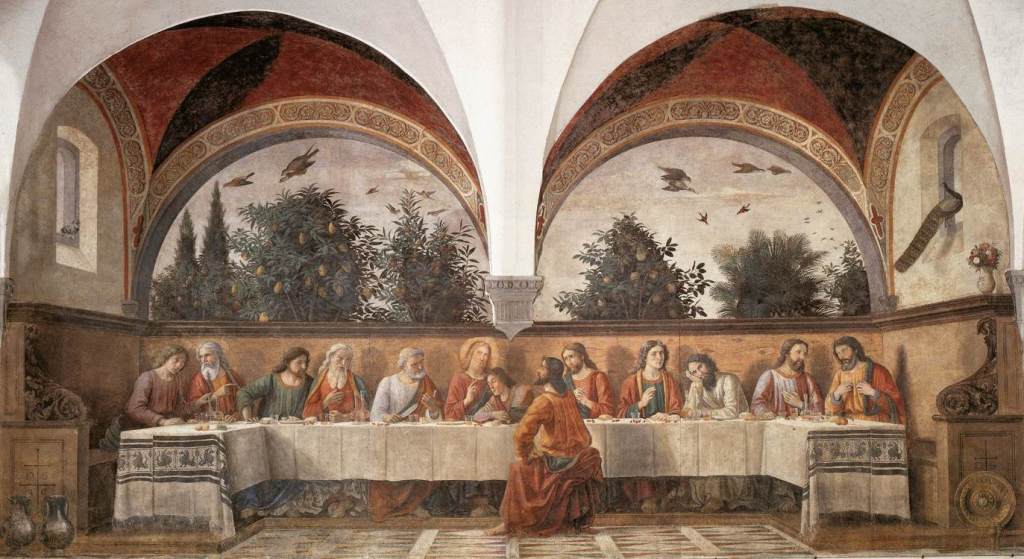
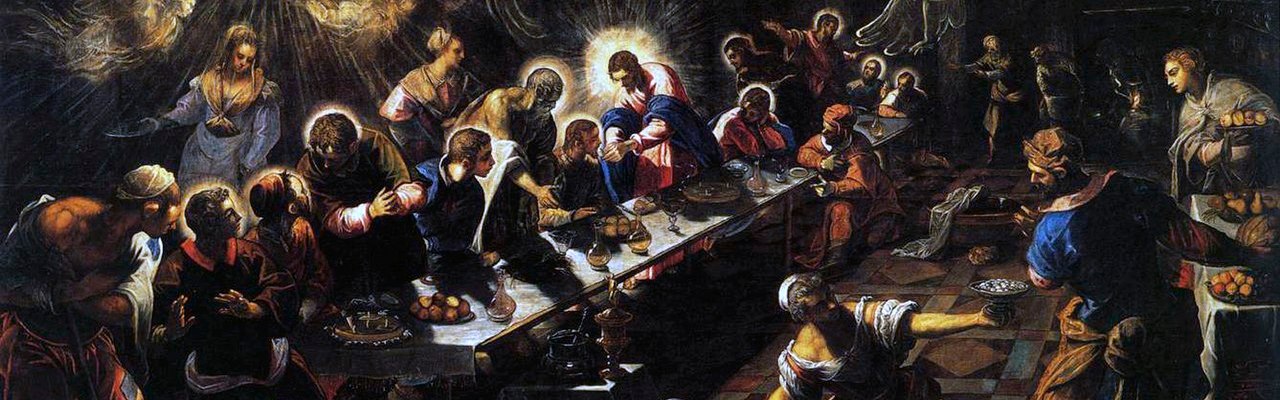
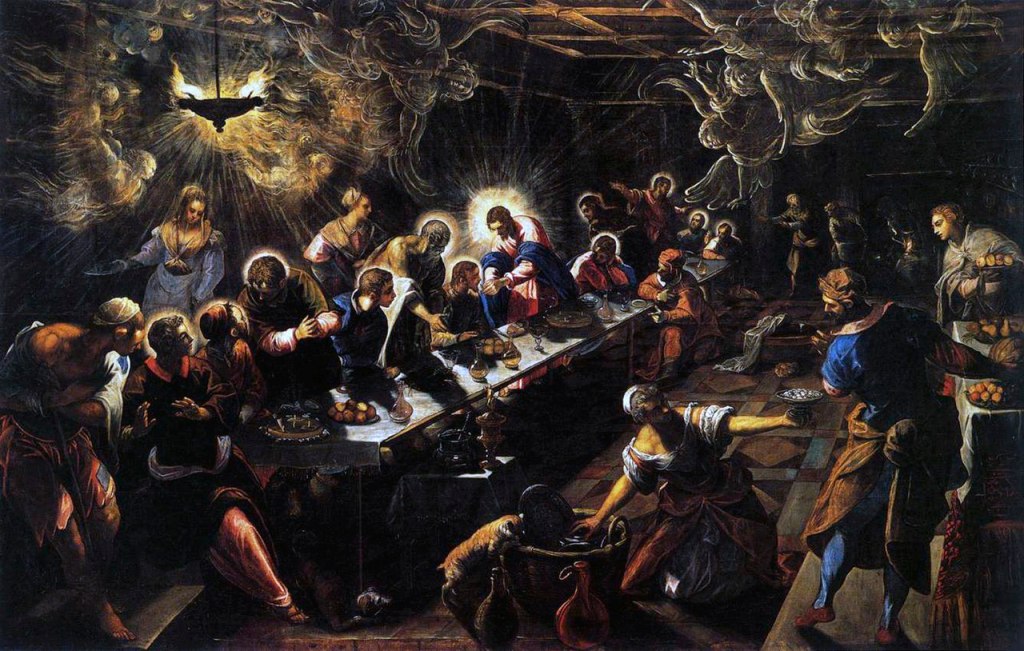
Tintoretto, like many before him, painted Last Supper scenes with the customary linear perspective. However, in this instance, he took a radical and compelling chance with his interpretation, resulting in what I consider one of the most captivating Last Supper paintings.
Why I love it: The scene is full of energy. The viewer is transported into bustling meal with friends breaking bread and immersed in conversation. This energetic scene is further emphasized by Tintoretto’s masterful use of light and dark to illuminate the wonder and mystery of the spiritual and physical nature of the event. This painting is very dark, yet light radiates from Christ and the heavenly angels that spreads to the rest of the painting. Christ is the light of the world and even the darkest parts of the painting are illuminated by light source of Christ
Where most depictions of the Last Supper only include the Disciples, Tintoretto incorporates an additional cast of characters including cooks and servers. Angels are also present. Approved by The Catholic Church during The Counter Reformation for its scriptural and spiritual depiction, this inclusion of cooks and servers, though not literally scriptural, offers a symbolic truth that resonates with the faithful.
A reenactment of The Last Supper is repeated in each Mass, when Catholics (and other Christians, depending on denomination) believe the bread and wine are transformed into the body and blood of Christ. This receiving of Christ in communion provides strength for the trials and the commission of service. We are called to be Christ’s servants on earth – His hands and feet in the world. In meditating on this painting, I see the extra guests as the people of the church, receiving the Eucharist and being sent forth into the world. They are moving around, active and empowered for their mission (my interpretation).
During Mass it is believed that heaven and earth are united with the angels and saints in heaven in the breaking of the bread, so having the angels present reminds the viewer that while The Last Supper is an historical event it is also a recurring invitation to having communion and the great commission to go out and proclaim the love of Christ. (Matthew 25 is my favorite passage on Christian service)
Who was Tintoretto :Born Jacopo Robusti in 1518 in the Veneto (Venice), Tintoretto, meaning ‘little dyer,’ inherited his nickname from his father’s profession and became known as a master colorist in his art. For me, Tintoretto is many ways the first modern artist in the sense he moved away from the strict conventions of the High Renaissance and Mannerism and created a style uniquely his own. Tintoretto uses large and quick brushwork that provides a dynamism and unparalleled animation that draws the viewer into the drama. He was nicknamed ‘il furioso’ because he painted with such rapid speed and energetic approach to painting. His work often featured strong gestures, dynamic movements, and a sense of perpetual motion.
We featured Tintoretto in our Masters of Venice Course …click here to learn more.
The Agony in The Garden:
Luke 22: 39-46 And he came out and went, as was his custom, to the Mount of Olives, and the disciples followed him. And when he came to the place, he said to them, “Pray that you may not enter into temptation.” And he withdrew from them about a stone’s throw, and knelt down and prayed, saying, “Father, if you are willing, remove this cup from me. Nevertheless, not my will, but yours, be done.” And there appeared to him an angel from heaven, strengthening him. …
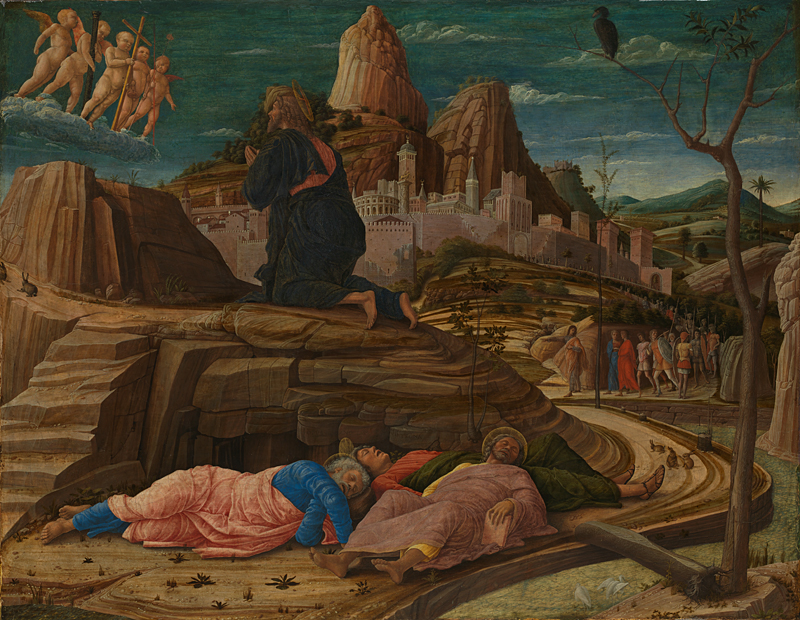
This depiction of The Agony of the Garden from The National Gallery in London, is one of my favorite works. Mantegna masterfully shows the tension of Jesus praying in The Garden of Gethsemane, in what should be a time of quiet prayer after The Passover Meal (Last Supper), but he knows his betrayal is at hand. Embracing the Father’s will in his divine nature, Jesus also experiences the human fear and terror that can cloud the faith of all humanity facing uncertainty. The realization and closeness of death, coupled by betrayal and the spiritual and physical weight of dying on a cross a battle of preparation in Gethsemane. When we face trials and uncertainty, persecution and betrayal it is important to reflect on The Agony in the Garden to remind ourselves that Jesus felt the pain and fear but trusted the father.
In this image he is looking up to heaven, versus the chaos of the world. He is fully in the world, but recognizes he must rely on the father to overcome the evil of the world. The angels are comforting him. God is not removing Jesus from the trial, but strengthening him in prayer and faith. The apostles, are sleeping below not being watchful of what is happening around them. I had a priest explain, this is partially do their feeling overwhelmed by the tension of battle ahead, and yet also a reminder while we need to take time to rest and tune out the chaos of the world, we also are called to be vigilant and The prayer ‘to remove you from this test’ doesn’t always mean the absence of temptation and trial, but rather in the agony of those moments we need to follow Christ’s example of looking up to heaven for support.
In the distance you see Judas and the Roman soldiers and Jewish officials approaching to arrest Jesus setting in wheels Good Friday.
A crow is seen perched on a branch. In the Bible, crows are often associated with God’s care and the divine judgement. They also symbolize earthliness and death.
Born in Padua in the Veneto (Venice) Andrea Mantegna was one of the preeminent Renaissance artists. He studied Greek and Roman architecture to create naturalistic perspective and had an attention to detailed unparalleled by any artist. He was the brother in law of the famous Gentile and Giovanni Bellini.
The Betrayal of Christ

Giotto’s Betrayal of Christ from his series at The Scrovegni Chapel in Padua
This panel by Giotto at The Scrovegni Chapel transports you to the drama of the moment when Christ is betrayed. While the apostles around them fight the approaching Roman soldiers and Jewish officials, Jesus’ gaze is fixed on Judas, as his former friend and disciple ‘betrays him with a kiss.’ Each time I meditate on this painting I notice another detail, especially in the expressions of the men. Jesus looks at Judas with conviction aware of his guilt and holds him accountable with a stare that penetrates the soul.
To learn more about Giotto click here for our Renaissance Wednesday feature on the master artist.
The Crucifixion:

I struggled to pick one crucifixion painting for this post, as there so many moving depictions of Good Friday. What draws me to this work by Titian is its powerful juxtaposition of simplicity, capturing the raw emotions of St. John holding the cross in a grasp of profound sorrow – the kind where you don’t want to let go of something you love and hold grief tightly. Titian, like other Venetian artists is a master of color…yet he doesn’t over state the color here. We are able to rest in the grief and contemplating the sacrifice of Christ.
The Lamentation of Christ
John 19: 40-42: Taking Jesus’ body, the two of them wrapped it, with the spices, in strips of linen. This was in accordance with Jewish burial customs. 41 At the place where Jesus was crucified, there was a garden, and in the garden a new tomb, in which no one had ever been laid. 42 Because it was the Jewish day of Preparation and since the tomb was nearby, they laid Jesus there.
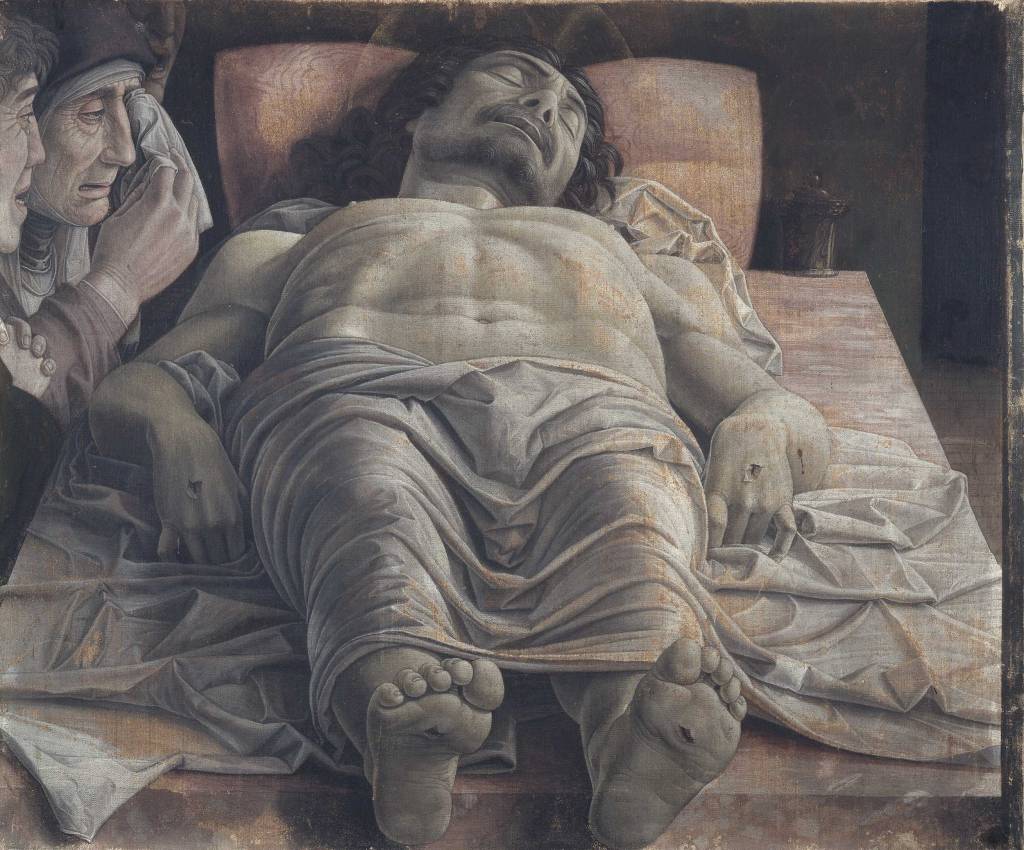
This work by Mantegna is haunting and forces us to understand the reality of Christ’s death, and death itself. We know that Christ will rise again, but in this moment the death is stifling and horrid, making us uncomfortable. This work is currently housed in The Pinacoteca di Brera in Milan.

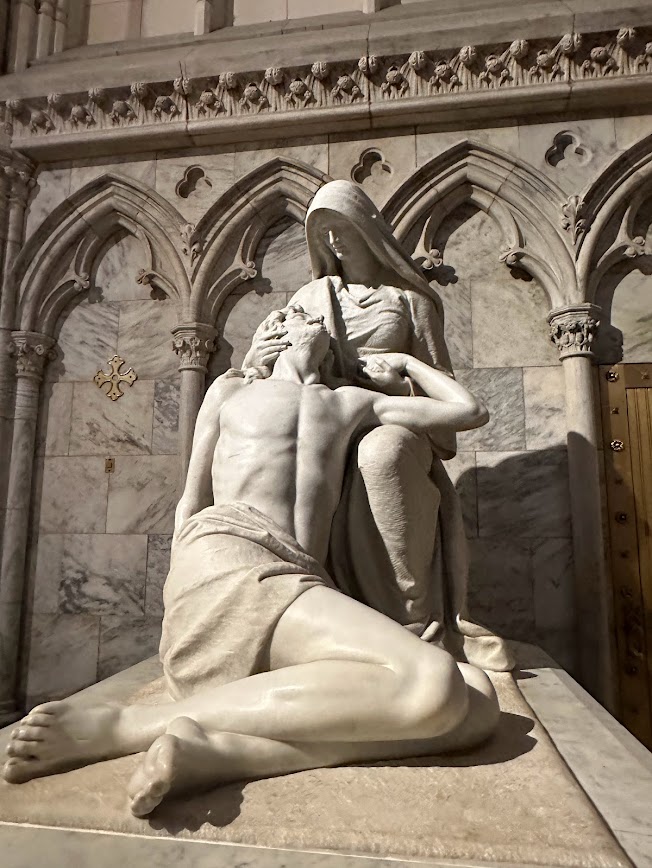
At only twenty-three years of age, Michelangelo was commissioned by French Abbot Jean de Bilheres for this burial chamber at the old St. Peter’s, for a Pieta. It is still one of the most moving depictions of the lamentation of Christ in art.
A pieta is an interpretation of Mary holding the crucified Jesus – in sorrow. This form of artistic representation became popular in Germany in the Middle Ages and spread to Italy.
The Resurrection

A striking commonality in depictions of the Resurrection is the contrasting reactions of the guards. Some are shown fainting, overcome by the sheer wonder of the event, while others remain awake, their gazes fixed upward as they witness Christ’s ascent.
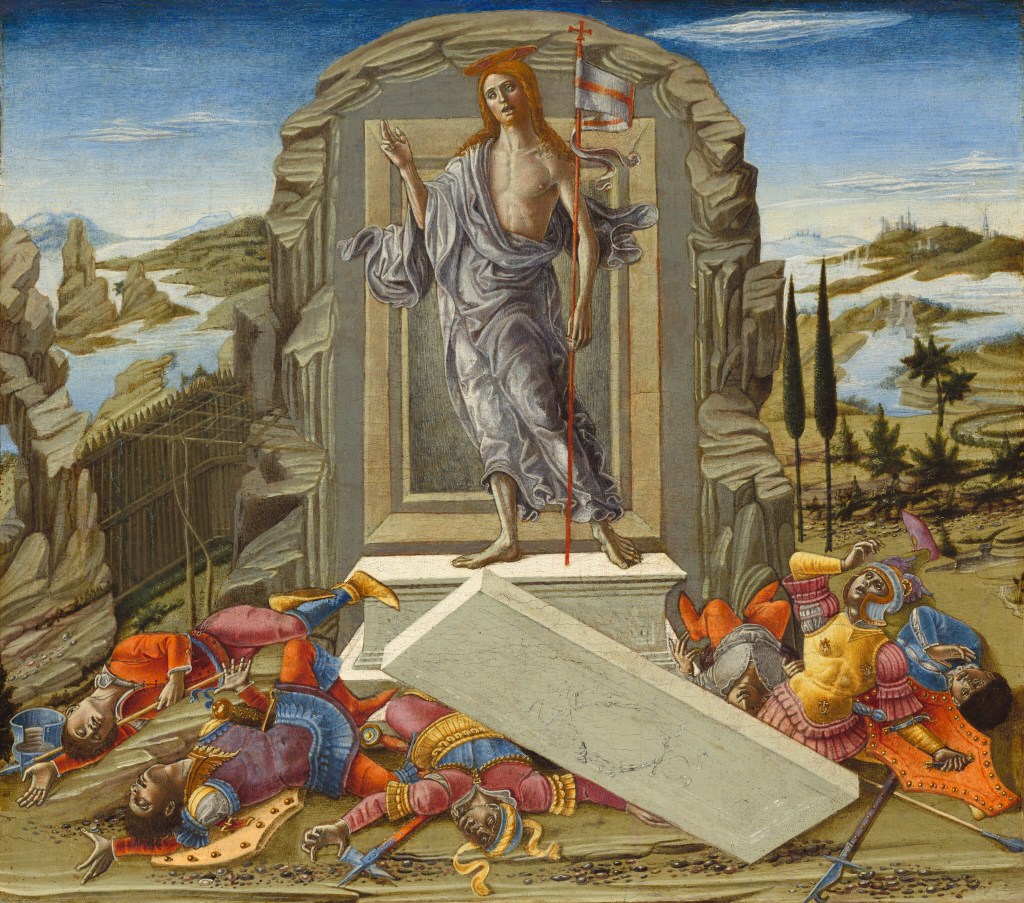
I chose to feature this painting by Benvenuto di Giovanni from the National Gallery in DC because each time I look at it stuns me a bit. Jesus emerges from the tomb like a marvel character, which the marble tomb door squishing the Roman guards below. They are completely stunned. While I don’t doubt the authority of God to have that supernatural power, it feels a little like action movie Jesus.
Thanks for traveling through Holy Week through art with Art Expeditions.
I wish you a blessed Holy Week and Happy Passover for those who celebrate.
Don’t forget to subscribe for more art inspired post


[…] Another Sienese painter featured in the PMA is Pietro Lorezetti, who we featured in our recent Unlocking The Easter Story through Art blog post. […]
LikeLike