

Today on Art Expeditions I’m thrilled to share my experience visiting a special exhibition – Michelangelo: The Genesis of the Sistine
This one in a lifetime exhibit, opened at William and Mary’s wonderful Muscarelle Art Museum on March 6th 2025, which happens to be the 550th anniversary of Michelangelo’s birth.
This exhibit brings together 25 rarely-displayed masterpiece drawings by Michelangelo, many of which have never been seen in the United States before this exhibit. Walking through this exhibition art lovers will have the chance to experience first-hand the genius of Michelangelo and learn about his ‘Prima pensare’ or first thoughts as he planned out his work on The Sistine Chapel.
Muscarelle Museum of Art Website
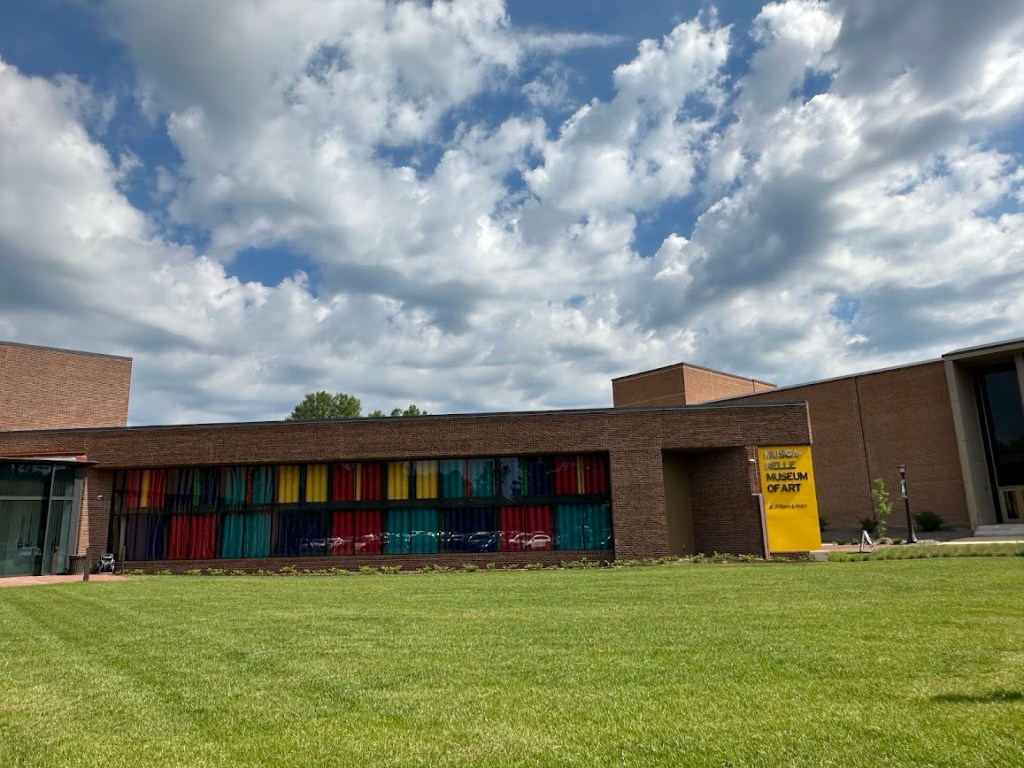
I was blessed to visit Florence in 2023 and am saving up to return (I’ve been taking Italian but Allora – I still get nervous when I speak it aloud). During this trip I was blessed to see Casa Buonarotti, the home of Michelangelo and his rotondo painting at The Uffizi.
Many of the drawings in this exhibit are from Casa Buonarroti and The Uffizi, where exhibition curator Adriano Marinazzo worked for a time. Marinazzo is considered a foremost expert on Michelangelo’s drawings and helped revolutionize the way they were studied.
While working at Casa Buonarroti in Florence, Marinazzo developed a groundbreaking hypothesis for a Michelangelo sketch identifying the lines in the drawings as the architectural outline for the Sistine Ceiling. One of the reasons he was able to notice this groundbreaking detail was his training as an architect. This drawing, on display at the exhibit is believed now by most scholars to be the first drawing made in preparation for The Sistine Ceiling. He presented his discovery at the 2014 Venice Biennale of Architecture.
The Casa Buonarotti is Michelangelo’s family home (his last name was Buonarotti), located in Florence. Today it is a world-class museum and research facility. You can visit The Casa Buonarotti in Florence, and they also have lots of resources and images of the art in the exhibition on their website.
William and Mary is very fortunate that Marinazzo is now their curator of special projects and helped to bring this revolutionary exhibition to Williamsburg.
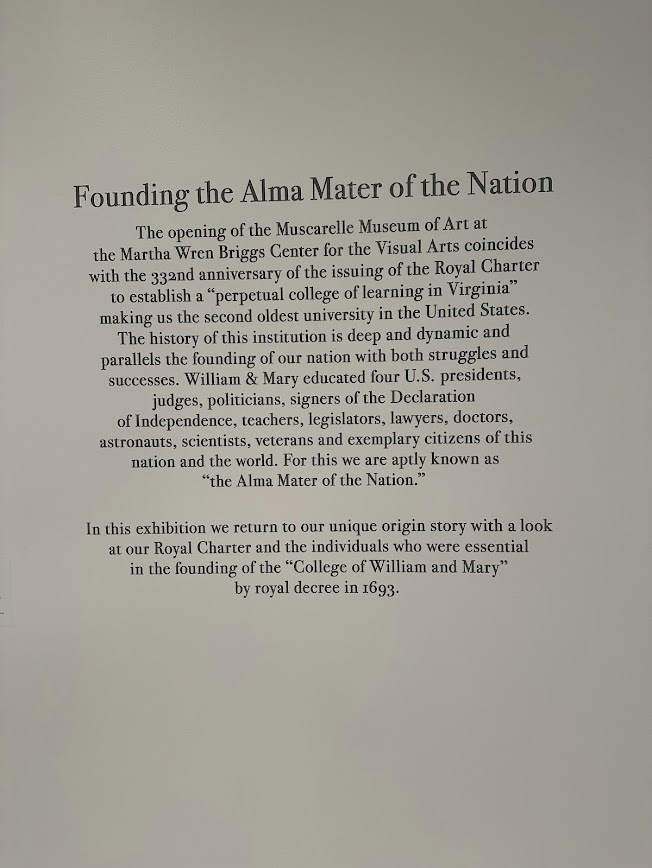
Our Art Expedition:
My mom and I drove from Raleigh to Williamsburg specifically for this exhibition, which we learned about from one of the online art instructors I follow, Rocky Ruggiero. As a lover of all things Michelangelo and Italian, I made it a priority to visit this exhibition.
Although I knew the Abby Aldrich Rockefeller Folk Art Museum in Williamsburg, with its focus on early American masters like Copley, Sully, and Stuart, I hadn’t truly appreciated the Muscarelle’s fabulous collection until this visit.
One of the reasons I started Art Expeditions was to have a central list of art museums throughout the United States, including those that are off the beaten path or overlooked by larger regional museums. I always encourage art lovers to take time to research and discover the smaller regional galleries, especially at esteemed universities like William and Mary.
William and Mary is considered the Alma Mater of America. It is the second oldest college in the United States after Harvard and is the alma mater of US Presidents like George Washington, Thomas Jefferson, James Monroe and John Tyler…so it makes sense that William and Mary, with such a storied tradition of strong academics and culture would have a wonderful art museum.
I love the fact that esteemed Italian art institutions partnered with William and Mary to display these works versus just going to the larger museums like The National Gallery or The Met. While I adore both of those institutions, I think the space at The Muscarelle was perfect for this exhibition. It was intimate and provided an opportunity for the university and community of Williamsburg to bring in art lovers who might not otherwise visit this historic and charming community.
God Wink: While visiting the exhibition the Papal Conclave, which is held in The Sistine Chapel was occurring. As I left the exhibit, I received a text that Pope Leo XIV had been elected. Kind of cool that we were ‘in the Sistine’ when it happened.
Planning your visit...The Muscarelle is located on the beautiful campus of William and Mary, steps away from historic Colonial Williamsburg. You truly feel as though you’ve stepped back in time as you meander the quaint campus and nearby neighborhoods. William and Mary has some of the oldest buildings in the United States still in use for a college campus, including designs by famed architect Christopher Wren…learn more here.
Williamsburg offers countless opportunities for art and historical adventures. Check out recent American Nomad post,(our sister blog) for travel tips to Williamsburg:
Accommodations – Williamsburg has tons of wonderful hotels. We usually like to stay at The Woodlands (owned by Colonial Williamsburg), Hampton Inn (both locations are nice) and this time we checked into the lovely Country Inn and Suites by Radisson. Check out Visit Williamsburg and Colonial Williamsburg for additional resources

Understandably the exhibit did not allow photography as these drawings were done on thin paper that is over 500 years old! On the tour we learned that these drawings are so fragile they can only be displayed in the public for three months every five years. So immediately after this exhibit the drawings will go into secure storage before being shown again in Italy in five years. That alone makes this a once in a lifetime opportunity.
The exhibit is going on through the end of May 2025, and I highly recommend purchasing tickets in advance. You will meet for the tour in the upstairs exhibition gallery where a knowledgeable curator will provide a half hour tour before you have some time to go back through the galleries on your own to look at each of the drawings up close.
During my trip to Italy in 2023 I felt ecstasy as I entered The Sistine Chapel. My tour mates joked that they wished they could have photographed me in the chapel because I was so overjoyed and my mouth was wide open with awe. It is unlike anything you can imagine. The ability to see these drawings and compare the preparatory inspiration to the finished product.
Michelangelo as the perfectionist was fearful of people judging him for having to prepare, but as an artist myself, studying the lines and his use of hatching and figuring things out on paper and even multiple versions on one page inspires me. It helps me understand how the creative and mechanical process oriented sides of art can lead to beautiful art. I do believe God gives us both skills as we work as our own creators of art – and this exhibit ignited a self-realization of process with creativity.
I mentioned this a few years ago during our Michelangelo blog series, but Michelangelo did not consider painting his art. He considered his art as his sculptures like David and The Pieta.

Prior to accepting The Sistine Chapel assignment from Pope Julius, Michelangelo had been commissioned to design the Tomb of Pope Julius II. This was actually Michelangelo’s dream job. He wanted more than anything to create a magnificent burial monument with statues and sculpture that would showcase his art while bringing glory to the Chair of St. Peter.
While Pope Julius still wanted his tomb, he felt called by God for Michelangelo instead to paint the ceiling of The Sistine Chapel.
Prior to that point, the ceiling was just painted blue. That being said, even before Michelangelo began painting his famous Sistine frescoes, the chapel was a who’s who of art. The bottom walls feature works by Renaissance masters like Pinturrichio, Perugino, Ghirlandaio, Botticelli…
Originally known as the Cappella Magna (Great Chapel) it derives its name from Pope Sixtus IV, who had it built between 1473 and 1481. One of the reasons that Pope Julius II wanted to adorn the walls of The Sistine Chapel is to pay respects to Sixtus IV, who was his uncle. Both popes were members of della Rovere family.
Julius also wanted to help bring beauty to Rome and The Vatican and enhance spirituality and community through artwork. Julius II also commissioned other leading artists like Raphael, who painted The Raphael Rooms at The Vatican, which were the pope’s apartments.
Michelangelo at first refused the commission and was afraid he couldn’t live up to the perfection it would demand. He insisted he was a sculptor first and wanted to finish the tomb project. He even fled Rome temporarily to avoid accepting the commission.
Julius however was insistent and Thank God Michelangelo eventually returned to Rome and began work on the ceiling in 1508.
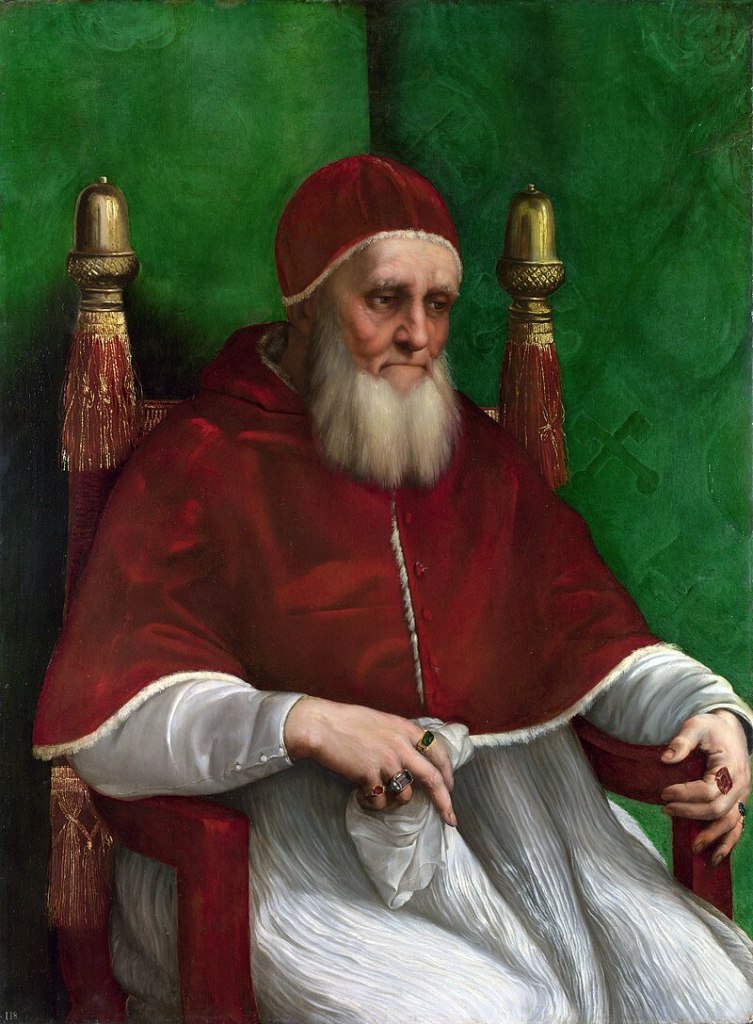
Known as The Warrior Pope and disliked for stirring up regional conflicts that drained resources and fueled instability, Julius II nonetheless possessed a keen understanding of art’s power to elevate the faithful and contribute to Rome’s cultural resurgence. He also began the monumental task of rebuilding St. Peter’s. Michelangelo was appointed the first chief architect in designing the new St. Peter’s Basilica, which took centuries to build. Learn more here
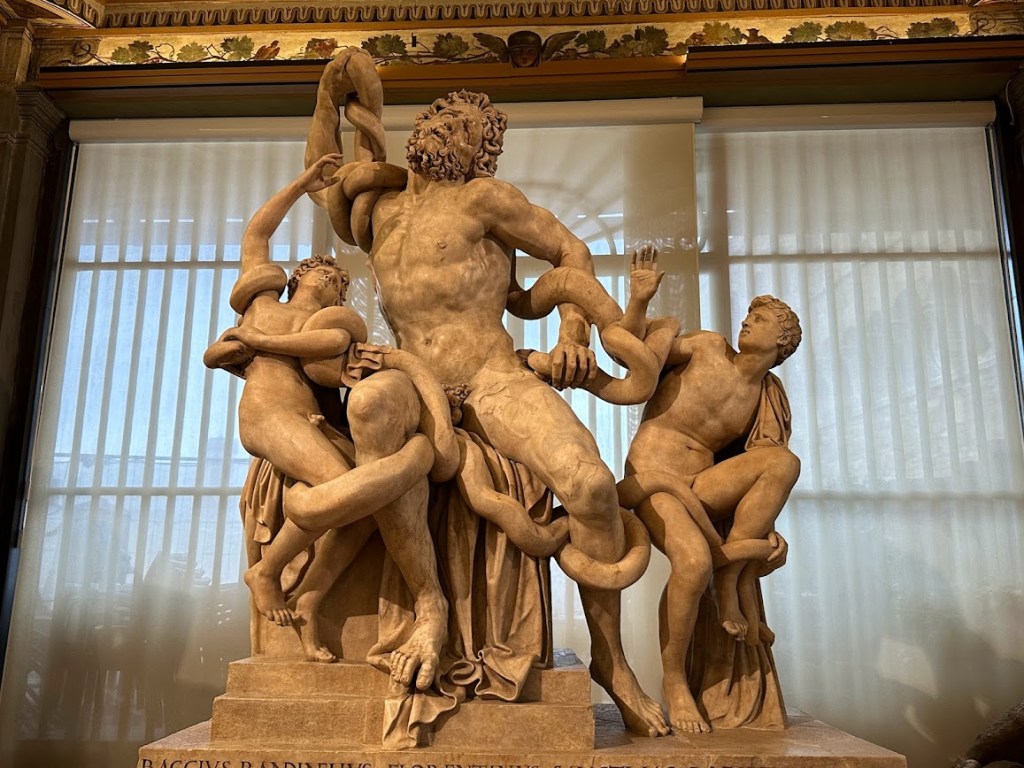
Prior to the Renaissance, Rome had become surprisingly provincial, a far cry from its glorious past, often resembling a glorified cow pasture with the exception of The Vatican and the haunting remnants of its ancient grandeur. It was during Michelangelo’s time in Rome that significant archaeological excavations unearthed long-buried ancient Roman sculptures, a pivotal moment that ignited a powerful classical influence among many artists of the era.
God works in mysterious ways and I often wonder if he used Pope Julius’s bullheaded ways to help force someone as equally formidable as Michelangelo to take on what many of us can say yielded a divinely inspired final product. But for all the resounding alleluias we can hear as we bask in the beauty of the final product, isn’t it wonderful to know that Michelangelo’s humanity’s what made it echo the beauty of creation that God grants us. Isn’t the process of creation just as fulfilling, if not more so than the final product.
Michelangelo might disagree with me, after all I’m sure four years painting with the burden of perfection would wear on you and hurt your joints too. He did complain in a sonnet to a friend about the painstaking work. And it was a literal pain in the neck, which you can see in the exhibit.
We learned on the tour that it took four years for Michelangelo to complete the Sistine Chapel ceiling. He didn’t paint on his back, but designed scaffolding to reach the 65 foot ceiling. Because the ceiling was curved, he could not employ a linear perspective, which had been first discovered at the beginning of the Renaissance (think a picture of a train track disappearing in the distance.) If you were to flatten out the images they would be slightly off because he had to use mathematics to account for the curve, which shows his engineering acumen as much as his artistic acumen. It makes sense that Michelangelo as a sculptor could figure out the details even in a different medium to ensure dimension. Sculptors have to use both creativity and precision to yield their work.
Fun fact: It took Michelangelo four years to complete the frescoes which spanned over 12,000 feet! Remarkably quick for that amount of space.
Twenty-five years after completing the Sistine Chapel ceiling, he returned to paint The Last Judgement on the altar wall of the Sistine Chapel.
When I was in Florence at The Accademia and saw David and other works by Michelangelo, I thought it was interesting that he did not look at the rock and think I’m going to just start chiseling away to made it look the way I want…of course he had to do that, but his view as that every piece of marble or stone had a hidden sculpture within it – a voice if you will and he would work with that specific stone to bring out the sculpture hiding inside. In fact several other sculptors tried to chisel the David with the marble slab and failed – they said it was terrible stone, but Michelangelo saw something even in the impossible.
The Tour:
Our tour guide started by giving a brief overview of Michelangelo’s life and his commission to paint The Sistine Chapel.
Prior to this project, Michelangelo had already achieved significant renown for his sculpture, including his Pietà, completed at the remarkably young age of 23. While he had executed a few smaller paintings, he was not an expert in the medium of fresco, the durable and widely preferred method for decorating expansive church walls.
This exhibit focuses on the preparatory drawings for The Sistine Chapel and the ‘genesis’ or beginning of the planning for this monumental project. One of the reasons planning was so important with frescoes is that the medium is very unforgiving for mistakes.
Frescoes are created by applying pigments to freshly laid plaster. The pigment is mixed with water and then applied to the damp plaster, where it’s absorbed and becomes part of the wall as the plaster dries and hardens. This means the painting is fused into the wall and becomes part of the wall itself. This is great for durability, but if you make a mistake the plaster has to be scrubbed off or you simply have to let the mistake be viewed for perpetuity.
The tour guide explained the process of preparing for the fresco painting and pointed out key drawings in the exhibit that helped with the various steps in the fresco process. One of the drawings actually indicated how to build the scaffolding to reach the ceiling for painting. Michelangelo painted most of the actual ceiling himself, but had assistants who would help with building the scaffolding and preparing the plaster.

In preparing the wall for painting, you’d first take a scratch layer called arriccio, which was applied to the wall creating a bond between the wall and subsequent layers. You then lay additional plaster layers to build up the surface and create a stable base for painting. The final coat – known as an intonaco, is a smooth, fine layer of plaster that is applied for the day’s work – known as the giornata.
In Italian the work for a day is ‘giorno’ and giornata means the amount of painting you can do on a fresco in one day. Because the plaster and paints dry quickly you have to paint with precision and speed, versus say a medium like oil that can dry days to dry.
The tour guide pointed out several cartoons that would have been used to transfer the outlines on the wall. A cartoon is not Bugs Bunny or Spongebob but refers to the full-scale preparatory drawing for a fresco, oil painting or tapestry. The word comes from the Italian cartone, which means a large sheet of paper or cardstock. He used various techniques to transfer the outlines of the cartoons onto the plaster, including pouncing (punching tiny holes through the cartoon and dusting powdered pigment) and incision (using a sharp tool to trace the outlines). Perforate outline then charcoal dust would wrap outline along perforate.
The collection of drawings from museums like the Uffizi and Casa Buonarroti in Florence include a number of early preparatory sketches, some with mere lines and indications, whereas you can also see larger cartoons of the Apostles. In listening to an online lecture by Marinazzo, I learned that the two apostle drawings were once on the same piece of paper and this is one of the first times they’ve been back together – side by side.
Perhaps one of the most famous pieces in the exhibit is a sketch of the Sibyl, where you can see the more complete drawing alongside of earlier faint lines as the final decision was being worked on.

Michelangelo did not want to waste paper so if he was still in the brainstorming phase, he would use a metal point to lightly outline the ideas, which modern day technology and provide more complete revelation of these ‘hidden drawings.’
Another highlight is a sonnet that Michelangelo wrote to a friend. I did not know that Michelangelo loved poetry and wrote sonnets to his friends. In the sonnet he complains about the difficult work of creating The Sistine Chapel and how laborious it was. He then has a doodle on the letter depicting himself as ‘The Creator,’ simply to the image of God in the creation fresco, trying to paint. This wasn’t Michelangelo being sacrilegious or saying he was God. While many called him ‘the divine one,’ Michelangelo was very faithful and this instead symbolizes how God gave him this creative ability and his attempt to bring heaven to earth in this art.
My perspective: God is not selfish in sharing gifts, and I think one of the best gifts he gives through creation is the ability for us to create art, music, architecture…ideas to come together for the community.
Alongside of the drawings, the exhibit has several full-size replicas of the finished Sistine frescoes and a breakdown of where each of the frescoes are located on The Sistine Chapel wall. These include 9 stories from the book of Genesis, 5 Sibyls – the pagan seers who prophesied the truth of God’s bring Christ and redemption through Him, 7 prophets from the Old Testament like Ezekiel. The Lunettes include images of the ancestors of Christ. The pendatives tell four stories from the salvation of Israel.
You’ll find the life of Jesus in the early works by Botticelli, Pinturicchio, Ghirlandaio and Perugino on the lower walls.
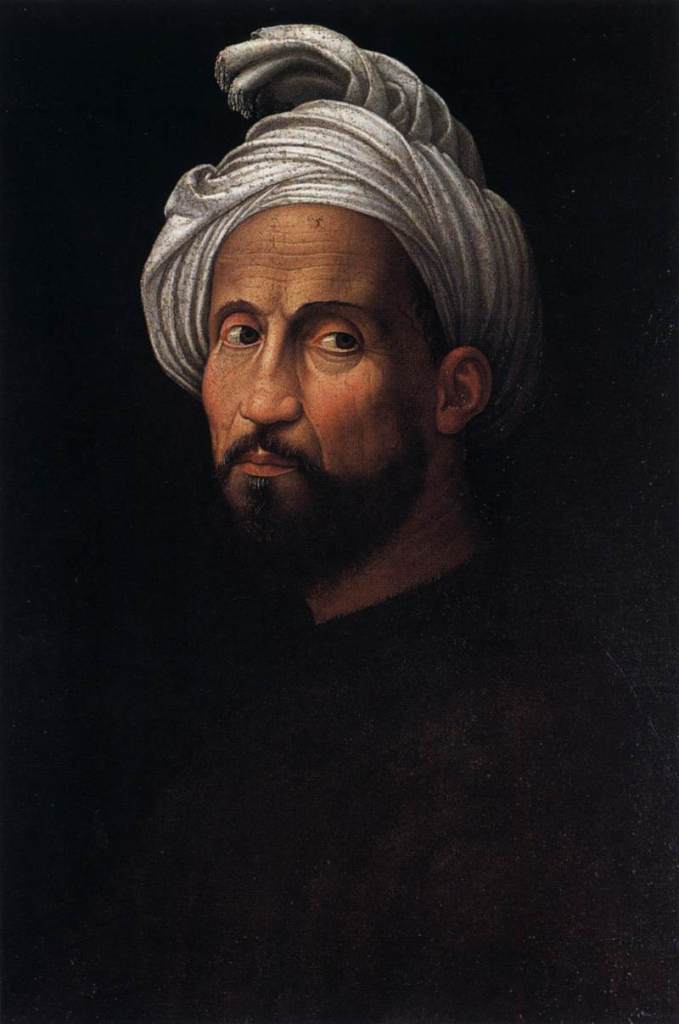
The exhibit also features etchings by other artists (18th century) who depict the frescoes. This helps with studying the original works as well.
I could write an extra textbook about how amazing this exhibit was and all the details, but I’ll leave our giornata, day’s blog work here.
In our next post, we’ll continue our visit at The Muscarelle, learning about their amazing permanent collection which has a great mix of American art from Colonial era to Modern art.
Subscribe for the latest posts:
I recommend purchasing the Exhibition Catalog which has pictures of the drawings and an expert analysis from Marinazzo and other leading Michelangelo scholars.
Coming soon – Art Expeditions Podcast! Stay tuned for more details.
Art Expeditions is written by artist, traveler and art history buff Adele Lassiter. You can follow her other travel adventures on our sister blog – American Nomad Traveler: americannomadtraveler.com
 Art Expeditions
[…] Adventures” took us from the colonial streets of Williamsburg and a once in a lifetime Michelangelo exhibit at William & Mary’s Muscarelle Museum of Art, to the coastal charm of Virginia Beach and […]
LikeLike